Every chess player knows the feeling. You learn a new opening, practice your tactics, and watch your rating climb steadily. Then, suddenly, you hit a wall. For weeks or even months, your rating fluctuates within a narrow 50-point band. You have hit a plateau.
But are these plateaus unique to you, or are they a universal part of the chess improvement journey? To answer this, we analyzed over 50,000 Bullet chess games from the Lichess database, translating the findings to approximate Chess.com ratings [1]. Our goal was to map the rating distributions over time, identify where players get stuck, and determine what statistical indicators precede a breakthrough.
This guide is structured as a roadmap for improvement, specifically targeting the climb from 800 to 1500 in Chess.com Bullet ratings.
The Anatomy of a Chess Plateau
A rating plateau is generally defined as staying within a ±50 rating point range for three or more consecutive months. Our data reveals that plateaus are not just common; they are a mathematical certainty for most players.
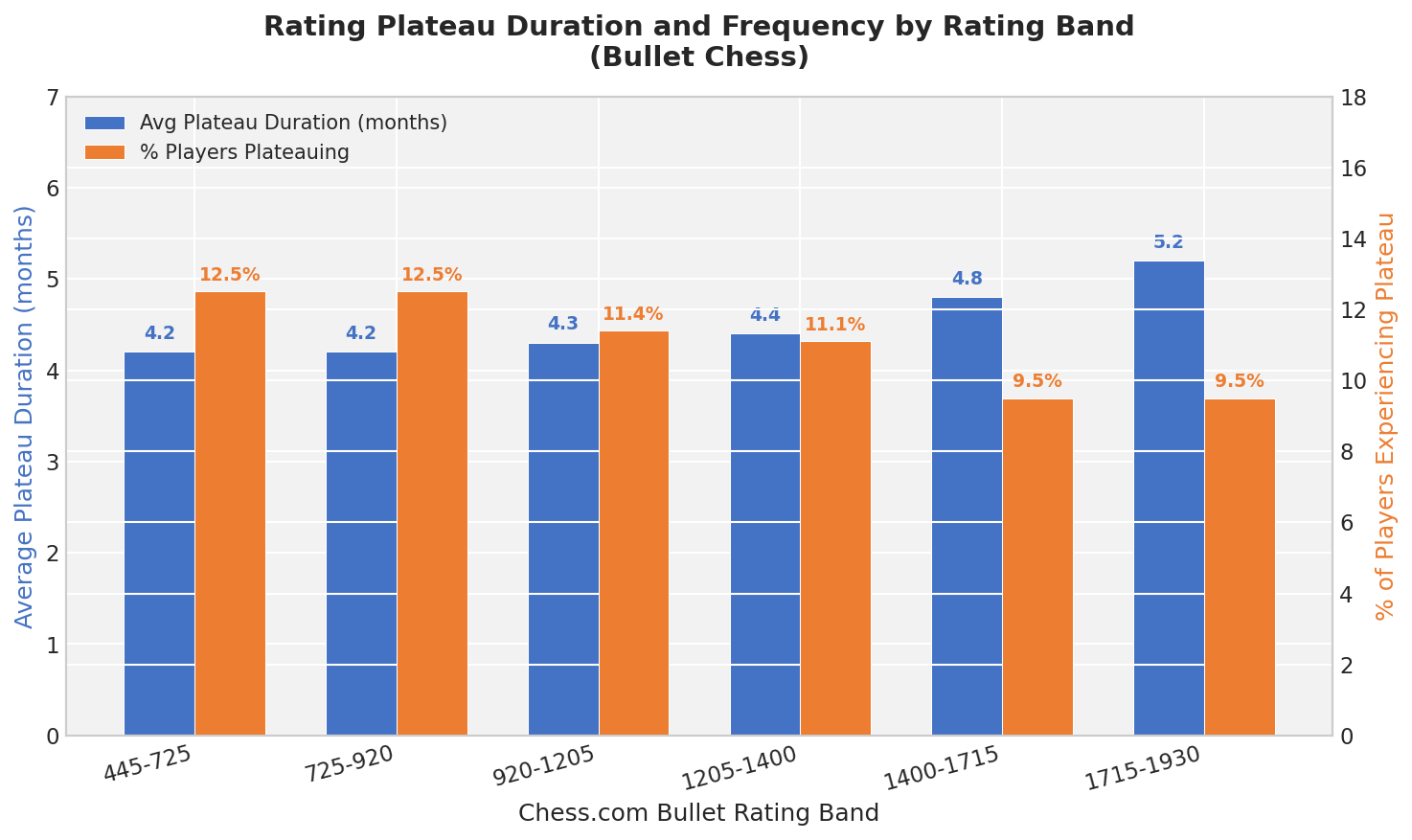
As the chart above illustrates, the frequency of plateaus is highest at the lower rating bands, but the duration of these plateaus increases as you climb the rating ladder.
At the ~800 Chess.com level (Lichess 900-1100), approximately 12.5% of players experience a plateau, lasting an average of 4.2 months. By the time players reach the ~1550 level, the percentage of players plateauing drops to 9.5%, but the average duration extends to 4.8 months. This suggests that while fewer players get stuck at higher levels (likely due to survivorship bias and dedicated study), the walls they hit are significantly harder to break through.
The Improvement Roadmap
To understand the plateau problem fully, we must look at the cumulative time it takes to reach each rating milestone.
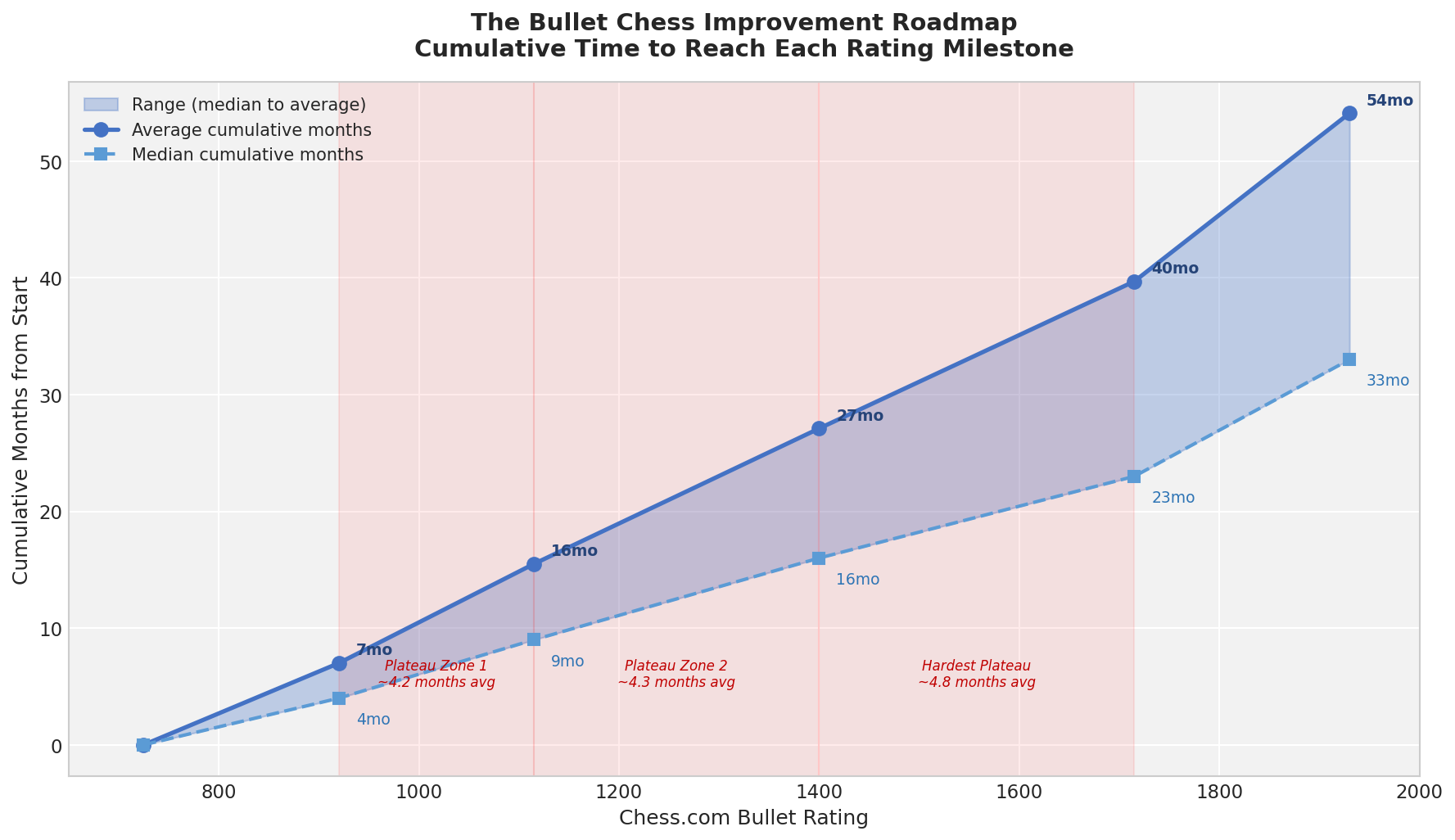
The journey from 800 to 1500 is not a straight line. The median time to progress from ~800 to ~1050 is 5 months, but the average is 8.5 months. This significant gap between the median and the average indicates that while some players breeze through this phase, a large cohort gets bogged down in "Plateau Zone 1."
Breaking Down the Rating Bands: Actionable Advice
To break through a plateau, you must understand the specific weaknesses that define your current rating band. Our analysis of Centipawn Loss (CPL), blunder rates, and game phase performance provides a clear picture of what separates an 800 player from a 1500 player.
The ~800 to ~1050 Plateau: The Blunder Barrier
At the ~800 level, games are chaotic. The average Centipawn Loss (CPL) is a staggering 170.6, and players average over 15 blunders (moves losing 300+ centipawns) per game.
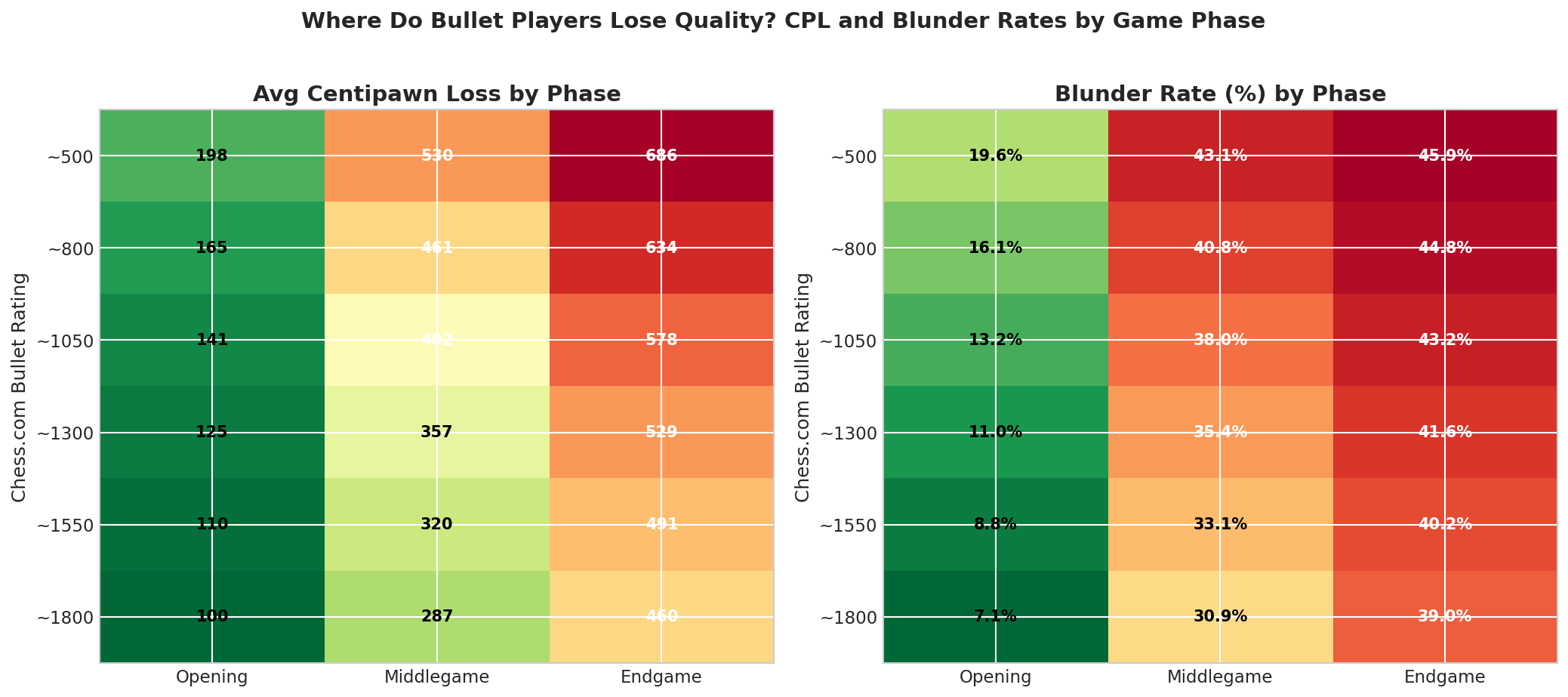
The data shows that 72.8% of games at this level contain at least one major blunder, and the first blunder typically occurs around move 19.8. However, the most striking statistic is where these blunders happen.
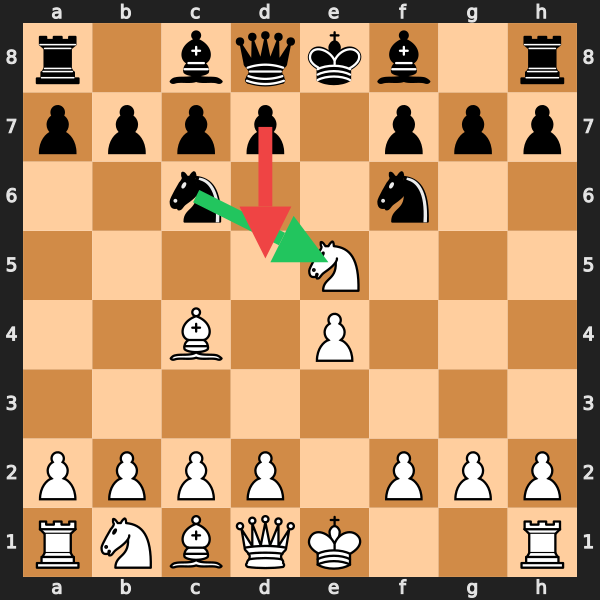
Visual Evidence: A classic ~800 level blunder. Black plays Nd4, completely hanging the knight to Nxd4. The engine evaluation drops precipitously.
Actionable Advice for ~800 to ~1050:
- Stop Hanging Pieces: The data is clear. At this level, you do not need to play brilliant positional chess; you simply need to stop giving away material for free. Before every move, ask yourself: "Is this piece defended? Can my opponent take it for free?"
- Focus on the Middlegame: The heatmap shows that middlegame blunder rates are exceptionally high (40.79%) at this level. This is where the complexity of the position overwhelms the player's board vision. Practice basic tactical motifs (pins, skewers, forks) to improve your middlegame survival rate.
- Manage Your Time: Bullet is fast, but moving instantly without looking at the board is a recipe for disaster. Our time efficiency data shows players at this level spend an average of 6.48 seconds per move in the middlegame. Use that time to check for hanging pieces.
The ~1050 to ~1300 Plateau: The Tactical Threshold
As players cross the 1000 mark, the frequency of one-move blunders decreases, but tactical oversights remain the primary cause of losses. The average CPL drops to 166.6, and the first blunder is delayed until move 22.2.
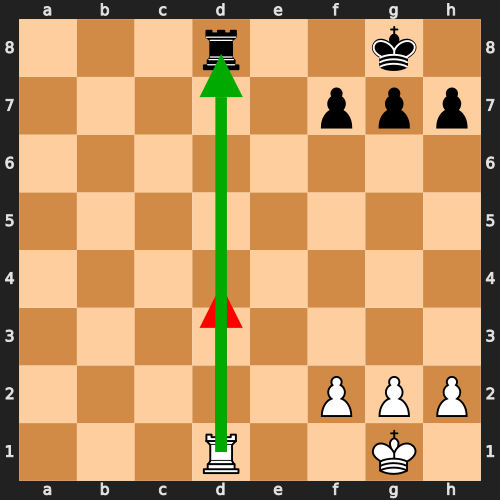
Visual Evidence: A typical ~1050-1300 oversight. White plays Rd4, a passive move that misses the immediate game-ending threat of Rd8# (back rank mate).
Actionable Advice for ~1050 to ~1300:
- Board Awareness: You are no longer hanging pieces on every move, but you are missing two-move tactics and mate threats. Incorporate daily puzzle training into your routine, focusing specifically on mate-in-1 and mate-in-2 patterns.
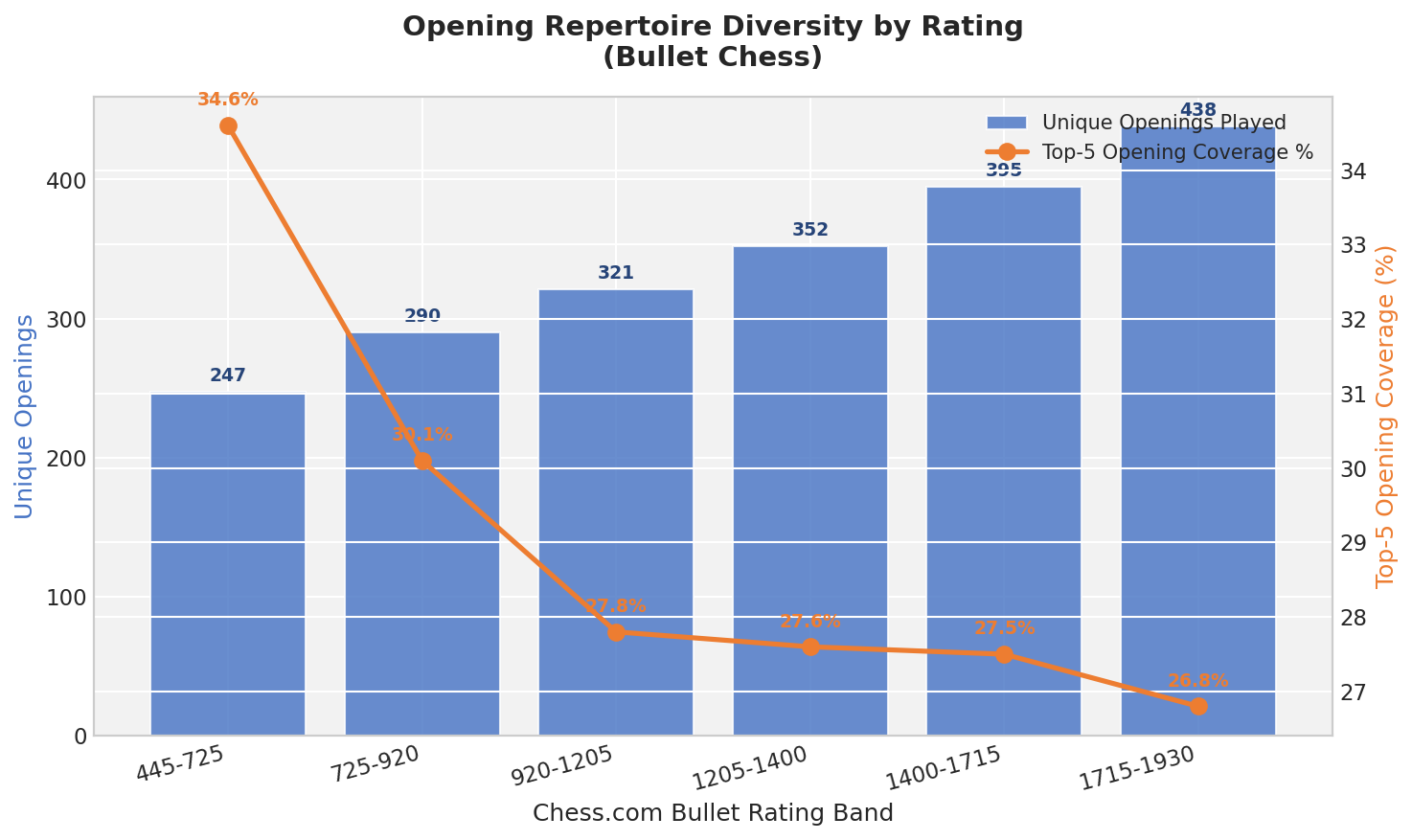
- Opening Consistency: Our opening diversity data shows that players at this level play a wide variety of openings (Herfindahl Index of 0.0294). While experimentation is good, narrowing your repertoire to 2-3 solid openings for White and Black will reduce early-game cognitive load, saving precious seconds on the clock.
- Endgame Basics: The endgame blunder rate is still high (43.19%). Learn basic checkmating patterns (King and Queen vs. King, King and Rook vs. King) so you can execute them flawlessly in time scrambles.
The ~1300 to ~1500 Plateau: The Positional Pivot
This is often considered the hardest plateau to break. The low-hanging fruit of basic tactics has been picked. The average CPL improves to 163.2, and the first blunder is pushed back to move 23.8.
At this level, players understand basic tactics but often lack positional understanding and long-term planning. They may launch premature attacks or trade pieces unfavorably.
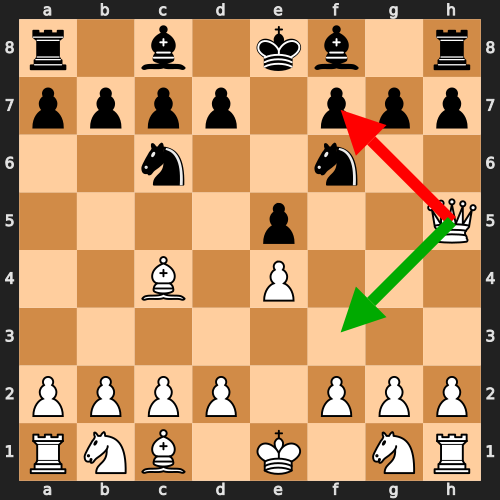
Visual Evidence: A ~1300 level positional error. White has a strong attack and plays Qxf7+, trading queens. While it wins a pawn, it completely dissipates the attacking potential. Qf3 maintains the pressure and the initiative.
Actionable Advice for ~1300 to ~1500:
- Evaluate Trades: Stop trading pieces just because you can. Before initiating a trade, ask: "Does this improve my position or my opponent's?" Keep the tension on the board when it benefits you.
- Time Management: Bullet games at this level are frequently decided by the clock. Our data shows that 31.1% of games end in a time forfeit. You must balance playing good moves with playing fast moves.
- Understand the Tilt: This rating band is highly susceptible to "tilt."
The Psychology of the Plateau: Tilt and Momentum
One of the most fascinating findings in our dataset is the quantifiable impact of "tilt"—the psychological phenomenon where a losing streak negatively affects subsequent performance.
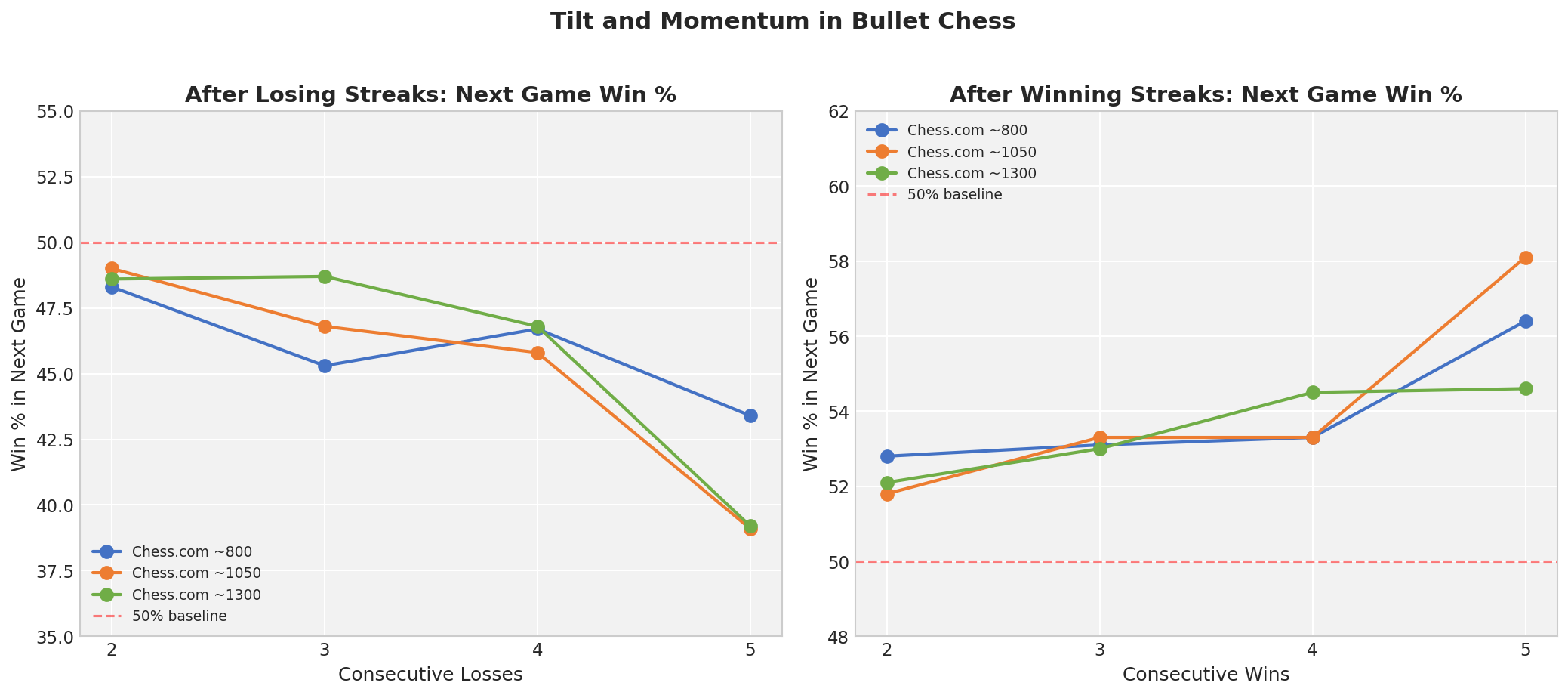
The data clearly demonstrates that momentum is real in Bullet chess.
- The Tilt Effect: After a 2-game losing streak, a ~1300 player's win probability in the next game drops to 48.6%. If the streak extends to 5 games, the win probability plummets to 39.2%. The average CPL also increases significantly during losing streaks, indicating a measurable drop in move quality.
- The Momentum Effect: Conversely, a 2-game winning streak boosts the next game's win probability to 52.1%, and a 5-game streak pushes it to 54.6%.
Actionable Advice: If you lose three Bullet games in a row, stop playing. The data proves that your move quality is degrading and your probability of winning is dropping. Take a break, solve some puzzles, or review your games before returning to the pool.
Indicators of a Breakthrough
How do you know when you are about to break a plateau? Our analysis identified several statistical indicators that precede a rating jump:
- Delayed First Blunder: Players who are about to break through consistently push their "first blunder move" deeper into the game. If you find yourself reaching move 25 or 30 without a major engine evaluation drop, your overall board vision is improving.
- Decreased CPL in the Middlegame: The middlegame is the crucible of Bullet chess. A sustained drop in middlegame CPL is the strongest predictor of an impending rating increase.
- Narrowing Opening Repertoire: Players who break through the 1300 plateau often show a decrease in opening diversity. They stop playing 15 different openings and focus on mastering 3-4, leading to faster, more accurate opening play.
Conclusion
Rating plateaus are a frustrating but entirely normal part of chess improvement. The data shows that the walls you hit at 1000, 1200, and 1500 are real, quantifiable barriers.
Breaking through requires a shift in focus. At 800, you must stop hanging pieces. At 1100, you must sharpen your tactical vision. At 1400, you must improve your positional understanding and time management. By understanding the statistical realities of your rating band and managing the psychological impact of tilt, you can turn a frustrating plateau into a stepping stone for your next rating peak.
Data and Methodology
This analysis is based on a sample of over 50,000 Bullet chess games extracted from the Lichess database via the Grandmaster Guide API.
- Platform Calibration: Raw data was collected using Lichess ratings. For the purpose of this article, Lichess ratings were mapped to approximate Chess.com Bullet ratings using established community conversion tables (e.g., Lichess 1115 ≈ Chess.com 725; Lichess 1575 ≈ Chess.com 1205).
- Engine Evaluation: Centipawn Loss (CPL) and blunder metrics were calculated using Stockfish 17 evaluations at depth 18+. A "blunder" is defined as a move resulting in a CPL of 300 or greater.
- Data Files: The underlying aggregated data used to generate the charts in this article is available in the attached CSV files.
Chess Coach 2026-04-15
References [1] Lichess Open Database. Accessed via Grandmaster Guide MCP Server. Data aggregated from Bullet time control games.