Every chess coach tells beginners to "control the center, develop your pieces, and castle early." But in the chaotic, high-speed world of Bullet chess, where games are often decided by flagging or one-move blunders, does taking the time to tuck your king away actually translate to more wins?
To answer this endlessly debatable premise, we analyzed over 283,000 Lichess Bullet games played in March 2025. We mapped the data to Chess.com rating equivalents to provide actionable advice for players climbing the ranks from 800 to 1500. The data reveals a clear, undeniable truth: castling is not just a positional nicety; it is a statistical imperative.
The Headline: Castling Wins Games
The most fundamental question is whether players who castle early win more often than those who leave their king in the center. The data provides a resounding "yes." Across every single rating band, players who castle by move 10 win significantly more games than those who never castle.
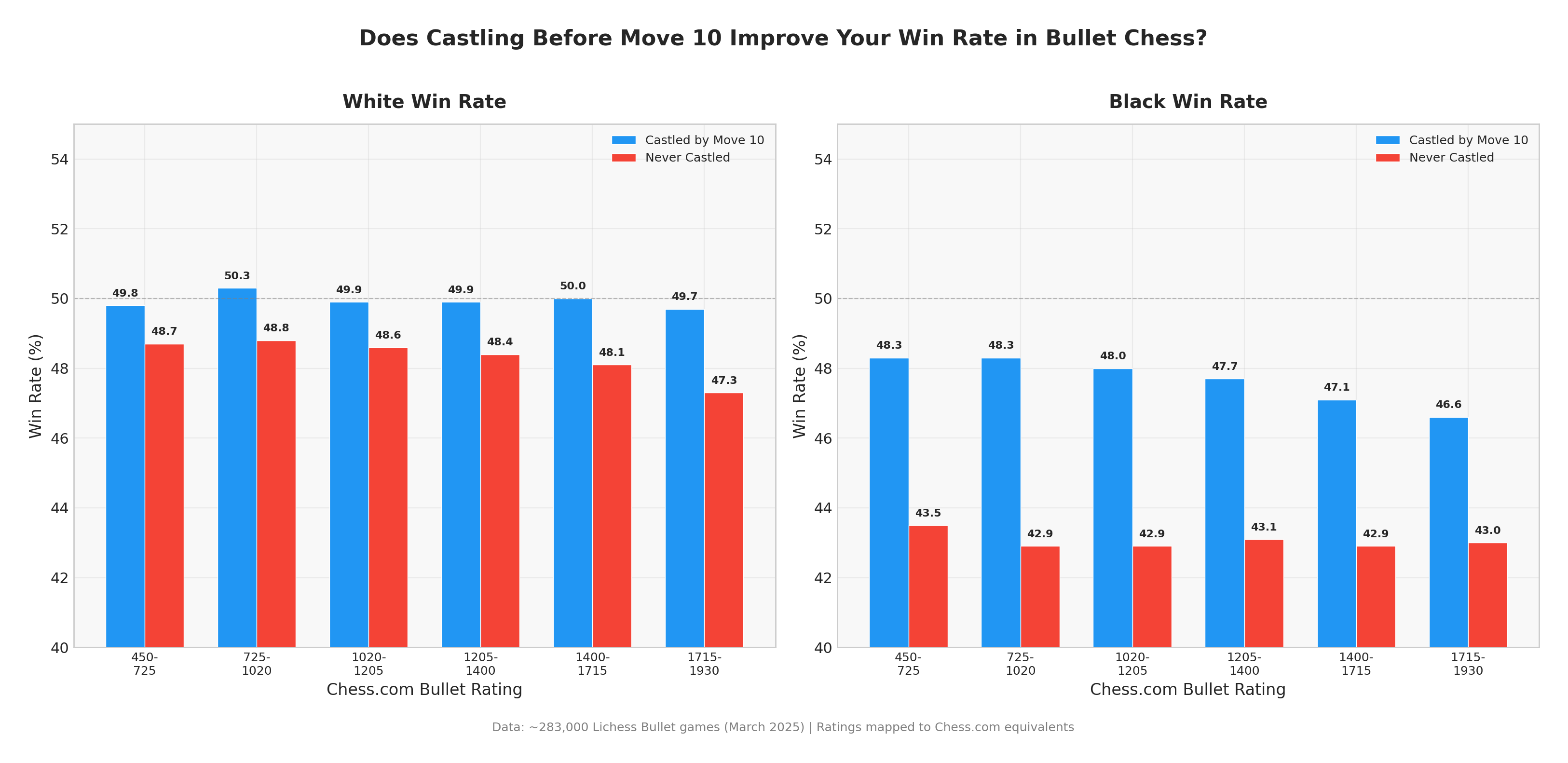
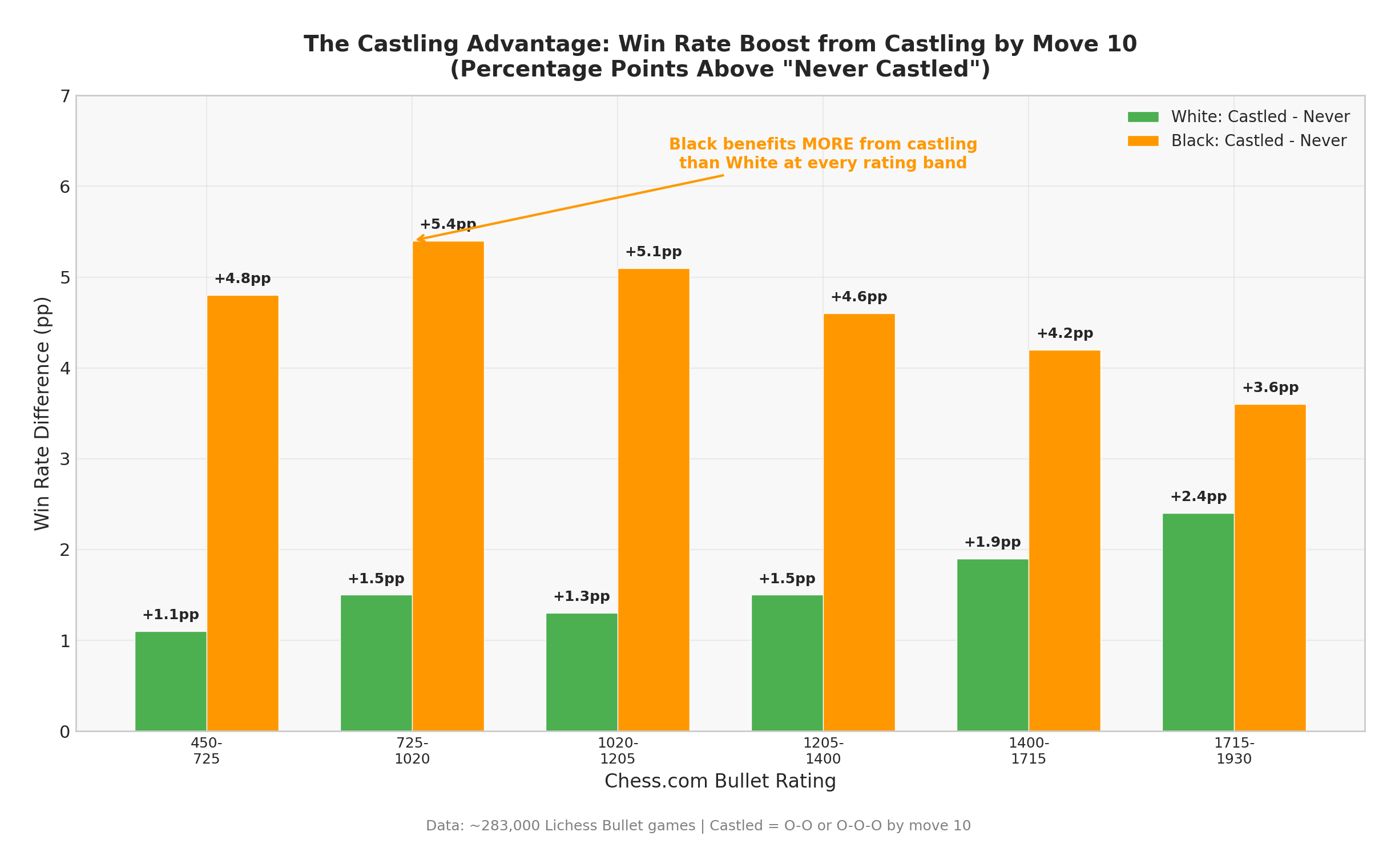
For White, castling by move 10 provides a steady win rate boost of 1.1 to 2.4 percentage points compared to never castling. However, the most striking finding is the impact on Black. Because Black starts half a tempo behind, king safety is even more critical. Black players who castle early see a massive 3.6 to 5.4 percentage point increase in their win rate compared to those who leave their king exposed.
The Castling Frequency Curve
If castling is so beneficial, why doesn't everyone do it? The data shows that castling frequency is strongly correlated with rating. As players improve, they learn the hard way that a central king is a liability.
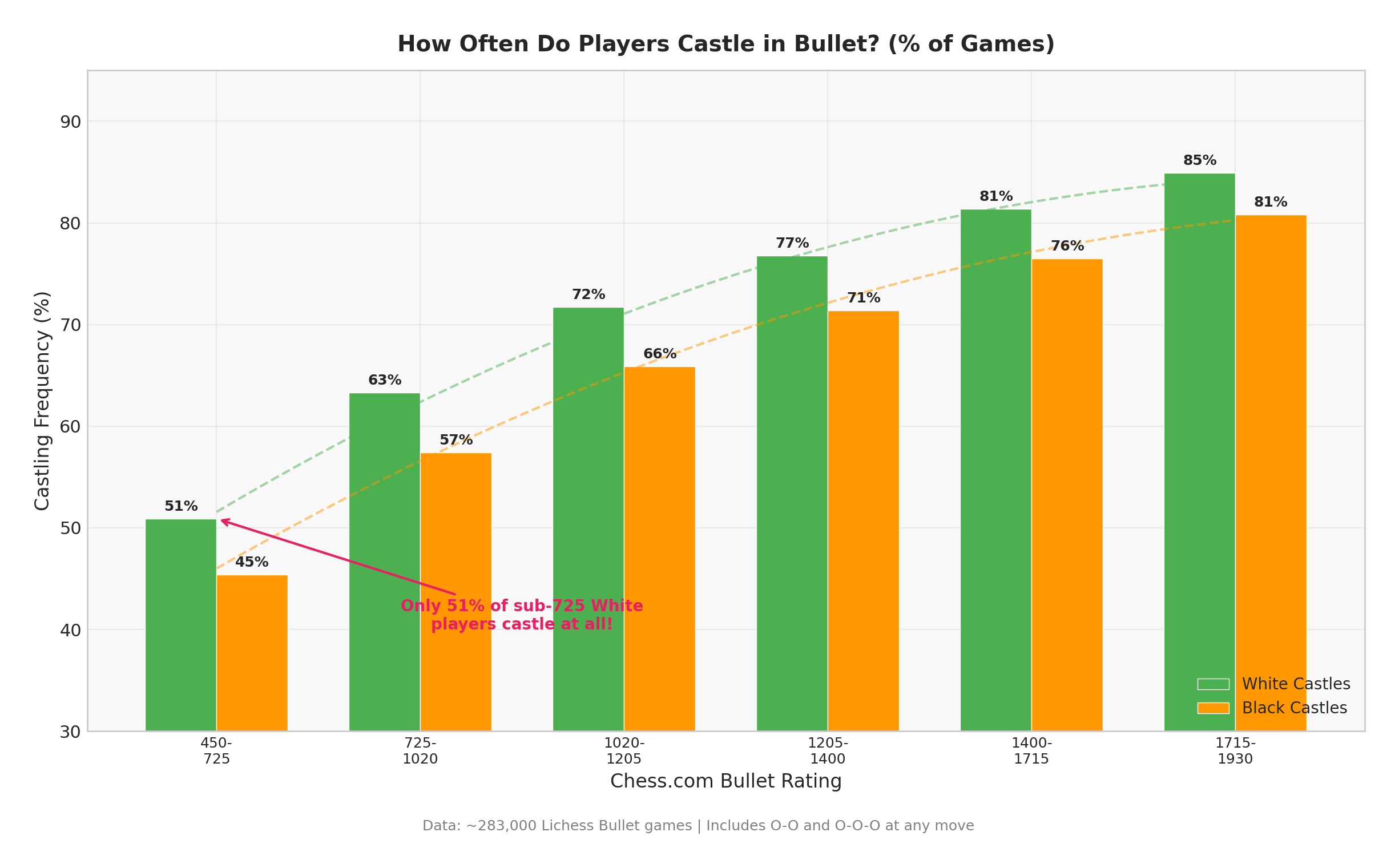
In the 450-725 Chess.com rating band (roughly 700-900 Lichess), only 51% of White players and 45% of Black players castle at all during a game. This means that in half of all games at this level, players are fighting with their king in the center. By the time players reach the 1400-1715 Chess.com range, castling becomes standard practice, with over 80% of players securing their king.
The "One-Sided" Castling Advantage
What happens when you follow the golden rule, but your opponent ignores it? The data on "one-sided" castling scenarios highlights the severe punishment for neglecting king safety.
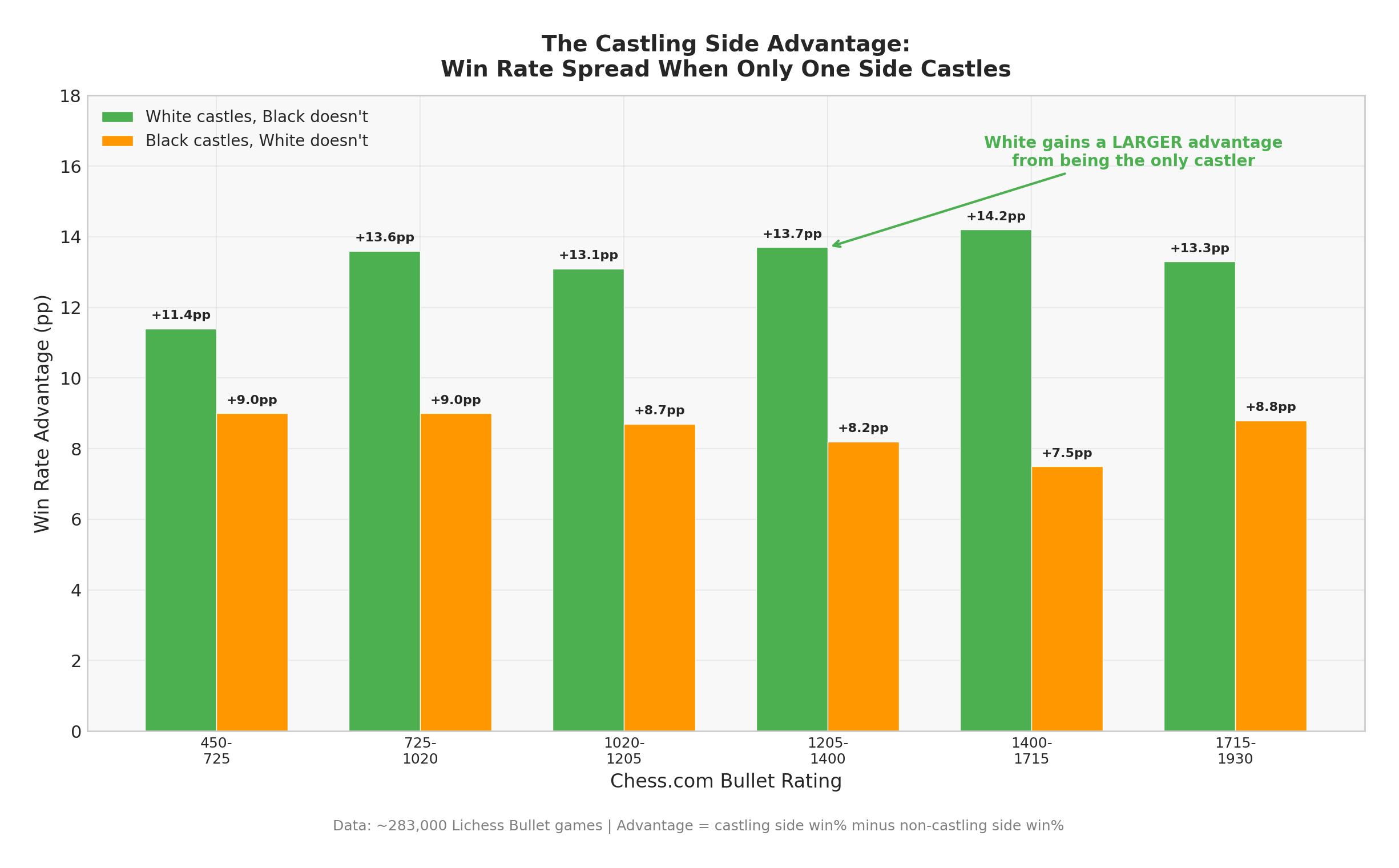
When only White castles, White wins between 53.5% and 55.6% of the time, depending on the rating band. This translates to a massive advantage of +11 to +14 percentage points over Black. When only Black castles, Black wins 52.0% to 52.8% of the time, an advantage of +7.5 to +9 percentage points over White.
This demonstrates that castling while your opponent does not is one of the most reliable ways to secure a statistical edge in Bullet chess.
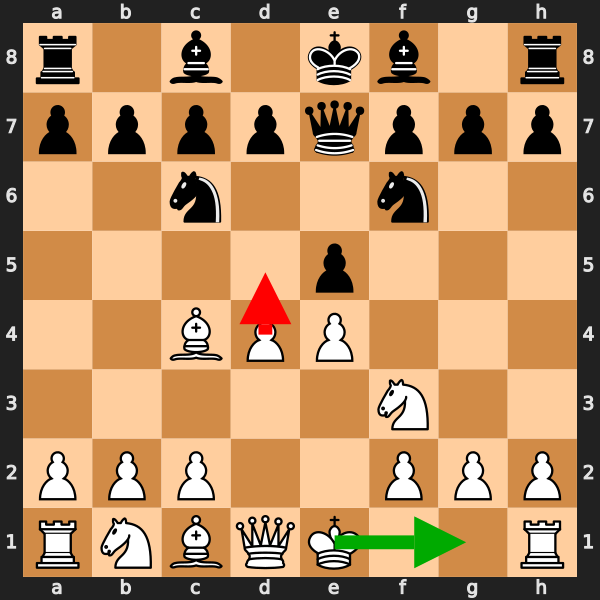 A classic scenario: White should castle (green arrow) before launching a premature central attack (red arrow).
Game Length and the "Neither Castled" Phenomenon
An interesting anomaly in the data is the "Neither Castled" scenario. In games where neither player castles, White actually maintains a high win rate (51.4% to 52.6%). Does this mean castling isn't necessary if your opponent also doesn't castle?
Not quite. The explanation lies in the average game length.
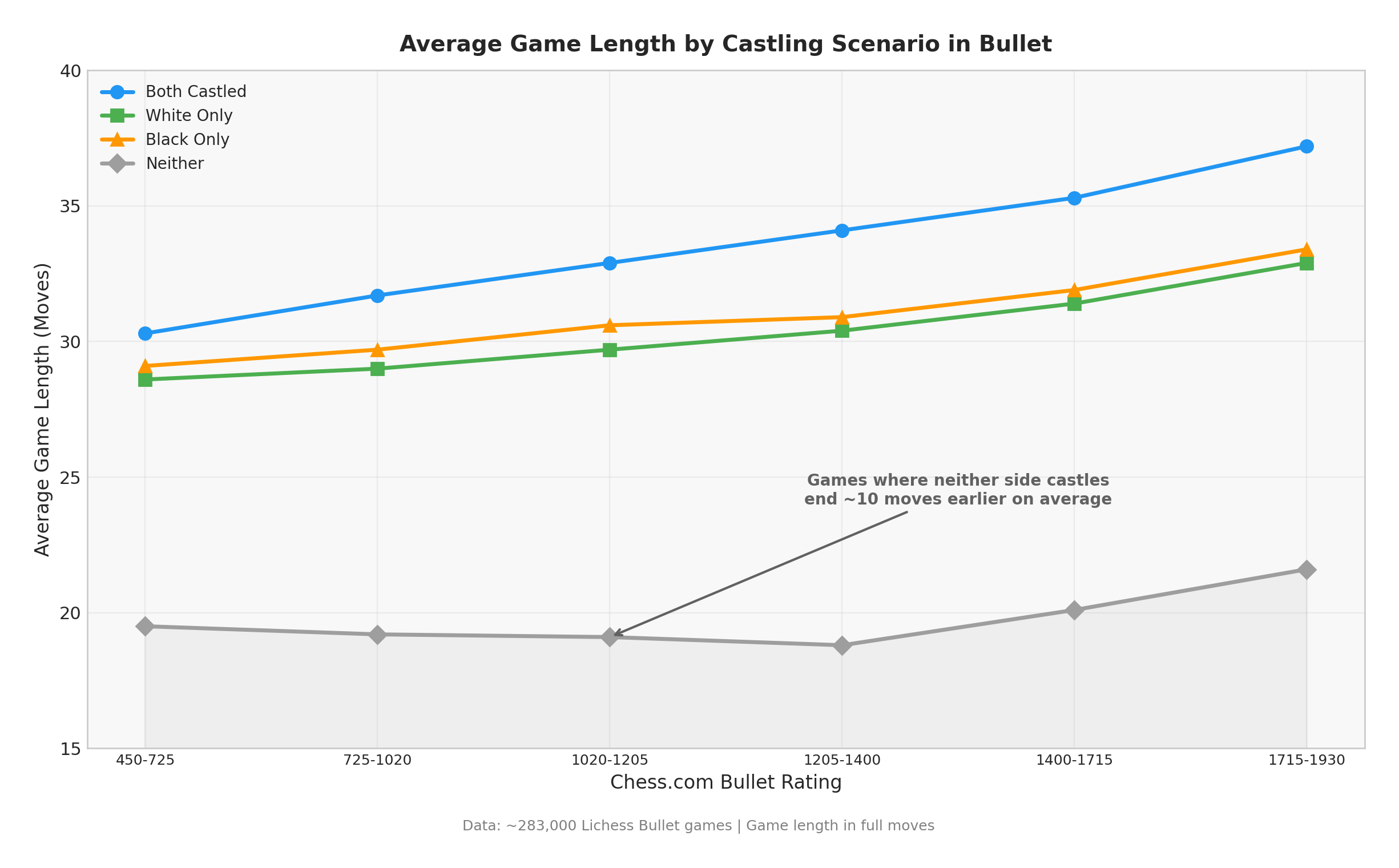
Games where neither side castles are exceptionally short, averaging only 19 to 22 moves. These are games decided by early blunders, opening traps, or quick checkmates before either player has the chance to castle. In these short, chaotic games, White's first-move advantage is amplified. If a game extends into the middlegame (30+ moves), castling becomes essential for survival.
Actionable Advice by Rating Band
Based on the data, here is a roadmap for improvement tailored to your Chess.com rating:
800 - 1000: The Survival Stage
At this level, nearly half of your opponents will not castle. Your primary goal is simply to survive the opening without blundering.
- Actionable Advice: Make castling your absolute highest priority. Do not launch attacks or push central pawns until your king is safe. The data shows that simply castling while your opponent does not gives you a massive +9 to +13 percentage point advantage.
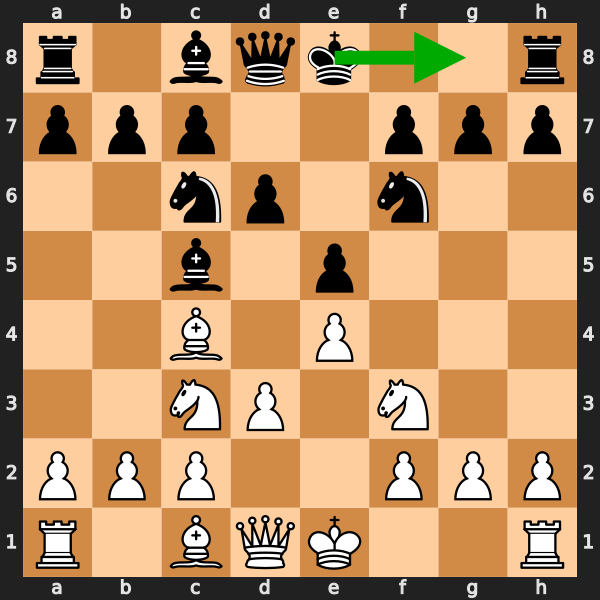 In Bullet, do not wait. Secure your king immediately.
1000 - 1200: The Consistency Stage
Players here are starting to castle more frequently (around 65-70% of the time), but they often delay it too long.
- Actionable Advice: Aim to castle by move 10. The data shows that early castling provides the most consistent win rate boost. If your opponent delays castling, look for ways to open the center and exploit their exposed king.
1200 - 1400: The Punishment Stage
Most players at this level know they should castle, but they may still neglect it in sharp openings or when trying to play aggressively.
- Actionable Advice: Learn to punish the uncastled king. If your opponent is delaying castling to launch a flank attack, counter-attack in the center. The statistics heavily favor the player with the safer king in these complex positions.
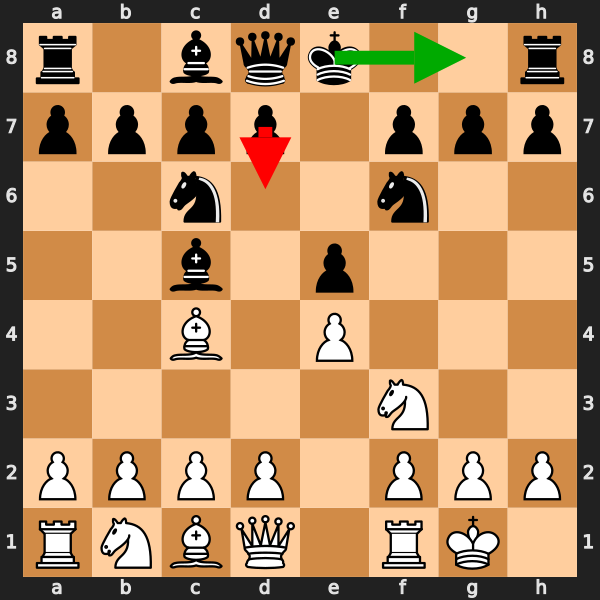 White has castled; Black should follow suit rather than playing slow pawn moves.
1400 - 1500+: The Refinement Stage
Castling is standard practice here (over 80% frequency). The focus shifts from whether to castle to when and where to castle.
- Actionable Advice: Consider opposite-side castling to create winning chances. While kingside castling is standard, queenside castling can lead to sharp, decisive games that favor the better attacker.
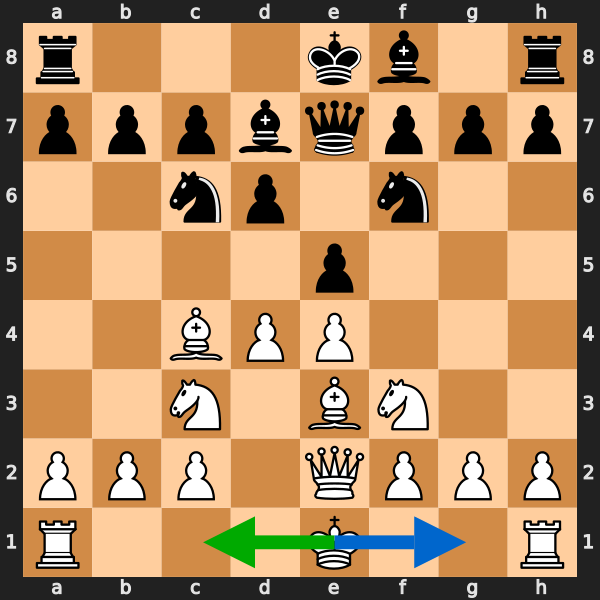 Queenside castling can lead to dynamic, attacking positions.
Conclusion
The data is unequivocal: castling improves your win rate in Bullet chess. It is not a slow, positional luxury; it is a critical defensive measure that prevents early disasters and provides a stable foundation for attacks. Especially for players with the Black pieces, securing the king is the single most effective way to neutralize White's first-move advantage.
So, the next time you are tempted to launch a premature attack with your king sitting on e1, remember the statistics. Castle first, attack later.
Data and Methodology
This analysis is based on a dataset of 283,468 Bullet games played on Lichess in March 2025. The data was extracted using the grandmaster-guide MCP server, which processes Lichess PGNs and engine evaluations.
- Rating Conversion: Lichess ratings were mapped to approximate Chess.com ratings to provide relevant advice for the target audience. The mapping assumes Lichess ratings are roughly 200-300 points higher than Chess.com ratings in this range.
- Castling Detection: Castling was identified by scanning the PGN movetext for standard castling notation (O-O and O-O-O).
- Data Files: The raw aggregated data used to generate the charts in this article is available in the attached CSV files.
Chess Coach April 15, 2026