Every beginner learns the classical opening principles: control the centre, develop your minor pieces, don't move the same piece twice, and castle early. But in the chaotic, time-scrambled world of Bullet chess, do these rules still apply? And more importantly, which rules can you safely break as you climb the rating ladder?
To answer these questions, we analysed over 6,000 Lichess Bullet games across four rating bands, mapping them to their Chess.com equivalents (800 to 1500). By comparing the win rates of players who followed the principles against those who broke them within the same game, we isolated the true Expected Value (EV) penalty of ignoring classical advice.
The data reveals a fascinating roadmap for improvement: the rules that punish you at 800 are not the same rules that hold you back at 1400.
The Big Picture: Which Principles Matter Most?
When we look at the expected-score advantage of following a principle (when your opponent breaks it), a clear hierarchy emerges.
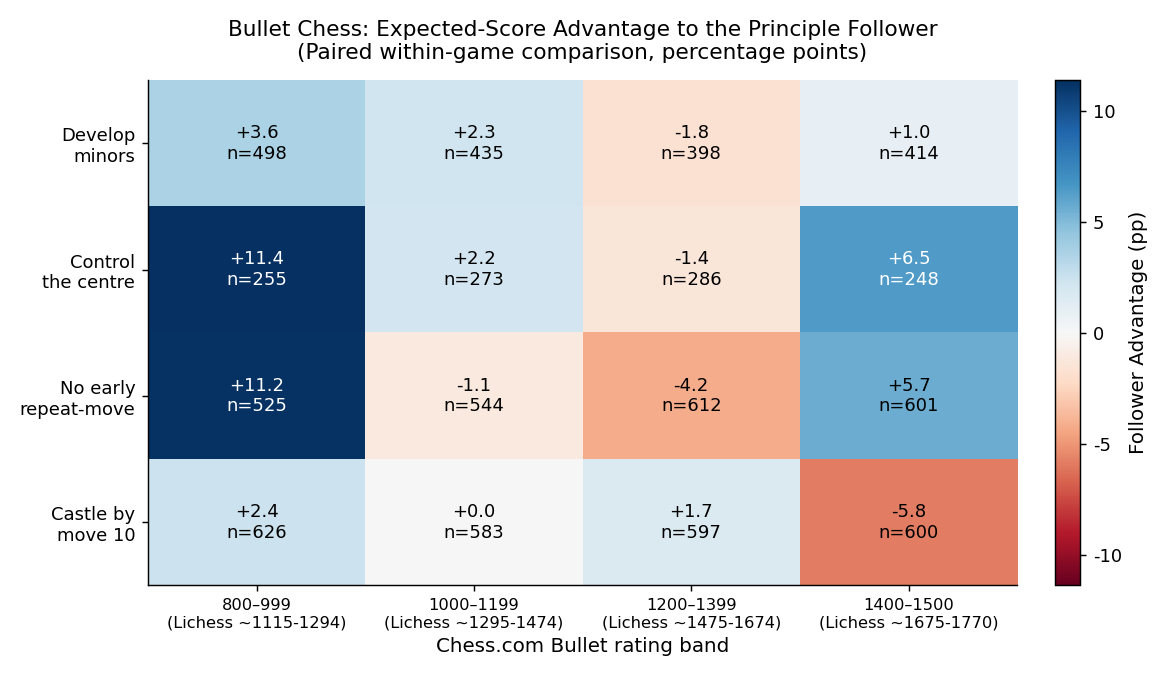
At the 800–999 level, controlling the centre and not moving the same piece twice are the absolute most critical rules. Breaking either of these while your opponent follows them costs you a massive 11 percentage points in expected score. However, as players improve, the penalty for moving the same piece twice vanishes entirely at the 1200 level, before returning at 1400.
Let's break down the journey rating by rating.
The 800–999 Roadmap: Stop the One-Move Attacks
At the beginner level (Chess.com 800–999, Lichess ~1115–1294), games are decided by rapid, uncoordinated aggression. The data shows that players at this level break the "don't move the same piece twice" rule in a staggering 74.2% of games.
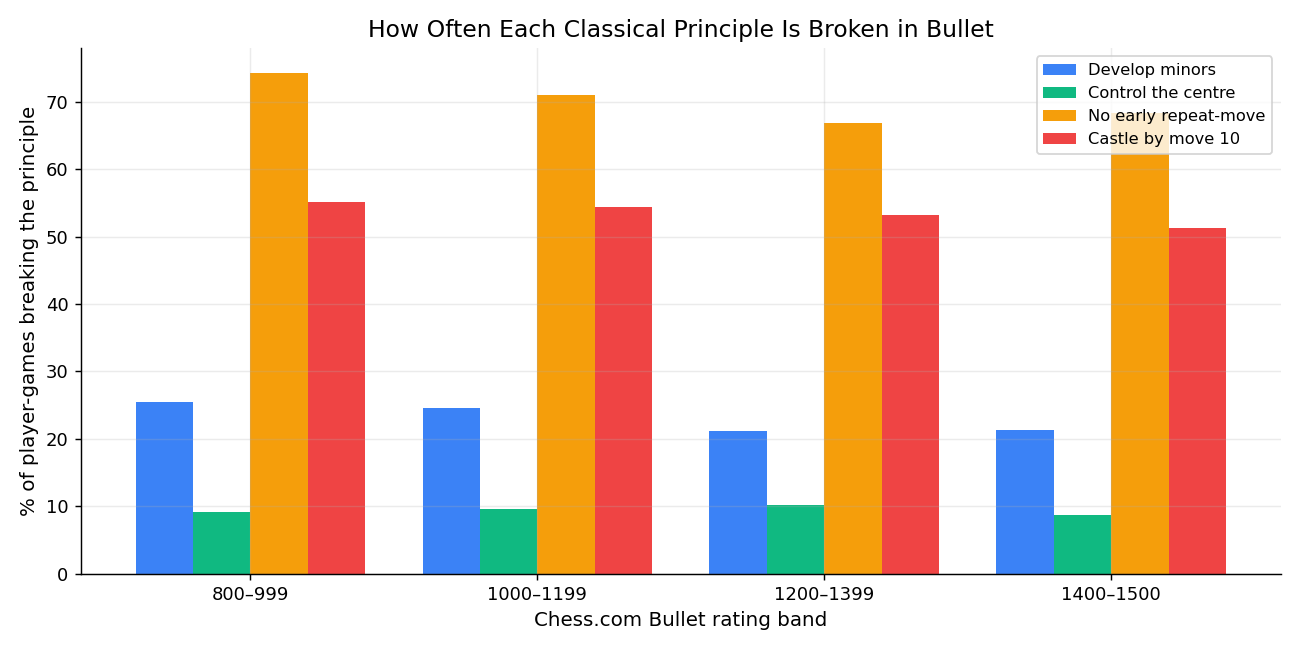
Why is this rule broken so often? Because beginners love to launch premature attacks, particularly with the Queen, or chase after one-move threats with a single Knight.
The Cost of Premature Aggression
When you move the same piece twice in the opening at 800–999, you are usually neglecting your development and centre control. The engine evaluations confirm this: in our sample, 45.6% of repeat-moves at this level resulted in a "severe punishment" (an evaluation drop of over 200 centipawns).
Illustrative Example: The Premature Queen
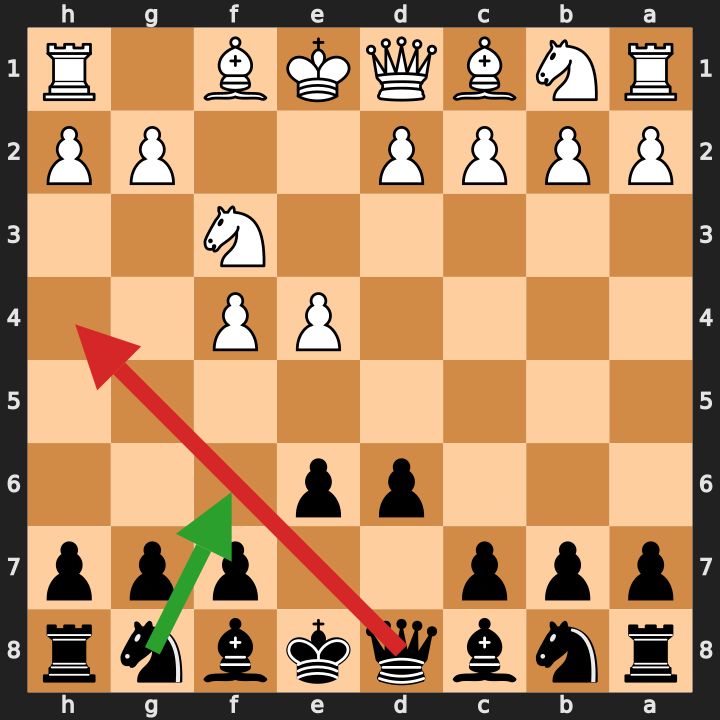
In this position, White has launched an early Queen sortie (Qh5). Black responds with the natural developing move Nf6 (green arrow), attacking the Queen. If White plays the tempting but terrible Qxg6+ (red arrow), they lose massive evaluation because the Queen is simply captured or chased away, wasting crucial opening tempi.
Actionable Advice for 800–999: Focus entirely on getting your pawns in the centre and your Knights and Bishops out. Ignore the temptation to attack until all your minor pieces are developed. If your opponent attacks early with one piece, calmly develop a piece that defends the threat or attacks the invading piece.
The 1000–1199 Roadmap: The Transition Phase
As players cross the 1000 threshold (Lichess ~1295–1474), the penalties for breaking principles begin to shrink. The advantage of controlling the centre drops from +11.4 points to just +2.2 points.
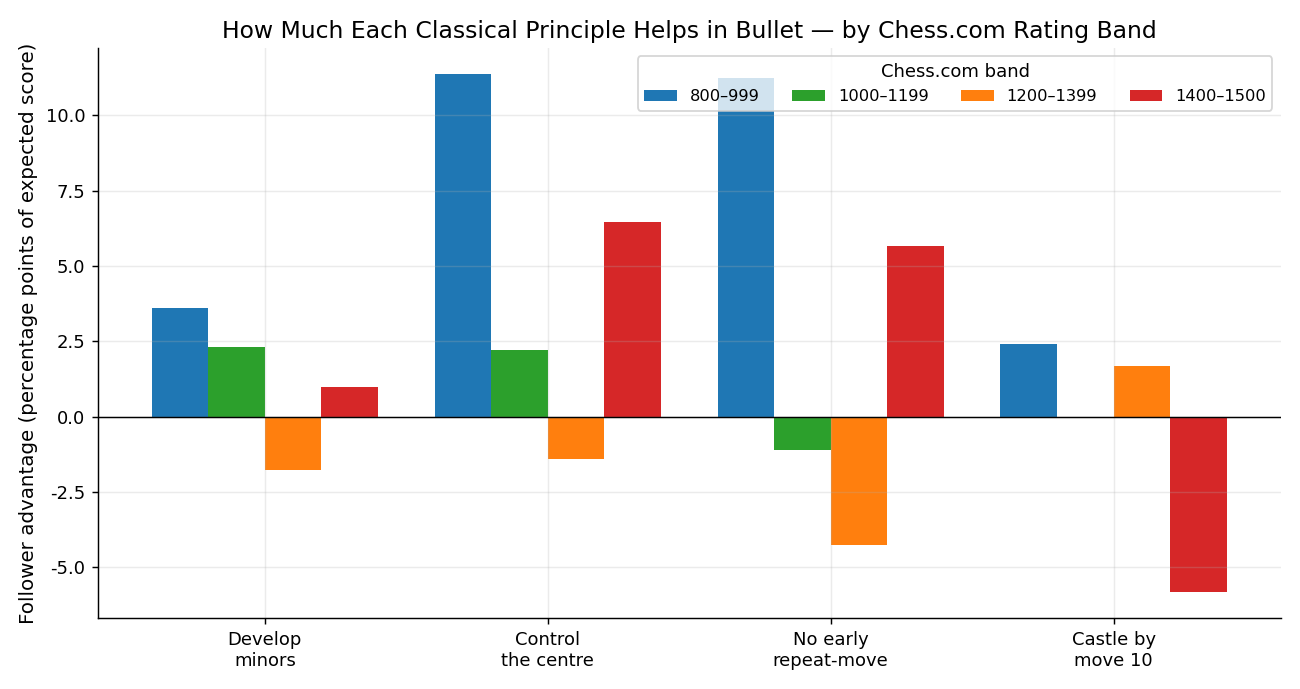
This is a transitional rating band. Players are making fewer outright blunders in the first 10 moves, meaning the game is more often decided by middle-game tactics rather than opening principle violations.
Actionable Advice for 1000–1199: You have likely internalized basic development. Your focus should now shift to tactical awareness. The principles still matter, but you can no longer rely on your opponent self-destructing in the first 10 moves simply because they moved a piece twice.
The 1200–1399 Roadmap: When Breaking the Rules is Good
The most surprising finding in our research occurs at the 1200–1399 level (Lichess ~1475–1674). Here, the "don't move the same piece twice" rule actually flips. Players who break this rule outscore players who follow it by 4.2 percentage points.
How is this possible?
At 1200, players start breaking principles for concrete tactical reasons. They aren't just wandering aimlessly; they are moving a piece twice to execute a fork, exploit a pin, or punish an opponent's mistake.
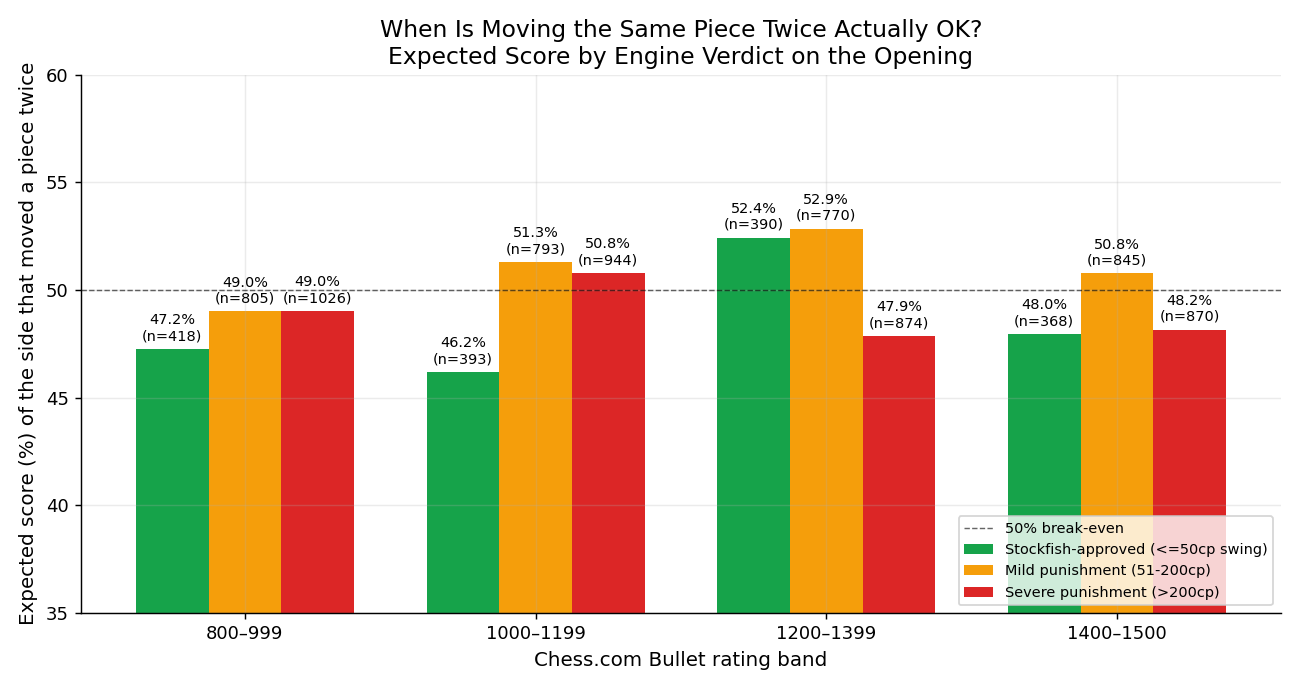
Our engine analysis shows that at 1200–1399, when a player moves a piece twice and the engine approves of the move (an evaluation swing of less than 50cp), that player scores an impressive 52.4% expected win rate. They have successfully identified an exception to the rule.
Illustrative Example: The Tactical Exception
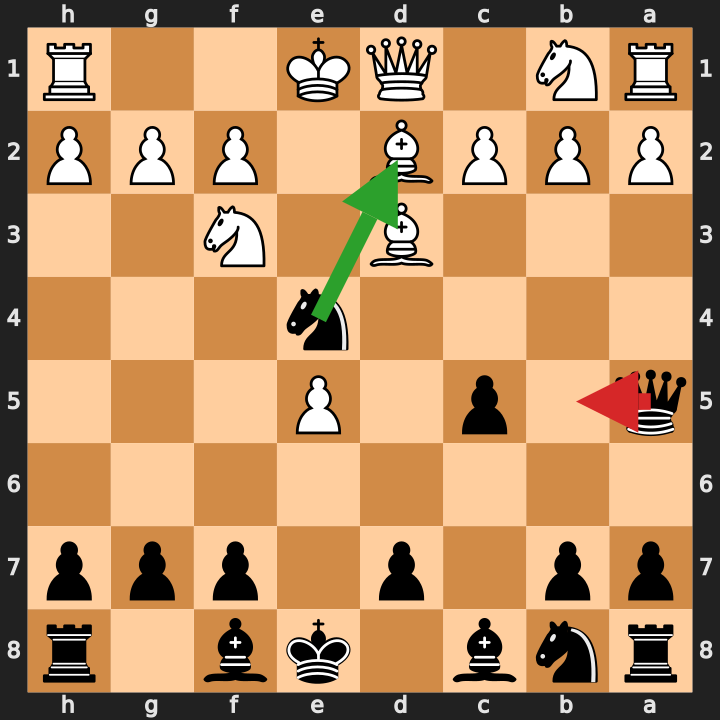
Here, Black has already moved their Queen to a5. Instead of developing a new piece, Black plays Qb5 (red arrow). However, the engine points out that the correct move was actually Nxd2 (green arrow) — another repeat move! In this specific tactical situation, capturing the Bishop is the best continuation, proving that concrete calculation trumps general principles.
Actionable Advice for 1200–1399: Start looking for exceptions. If you see a concrete tactical sequence that wins material or creates a severe weakness, calculate it. Do not blindly follow "develop a new piece" if a piece you've already moved can strike a decisive blow.
The 1400–1500 Roadmap: The Return of the Centre
As players approach 1500 (Lichess ~1675–1770), the game tightens up. The tactical free-for-all of the 1200s settles down, and positional understanding becomes a differentiator again.
At this level, the penalty for neglecting the centre returns strongly (+6.5 points for the follower). Furthermore, the "don't move the same piece twice" rule becomes valid again (+5.7 points). Why? Because 1400s are better at defending against premature attacks. If you waste time moving a piece twice without a concrete tactical justification, a 1400 player will use that time to seize the centre and squeeze you off the board.
Interestingly, castling by move 10 is actually negatively correlated with winning at this level (-5.8 points).
Illustrative Example: Losing Castling Rights
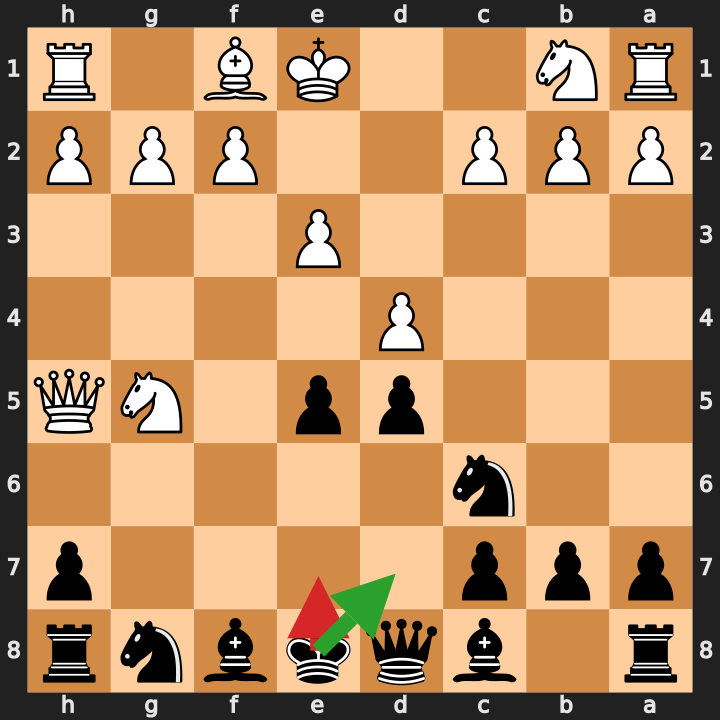
In Bullet, sometimes the King has to move manually. Here, Black plays Ke7 (red arrow), losing castling rights and stepping into a dangerous file. The engine prefers Kd7 (green arrow), which also loses castling rights but keeps the King safer. At 1400+, players are comfortable delaying castling or playing with an uncastled King if the position demands it.
Actionable Advice for 1400–1500: Recommit to the centre. Your opponents are tactically sharp enough that you cannot afford to give them a space advantage. However, be flexible with your King. Do not castle automatically on move 6 if the centre is closed or if castling walks into an attack.
Conclusion
Classical chess principles are not rigid laws; they are training wheels. At 800, you must keep the training wheels on to avoid crashing immediately. By 1200, you can start taking them off to execute sharp tactical turns. But as you approach 1500, you realize that the fundamental physics of the game—space, time, and central control—still govern everything you do.
Chess Coach April 20, 2026
Data and Methodology
- Dataset: 6,060 Lichess Bullet games (time controls < 180s base) sampled across four rating bands.
- Engine Analysis: Stockfish 17 NNUE evaluations via the Grandmaster Guide MCP.
- Methodology: Paired within-game comparisons were used to isolate the effect of principle adherence from baseline win-rate symmetry.
- Raw Data:
View full data →gameId band color playerElo result score minors_developed developed_3plus central_pawn no_repeat_move castled_by10 castle_ply biggest_eval_drop_cp biggest_drop_ply gCg4THX0 800-999 white 1229 0-1 0.0 3 1 0 0 1 13 0 gCg4THX0 800-999 black 1293 0-1 1.0 2 0 1 1 1 12 0 dnCi34bK 800-999 white 1189 1-0 1.0 4 1 1 0 0 0 dnCi34bK 800-999 black 1217 1-0 0.0 3 1 1 0 0 0 Ztflp9Cc 800-999 white 1258 0-1 0.0 3 1 1 0 0 0
View full data →band principle n_games_in_band both_followed both_broken asymmetric_games follower_expected_score_pct breaker_expected_score_pct follower_advantage_pp 800-999 Develop 3+ minor pieces 1515 880 137 498 51.81 48.19 3.61 800-999 Control the centre (d/e pawn advance) 1515 1250 10 255 55.69 44.31 11.37 800-999 Don't move the same piece twice early 1515 128 862 525 55.62 44.38 11.24 800-999 Castle by move 10 1515 366 523 626 51.2 48.8 2.4 1000-1199 Develop 3+ minor pieces 1501 915 151 435 51.15 48.85 2.3
View full data →band principle adherence n_observations wins draws losses win_rate_pct expected_score_pct 800-999 Develop 3+ minor pieces Followed 2258 1124 28 1106 49.78 50.4 800-999 Develop 3+ minor pieces Broken 772 371 12 389 48.06 48.83 800-999 Control the centre (d/e pawn advance) Followed 2755 1373 38 1344 49.84 50.53 800-999 Control the centre (d/e pawn advance) Broken 275 122 2 151 44.36 44.73 800-999 Don't move the same piece twice Followed 781 416 8 357 53.27 53.78
View full data →band category n pct_of_repeat_moves expected_score_pct 800-999 Stockfish-approved (<=50cp swing) 418 18.59 47.25 800-999 Mild punishment (51-200cp) 805 35.79 49.01 800-999 Severe punishment (>200cp) 1026 45.62 49.03 1000-1199 Stockfish-approved (<=50cp swing) 393 18.45 46.18 1000-1199 Mild punishment (51-200cp) 793 37.23 51.32