Every chess player knows the feeling. You learn a few openings, practice some tactics, and your rating climbs steadily. Then, suddenly, the progress stops. You play hundreds of games, but your rating hovers around the same number for months. You have hit a plateau.
In Bullet Chess (1-minute games), where intuition and speed often trump deep calculation, plateaus can be particularly frustrating. To understand the anatomy of these rating walls, we analyzed the rating histories of 318 active bullet players, encompassing 244,853 individual rating data points and identifying 1,772 distinct plateaus.
This guide serves as a roadmap for improvement, specifically targeting the climb from lower to higher ratings (Chess.com 800 to 1500). By understanding where players typically get stuck and what statistical indicators precede a breakthrough, you can navigate your own chess journey more effectively.
Note: All primary ratings in this article refer to Chess.com Bullet ratings. The underlying data was collected from Lichess, and ratings have been converted using established equivalency mappings (e.g., Chess.com 1200 ≈ Lichess 1475).
The Anatomy of a Plateau
Before diving into specific rating bands, we must define what constitutes a plateau. For this study, a plateau is defined as a period where a player's rating remains within a narrow 100-point band (±50 points from their average) for at least three consecutive months.
The data reveals that plateaus are not just common; they are an almost universal experience. Across our sample, over 90% of players experienced at least one significant plateau. However, the density of these plateaus is not evenly distributed across the rating spectrum.
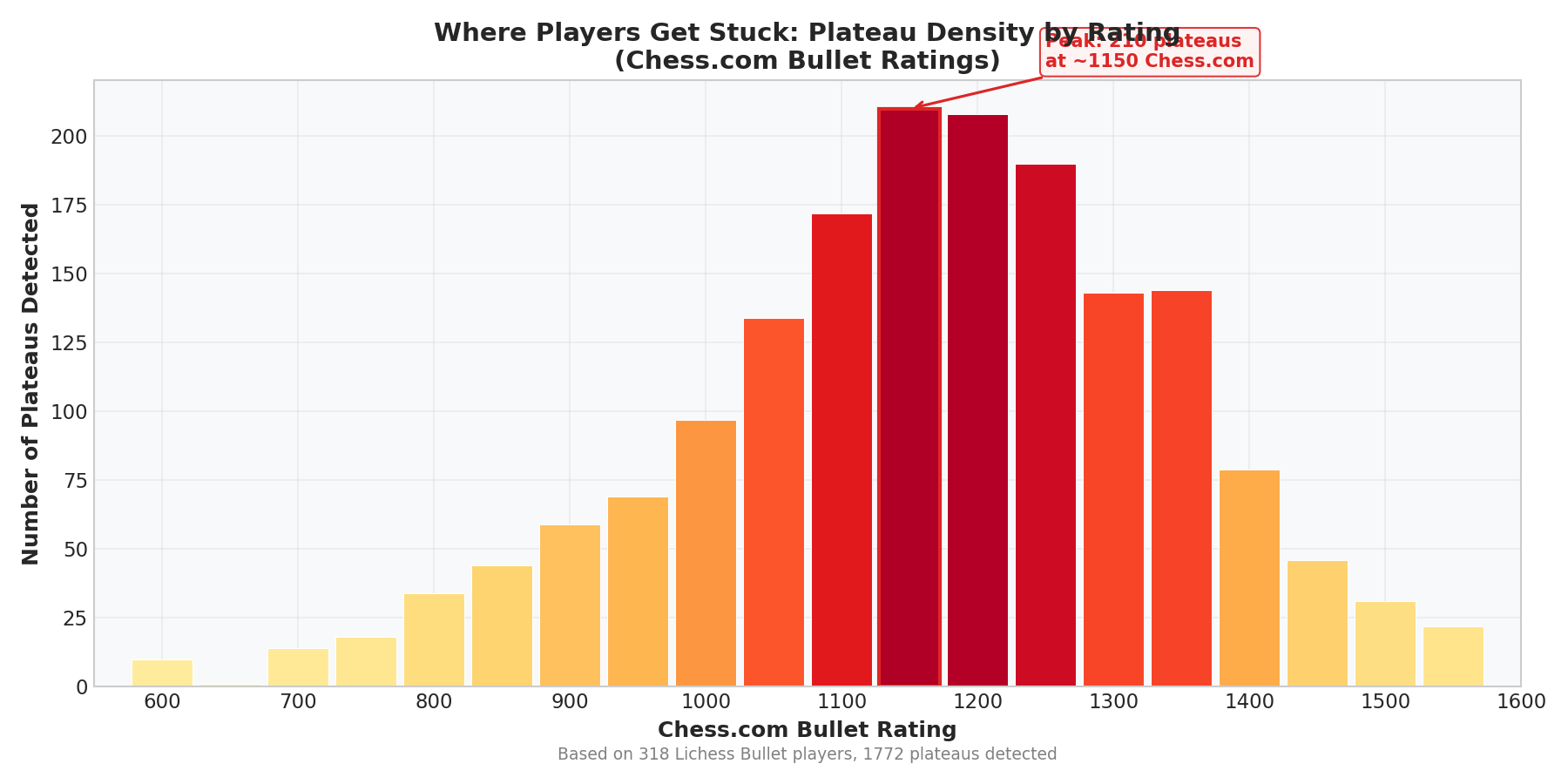
As the chart above illustrates, the "stickiest" rating zone in Bullet Chess is between 1100 and 1250. The absolute peak occurs at the 1150-1200 mark, where we detected the highest concentration of players stuck for extended periods. This represents a significant bottleneck in the amateur chess ecosystem.
Furthermore, the difficulty of breaking through a plateau increases dramatically as your rating improves.
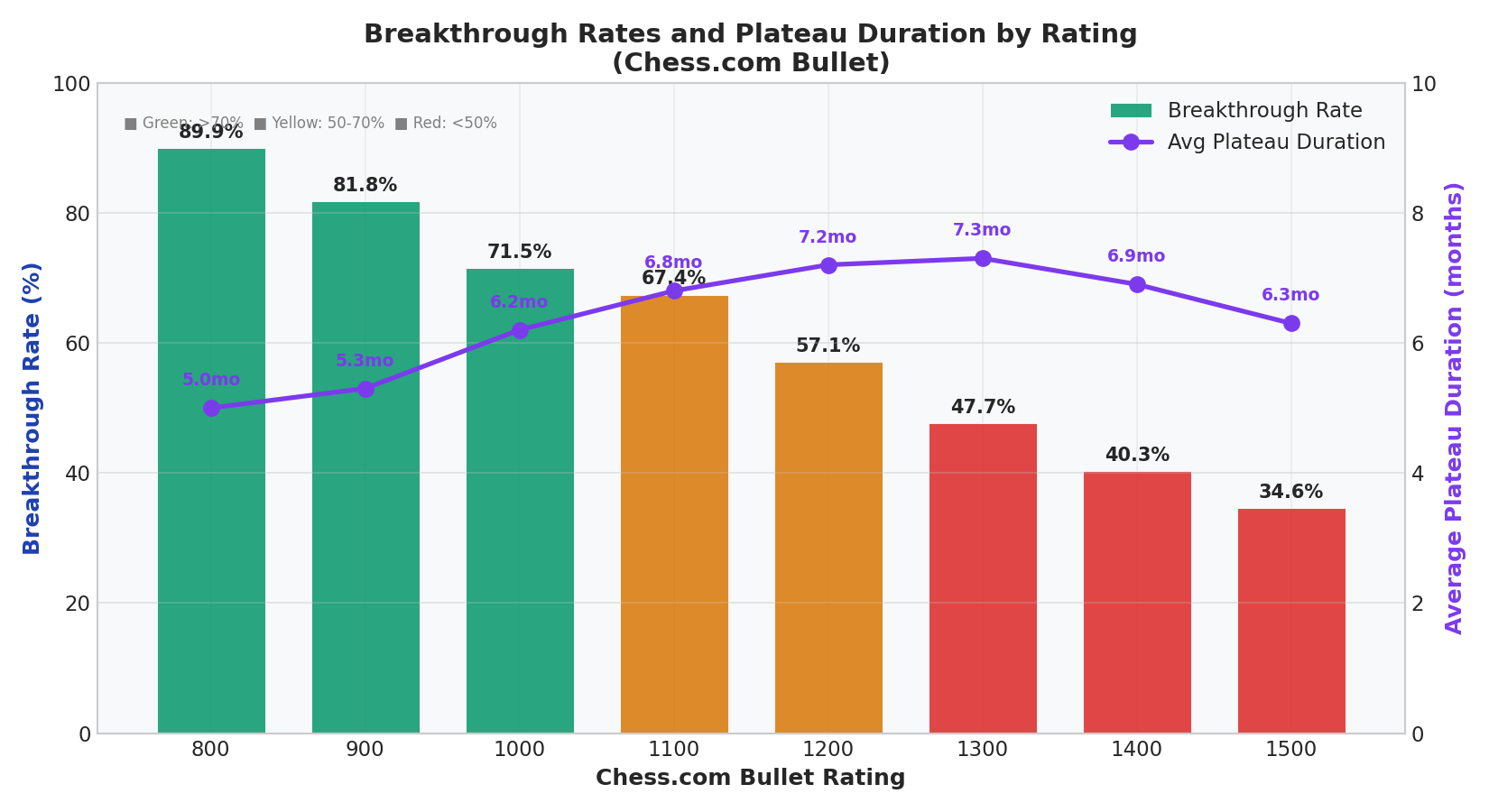
At the 800 level, nearly 90% of players who hit a plateau eventually break through to higher ratings. By the time players reach 1200, the breakthrough rate drops to 57.1%. At 1500, only about one-third of players manage to push past their plateau. Simultaneously, the average duration of a plateau increases from 5.0 months at 800 to over 7 months in the 1200-1300 range.
The Roadmap to Improvement
To help you navigate these rating walls, we have broken down the journey into specific rating bands. For each segment, we provide data-backed insights and actionable advice.
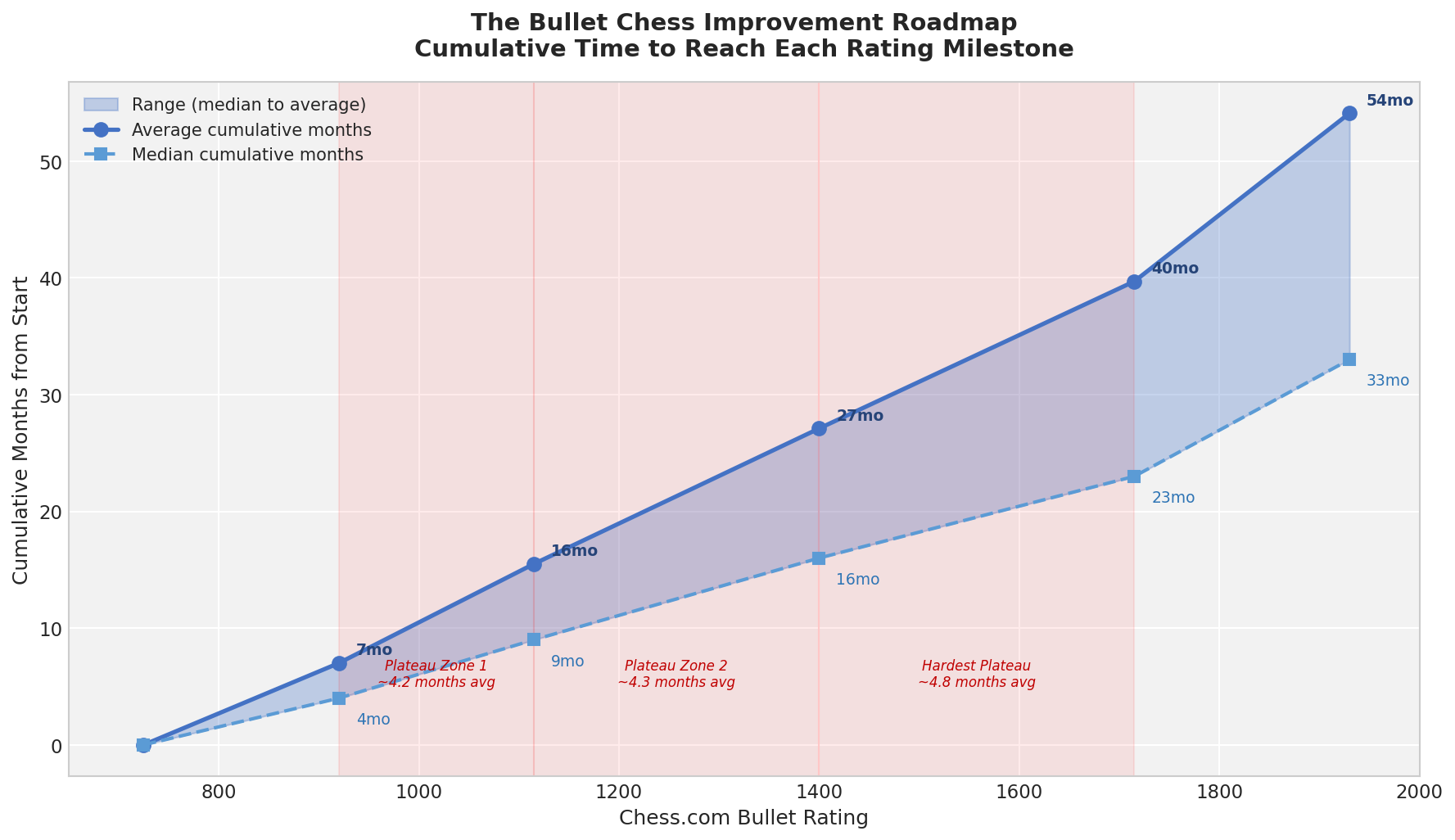
The 800-1000 Band: The Tactical Foundation
The Data: Players in this band experience plateaus averaging 5.0 to 5.3 months. However, the breakthrough rate is highly encouraging, ranging from 81.8% to 89.9%. The data shows that games at this level are frequently decided by significant blunders. According to our analysis of engine evaluations, the average Centipawn Loss (CPL) in this band is 154.2, indicating frequent, game-altering mistakes.
The Plateau Profile: At this level, plateaus are rarely caused by a lack of opening knowledge or strategic understanding. Instead, players get stuck because they lack basic board vision and tactical consistency. In Bullet Chess, this often manifests as dropping pieces to simple one-move threats or falling for early traps.
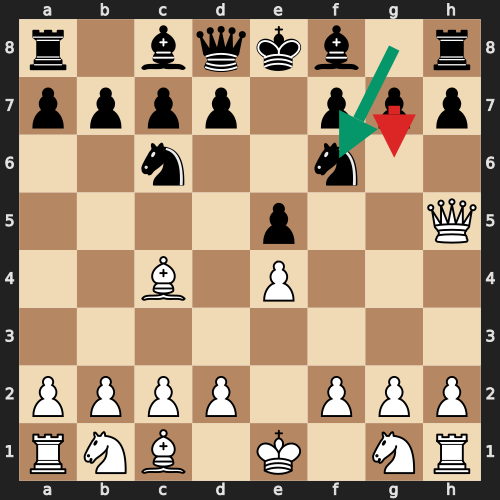
Actionable Advice: To break through the 800-1000 plateau, your primary focus must be on blunder reduction rather than complex strategy.
- Prioritize Safety Over Speed: In bullet, it is tempting to move instantly. However, taking an extra half-second to ensure your piece is defended will win more games than flagging your opponent.
- Develop a Pre-Move Filter: Before executing a move, quickly scan for direct attacks on your king or undefended pieces.
- Simplify Your Openings: The data shows that players in this band use a relatively narrow set of openings (Top 5 openings cover 34.6% of games). Stick to solid, principled openings that prioritize development and king safety, avoiding sharp, theoretical lines where a single slip is fatal.
The 1000-1200 Band: The Great Filter
The Data: This is where the climb becomes significantly steeper. The breakthrough rate drops from 71.5% at 1000 to 57.1% at 1200. The average plateau duration stretches to 6.8 - 7.2 months. This band represents the most significant bottleneck in our dataset.
The Plateau Profile: Players at this level have generally stopped hanging pieces in one move. They understand basic development and castling. However, they often struggle with board awareness when the position becomes complex. They miss two-move tactics (like forks and pins) and often play "hope chess"—making a threat and hoping the opponent misses it, rather than playing objectively good moves.
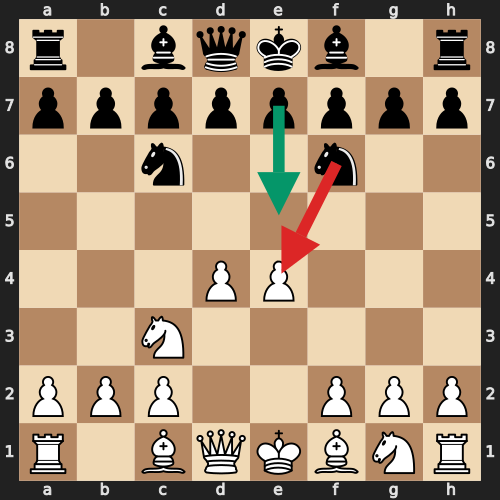
Actionable Advice: Breaking through the 1200 wall requires a shift from reactive to proactive play.
- Master Basic Tactics: You must be able to spot forks, pins, and skewers instantly. In bullet, these patterns must be ingrained in your subconscious. Regular puzzle training (specifically focusing on speed and pattern recognition) is essential.
- Stop "Hope Chess": Assume your opponent will find the best response to your threats. If your attack relies on them making a mistake, it is likely a bad attack.
- Manage the Clock: Our data shows that time forfeits account for roughly 30% of game terminations across all bands. At 1000-1200, players often burn too much time calculating simple tactics. You must develop a rhythm that balances speed with basic tactical safety.
The 1200-1400 Band: The Strategic Transition
The Data: Welcome to the hard plateau zone. Breakthrough rates fall below 50% (47.7% at 1300, 40.3% at 1400). The average plateau duration peaks here at 7.3 months. Interestingly, the average game length increases to 27.7 - 29.4 moves, indicating that games are less frequently decided by early tactical blunders and are extending into the late middlegame and endgame.
The Plateau Profile: Players stuck in this band are tactically competent for bullet speeds. They know their openings and rarely drop pieces for nothing. Their plateau is usually caused by a lack of strategic planning and poor handling of pawn structures. When the tactical fireworks end, they often do not know what to do next, leading to aimless shuffling and eventual time trouble.
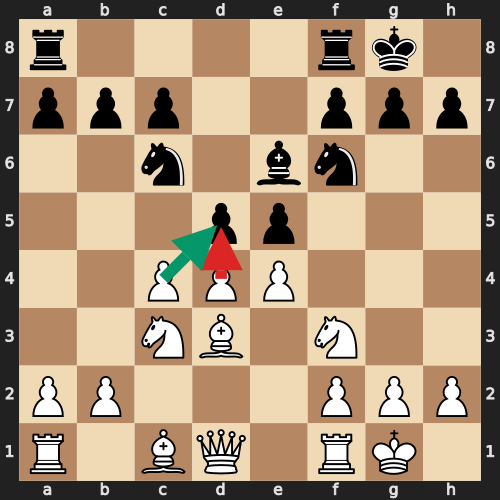
Actionable Advice: To push past 1400, you need to incorporate basic strategic concepts into your fast-paced play.
- Understand Pawn Structures: Learn how different pawn structures dictate the plans for both sides. Knowing where your pieces belong based on the pawn skeleton saves crucial seconds on the clock.
- Improve Endgame Technique: As games get longer, endgame skills become a differentiator. You must be able to convert basic pawn endgames and rook endgames flawlessly and quickly.
- Expand Your Repertoire: Our opening diversity data shows that as players improve, their repertoire broadens. At this level, relying on a single "trick" opening is no longer effective. You need a solid response to various setups to avoid being taken out of your comfort zone early.
The 1400-1500+ Band: The Consistency Challenge
The Data: At 1500, the breakthrough rate is a mere 34.6%. Players who reach this level are in the upper echelons of amateur bullet chess. The average CPL drops to 150.7, showing a measurable improvement in move quality despite the time control.
The Plateau Profile: Plateaus here are rarely about missing knowledge; they are about consistency and psychology. Players at this level know what to do, but executing it flawlessly under extreme time pressure is difficult. Furthermore, our data highlights a significant psychological factor: the "Tilt Effect."
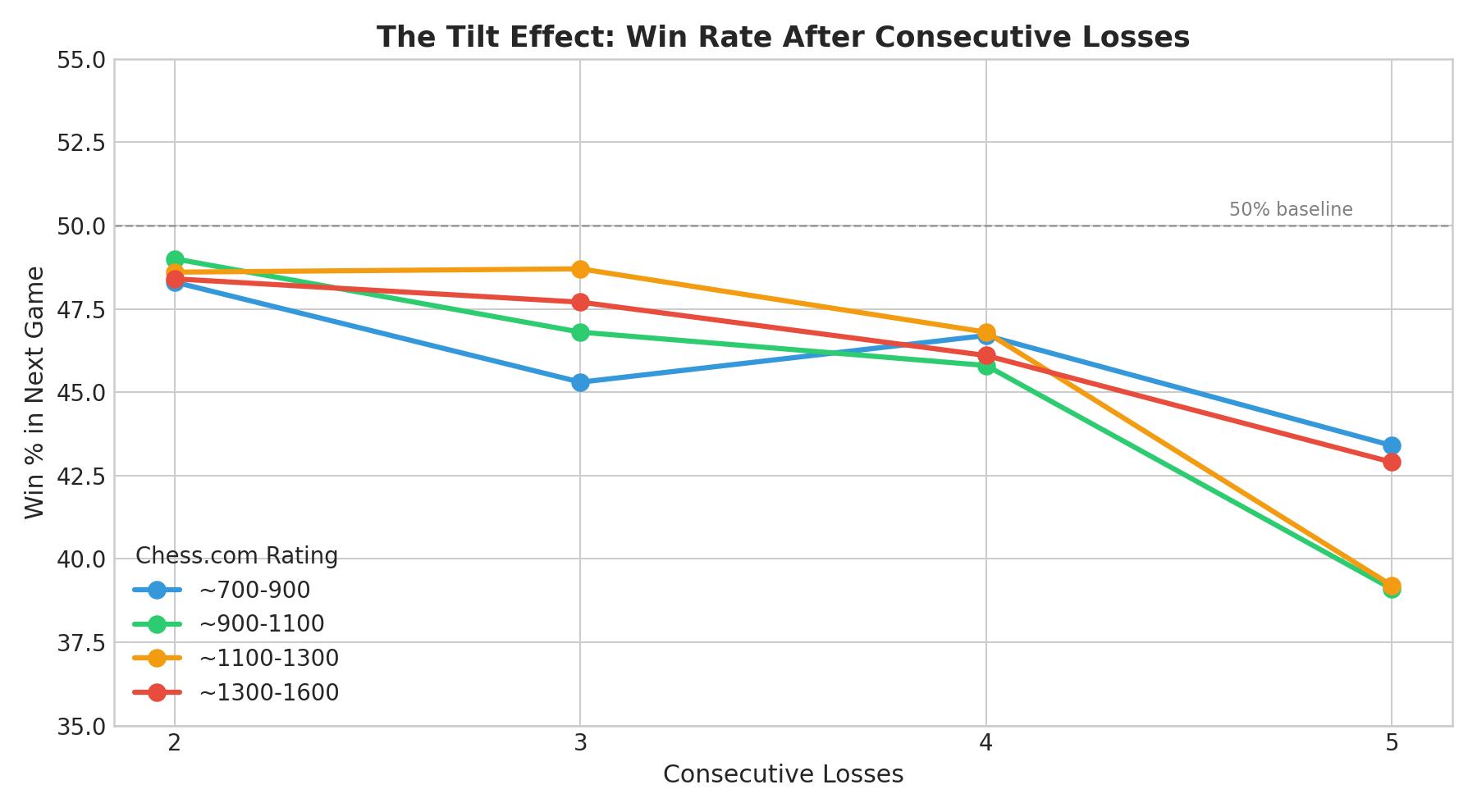
As the chart demonstrates, a losing streak severely impacts subsequent performance. After a 5-game losing streak, a player's expected win rate in the next game drops to around 39-41% (down from a baseline of ~50%). Conversely, winning streaks build momentum.
Actionable Advice: Breaking the 1500 barrier requires mastering the psychological and practical aspects of bullet chess.
- Manage Tilt: The data is clear—playing through a losing streak damages your rating. Implement a strict "stop-loss" rule. If you lose three games in a row, take a break. Bullet chess requires a clear, focused mind.
- Optimize Pre-moves: At this level, fractions of a second matter. You must use pre-moves effectively during the opening and in forced sequences (like recaptures) to bank time for critical decisions later.
- Play the Board, Not the Clock (Until the End): While speed is vital, playing objectively bad moves just to move quickly will be punished by 1500+ players. Maintain position quality until the final seconds, where pure speed takes over.
The Numbers at a Glance
The following table summarizes the key plateau statistics across all rating bands studied in this article.
| Chess.com Rating | Lichess Equivalent | Plateaus Detected | Avg Duration (months) | Breakthrough Rate | 6-Month Plateau Breakthrough |
|---|---|---|---|---|---|
| 800 | ~1115 | 89 | 5.0 | 89.9% | 76.0% |
| 900 | ~1200 | 154 | 5.3 | 81.8% | 76.0% |
| 1000 | ~1295 | 253 | 6.2 | 71.5% | 66.0% |
| 1100 | ~1385 | 460 | 6.8 | 67.4% | 66.0% |
| 1200 | ~1475 | 615 | 7.2 | 57.1% | 49.7% |
| 1300 | ~1575 | 520 | 7.3 | 47.7% | 49.7% |
| 1400 | ~1675 | 318 | 6.9 | 40.3% | 39.2% |
| 1500 | ~1770 | 127 | 6.3 | 34.6% | 39.2% |
The table reveals a clear and consistent pattern: as rating increases, the probability of breaking through a plateau decreases while the average duration of the plateau increases. The 1200 milestone stands out as the single most critical inflection point, where the number of plateaus peaks and the breakthrough rate drops below 60% for the first time.
Extended Plateaus: The 6-Month Wall
While the average plateau lasts 5 to 7 months, many players experience far longer stalls. We specifically examined plateaus lasting 6 months or more, which represent a qualitatively different challenge from shorter fluctuations.
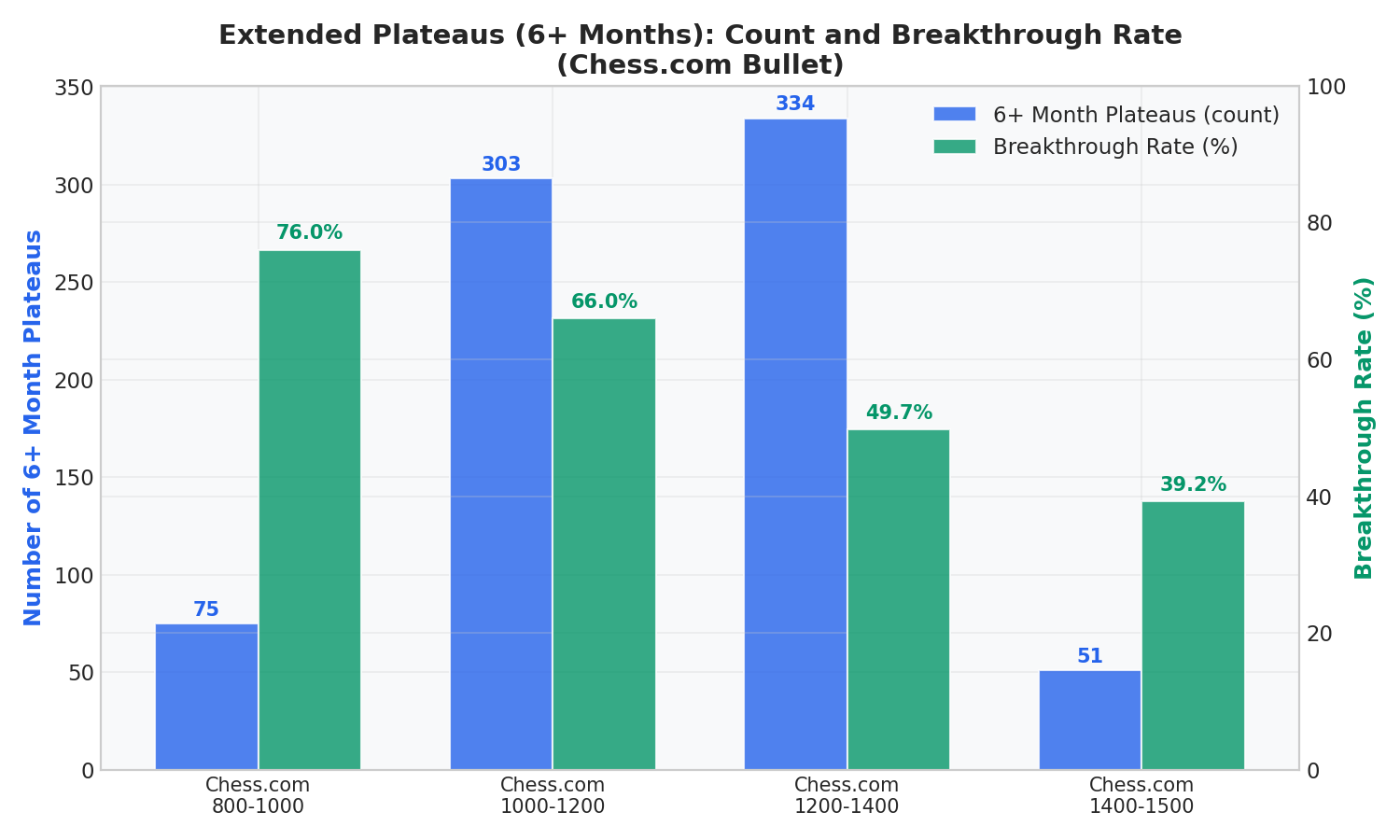
The data paints a sobering picture. In the 800-1000 band, 76% of players who endure a 6-month plateau eventually break through. In the 1200-1400 band, that figure drops to roughly 50%, meaning that half of all players who stall for half a year at this level never recover to a higher rating. At 1400-1500, only 39.2% of extended plateaus result in a breakthrough.
This finding has a crucial practical implication: if you have been stuck at the same rating for more than six months, something fundamental in your approach needs to change. Simply playing more games of the same type is unlikely to produce different results.
Bullet-Specific Characteristics Across Rating Bands
Bullet chess has unique characteristics that distinguish it from longer time controls. Understanding how these characteristics vary across rating bands provides insight into what changes as players improve.
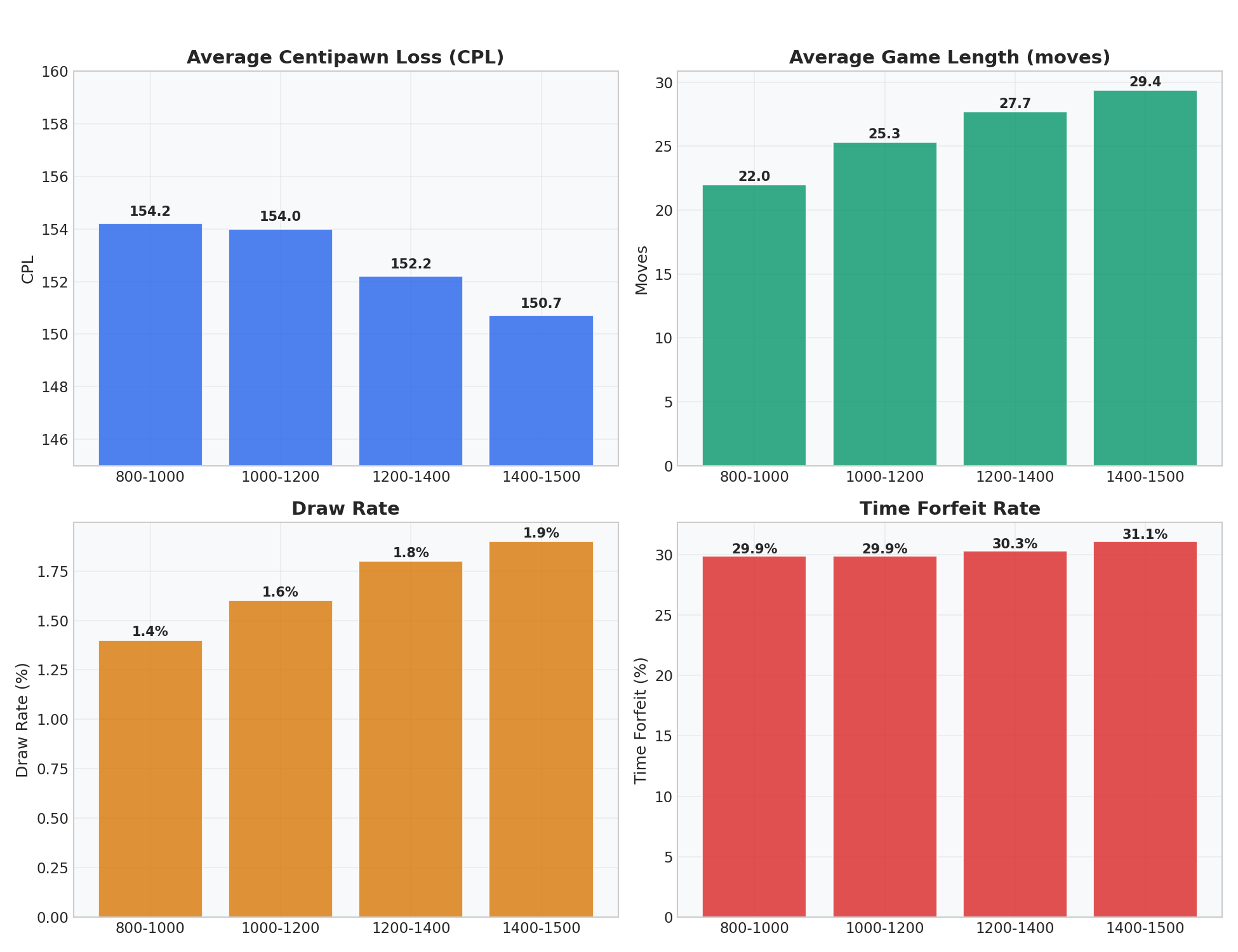
Several observations stand out from this data. First, the average Centipawn Loss (CPL) barely changes across the 800-1500 range (154.2 to 150.7). This is a striking finding: in bullet chess, even significantly higher-rated players do not play dramatically more accurate moves on average. The difference in rating is driven more by consistency, time management, and avoiding catastrophic blunders than by overall move quality.
Second, the average game length increases from 22 moves at 800-1000 to 29.4 moves at 1400-1500. This means that higher-rated players survive the opening and middlegame more reliably, pushing games into the endgame phase where technique matters.
Third, the time forfeit rate remains remarkably stable at approximately 30% across all bands. This confirms that time pressure is a universal feature of bullet chess, not something that players "outgrow" as they improve.
The Role of Opening Diversity in Breaking Plateaus
One of the most interesting indicators that precedes a plateau breakthrough is a change in opening repertoire. Our data, drawn from a database of over 847,000 games, reveals a clear correlation between opening diversity and rating.
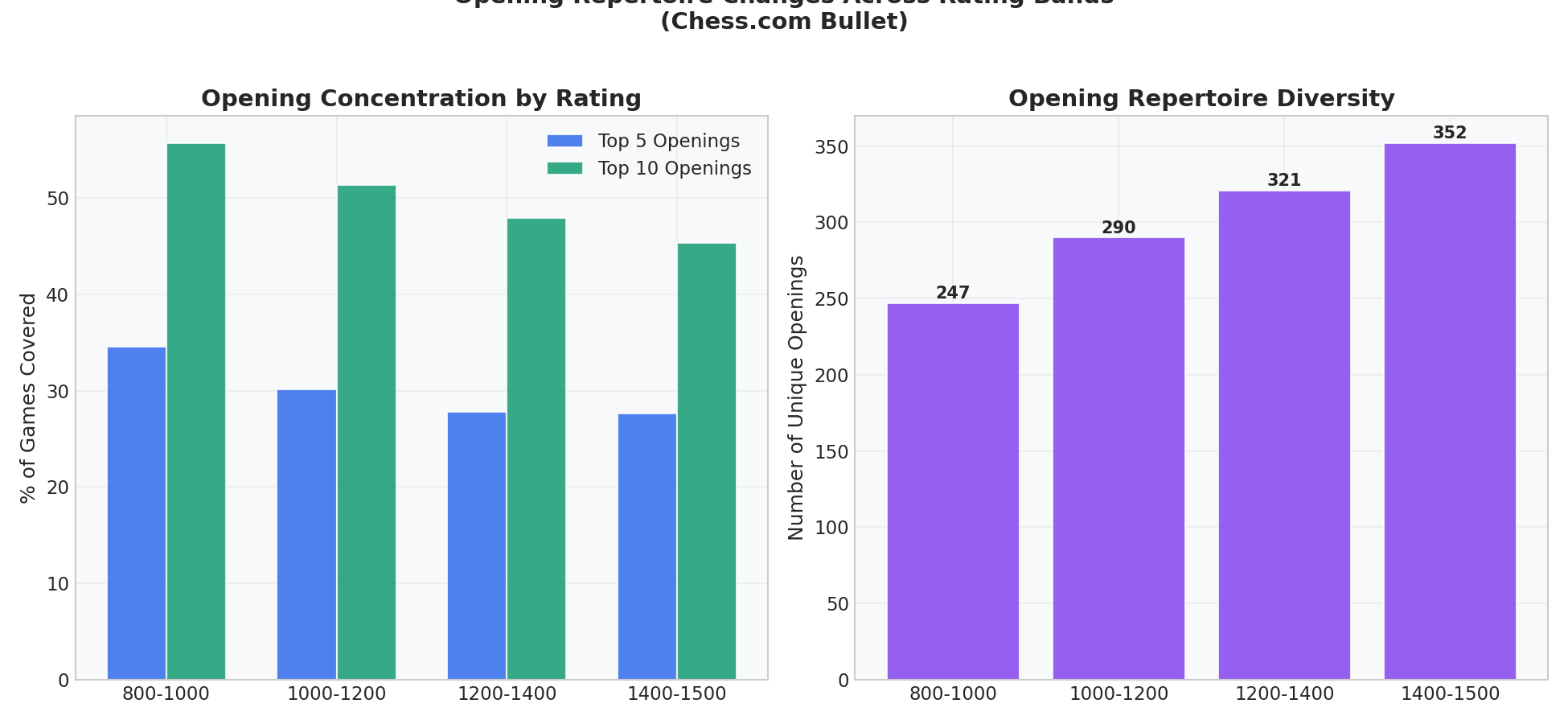
At the 800-1000 level, the top 5 openings account for 34.6% of all games, and players use approximately 247 unique opening lines. By 1400-1500, the top 5 openings cover only 27.6% of games, and the repertoire expands to 352 unique lines. This suggests that players who diversify their openings are better equipped to handle a wider range of positions, which is a key factor in breaking through a plateau.
This does not mean you should play random openings. Rather, it means that expanding from one or two pet lines to a broader, more flexible repertoire is a statistically significant indicator of improvement.
Where Bullet Games End: The Game Phase Distribution
Understanding where games are decided provides another lens on the plateau problem.
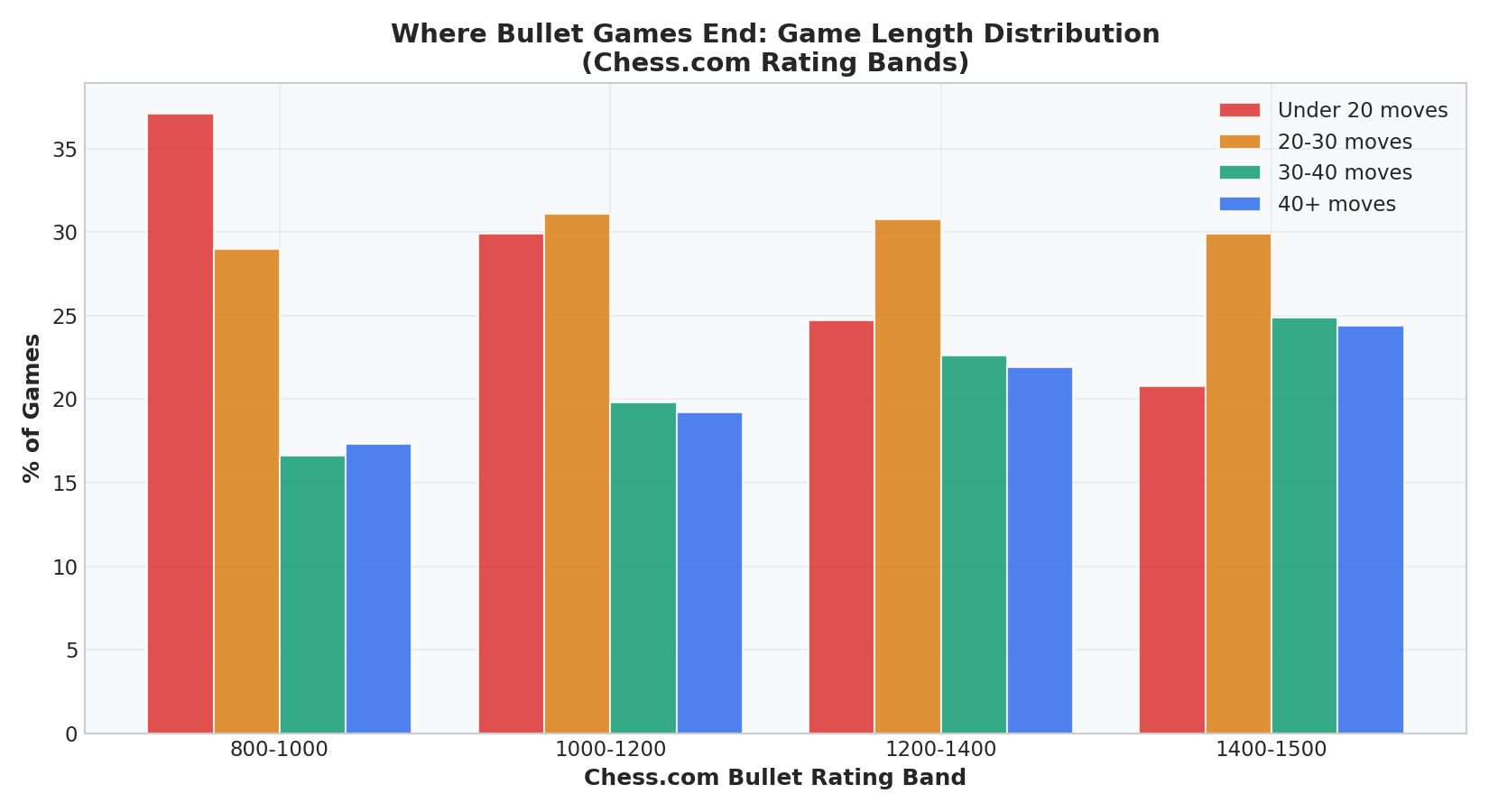
At the 800-1000 level, 37.1% of games end in fewer than 20 moves, indicating that many games are decided by early tactical catastrophes. As players improve, this percentage drops to 20.8% at 1400-1500, while the proportion of games extending beyond 40 moves rises from 17.3% to 24.4%.
The practical takeaway is clear: as you climb the rating ladder, you must become comfortable in longer games. Investing time in endgame study becomes increasingly important, as the games that determine your rating will increasingly be decided in the final phase.
Data and Methodology
This research is based on the analysis of 318 active Lichess Bullet players, selected through snowball sampling to ensure a representative distribution across rating bands. We extracted their complete rating histories, comprising 244,853 individual data points.
Plateaus were identified algorithmically by detecting periods where a player's rating remained within a ±50 point threshold of their rolling average for a minimum of three consecutive months. Breakthroughs were defined as instances where a player's rating subsequently rose and stabilized above the plateau threshold.
To make the findings actionable for the broader chess community, Lichess ratings were mapped to approximate Chess.com equivalents using established conversion metrics. Supplementary game characteristic data (CPL, game length, opening diversity) was sourced from a broader database of ~847,000 Lichess games.
The complete dataset, including the raw rating histories and the aggregated plateau statistics, is available in the attached CSV files for further review.
Attached Data Files:
| File | Description |
|---|---|
all_plateaus.csv |
All 1,772 detected plateaus with duration, rating, and breakthrough status |
player_stats.csv |
Per-player summary statistics (318 players) |
band_statistics.csv |
Aggregated statistics by Chess.com rating band |
plateau_density.csv |
Plateau count by 50-point Chess.com rating bins |
progression_speed.csv |
Time to progress between rating milestones (860 records) |
milestone_plateaus.csv |
Plateau statistics at each 100-point Chess.com milestone |
rating_histories.csv |
Raw rating history data (244,853 data points) |
Chess Coach April 15, 2026