A Data-Driven Guide to Pawn Endgame Conversion for 800-1500 Rated Players
When the clock ticks down to the final seconds in a bullet chess game, technique often crumbles under pressure. A common frustration for improving players is reaching an endgame with a clear material advantage—perhaps an extra pawn or two—only to blunder it away into a draw or even a loss. But how often does this actually happen? Is it just you, or is endgame conversion a universal struggle at certain rating levels?
To answer this, we analyzed hundreds of thousands of bullet games from the Lichess database, mapping the results to approximate Chess.com bullet ratings [1]. By examining endgame frequencies, material conversion rates, and phase-specific accuracy, we can uncover exactly where players go wrong and provide a roadmap for improvement.
Do Bullet Games Even Reach the Endgame?
Before analyzing how well players play endgames, we must ask: do bullet games even last that long? The data reveals a stark difference in game length across rating bands.
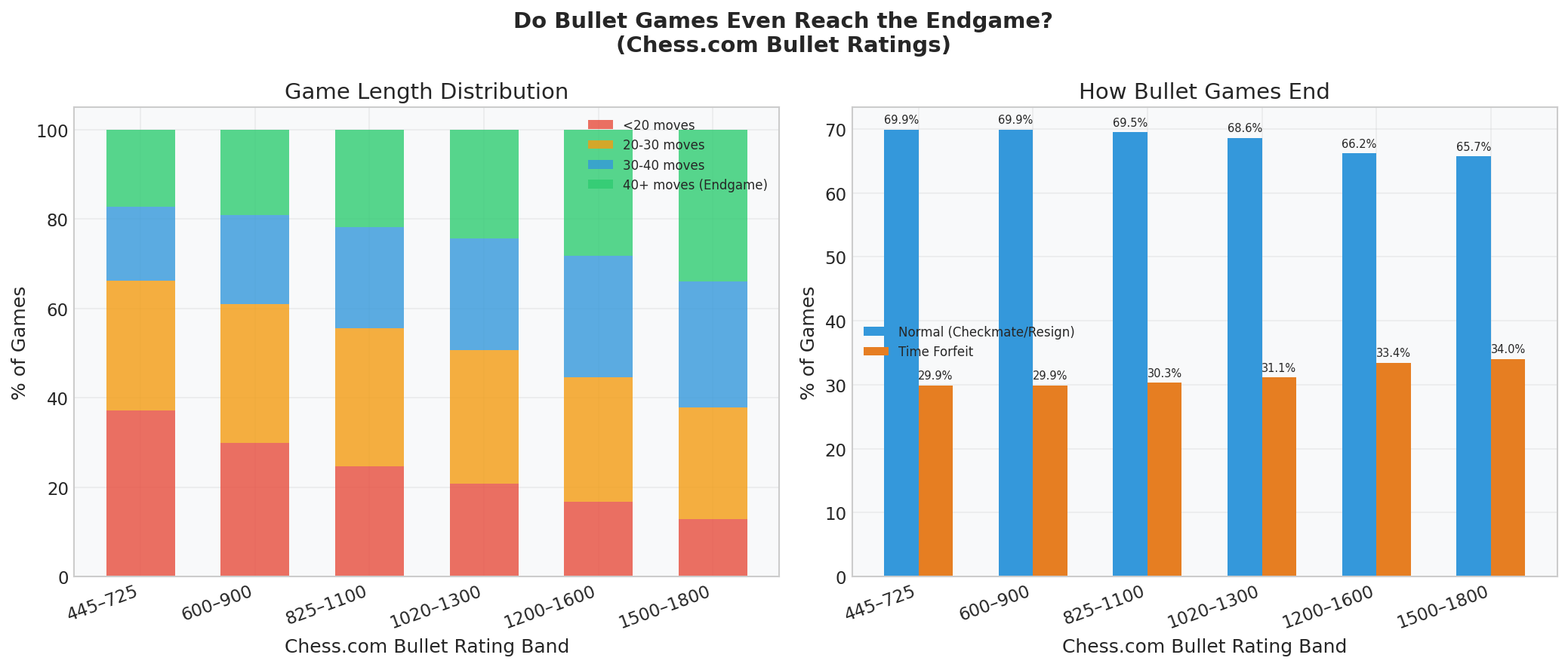
At the lowest rating band (Chess.com 445–725), only 17.3% of games reach move 40 (our threshold for the endgame phase). A massive 37% of games end before move 20, usually due to early checkmates or blunders leading to resignation. However, as ratings increase, games get longer. By the 1500–1800 rating band, 34% of games reach the endgame.
Interestingly, the time forfeit rate remains remarkably consistent across all ratings, hovering around 30-34%. This means that when you do reach an endgame in bullet, you are almost certainly playing with just seconds on the clock, making technique and intuition paramount.
The Accuracy Drop-Off
Chess engines evaluate positions in "centipawns" (100 centipawns = 1 pawn). By measuring the average Centipawn Loss (CPL) per move, we can see how accurately players play in different phases of the game.
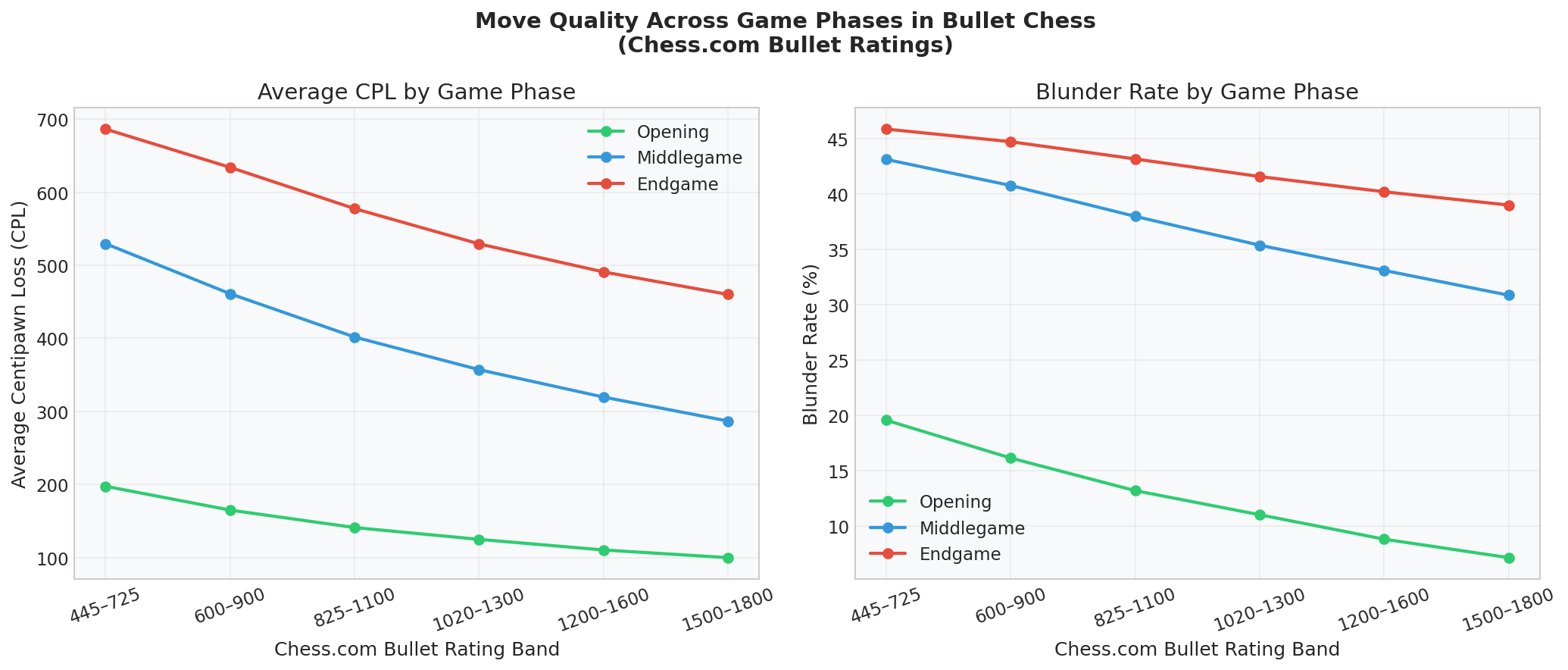
The data shows a clear trend: the endgame is universally the least accurate phase of the game. For a player rated 725–1000 on Chess.com, the average CPL in the opening is around 150, but it skyrockets to over 600 in the endgame. The blunder rate (moves losing 300+ centipawns) in the endgame is staggering—nearly 45% at lower ratings and still hovering near 40% at higher ratings.
This drop in accuracy is largely due to the time control. In bullet chess, the endgame is played almost entirely on premoves and instinct. If your endgame fundamentals are not automatic, the clock will force errors.
Converting Material Advantages
When you enter an endgame up a pawn, you should win. But the reality of bullet chess is far less forgiving. We analyzed positions where one side was ahead by 1-2 pawns at move 20 to see how often they converted that advantage into a win.
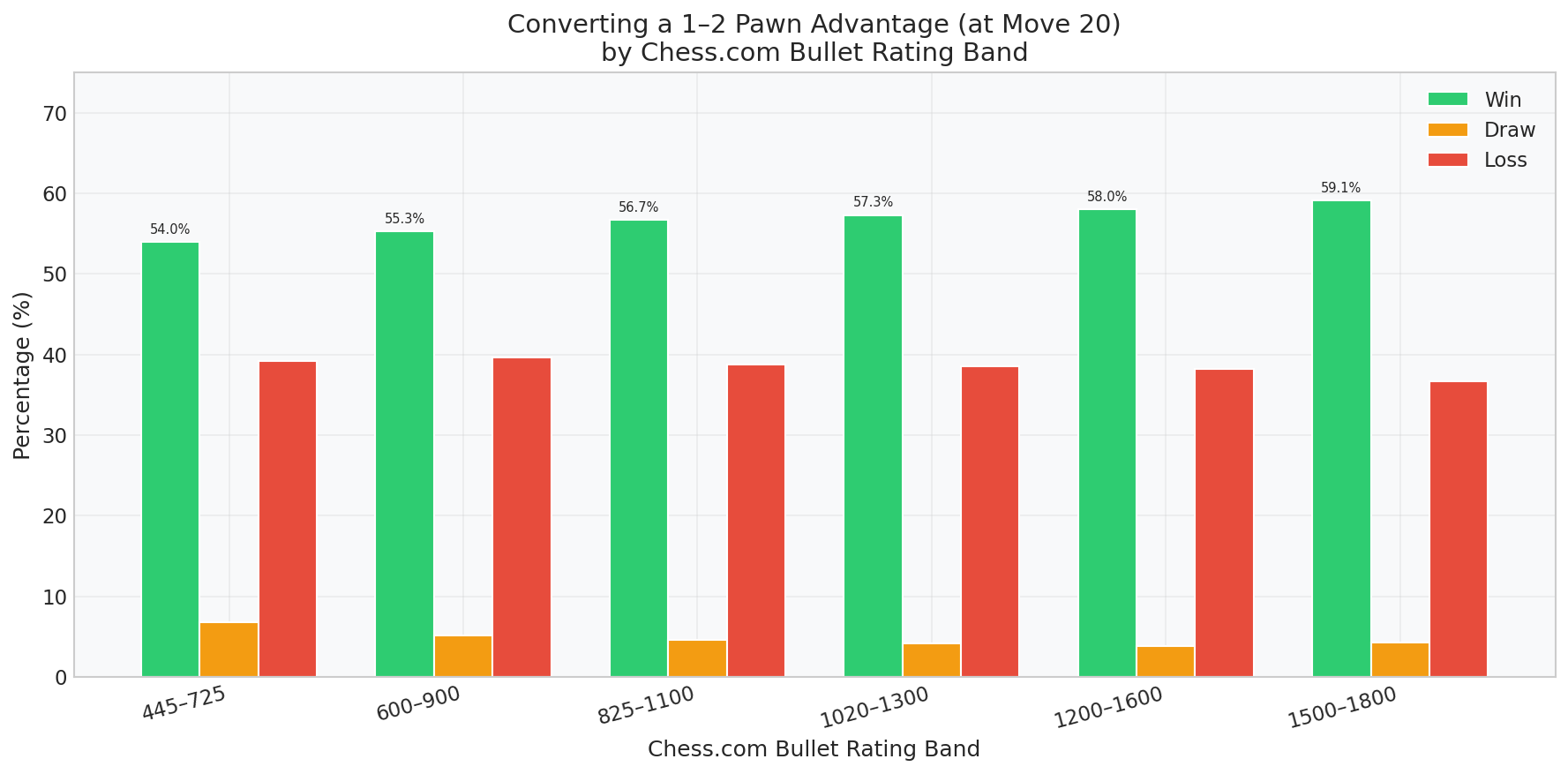
For players rated 445–725, being up a pawn only results in a win 54% of the time. The opponent manages to draw or even win the game nearly half the time! As ratings improve, conversion rates climb, reaching about 62% for players in the 1500–1800 range. While this is an improvement, it still means that nearly 40% of the time, a clear material advantage is squandered.
The Pure Pawn Endgame: A Test of Technique
To isolate endgame technique from tactical chaos, we looked specifically at pure pawn endgames (Kings and Pawns only). These endgames are highly theoretical; they are usually mathematically won, drawn, or lost, with very little room for ambiguity.
Let's look at the conversion rates for a specific scenario: 3 Pawns vs 2 Pawns (KPPP vs KPP).
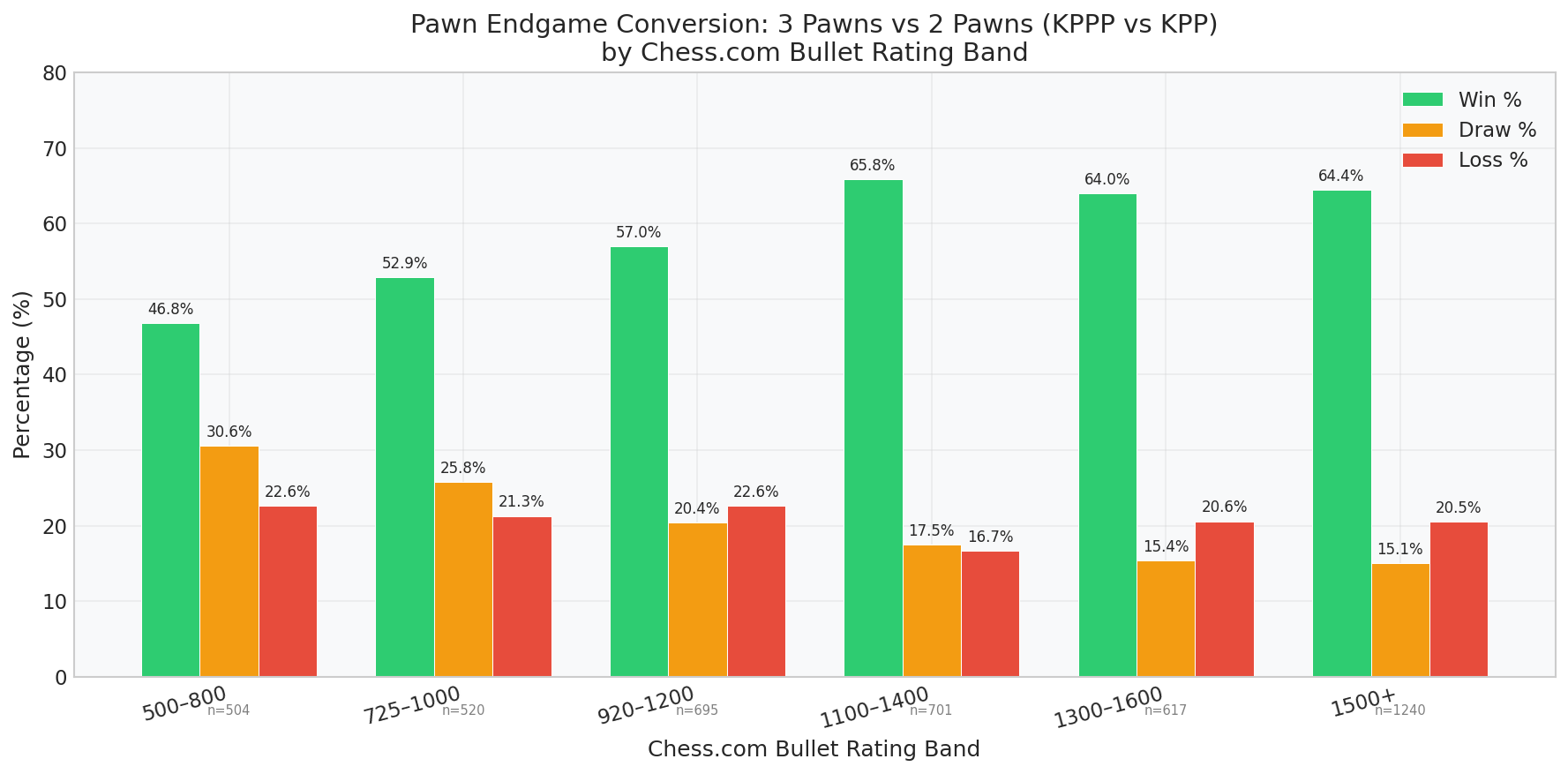
In this scenario, the side with three pawns has a decisive advantage and should win. However, players rated 500–800 only win 46.8% of the time. They draw 30.6% of the time and actually lose 22.6% of the time!
As players climb the rating ladder, their technique improves significantly. By the 1100–1400 rating band, the win rate jumps to 65.8%, and the loss rate drops to 16.7%. This demonstrates that studying basic pawn endgames yields tangible results as you progress through the intermediate ranks.
Common Pitfalls and Actionable Advice
Why do players fail to convert these advantages? The data, combined with engine analysis of common positions, points to a few recurring themes.
1. Misunderstanding the Opposition
The most fundamental concept in pawn endgames is "the opposition"—placing your King directly opposite the enemy King with an odd number of squares between them. Whoever has to move loses the opposition and must give way.
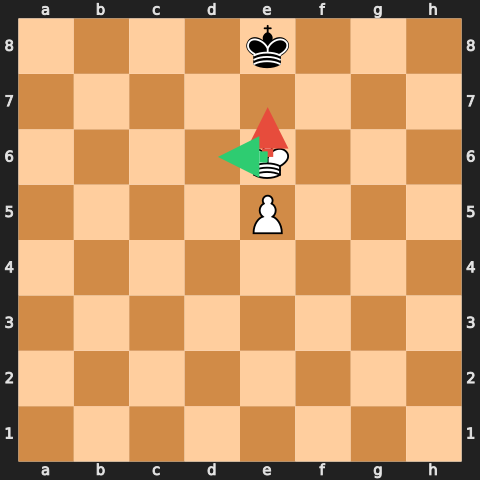
In the position above, White is up a pawn and must win. The engine's best move is Kd6! (green arrow), taking the opposition. If Black plays ...Kd8, White plays e6, and the pawn marches forward. However, a common bullet blunder is pushing the pawn immediately with e6?? (red arrow). After Black plays ...Ke8, White must play Kd6 to protect the pawn, but after ...Kd8, White is forced to play e7+ Ke8 Ke6, resulting in a stalemate.
Actionable Advice (800-1000): Stop pushing your pawns blindly! In King and Pawn endgames, your King is your most powerful attacking piece. Use it to take the opposition and clear a path for your pawn.
2. Rushing in Time Pressure
Bullet chess induces panic. When players see their clock ticking down to single digits, they often abandon calculation and play the most obvious forcing moves, usually pushing pawns.
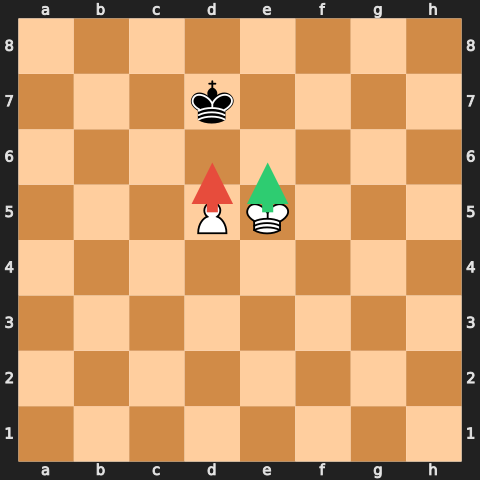
Here, White is completely winning. The correct technique is to maintain the opposition with Ke6! (green arrow). But in a time scramble, a 1200-rated player might panic and push d6?? (red arrow). Black simply replies ...Kd8, and the position is a dead draw.
Actionable Advice (1000-1200): Practice basic King and Pawn vs King checkmates against an engine until you can execute them in under 5 seconds. If the pattern is hardwired into your brain, you won't need to calculate when the clock is low.
3. Failing to Create Passed Pawns
When you have a pawn majority (e.g., 3 pawns vs 2 pawns on one side of the board), the goal is to create a passed pawn.
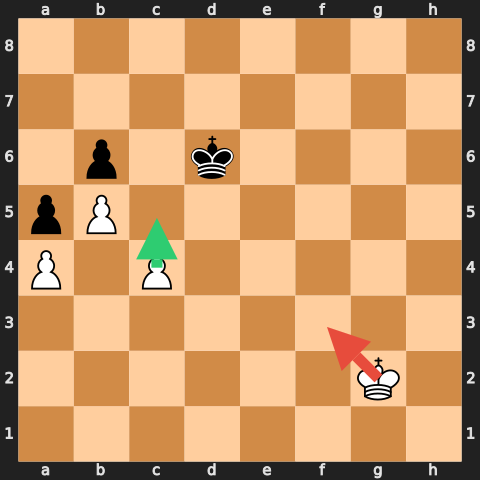
In this 3 vs 2 scenario, White must force a breakthrough. The winning move is c5! (green arrow). If Black captures with ...bxc5, White plays b6, creating an unstoppable passed pawn. A passive move like Kf3 (red arrow) wastes time and allows Black to organize a defense.
Actionable Advice (1200-1500): Learn the mechanics of pawn breakthroughs. When you have a majority, identify the "candidate" passed pawn (the one without an enemy pawn directly in front of it) and support its advance.
Roadmap for Improvement
Based on the data, here is a targeted roadmap for improving your endgame conversion rates:
| Rating Band (Chess.com) | Primary Focus | Key Metric to Improve |
|---|---|---|
| 800 - 1000 | Stop blundering full pieces in the endgame. Learn the basic King and Pawn vs King win (the opposition). | Reduce endgame blunder rate from 45% to <40%. |
| 1000 - 1200 | Practice converting 1-2 pawn advantages. Learn to activate your King before pushing pawns. | Increase 1-2 pawn advantage conversion from 55% to >60%. |
| 1200 - 1400 | Study pawn majorities and breakthroughs. Learn how to create passed pawns on the side where you have an advantage. | Increase 3P vs 2P win rate from 57% to >65%. |
| 1400 - 1500+ | Speed up your execution. The technique must be automatic to survive the 30%+ time forfeit rate in bullet endgames. | Maintain accuracy while playing on premove. |
Conclusion
The data is clear: material advantage does not guarantee a win in bullet chess, especially at the beginner and intermediate levels. The endgame is a chaotic, error-prone phase where technique often succumbs to time pressure. However, this also presents a massive opportunity. Because your opponents are also blundering in the endgame, mastering just a few fundamental concepts—like the opposition and pawn breakthroughs—can drastically improve your conversion rates and add hundreds of points to your rating.
Chess Coach April 14, 2026
Data and Methodology
This analysis was conducted using a dataset of Lichess bullet games, accessed via the Grandmaster Guide MCP analytics engine. The data includes endgame frequencies, material conversion rates, and move-by-move engine evaluations (Stockfish 12).
Lichess ratings were mapped to approximate Chess.com bullet ratings using standard community conversion tables to ensure relevance for the target audience.
Underlying Data Files:
- Endgame Frequencies
- Pawn Endgame Conversion Rates
- Material Advantage Conversion
- Phase Accuracy Breakdown
- Game Phase Distribution
References: [1] Lichess Game Database and Analytics API. Data collected and aggregated via Grandmaster Guide MCP.