By Chess Coach April 14, 2026
Bullet chess is a chaotic, adrenaline-fueled variant where the clock is often a more dangerous opponent than the pieces on the board. For players looking to climb the rating ladder—particularly those transitioning from beginner to intermediate levels—understanding how to manage time is just as critical as spotting tactics.
A common question among improving players is: "How fast should I be moving in the middlegame?"
To answer this, we analyzed over 1,500 bullet games (nearly 100,000 individual moves) played on Lichess, mapping the data to approximate Chess.com ratings. By examining how players between 600 and 1500+ Elo manage their clocks, we can uncover the hidden mechanics of bullet chess and provide a data-driven roadmap for improvement.
The Speed of the Middlegame: A Rating Progression
The middlegame in bullet chess is where the most complex decisions are made, and consequently, where the most time is burned. Our analysis reveals a clear, linear relationship between a player's rating and their average speed during this critical phase.
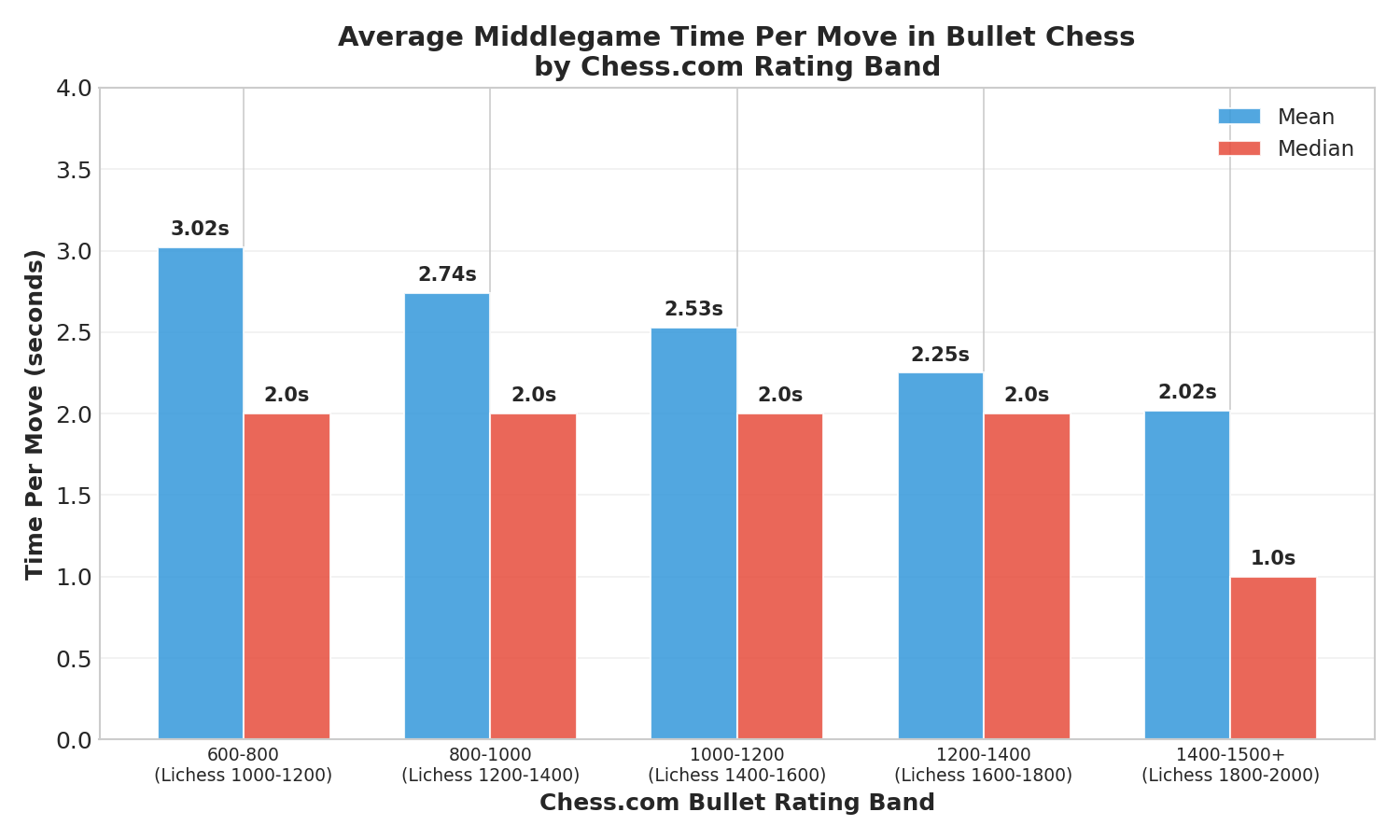
At the 600-800 rating band, players spend an average of 3.02 seconds per middlegame move. As we move up the rating ladder, this number steadily decreases. By the time players reach the 1400-1500+ bracket, their average time per move drops by a full second to 2.02 seconds.
Interestingly, the median time per move remains stubbornly fixed at 2.0 seconds for almost all rating bands below 1400. This suggests that the difference between a 800-rated player and a 1200-rated player isn't necessarily their "normal" playing speed, but rather how often they freeze. Lower-rated players are much more prone to long "thinks" (spending 5+ seconds on a single move), which drastically inflates their average time and depletes their clock for the endgame.
Actionable Advice for 600-1000 Players
If you find yourself frequently losing on time or blundering in the final seconds, your primary goal should be eliminating the "long thinks" in the middlegame. In a 60-second game, spending 8 seconds calculating a tactic is a mathematical disaster. Trust your intuition more, accept that you will make mistakes, and keep the pieces moving. A slightly suboptimal move played in 1 second is often better than the perfect move played in 10 seconds.
Where Does the Time Go? Phase Allocation
To truly understand bullet time management, we must look at how players allocate their 60 seconds across the three phases of the game: the opening, the middlegame, and the endgame.
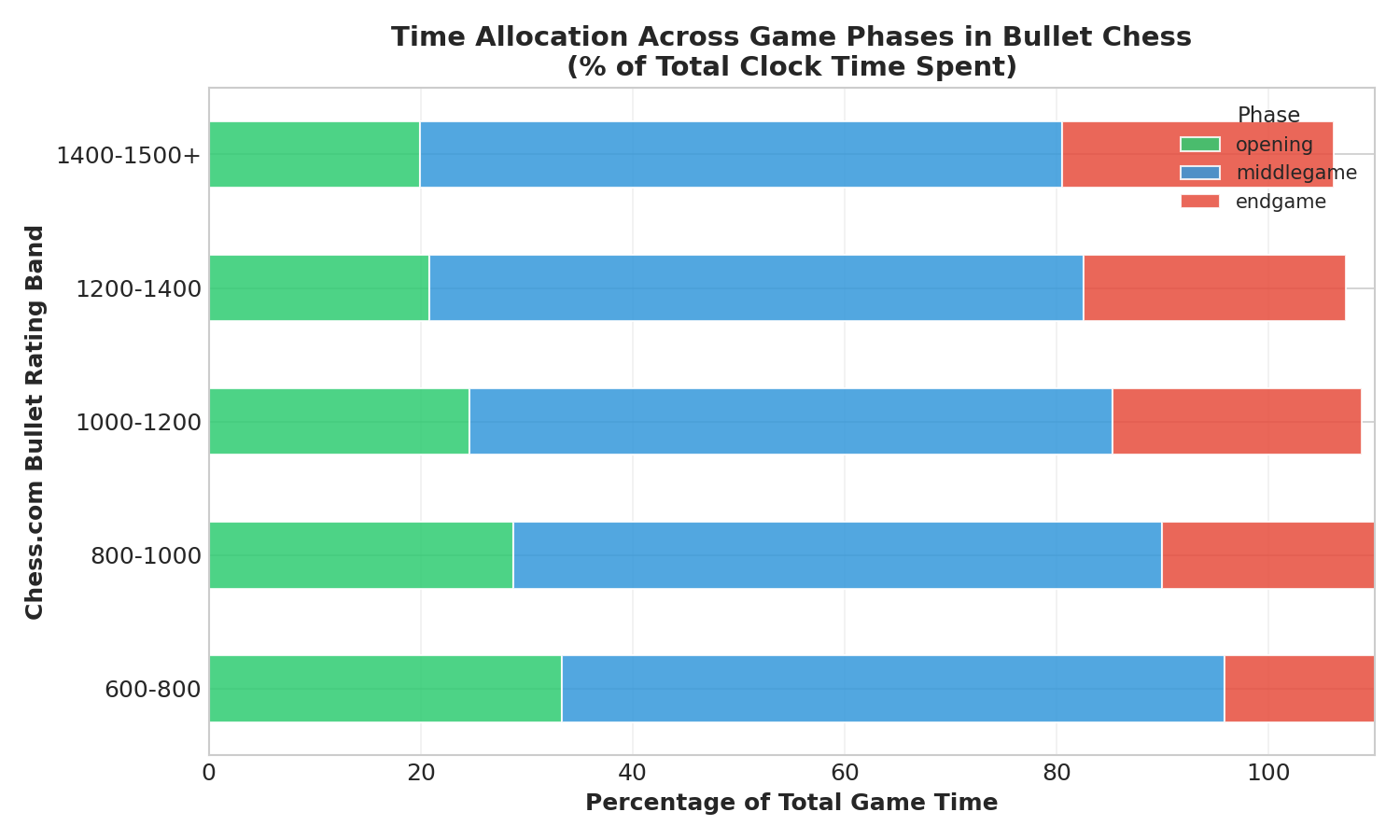
Across all rating bands, the middlegame consumes the lion's share of the clock—typically around 60% to 62% of the total time spent. However, the way players handle the opening and endgame shifts dramatically as they improve.
Lower-rated players (600-1000) spend significantly more time in the opening (up to 33% of their total time) compared to higher-rated players (who spend around 20%). This is largely due to a lack of opening repertoire memorization and a lower frequency of premoving. Because they burn so much time early on, lower-rated players reach the endgame with very little time left, leading to a high rate of time forfeits.
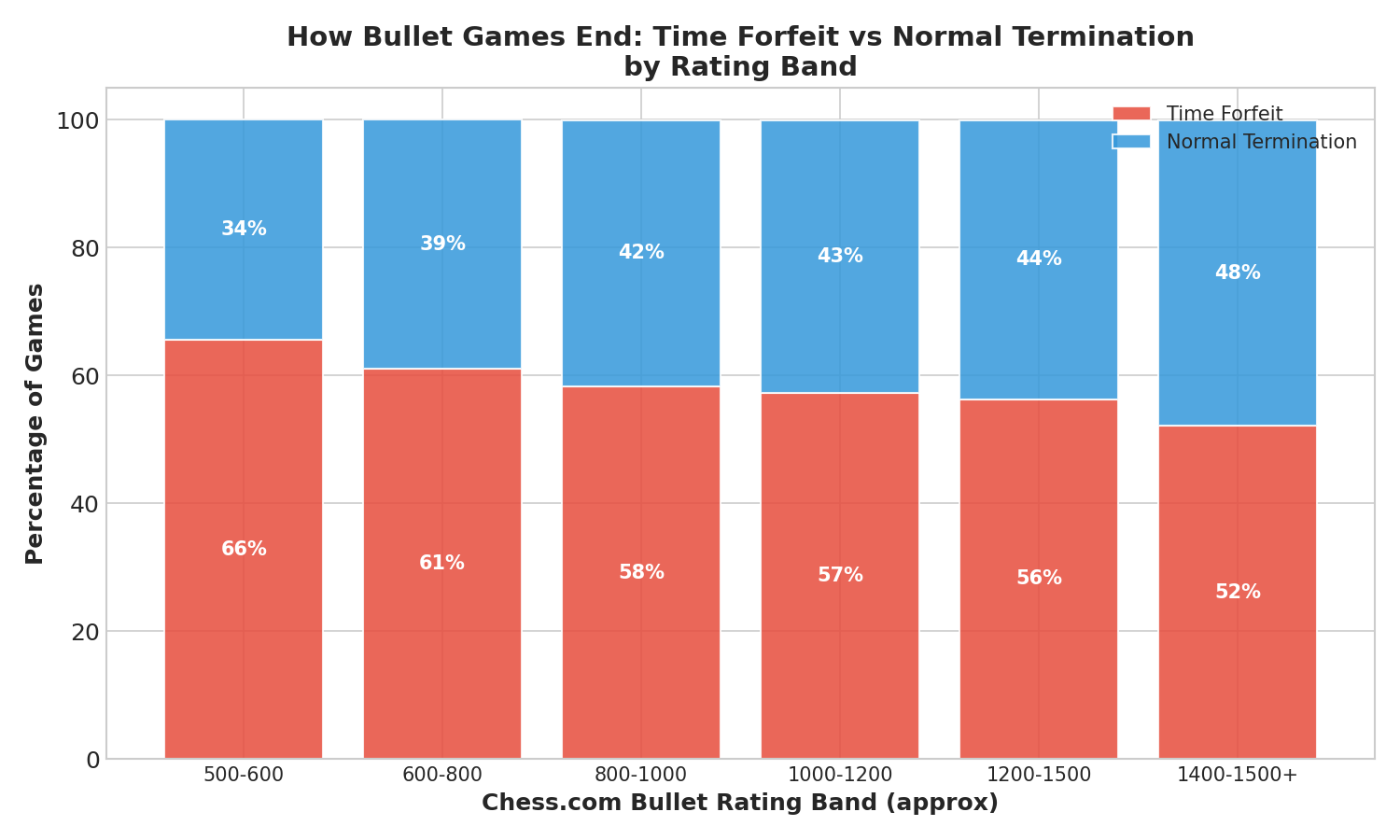
The data shows that at the 600-800 level, a staggering 65.6% of games end in a time forfeit. As players improve their opening speed and middlegame efficiency, this number drops to 52.1% at the 1400-1500+ level, allowing more games to be decided by checkmate or resignation.
Actionable Advice for 1000-1200 Players
To break through the 1000-1200 plateau, you must automate your openings. You should be able to play the first 8-10 moves of your standard repertoire using premoves or sub-second reactions. This preserves your precious clock for the middlegame complexities and ensures you have a buffer for the endgame scramble.
The Quality vs. Speed Trade-off
A central dilemma in bullet chess is the trade-off between moving fast and playing well. Does thinking longer actually result in better moves?
Using Stockfish 17 evaluations, we measured the average Centipawn Loss (CPL) based on how much time a player spent on a move. Lower CPL indicates higher accuracy.
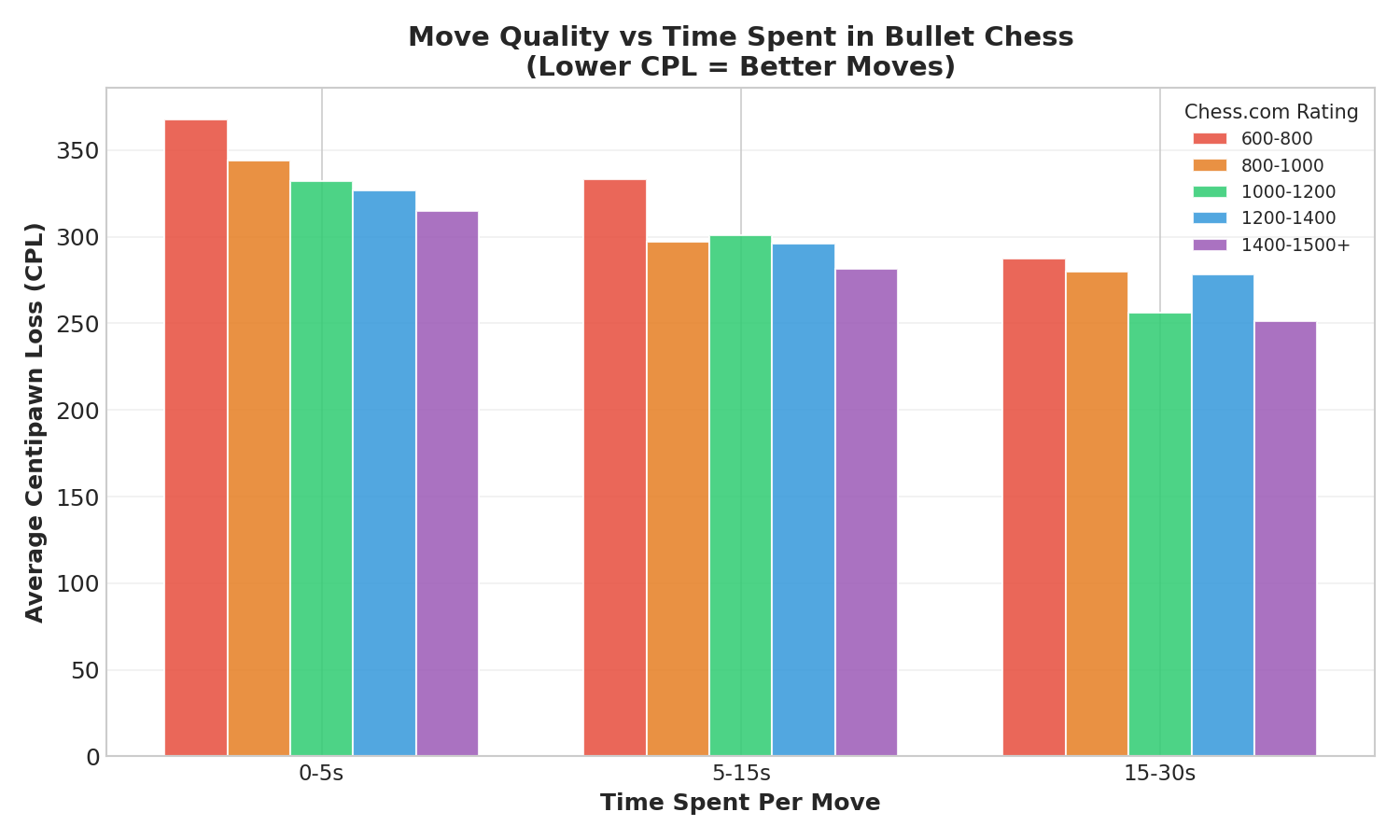
The data confirms that taking more time does improve move quality across all rating bands. Moves played in the 0-5 second window have the highest CPL (most errors), while moves where players pause for 15-30 seconds show significantly better accuracy.
However, this presents a paradox: while thinking longer improves the current move, it ruins your chances for the rest of the game.
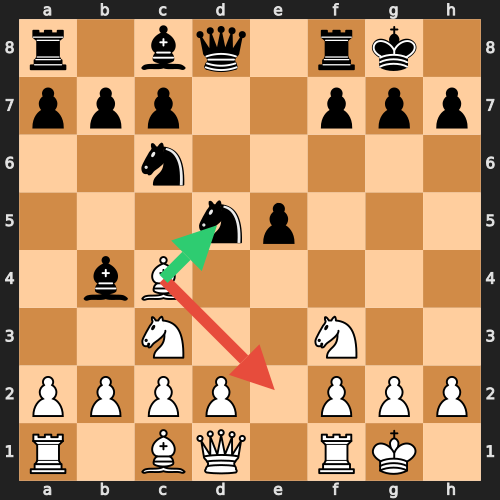 A classic bullet speed blunder: White plays the natural developing move Bc4-e2, completely missing the tactical opportunity Bxd5, winning a piece.
This is why the overall average CPL in bullet chess remains remarkably flat across rating bands (hovering around 152-155 CPL), unlike in Blitz or Rapid where higher-rated players show massive accuracy improvements. In bullet, the skill is not necessarily playing better chess, but playing adequate chess much faster.
Actionable Advice for 1200-1400 Players
At this level, you are likely losing games because you are trying to play "good" chess instead of "bullet" chess. When you spot a complex tactical sequence, you must evaluate instantly whether you have the clock advantage to calculate it. If you are down on time, play a solid, practical move instead of searching for the brilliant one. Your goal is to maintain equality while keeping the pressure on your opponent's clock.
The Clock Depletion Curve
How much time should you have left at move 20? Our analysis of the clock depletion curve provides a benchmark for pacing yourself.
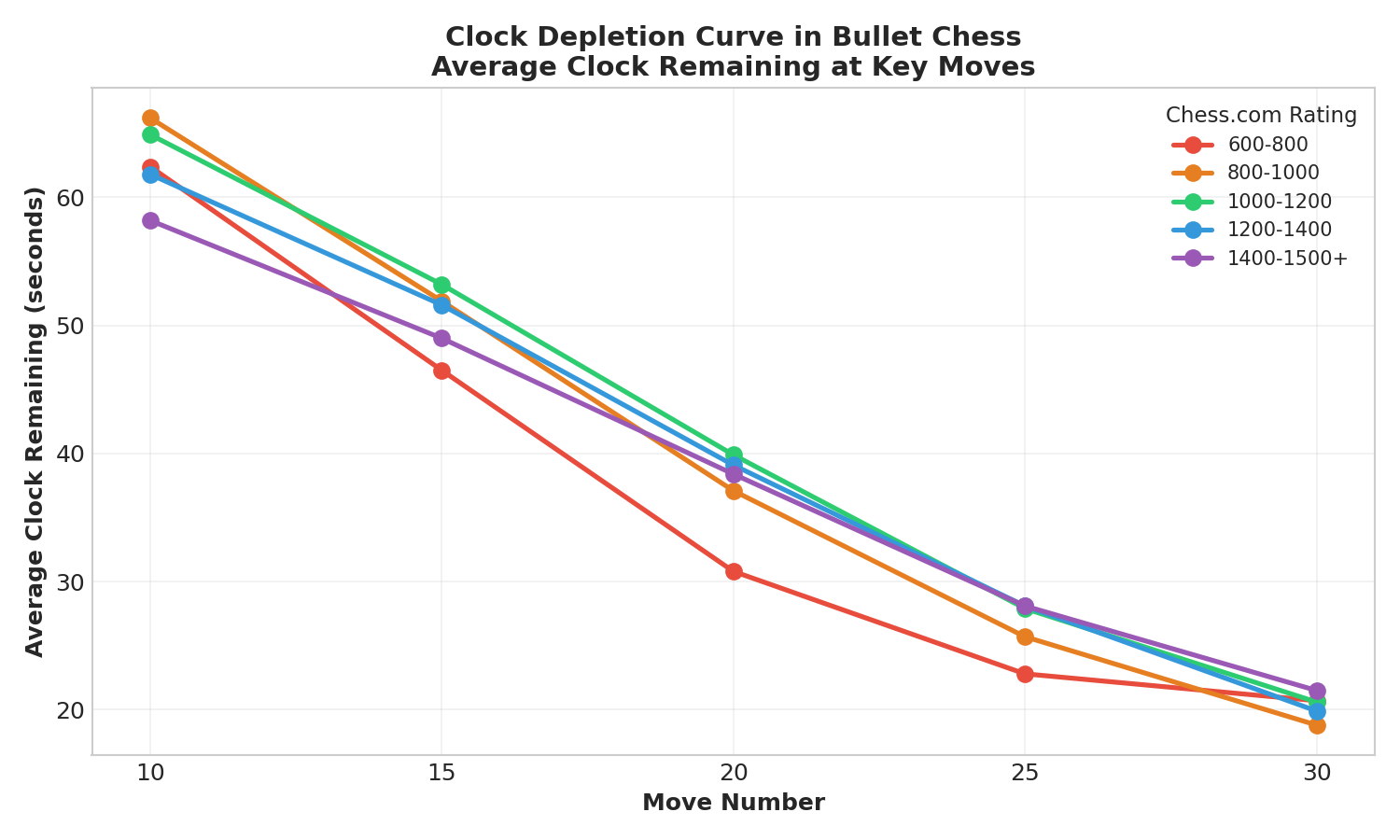
By move 20, a 1400+ player typically has about 38 seconds remaining on their clock. In contrast, a 600-800 player has already burned down to 30 seconds. This 8-second differential is massive in bullet chess and often dictates who controls the pace of the late middlegame.
Interestingly, by move 30, the curves converge. Almost all rating bands find themselves with roughly 20 seconds left. The difference is that the higher-rated player used those 20 seconds to navigate a complex middlegame, while the lower-rated player burned their time surviving the opening and early middlegame.
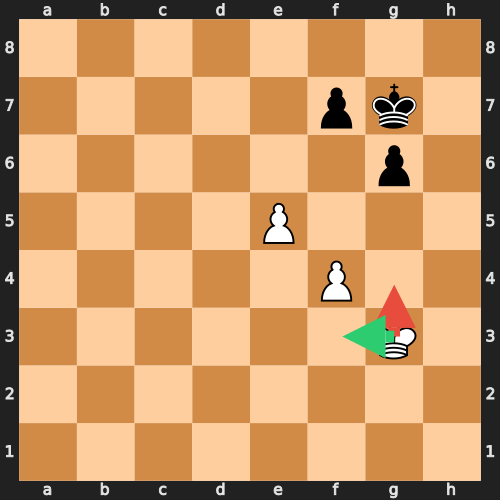 In the inevitable time scramble, passive moves like Kg4 (red) lose precious tempos. Active moves like Kf3 (green) that support pawn advances are critical when playing on increment or pure reaction.
Actionable Advice for 1400-1500+ Players
To push toward the advanced ranks, you need to master the art of "flagging" (winning on time) from equal or slightly worse positions. This requires recognizing when the position is locked or simplified enough that you can switch to pure speed mode. Practice making safe, non-committal moves instantly (often called "shuffling") when you have a time advantage, forcing your opponent to burn their remaining seconds trying to break through.
Conclusion: The Bullet Roadmap
Improving at bullet chess requires a fundamental shift in how you view the game. The clock is a piece, and often the most powerful one on the board.
Based on the data, here is your roadmap for climbing the ranks:
- 600-1000 Elo: Stop the "long thinks." Accept that blunders will happen and prioritize keeping your clock above 30 seconds going into the middlegame.
- 1000-1200 Elo: Automate your openings. Use premoves for your first 5-8 moves to bank time for the middlegame.
- 1200-1400 Elo: Embrace practical chess over perfect chess. A 1-second okay move beats a 5-second great move.
- 1400-1500+ Elo: Master time-pressure psychology. Learn to play fast, non-committal moves in equal positions to pressure your opponent's clock.
By aligning your time management with these data-backed benchmarks, you'll find yourself surviving the middlegame chaos and entering the endgame with the seconds you need to secure the win.
Data and Methodology
This analysis was conducted using a sample of 1,585 bullet games (96,988 individual moves) sourced from the Lichess database via the Grandmaster Guide API. Games were filtered for standard bullet time controls (e.g., 60+0).
Lichess ratings were mapped to approximate Chess.com ratings using standard community conversion tables (e.g., Lichess 1400-1600 ≈ Chess.com 1000-1200). Game phases were classified dynamically based on total game length, with the middlegame typically spanning moves 11 through 25-30.
Underlying Data Files:
View full data →chesscom_band avg_time median_time std_time p25_time p75_time total_moves pct_under_2s pct_under_5s pct_over_10s 1000-1200 2.53 2.0 2.9 1.0 3.0 8342 43.48 86.07 2.45 1200-1400 2.25 2.0 2.78 1.0 3.0 9688 49.37 88.7 2.01 1400-1500+ 2.02 1.0 2.62 1.0 2.0 9653 53.69 91.11 1.42 600-800 3.02 2.0 3.45 1.0 4.0 7952 36.26 81.05 3.7 800-1000 2.74 2.0 3.41 1.0 3.0 8112 40.83 84.5 3.17
View full data →chesscom_band phase avg_pct_of_total avg_time_spent avg_moves 1000-1200 endgame 23.5 32.2 21.7 1000-1200 middlegame 60.7 72.2 28.6 1000-1200 opening 24.6 21.8 19.7 1200-1400 endgame 24.8 30.5 22.6 1200-1400 middlegame 61.7 67.7 30.1
View full data →chesscom_band move_num avg_clock median_clock count 1000-1200 10 64.9 53.0 587 1000-1200 15 53.2 44.0 559 1000-1200 20 39.9 33.0 500 1000-1200 25 27.9 23.0 440 1000-1200 30 20.6 15.0 337
View full data →gameId avgRating lichess_band chesscom_band move_num color time_spent clock_remaining phase timeControl yKPRoSND 1099 1000-1200 600-800 1 white 0 60 opening 60+0 yKPRoSND 1099 1000-1200 600-800 1 black 0 60 opening 60+0 yKPRoSND 1099 1000-1200 600-800 2 white 1 59 opening 60+0 yKPRoSND 1099 1000-1200 600-800 2 black 1 59 opening 60+0 yKPRoSND 1099 1000-1200 600-800 3 white 1 58 opening 60+0
Chess Coach April 14, 2026