Bullet chess is a fundamentally different game from classical, rapid, or even blitz chess. In bullet, the clock is not just a constraint; it is a weapon, a shield, and often the primary cause of defeat. For players rated between 800 and 1500 on Chess.com, mastering clock management is often the fastest path to rating improvement.
To understand exactly how clock management affects win rates, we analyzed 2,072 bullet games played on Lichess, mapping the ratings to their Chess.com equivalents (approximately 200-300 points lower). The data reveals clear patterns separating players who climb the rating ladder from those who remain stuck. This guide serves as a roadmap for improvement, breaking down the data and providing actionable advice for each rating segment.
The Bullet Chess Clock Management Dashboard
Before diving into specific rating bands, it is essential to understand the broader landscape of bullet chess. The data shows that bullet games are significantly shorter than blitz or rapid games, yet the time forfeit rate is staggeringly high.
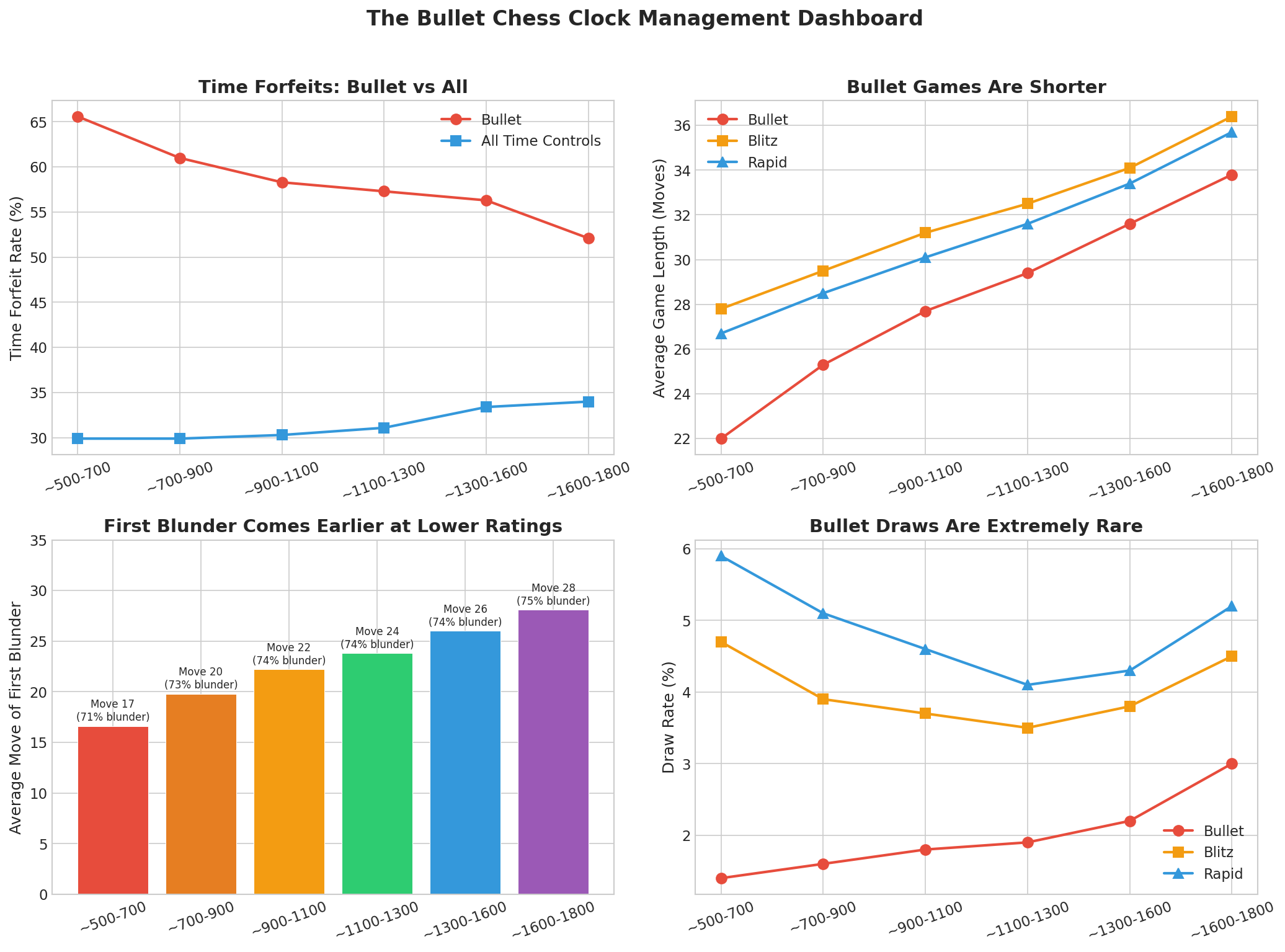
Across all analyzed games, 56.2% ended in a time forfeit. This means that in more than half of your bullet games, the clock—not checkmate or resignation—determines the outcome. Furthermore, in 2.8% of all games, a player lost on time despite having a completely winning position (an engine evaluation of +2.0 or better).
The data also highlights a critical difference in move quality. While average centipawn loss (CPL) drops significantly as players improve in rapid chess, bullet CPL remains stubbornly high across all rating bands. The speed required in bullet chess forces errors, making time management even more critical than finding the perfect move.
Time Distribution: Where Does the Clock Go?
One of the most striking findings from the data is how players distribute their time across the three phases of the game: opening (moves 1-10), middlegame (moves 11-25), and endgame (moves 26+).
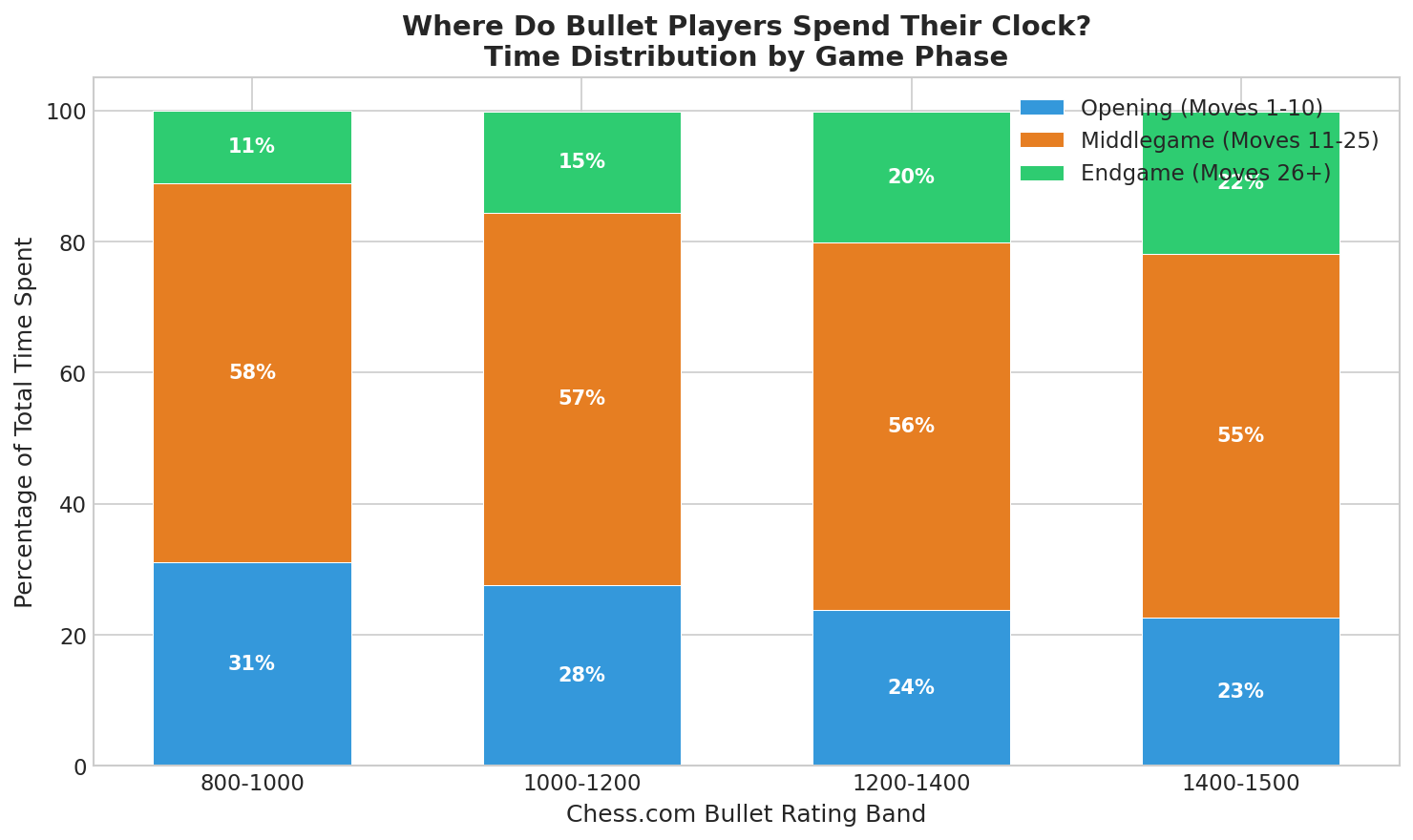
Lower-rated players (800-1000) spend a disproportionate amount of time in the opening (31%), leaving only 11% of their time for the endgame. As players improve, this distribution shifts. By the 1400-1500 rating band, players spend significantly less time in the opening (23%) and reserve twice as much time for the endgame (22%).
This shift is not accidental. Higher-rated players rely on opening preparation and premoves to navigate the first ten moves quickly, banking time for the complex middlegame and the inevitable endgame scramble.
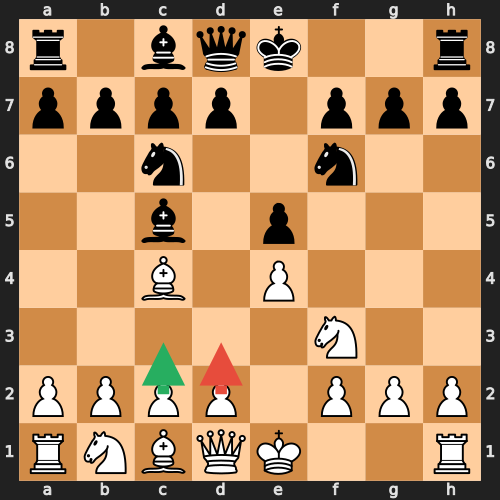 Opening Knowledge = Clock Savings: In this standard Italian Game position, knowing the mainline (c3) saves precious seconds compared to calculating passive alternatives like d3.
The Penalty of Uneven Time Usage
Does it matter if you play fast and then think for 10 seconds, or is it better to play at a steady rhythm? The data provides a definitive answer: even time usage wins games.
We calculated the Coefficient of Variation (CV) for each player's time spent per move. A low CV indicates a steady, even rhythm, while a high CV indicates erratic time usage (e.g., playing fast, then freezing for a long think).
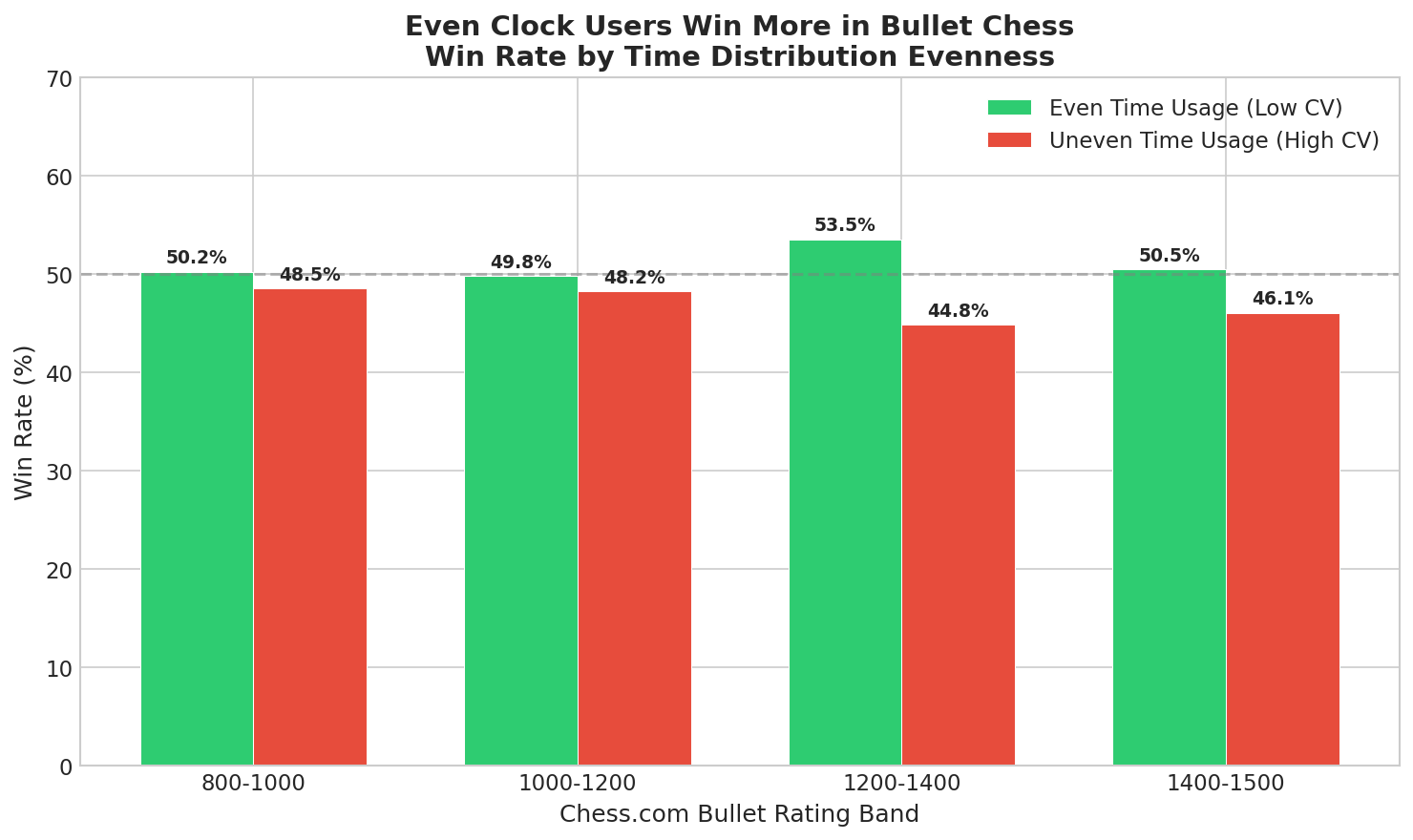
Across every rating band, players with a more even time distribution (lower CV) won significantly more often than those with erratic time usage. The penalty for uneven time usage is severe, costing players between 5% and 10% in win rate. In bullet chess, freezing to calculate a complex tactic is rarely worth the time investment. A "good enough" move played quickly is almost always superior to the "best" move played slowly.
The Devastating Impact of Time Pressure
Time pressure is the defining characteristic of bullet chess, but how much does it actually hurt your chances of winning? We analyzed the win rates of players based on the number of moves they made with less than 10 seconds remaining on their clock.
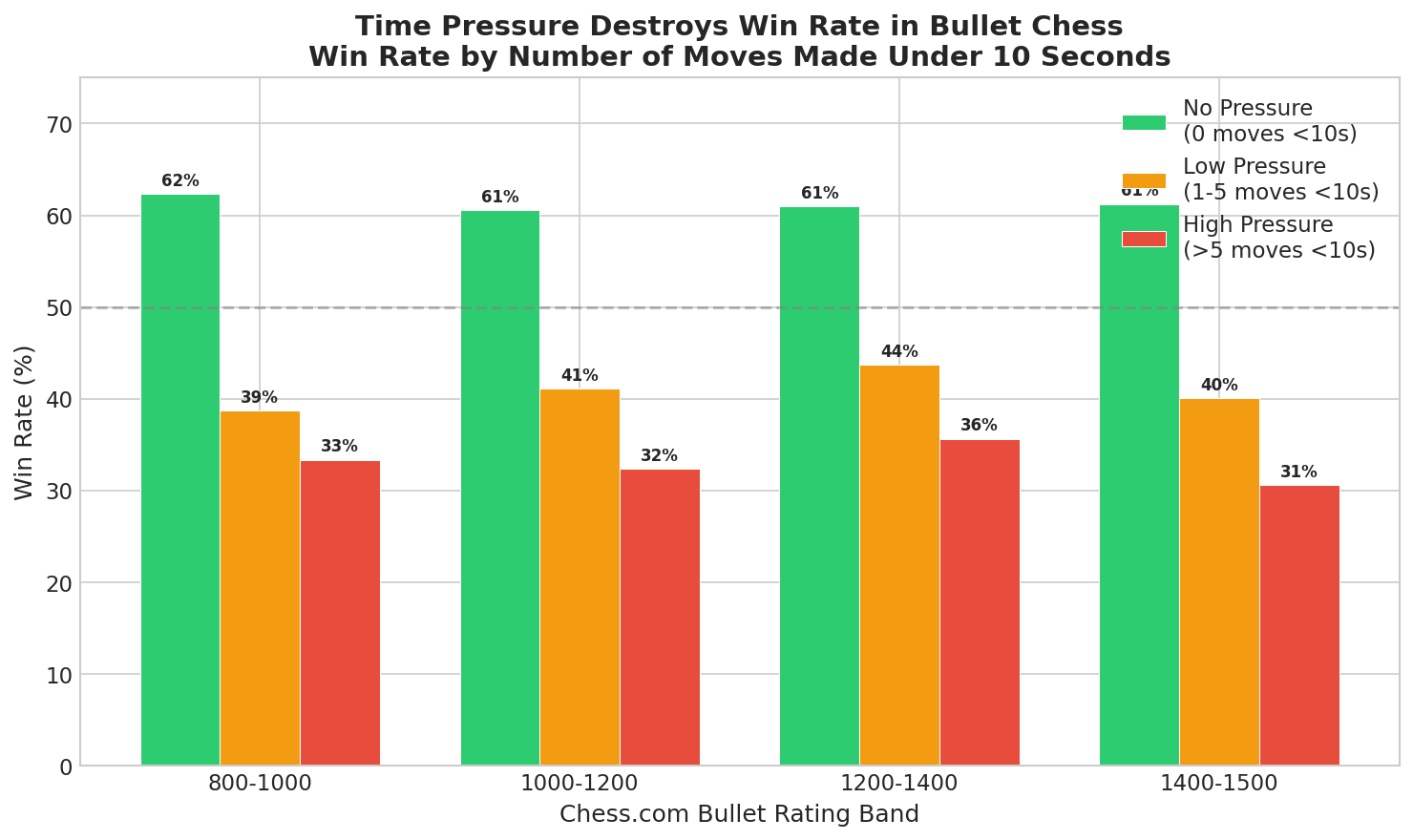
The results are stark. Players who avoid time pressure entirely (0 moves made with <10s) maintain a win rate of around 61-62%. However, once a player enters "high pressure" (>5 moves made with <10s), their win rate plummets to the low 30s.
This massive 30-point drop in win rate illustrates why banking time is so crucial. When you fall behind on the clock, you are forced to play sub-optimal moves, and your opponent can simply play solid, non-committal moves to flag you.
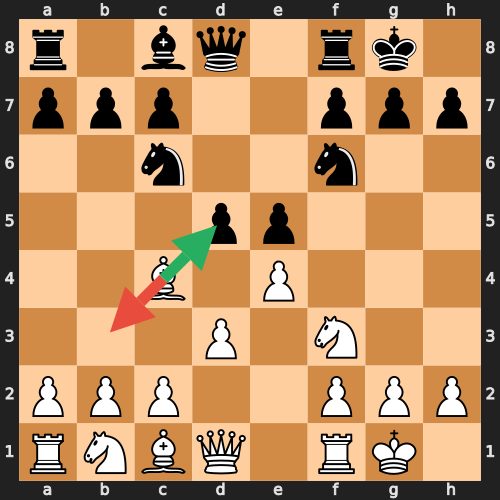 Time Pressure Blunder: With 3 seconds left, a player panics and retreats their bishop passively (red arrow), missing the active central capture (green arrow) that maintains the advantage.
Losing on Time While Winning
Perhaps the most frustrating experience in bullet chess is outplaying your opponent, achieving a completely winning position, and then losing on time. Our analysis found that this happens in approximately 2.8% of all bullet games.
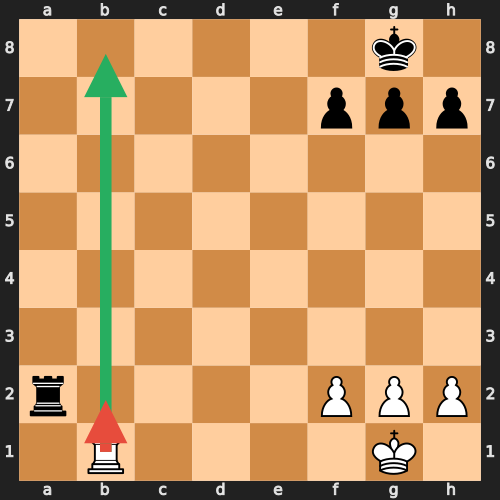 The Bullet Tragedy: Up a full rook, White has a forced mate (green arrow) but runs out of time while attempting a passive defensive move (red arrow).
This phenomenon is particularly common in endgames where players lack the necessary technique to convert their advantage quickly.
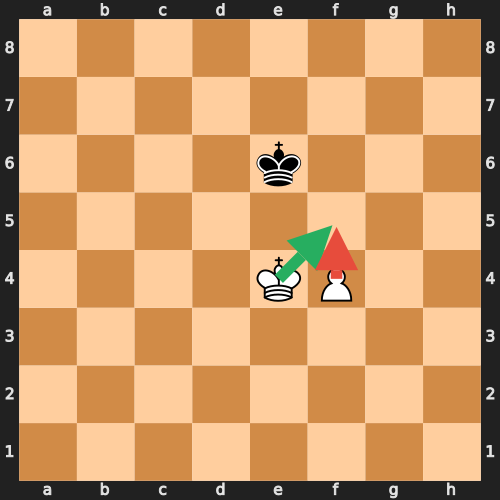 Endgame Clock Burn: In a simple King and Pawn endgame, the player burns crucial seconds pushing the pawn (red arrow) instead of using the King to gain opposition (green arrow).
Actionable Advice by Rating Band
Based on the data, here is a roadmap for improving your clock management and climbing the rating ladder.
The 800-1000 Rating Band (Lichess ~1115-1295)
The Data: Players in this band spend 31% of their time in the opening and suffer a 59% time forfeit rate. They average 2.48 seconds per move.
Actionable Advice:
- Stop Thinking in the Opening: You are burning nearly a third of your clock in the first 10 moves. Adopt a simple, robust opening system (like the London System or the Caro-Kann) and play the first 10 moves automatically.
- Accept Sub-Optimal Moves: Do not spend 5 seconds looking for a tactic. If you see a safe, developing move, play it immediately. Your goal is to reach move 20 with at least 30 seconds on the clock.
- Practice Basic Checkmates: Many time forfeits in this band occur because players cannot execute a ladder mate or a King and Queen mate quickly. Practice these until you can do them with 5 seconds on the clock.
The 1000-1200 Rating Band (Lichess ~1295-1475)
The Data: Players here are slightly faster (2.24 seconds per move) but still suffer a 56% time forfeit rate. The penalty for uneven time usage is highest in this band (nearly a 10% drop in win rate).
Actionable Advice:
- Develop a Rhythm: The data shows that erratic time usage is killing your win rate. Focus on playing at a steady, consistent pace. Avoid the temptation to "freeze" when the position gets complicated.
- Start Premoving: Players in this band who use premoves (>3 per game) see a noticeable bump in their win rate. Use premoves for obvious recaptures and forced opening moves.
- Beware the Tilt: Our analysis shows that after a 5-game losing streak, win rates in this band drop to 39%. If you lose three games in a row, take a 5-minute break.
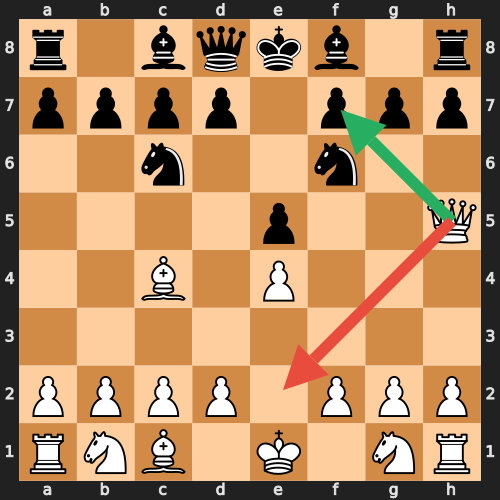 Premove Error: While premoving is essential, it carries risks. Here, Black premoves a Queen retreat (red arrow), missing the devastating Scholar's mate threat (green arrow).
The 1200-1400 Rating Band (Lichess ~1475-1675)
The Data: Average time per move drops to 2.01 seconds, and games get longer (32.6 moves on average). Players here are starting to bank time for the endgame (20% of total time).
Actionable Advice:
- Play the Clock, Not the Board: At this level, you must constantly monitor the clock differential. If you are up 10 seconds, simplify the position and force your opponent to make decisions.
- Endgame Technique: You are reaching the endgame more often, but blunder rates in the endgame remain high (over 40%). Study basic pawn endgames so you can play them instantly without calculating.
- The "Opening Heavy" Strategy: Interestingly, the data shows that players in this band who spend slightly more time in the opening (to secure a better position) win more often, provided they don't fall into severe time pressure later.
The 1400-1500 Rating Band (Lichess ~1675-1770)
The Data: These players are fast (1.90 seconds per move) and reserve 22% of their time for the endgame. Time forfeit rates drop to 53%.
Actionable Advice:
- Master the Scramble: Games at this level often come down to the final 5 seconds. Practice playing "dirty" chess in time scrambles—creating unexpected threats, giving random checks, and complicating the position to run your opponent out of time.
- Optimize Your Setup: At this speed, hardware matters. Ensure you are using a good mouse, a wired connection, and have board animations turned off.
- Positional Understanding: Since you cannot calculate deeply in bullet, you must rely on intuition. Improve your rapid and classical chess to build a better intuitive understanding of where pieces belong, allowing you to play good moves instantly.
Conclusion
Bullet chess is a game of rhythm, preparation, and pragmatism. The data clearly shows that players who manage their clock evenly, navigate the opening quickly, and avoid severe time pressure are the ones who climb the rating ladder. By applying the actionable advice tailored to your rating band, you can turn the clock from your greatest enemy into your most powerful weapon.
Chess Coach April 15, 2026
Data and Methodology
This analysis is based on a dataset of 2,072 bullet chess games downloaded via the Lichess API and the Grandmaster Guide MCP server. The games were filtered to match Chess.com rating bands between 800 and 1500, using an approximate conversion formula (Chess.com ratings are typically 200-300 points lower than Lichess ratings in this range).
The raw data and aggregated statistics used to generate the charts in this article are available in the attached CSV files:
bullet_clock_data.csv: The raw dataset of 2,072 games with parsed clock times.phase_time_distribution.csv: Aggregated data on time spent per game phase.time_evenness_vs_winrate.csv: Analysis of time usage consistency (Coefficient of Variation).time_forfeit_analysis.csv: Statistics on games ending in time forfeits.time_pressure_winrate.csv: Win rates based on moves played with under 10 seconds.avg_time_per_move.csv: Average move times and game lengths by rating band.