A data-driven guide for intermediate players looking to improve their Black repertoire in Bullet chess.
In chess, White moves first. This simple fact grants White a persistent advantage that has been debated, analyzed, and quantified for centuries. But how does this advantage manifest in the chaotic, time-scrambled world of Bullet chess? More importantly, if you are an intermediate player hovering around the 1000 rating mark on Chess.com, what can you play as Black to neutralize this advantage?
To answer these questions, we analyzed over 840,000 Bullet games from the Lichess database, focusing specifically on the rating bands that correspond to Chess.com ratings between 800 and 1500. Our goal was to identify which Black openings perform best under extreme time pressure and provide actionable advice for players looking to climb the rating ladder.
(Note: All data in this article is sourced from Lichess. To make the insights directly applicable to Chess.com users, we have calibrated the rating bands. A Chess.com Bullet rating of ~1000 corresponds approximately to a Lichess Bullet rating of 1200-1300. We will primarily refer to Chess.com ratings throughout this guide.)
The Reality of the First-Move Advantage in Bullet
Before we dive into specific openings, we must understand the baseline. Does White actually have an advantage in Bullet chess at the intermediate level?
The data provides a clear answer: Yes, but it is smaller than you might think, and it fluctuates based on rating.
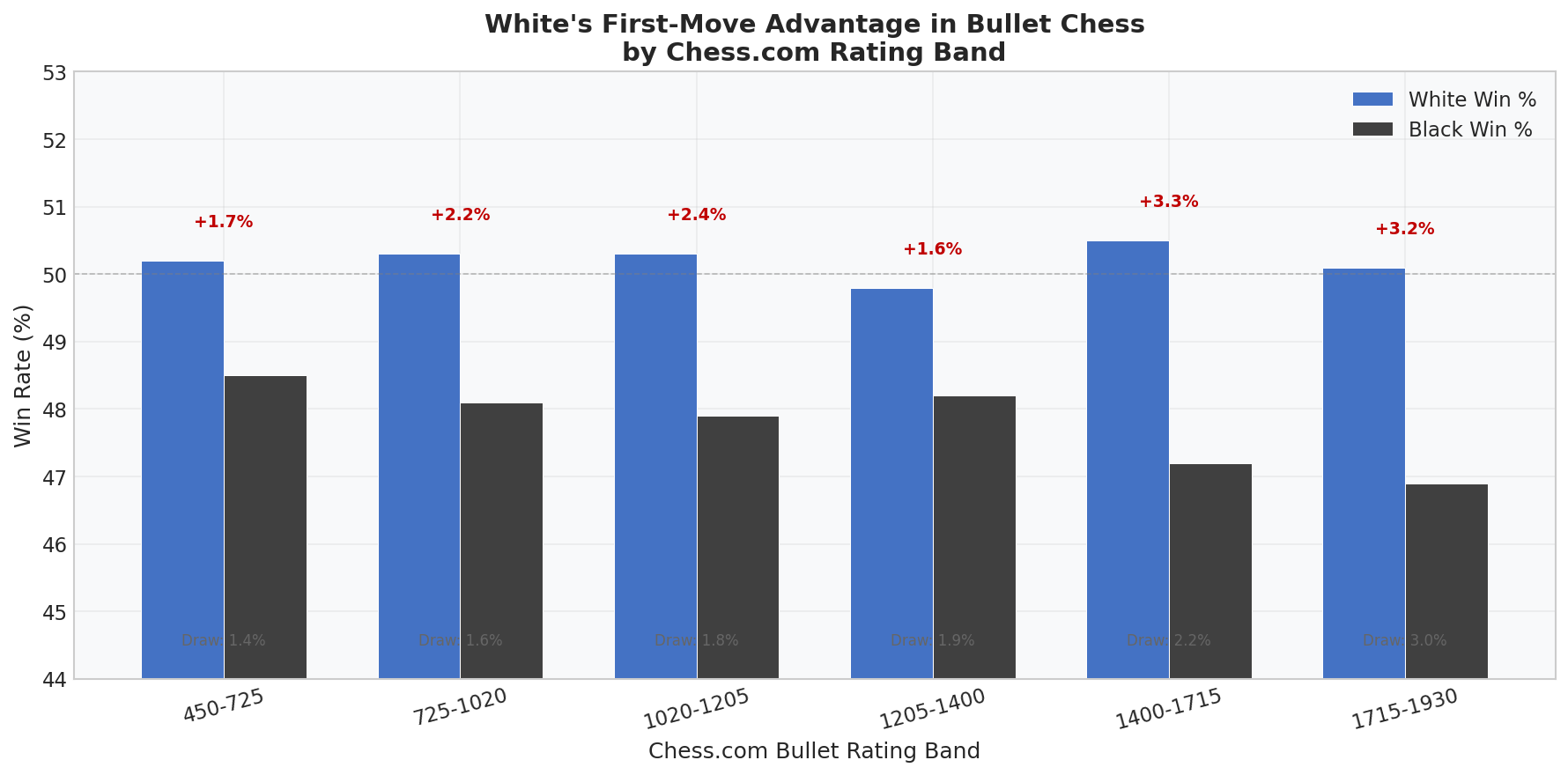
As the chart above illustrates, White maintains a positive win rate advantage across all intermediate rating bands. At the ~1000 Chess.com level (Lichess 1100-1300), White wins 50.3% of games, while Black wins 47.9%, resulting in a +2.4% advantage for White. Draw rates in Bullet are exceptionally low, hovering around 1.4% to 3.0% depending on the rating.
Interestingly, the first-move advantage dips slightly at the ~1300 Chess.com level (+1.6%) before rising again as players approach the 1500+ mark (+3.3%). This suggests a transitional phase where Black players become proficient enough to defend against crude early attacks, but before White players develop the sophisticated positional understanding required to squeeze a lasting advantage out of the opening.
The Impact of White's First Move
The size of White's advantage is heavily dependent on their choice of first move. When we group the data by ECO (Encyclopedia of Chess Openings) families, a fascinating pattern emerges.
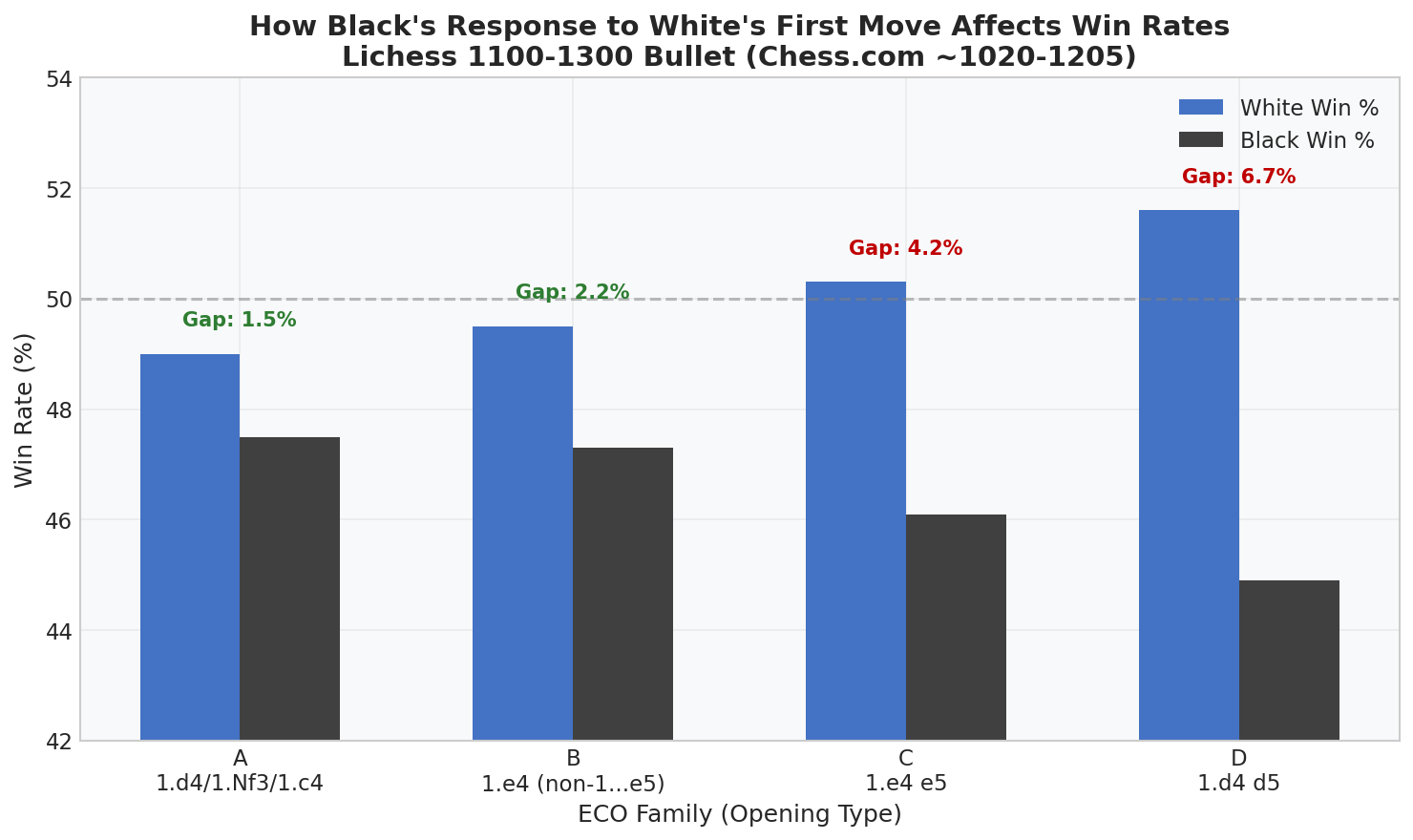
At the ~1000 Chess.com level, White's advantage is most pronounced when the game begins with 1.d4 d5 (ECO D), where White enjoys a massive +6.7% advantage. Conversely, when White plays 1.e4 and Black responds with anything other than 1...e5 (ECO B), White's advantage shrinks to just +2.2%.
This leads us to our first major insight: As Black, playing asymmetrical responses to 1.e4 is the most effective way to drag White out of their comfort zone and neutralize the first-move advantage.
The Best Black Openings at ~1000 Elo
Let us zoom in on our target demographic: players rated around 1000 in Bullet on Chess.com. We analyzed the performance of the most popular Black openings to see which ones actually score better than White.
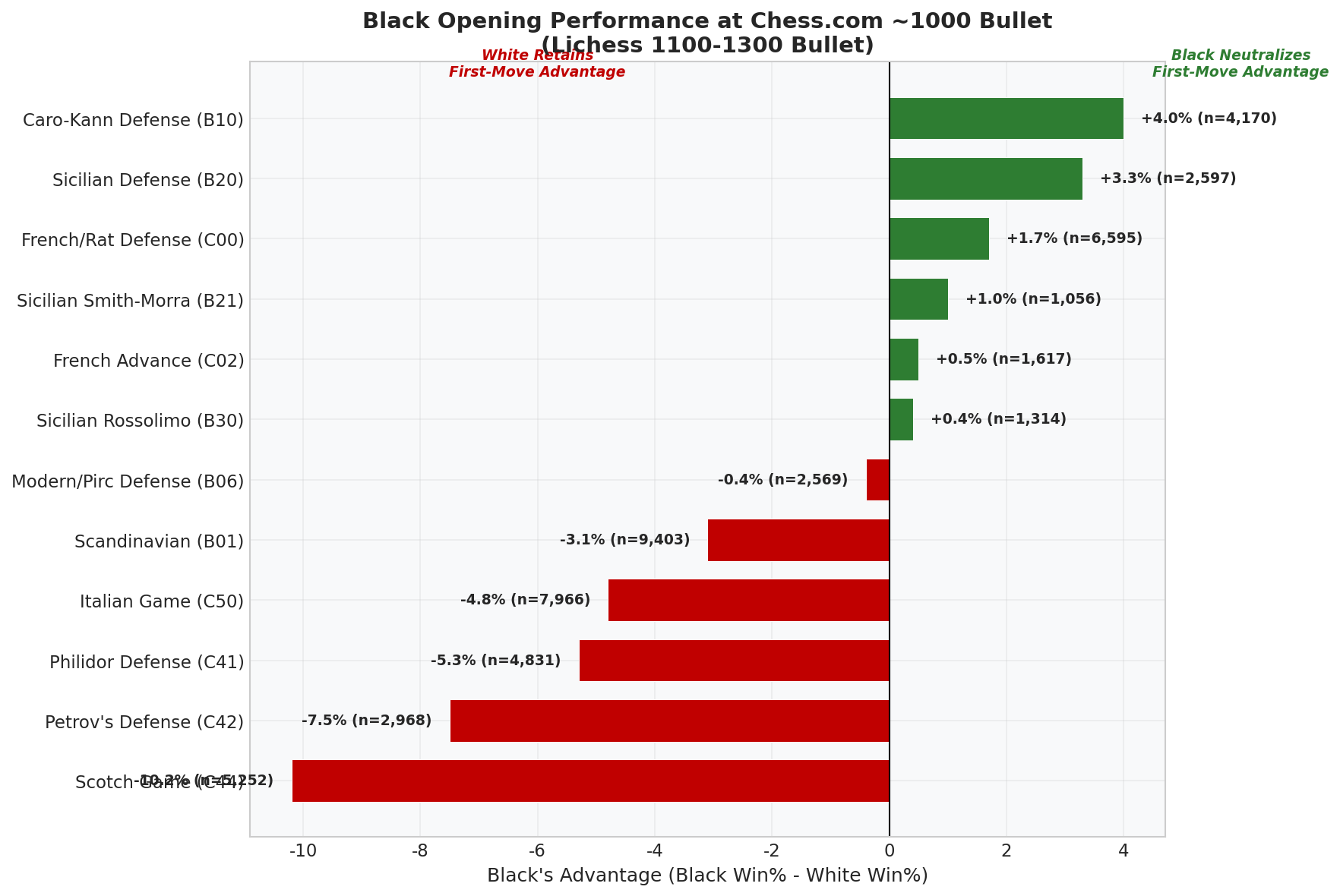
The results are striking. Only a handful of openings allow Black to achieve a positive win rate relative to White. Let us examine the top performers.
1. The Caro-Kann Defense (B10)
Black Win Rate: 50.5% | White Win Rate: 46.5% | Black Advantage: +4.0%
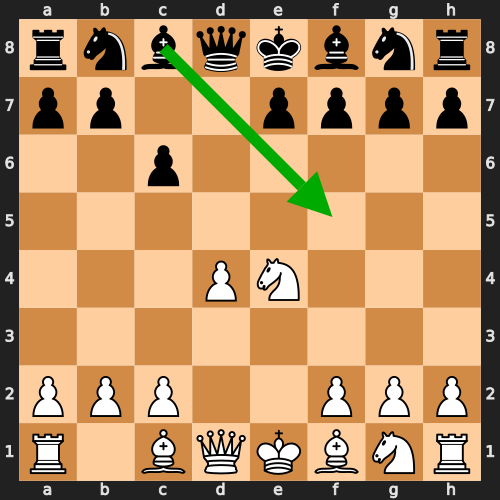
The Caro-Kann Defense emerges as the undisputed king of Bullet chess at the 1000 Elo level. By responding to 1.e4 with 1...c6, Black immediately challenges White's central control while maintaining a rock-solid pawn structure.
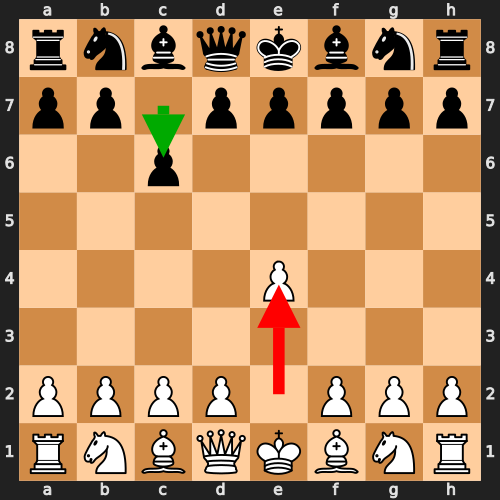
Why does the Caro-Kann perform so well in Bullet? The answer lies in its resilience. At the 1000 level, White players often launch premature, speculative attacks. The Caro-Kann's robust structure easily absorbs these blows, leaving White overextended and vulnerable to counterattacks as the clock ticks down. Furthermore, the Caro-Kann allows Black to develop their light-squared bishop (usually to f5 or g4) before playing ...e6, avoiding the passive positions often seen in the French Defense.
2. The Sicilian Defense (B20)
Black Win Rate: 50.0% | White Win Rate: 46.7% | Black Advantage: +3.3%
The Sicilian Defense (1.e4 c5) is the most popular response to 1.e4 at the master level, and our data shows it is highly effective for intermediate Bullet players as well.
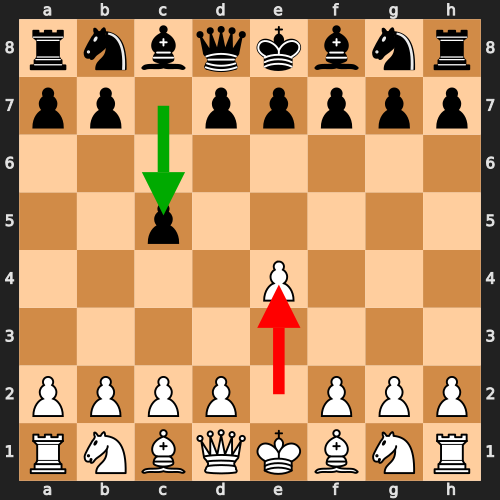
The Sicilian immediately creates an asymmetrical position, leading to complex, tactical middlegames. In Bullet, complexity is often Black's best friend. White players at the 1000 level frequently struggle to navigate the labyrinthine variations of the Open Sicilian, leading to time trouble and blunders. Even against anti-Sicilian systems like the Wing Gambit (which the B20 ECO code specifically tracks), Black scores exceptionally well, punishing White's early deviations.
3. The French/Rat Defense (C00)
Black Win Rate: 49.2% | White Win Rate: 47.5% | Black Advantage: +1.7%
The C00 ECO code encompasses various irregular responses to 1.e4, including early deviations in the French Defense and the Rat Defense (1.e4 d6). While less theoretically sound than the Caro-Kann or Sicilian, these openings excel in Bullet by taking White out of their prepared lines immediately.
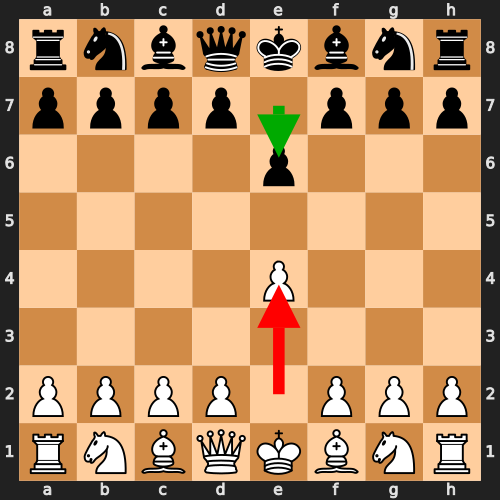
The French Defense (1.e4 e6), when played solidly, forces White to make critical decisions about the center early on. If White over-pushes with the Advance Variation (C02), Black still maintains a slight edge (+0.5% advantage), proving that solid, counter-attacking structures are highly effective under time pressure.
Openings to Avoid at ~1000 Elo
Just as the data reveals the best openings for Black, it also highlights the ones that intermediate players should avoid in Bullet chess.
The Danger of Symmetrical 1...e5
When Black responds to 1.e4 with 1...e5, they enter White's most prepared territory. The data shows that symmetrical 1...e5 openings perform poorly for Black across the board.
- The Scotch Game (C44): Black suffers a devastating -10.2% disadvantage. White's early central break (d4) often catches Black off guard, leading to rapid development and crushing attacks.
- Petrov's Defense (C42): Despite its reputation for solidity at the grandmaster level, the Petrov yields a -7.5% disadvantage for Black at 1000 Elo. Intermediate players often misplay the symmetrical positions, falling victim to early tactics.
- The Italian Game (C50): Black faces a -4.8% disadvantage. White's early pressure on f7 is difficult to handle in Bullet, and Black often falls into passive defensive setups.
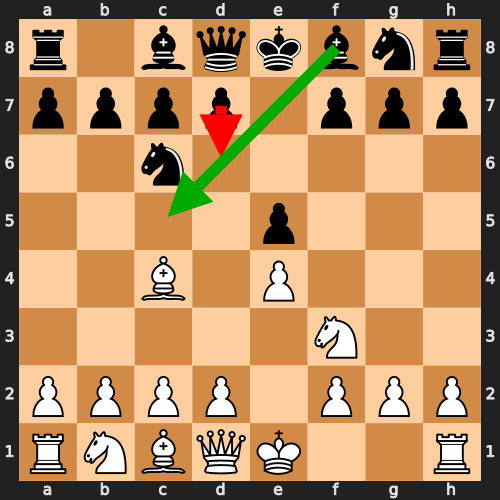
In the Italian Game, Black often plays the passive ...d6 (red arrow) instead of the active ...Bc5 (green arrow), allowing White to dictate the pace of the game.
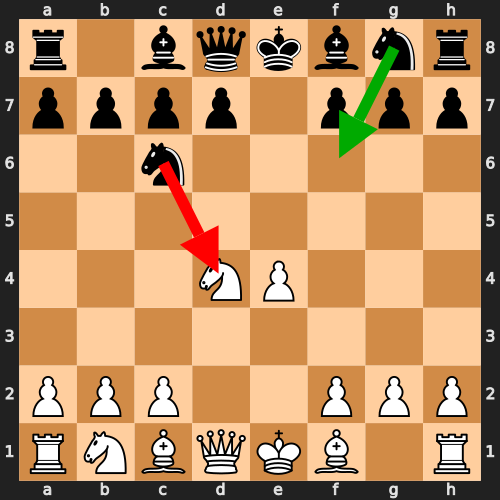
In the Scotch Game, intermediate Black players frequently recapture with ...Nxd4 (red arrow), losing a crucial tempo, instead of developing with ...Nf6 (green arrow).
The Evolution of Opening Effectiveness
An opening that works brilliantly at 800 Elo might become a liability at 1500 Elo. To understand how opening effectiveness changes as players improve, we generated decay curves for the top Black openings.
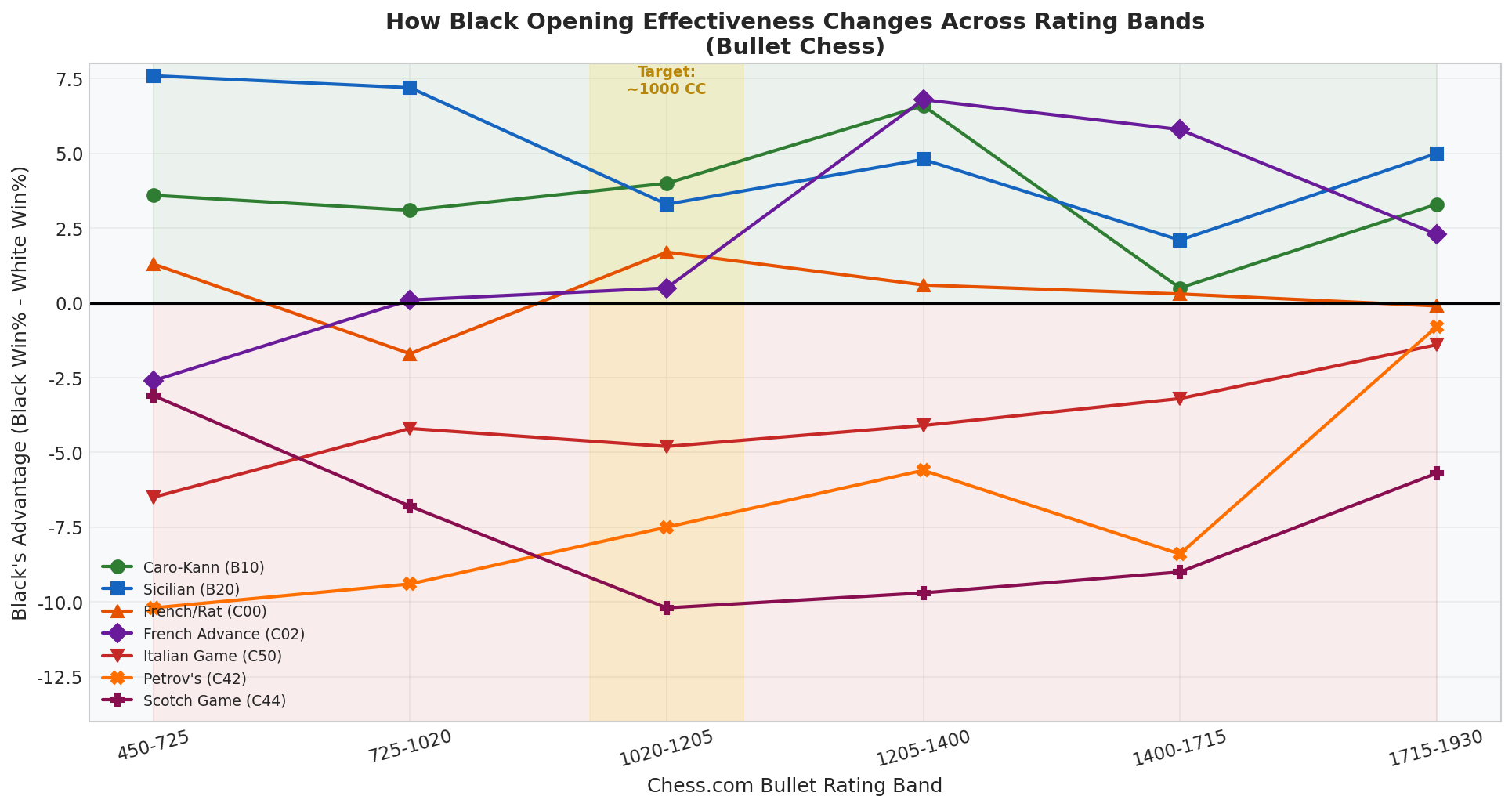
This chart reveals several crucial insights for players looking to climb the rating ladder:
- The Caro-Kann's Consistency: The Caro-Kann (green line) remains a top-tier choice across all intermediate rating bands. It is not a "trick" opening; it is a fundamentally sound system that scales with your skill level.
- The Sicilian's Rise: The Sicilian Defense (blue line) starts strong and remains highly effective. As players improve their tactical vision, the Sicilian becomes an even more potent weapon.
- The Decline of the French Advance: The French Advance (purple line) is highly effective for Black at lower ratings, but its advantage begins to wane as players approach 1500 Elo, where White players learn how to properly maintain their spatial advantage.
- The Persistent Struggle of 1...e5: Openings like the Italian Game (red line) and the Scotch Game (maroon line) consistently yield negative results for Black across all intermediate bands.
Defending Against 1.d4
While 1.e4 is the most common opening at the intermediate level, players must also have a reliable response to 1.d4. Our data shows that White's advantage is generally larger after 1.d4, making Black's choice of opening even more critical.
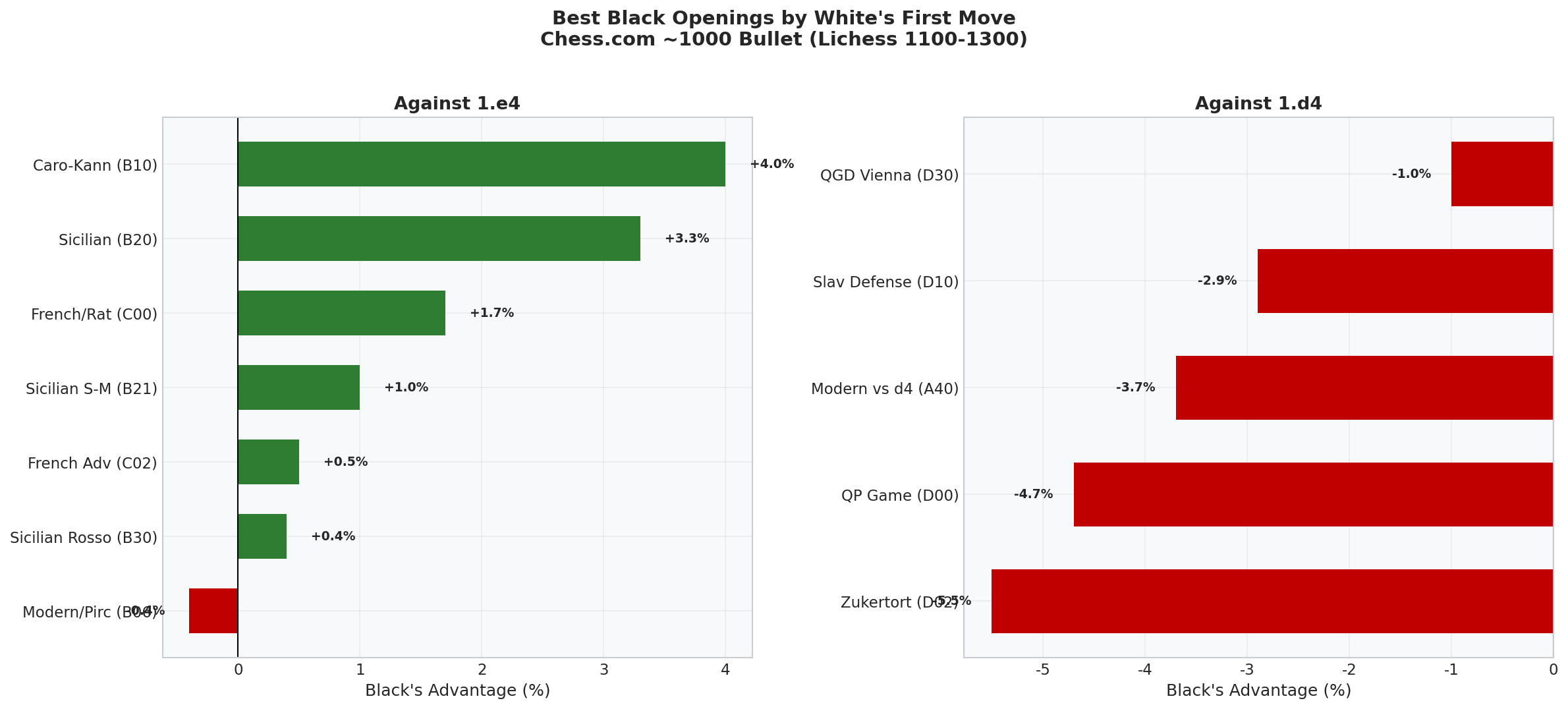
As the chart demonstrates, Black struggles to find openings that completely neutralize White's advantage against 1.d4. However, some choices are significantly better than others.
- The Queen's Gambit Declined (Vienna Variation - D30): This is Black's best performing option against 1.d4, keeping White's advantage to a minimal +1.0%.
- The Slav Defense (D10): A solid choice that limits White's advantage to +2.9%. Like the Caro-Kann, the Slav relies on a robust c6-d5 pawn structure.
- The Modern Defense (A40): By responding to 1.d4 with 1...g6, Black avoids early central confrontation and creates a flexible, asymmetrical position. This limits White's advantage to +3.7%.
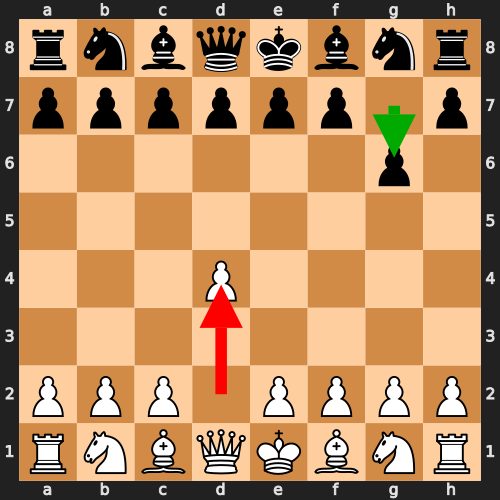
The Modern Defense (1...g6) allows Black to flexibly respond to White's central expansion.
Actionable Advice by Rating Band
Based on our comprehensive data analysis, here is a roadmap for improving your Black repertoire in Bullet chess as you climb the Chess.com rating ladder.
For Players Rated 800 - 1000 (Chess.com)
- Against 1.e4: Stop playing 1...e5. The data is clear: symmetrical positions favor White heavily at this level. Switch to the Caro-Kann (1...c6) or the Sicilian (1...c5). These openings immediately create imbalances that confuse White players who are used to standard 1.e4 e5 games.
- Against 1.d4: Play the Modern Defense (1...g6). It is flexible, avoids early tactical traps, and allows you to develop your pieces quickly while White spends time building a large center that they often overextend.
For Players Rated 1000 - 1200 (Chess.com)
- Against 1.e4: The Caro-Kann remains your best weapon. Focus on mastering the main lines and understanding the typical pawn structures. If you prefer sharper play, the Sicilian is equally effective.
- Against 1.d4: Transition to the Slav Defense (1...c6). It shares structural similarities with the Caro-Kann, making it easier to learn, and it performs significantly better than symmetrical 1...d5 responses.
For Players Rated 1200 - 1500 (Chess.com)
- Against 1.e4: You now have a solid foundation. The Caro-Kann and Sicilian will continue to serve you well. If you play the French Defense, be prepared for White players to handle the Advance Variation more competently.
- Against 1.d4: The Queen's Gambit Declined (specifically variations like the Vienna) becomes highly effective. White players at this level often struggle to break down Black's solid center without overcommitting.
Conclusion
The first-move advantage in chess is real, but in the fast-paced arena of Bullet chess, it is far from insurmountable. By choosing openings that create asymmetrical positions, challenge White's early plans, and rely on solid, resilient pawn structures, intermediate players can effectively neutralize White's edge.
The data speaks loudly: If you are rated around 1000 on Chess.com and want to win more games as Black, it is time to embrace the Caro-Kann and the Sicilian, and leave the symmetrical 1...e5 responses behind.
Data and Methodology
This analysis was conducted using a dataset of over 840,000 Bullet chess games sourced from Lichess. The data was processed to extract win rates, draw rates, and centipawn loss metrics across various rating bands and ECO codes.
To make the findings applicable to Chess.com users, Lichess ratings were adjusted downwards by approximately 200-300 points, reflecting the established rating disparity between the two platforms at the intermediate level.
The underlying CSV data files generated during this research are attached for further review:
opening_analysis_all_bands.csv: Comprehensive opening performance data across all rating bands.opening_summary_target_band.csv: Summarized performance metrics for the target ~1000 Chess.com rating band.decay_curves_processed.csv: Data tracking opening effectiveness across rating progression.opening_by_time_control.csv: Performance metrics separated by time control.sub_variations.csv: Detailed performance data for specific opening sub-variations.
Chess Coach, April 13, 2026