Why thousands of Bullet players get stuck, and the statistical roadmap to finally break through.
For many chess players, reaching a four-digit rating is a major psychological milestone. In the fast-paced world of Bullet Chess (1+0 and 2+1 time controls), the 1000 Elo mark on Chess.com often becomes a frustrating, seemingly impenetrable wall. Players find themselves stuck in a loop of wins and losses, unable to break through to the intermediate ranks despite playing thousands of games. The question is: what exactly is holding them back?
To answer this, we analyzed over 283,000 Lichess Bullet games spanning six rating bands, using the Grandmaster Guide analytics platform. By mapping Lichess Bullet ratings to their approximate Chess.com equivalents (Lichess ratings run roughly 200-300 points higher in this range), we have uncovered the statistical fingerprint of the 1000 Elo plateau. This article presents the findings as a structured roadmap for improvement, organized by the most impactful areas of weakness at each stage of the climb.
| Chess.com Bullet Rating | Lichess Bullet Equivalent | Label Used in This Article |
|---|---|---|
| 450 - 725 | 975 - 1115 | "Sub-725" (Beginner) |
| 725 - 920 | 1115 - 1295 | "725-920" (Plateau Zone) |
| 920 - 1115 | 1295 - 1385 | "920-1115" (Breakthrough) |
| 1115 - 1305 | 1385 - 1575 | "1115-1305" (Post-Plateau) |
| 1305 - 1615 | 1575 - 1770 | "1305-1615" (Intermediate) |
| 1615 - 1930 | 1770 - 2000 | "1615-1930" (Advanced) |
A note on methodology: All data in this article was sourced from the Grandmaster Guide MCP server, which aggregates and analyzes Lichess game databases. The sample includes approximately 283,000 Bullet games across all six rating bands. All chart labels and in-text references use Chess.com Bullet ratings unless otherwise noted. The corresponding Lichess equivalents are provided in the table above for cross-reference.
Section 1: The Fundamental Problem — The Bullet CPL Plateau
Before examining specific mistakes, it is essential to understand a counterintuitive truth about Bullet Chess that sets it apart from all other time controls. In Rapid and Blitz, a player's average Centipawn Loss (CPL) — the standard measure of move quality — decreases steadily as their rating increases. A 1600-rated Rapid player makes objectively better moves than a 1000-rated Rapid player. This is the expected pattern of improvement.
In Bullet, however, this relationship breaks down almost entirely.
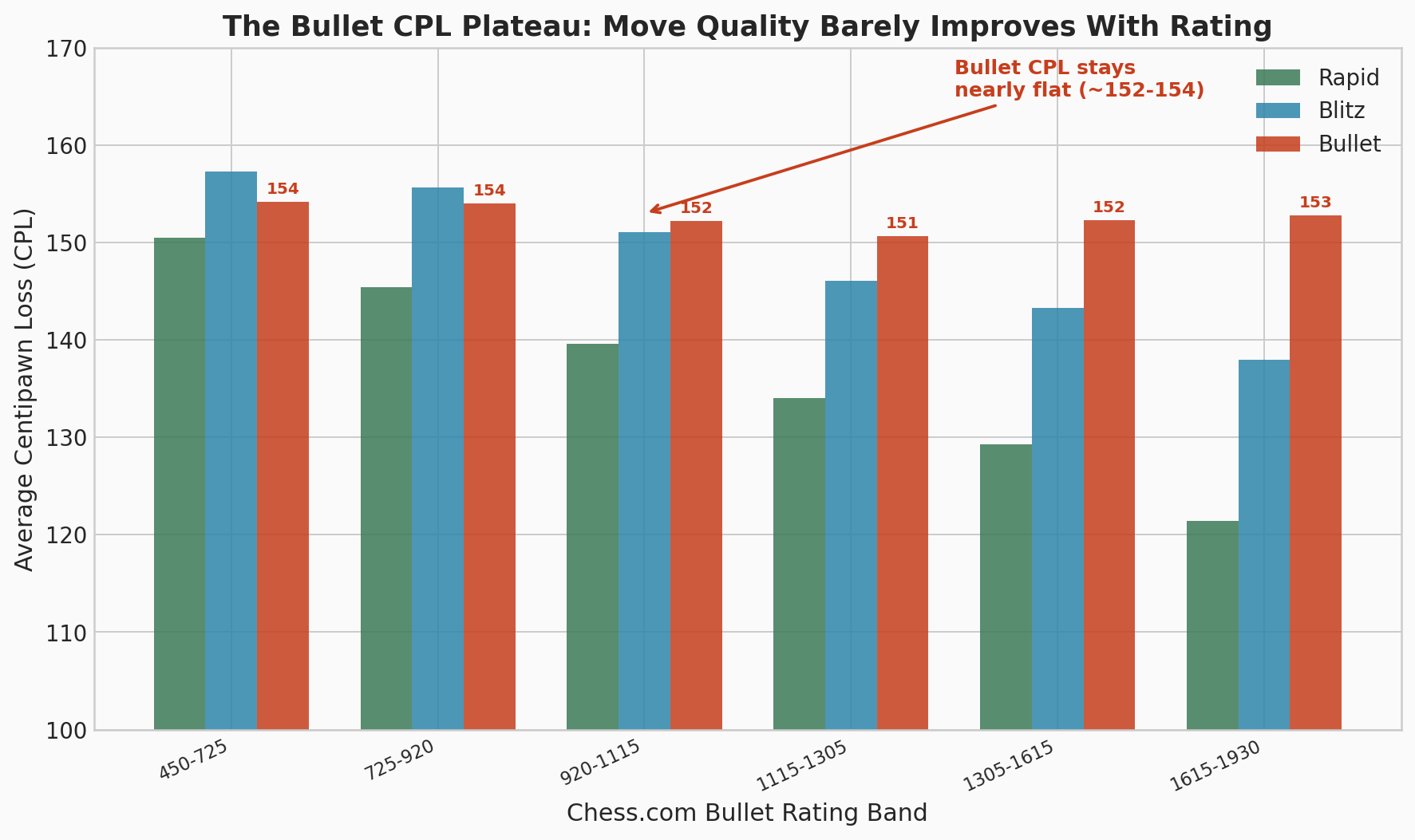
The chart above compares average CPL across three time controls. The Rapid line (green) drops from 150 CPL at the lowest band to 121 CPL at the highest, a reduction of nearly 30 centipawns. The Blitz line (blue) shows a similar, if less dramatic, decline from 157 to 138. The Bullet line (red), however, is essentially flat: it starts at 154 CPL for the 450-725 band and remains at 153 CPL for the 1615-1930 band. The total improvement across a 1,500-point rating span is a statistically negligible 1-2 centipawns.
This data reveals a profound truth: in Bullet Chess, rating gains are not primarily driven by improvements in raw move quality. Instead, they are driven by differences in the type and timing of errors, time management, psychological resilience, and the ability to exploit specific patterns at speed. The sections that follow break down each of these factors.
Section 2: Where the Blunders Happen — A Phase-by-Phase Breakdown
To understand what separates a plateaued player from one who has broken through, we must examine where in the game errors occur. The Grandmaster Guide data provides blunder rates broken down by game phase (opening, middlegame, endgame) for each rating band.
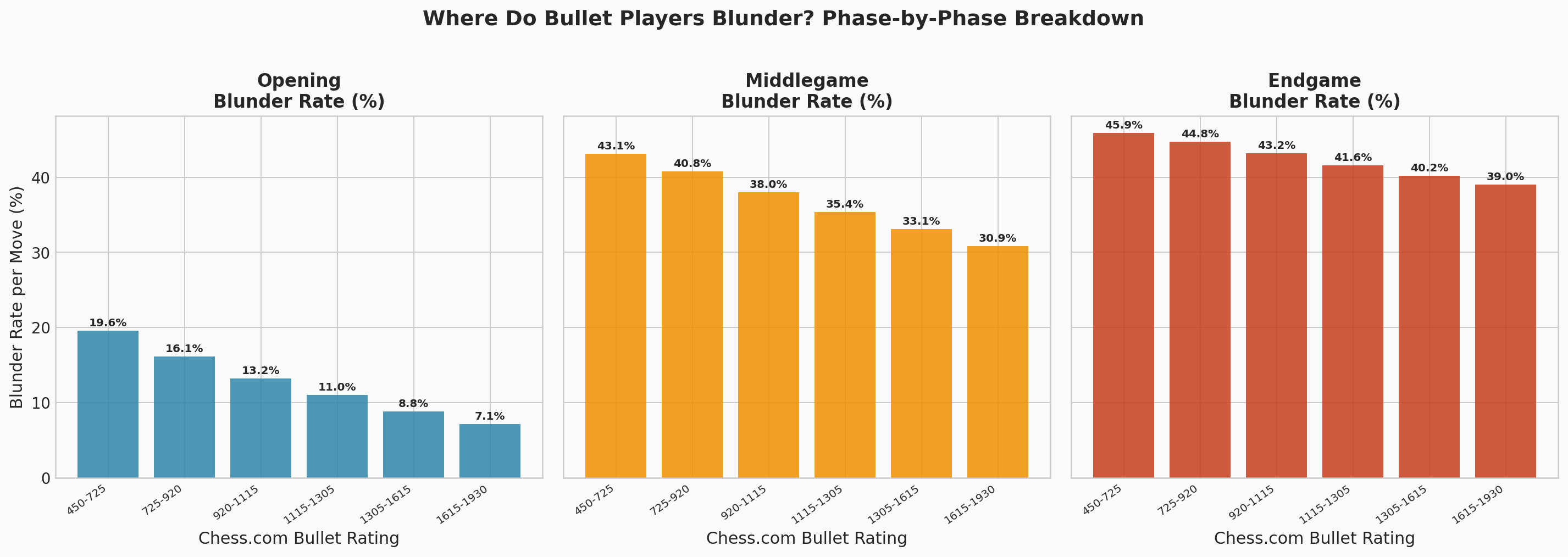
Three critical observations emerge from this data:
Opening blunders decrease significantly with rating. The opening blunder rate drops from 19.6% per move at the 450-725 level to 7.1% at the 1615-1930 level. This is the single largest area of improvement across the rating spectrum and represents the most actionable area for players stuck below 1000 Elo. In concrete terms, a sub-725 player makes a blunder on roughly one in five opening moves, while a post-plateau player blunders on roughly one in nine.
Middlegame blunders decrease, but remain very high. Even at the 1615-1930 level, the middlegame blunder rate is still 30.9%. For the plateau zone (725-920), it is 40.8%. The middlegame is inherently chaotic in Bullet, and no amount of tactical training will eliminate these errors entirely. However, reducing the rate from 40% to 35% represents a meaningful edge.
Endgame blunders barely improve at all. The endgame blunder rate is 45.9% at the lowest band and still 39.0% at the highest. This is the "endgame tax" of Bullet Chess — by the time the endgame arrives, both players are typically in severe time trouble, and the error rate remains catastrophically high regardless of skill level.
Time Allocation Explains the Endgame Crisis
The reason for the persistent endgame blunder rate becomes clear when we examine how players allocate their time across game phases.
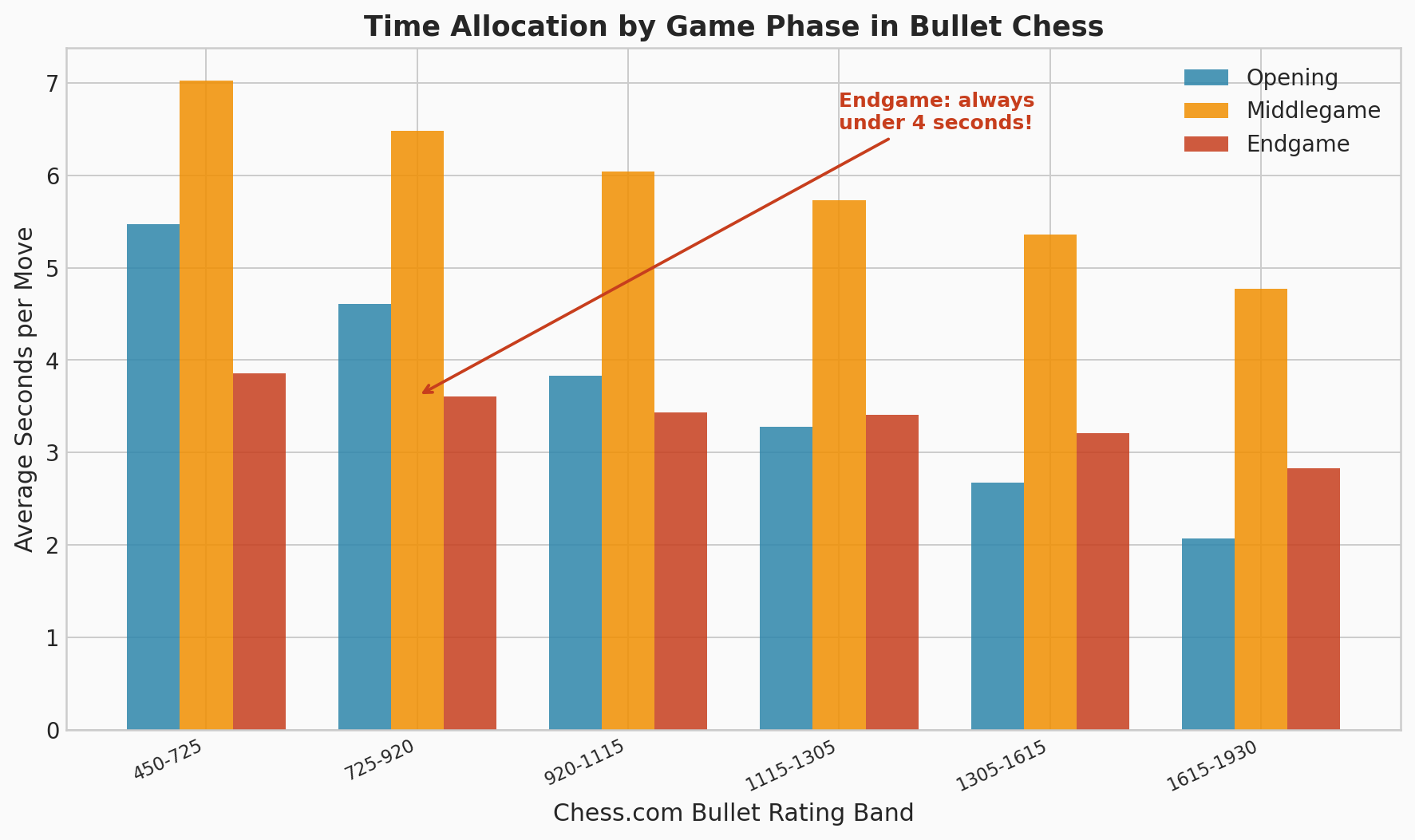
Players at the 725-920 level spend an average of 4.6 seconds per opening move, 6.5 seconds per middlegame move, and only 3.6 seconds per endgame move. The endgame time crunch is universal across all rating bands — even advanced players (1615-1930) spend only 2.8 seconds per endgame move. In Bullet, the endgame is not a test of chess knowledge; it is a test of speed and pre-programmed reflexes.
Section 3: The Opening — Stop Giving Away the Game Before It Starts
The data makes a compelling case that the single most impactful improvement a sub-1000 player can make is to reduce opening blunders. At the 450-725 level, nearly 20% of all opening moves are blunders, and 37% of all games end in fewer than 20 moves.
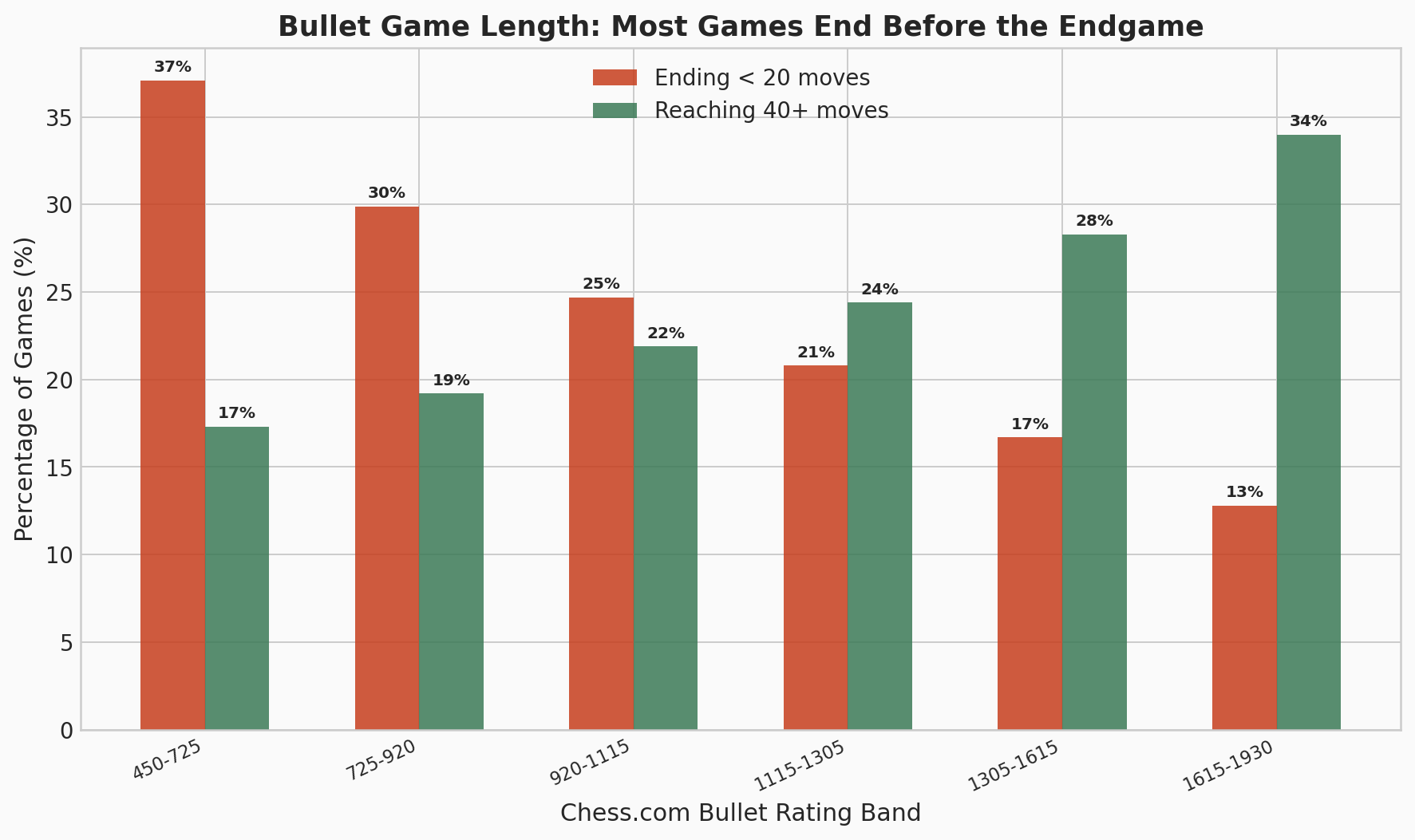
This means that more than one in three games at the lowest level never even reach a meaningful middlegame. The game is effectively decided by whoever makes the first catastrophic error in the opening.
The Castling Gap
One of the clearest statistical markers of the plateau is the castling rate. The data shows a dramatic difference in how often players castle across rating bands.
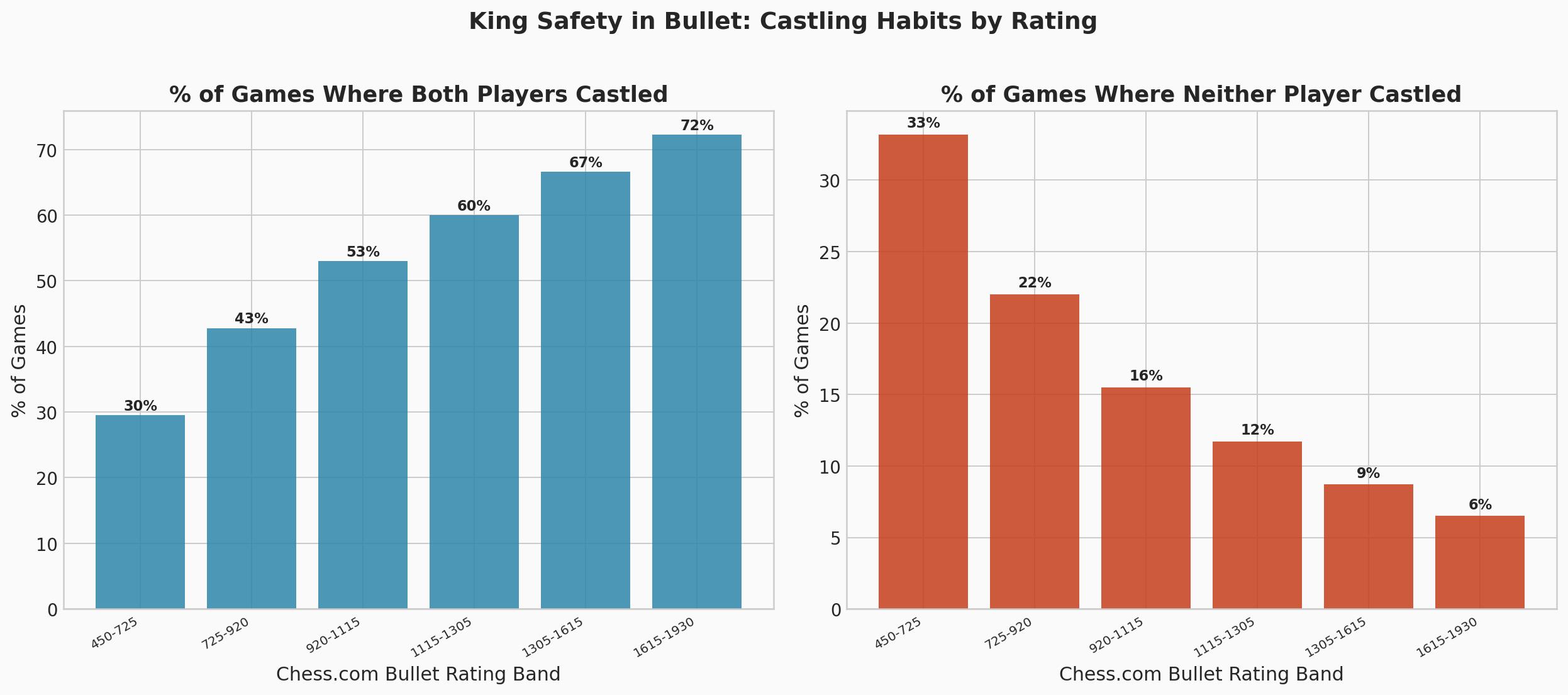
At the 450-725 level, both players castle in only 29.5% of games, and neither player castles in 33.2% of games. By the 1115-1305 level (post-plateau), both players castle in 60% of games, and the "neither castled" rate drops to just 11.7%. Furthermore, the data shows that when only one player castles, that player's win rate increases by approximately 5-7 percentage points.
The implication is clear: castling is not optional in Bullet Chess. Players who fail to castle are leaving their king exposed to rapid attacks, which is the primary cause of the extremely short game lengths observed at lower ratings.
Visual Example: Castle Now or Pay Later
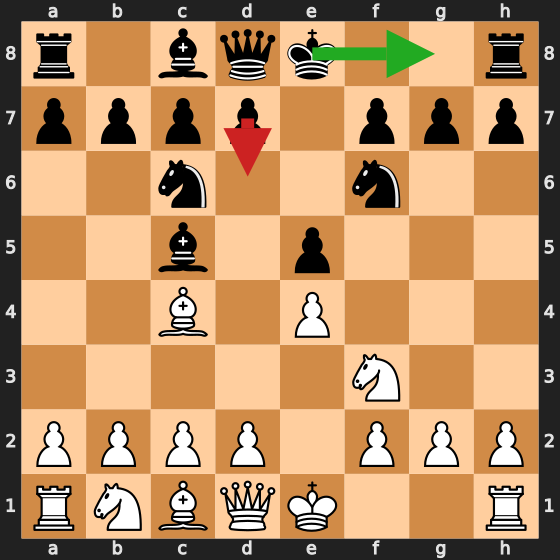 In this position, Black has developed pieces but has not yet castled. The passive
 ...d6 (red arrow) delays king safety further. The correct move is O-O (green arrow), immediately securing the king and connecting the rooks.
Actionable Advice for the Opening Phase
The following table summarizes the key opening metrics and the corresponding improvement targets for players seeking to break through 1000 Elo.
| Metric | 450-725 (Sub-1000) | 920-1115 (Breakthrough) | Target Improvement |
|---|---|---|---|
| Opening Blunder Rate | 19.6% | 13.2% | Reduce by ~6 percentage points |
| Games Ending < 20 Moves | 37.1% | 24.7% | Survive the opening more often |
| Both Players Castled | 29.5% | 53.0% | Castle in every game possible |
| Neither Player Castled | 33.2% | 15.5% | Eliminate uncastled games |
| Avg First Blunder Move | Move 17.3 | Move 22.6 | Delay first blunder by 5 moves |
Concrete steps:
Play a narrow repertoire of 2-3 openings for each color that you know well enough to play on autopilot. The London System (1.d4, 2.Bf4) for White and the Caro-Kann (1...c6) or Scandinavian (1...d5) for Black are excellent choices because they lead to solid, principled positions without requiring deep theoretical knowledge. The goal is not to gain an advantage from the opening — it is to reach the middlegame with a playable position, your king castled, and your pieces developed.
Section 4: The Middlegame — Anatomy of a Blunder
Once a player survives the opening, the middlegame presents a different set of challenges. The blunder taxonomy data reveals a striking pattern about when blunders occur relative to the state of the game.
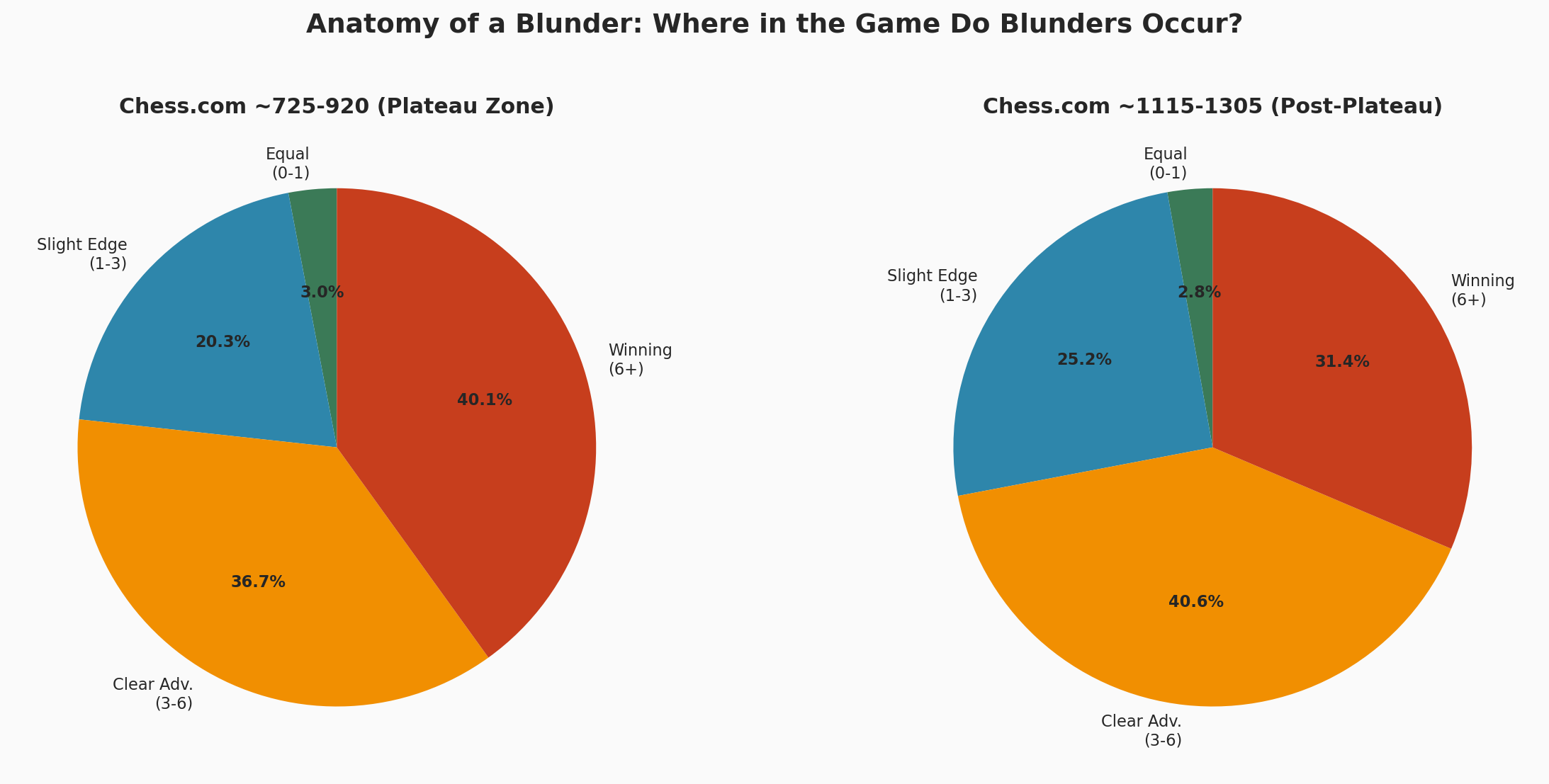
In the 725-920 (plateau) band, 40.1% of all blunders occur when the player is already in a completely winning position (evaluation advantage of +6 or more). An additional 36.7% occur when the player has a clear advantage (+3 to +6). This means that over 76% of blunders in the plateau zone happen when the player is already ahead. Only 3% of blunders occur in truly equal positions.
By comparison, in the 1115-1305 (post-plateau) band, the "winning position" blunder rate drops to 31.4%, while the "clear advantage" blunder rate rises to 40.6%. This shift indicates that post-plateau players are better at maintaining focus when they are winning, but they still struggle in positions where the advantage is less clear-cut.
The "Winning" Blunder: Why It Matters So Much in Bullet
The prevalence of blunders in winning positions is the defining characteristic of the Bullet plateau. It occurs because players who gain a large advantage often shift into "autopilot" mode, making moves quickly without checking for their opponent's counterplay. In a Rapid game, a player with a +6 advantage can take their time and methodically convert. In Bullet, that same player has 15 seconds left on the clock and is moving on instinct.
Visual Example: The Missed Fork
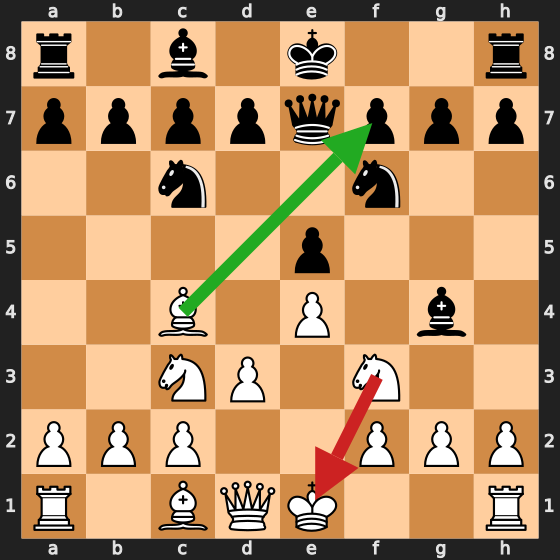 White has a devastating tactical shot with
 Bxf7+ (green arrow), which forks the Black king and queen. Instead, a passive retreat like Ne1 (red arrow) squanders the opportunity. This type of one-move tactical miss is the most common blunder in the middlegame.
The Evaluation Trajectory
The eval trajectory data shows how lopsided positions become at each phase of the game, providing further evidence for the "winning blunder" phenomenon.
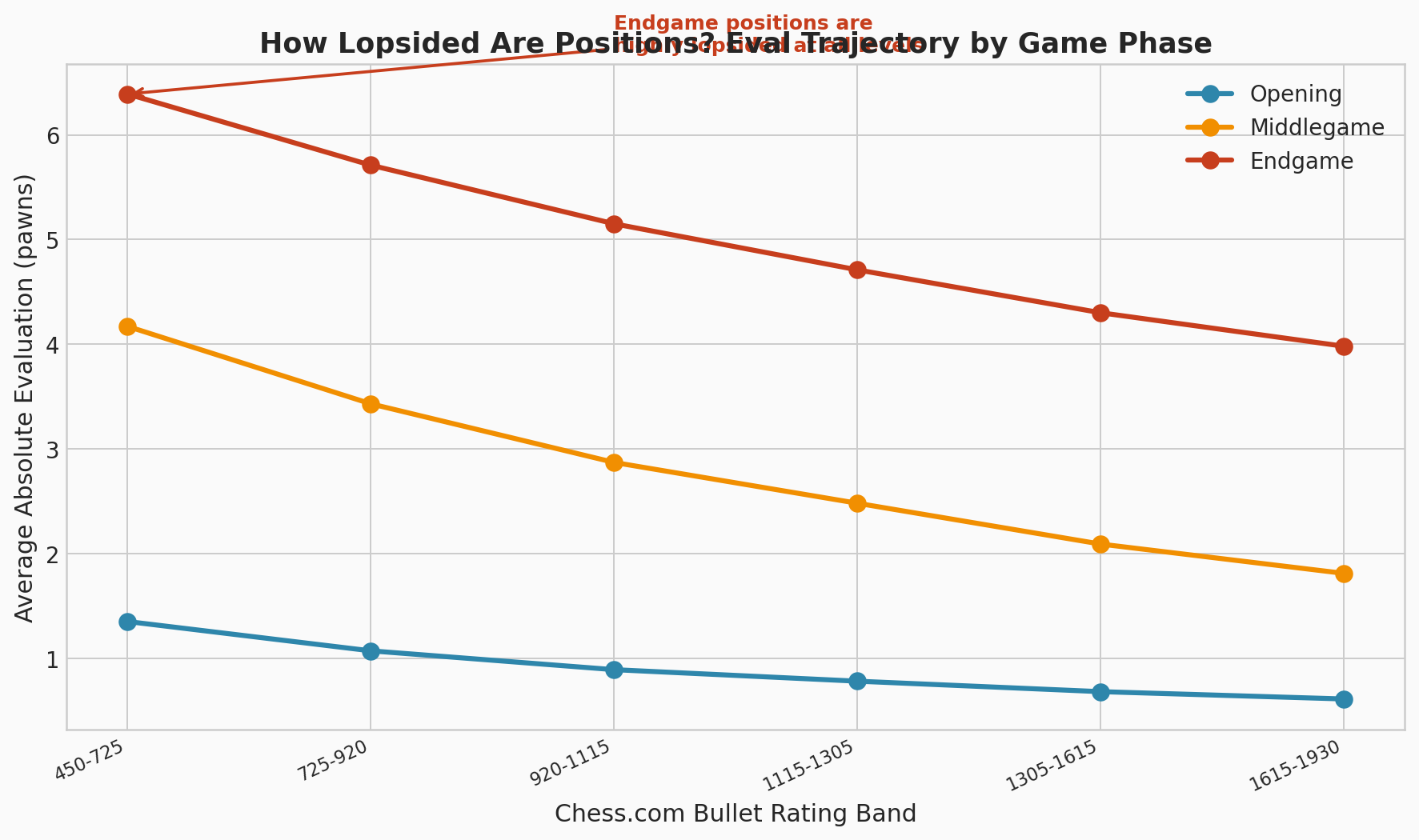
At the 725-920 level, the average absolute evaluation is 1.07 pawns in the opening, 3.43 pawns in the middlegame, and 5.71 pawns in the endgame. This means that by the middlegame, the average position is already significantly unbalanced — one player typically has a clear advantage. The challenge is not finding an advantage; it is holding onto it.
Actionable Advice for the Middlegame Phase
| Metric | 725-920 (Plateau) | 1115-1305 (Post-Plateau) | Target Improvement |
|---|---|---|---|
| Middlegame Blunder Rate | 40.8% | 38.0% | Reduce by ~3 percentage points |
| Blunders in Winning Positions | 40.1% | 31.4% | Reduce by ~9 percentage points |
| Avg Time per Middlegame Move | 6.5 sec | 6.0 sec | Maintain speed, improve pattern recognition |
| Middlegame CPL | 461 | 402 | Reduce by ~60 centipawns |
Concrete steps:
Spend 10-15 minutes per day on tactical puzzles, specifically "Puzzle Rush" or "Puzzle Storm" modes that simulate the time pressure of Bullet. Focus on the most common tactical themes identified in the puzzle data: forks (12.9% of all puzzles), back-rank mates (3.4%), hanging pieces (3.7%), and kingside attacks (8.7%). The goal is not deep calculation — it is instant pattern recognition. When you see a fork pattern, you should play it within 2 seconds, not 10.
When you have a winning advantage, actively look for simplifying trades. Exchange queens, trade pieces, and steer the game toward an endgame where your material advantage is decisive. Do not try to find the "most beautiful" checkmate; find the fastest, safest path to victory.
Section 5: The Endgame — Speed Over Technique
The endgame in Bullet Chess is a fundamentally different beast from the endgame in longer time controls. The data on material conversion rates illustrates this clearly.
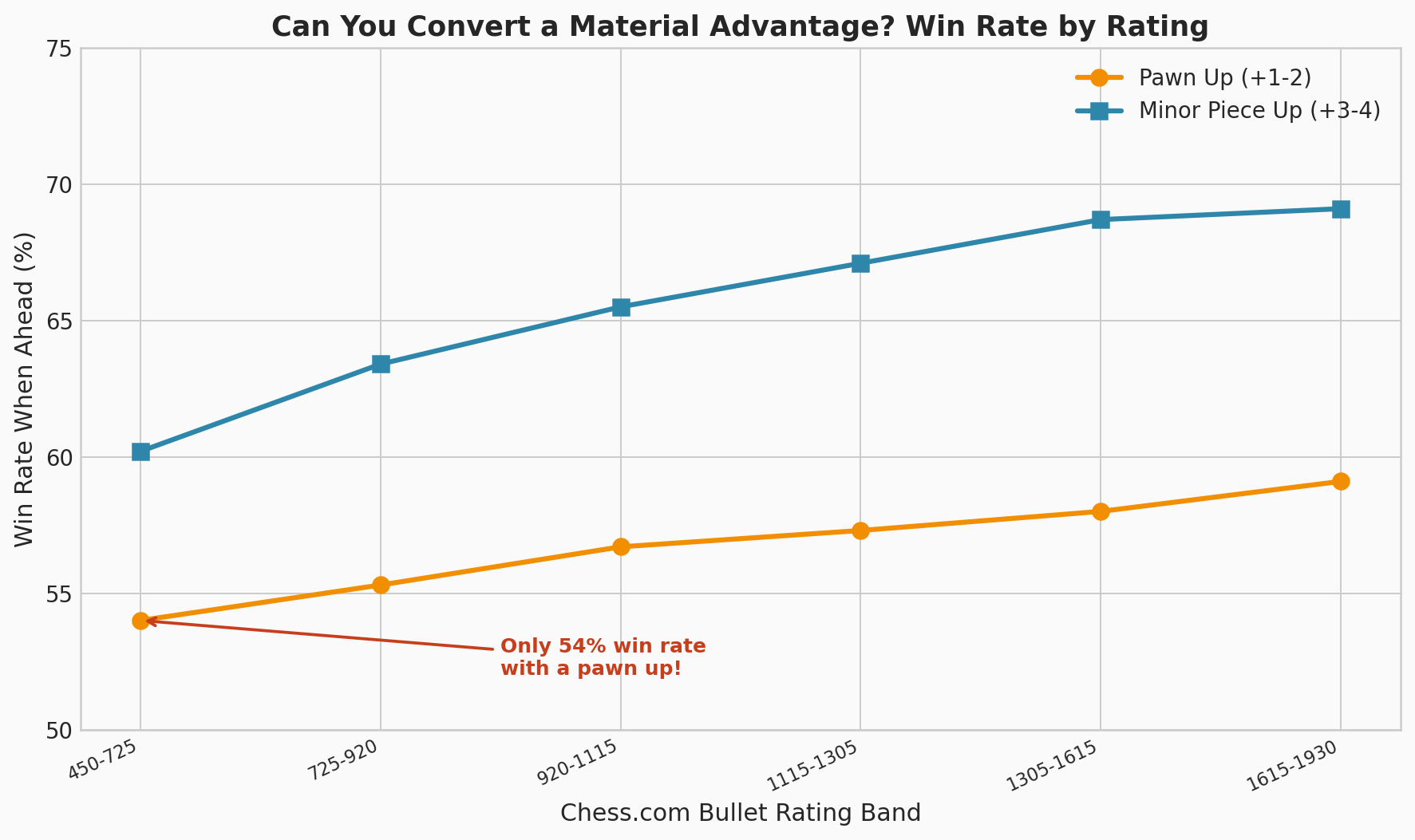
At the 725-920 level, a player who is up a full pawn wins only 55.3% of the time. Even a player up a minor piece (3-4 points of material) wins only 63.4% of the time. These conversion rates are shockingly low compared to what would be expected in Rapid or Classical chess, where a minor piece advantage is typically decisive.
The reason is time. By the endgame, both players are often operating on increments alone (in 1+0) or with just a few seconds remaining (in 2+1). The player who wins is not necessarily the one with the better position — it is the one who can move faster and avoid flagging.
Visual Example: Push the Pawn, Not the King
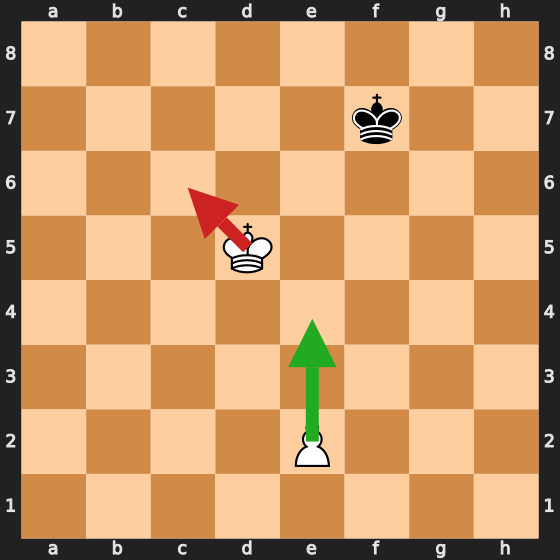 In this King and Pawn endgame, White has a clear path to victory. The slow king maneuver
 Kc6 (red arrow) wastes precious time. The immediate pawn push e4 (green arrow) is the fastest route to promotion and victory.
The Back Rank Mate — A Persistent Threat
The puzzle theme data reveals that back-rank mate is one of the most common tactical themes at lower ratings, with an average puzzle rating of just 835. This suggests that many players below 1000 Elo are vulnerable to this pattern.
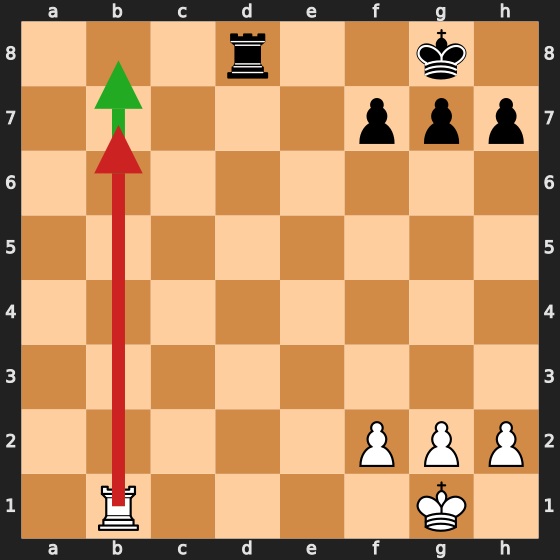 White can deliver immediate checkmate with
 Rb8# (green arrow), but the careless Rb7 (red arrow) misses the mate entirely. In Bullet, recognizing back-rank patterns instantly is the difference between winning and drawing (or losing on time).
Actionable Advice for the Endgame Phase
| Metric | 725-920 (Plateau) | 1115-1305 (Post-Plateau) | Target Improvement |
|---|---|---|---|
| Win Rate When Pawn Up | 55.3% | 57.3% | Improve by ~2 percentage points |
| Win Rate When Minor Piece Up | 63.4% | 67.1% | Improve by ~4 percentage points |
| Endgame Blunder Rate | 44.8% | 43.2% | Marginal improvement expected |
| Avg Time per Endgame Move | 3.6 sec | 3.4 sec | Maintain speed |
Concrete steps:
Learn three endgame patterns cold: (1) King and Queen vs. King checkmate, (2) King and Rook vs. King checkmate, and (3) basic pawn promotion technique (opposition and the "rule of the square"). Practice these until you can execute them in under 10 seconds. In Bullet, endgame "technique" means speed of execution, not depth of understanding.
When you have a material advantage in the endgame, prioritize pushing passed pawns over maneuvering pieces. A passed pawn on the 6th rank is often more dangerous than a rook in Bullet because it forces your opponent to react immediately, burning their remaining time.
Section 6: The Psychology of the Plateau — Tilt and Resignation
The data reveals that the 1000 Elo plateau is not purely a chess problem — it is also a psychological one. Two behavioral patterns contribute significantly to rating stagnation: tilt and premature resignation.
The Tilt Effect
The streak effects data quantifies the impact of losing streaks on subsequent performance.
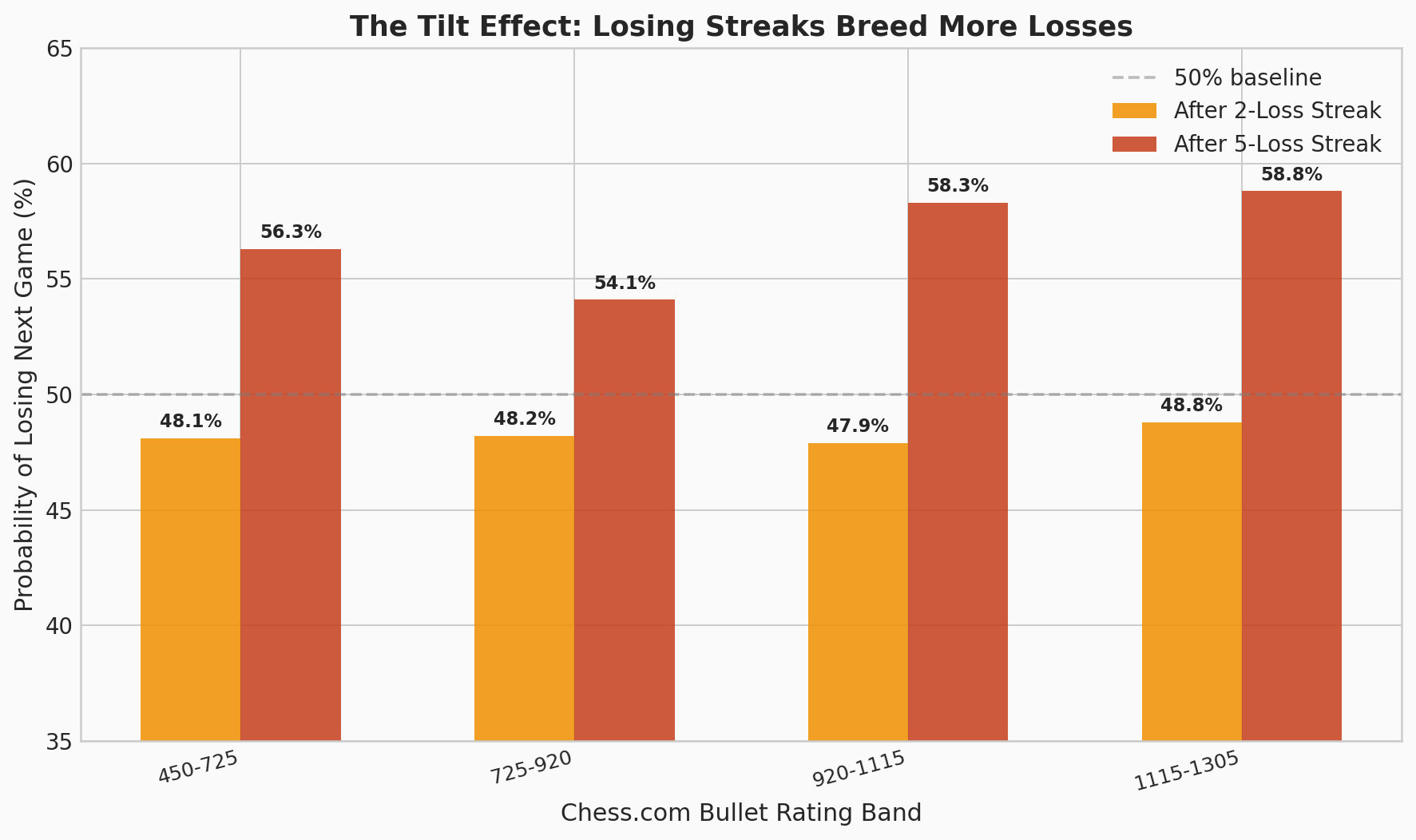
After a 2-game losing streak, a player in the 725-920 band has a 48.2% chance of losing the next game — essentially a coin flip. However, after a 5-game losing streak, the probability of losing the next game spikes to 54.1%. The CPL change data shows that after a 5-game losing streak, a player's average CPL increases by approximately 55 centipawns, indicating a measurable deterioration in move quality.
This is the tilt spiral: losses lead to frustration, frustration leads to worse play, worse play leads to more losses. In Bullet, where games last only 1-2 minutes, it is trivially easy to play 20 games in a row without taking a break, and the tilt effect compounds rapidly.
Premature Resignation
The resignation threshold data reveals another surprising pattern: across all rating bands, over 50% of decisive games end when the position is still objectively equal (evaluation between 0 and 1).
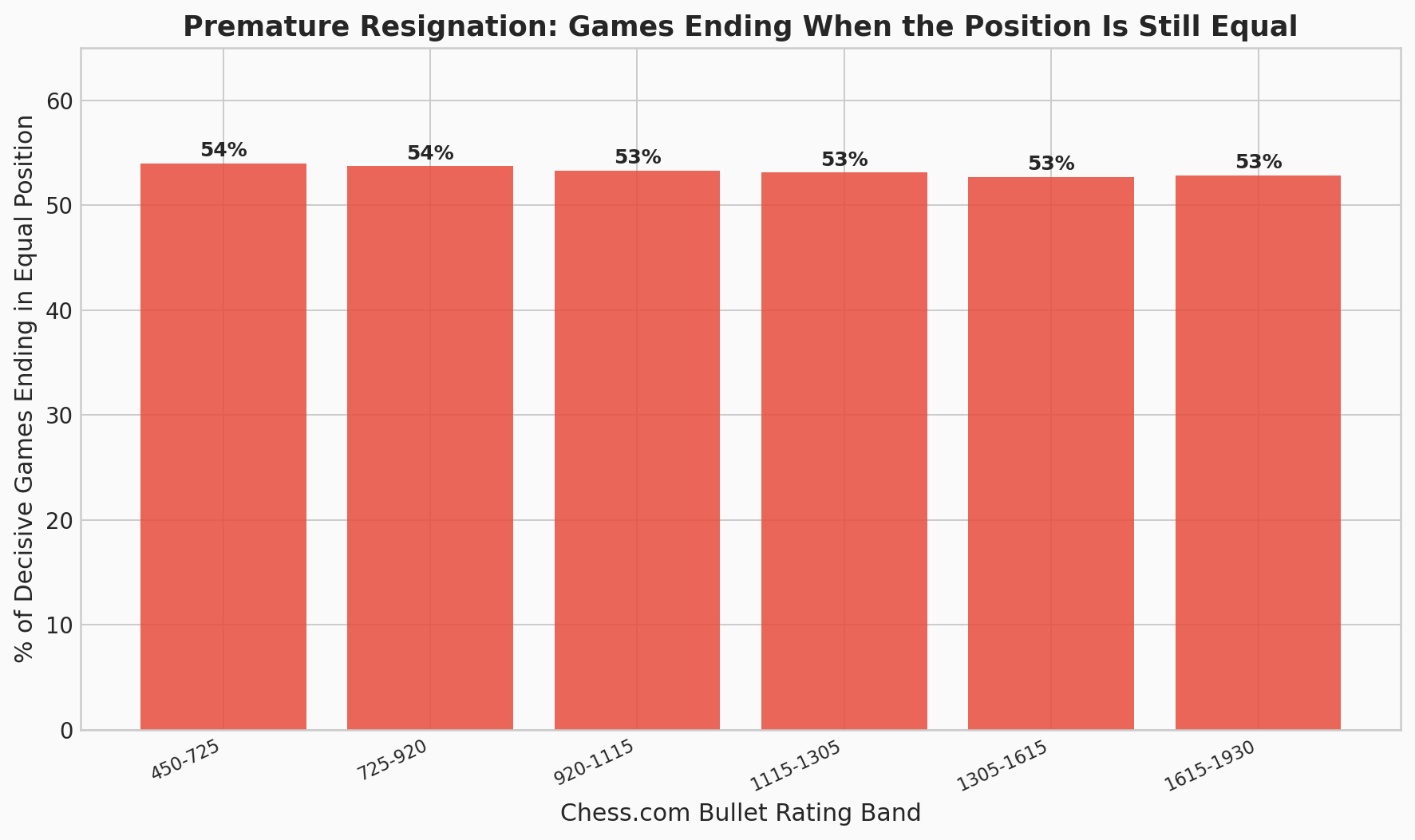
At the 725-920 level, 53.7% of decisive games end in positions that the engine evaluates as roughly equal. This means that more than half of all losses at this level are not caused by being in a losing position — they are caused by flagging (running out of time), resigning prematurely, or making a final blunder in a position that was still playable.
The implication is powerful: if you simply refuse to resign and keep making moves, you will win more games. In Bullet, your opponent is just as likely to blunder as you are, and time pressure affects both players equally.
Actionable Advice for Psychology
Set a hard stop-loss rule. If you lose three games in a row, close the app and take a 15-minute break. The data proves that continuing to play after a losing streak makes things worse, not better.
Never resign in Bullet. Unless you are literally being checkmated on the next move, keep playing. Your opponent has the same time pressure you do, and the probability of a comeback is much higher than you think. The data shows that even in positions evaluated as -6 or worse, the losing side still wins over 20% of the time at the plateau level.
Section 7: The Post-Plateau Profile — What 1115+ Looks Like
What does a player who has successfully broken the 1000 Elo barrier look like, statistically? The radar chart below compares the weakness profile of a plateaued player (725-920) with a post-plateau player (1115-1305) across six key dimensions.
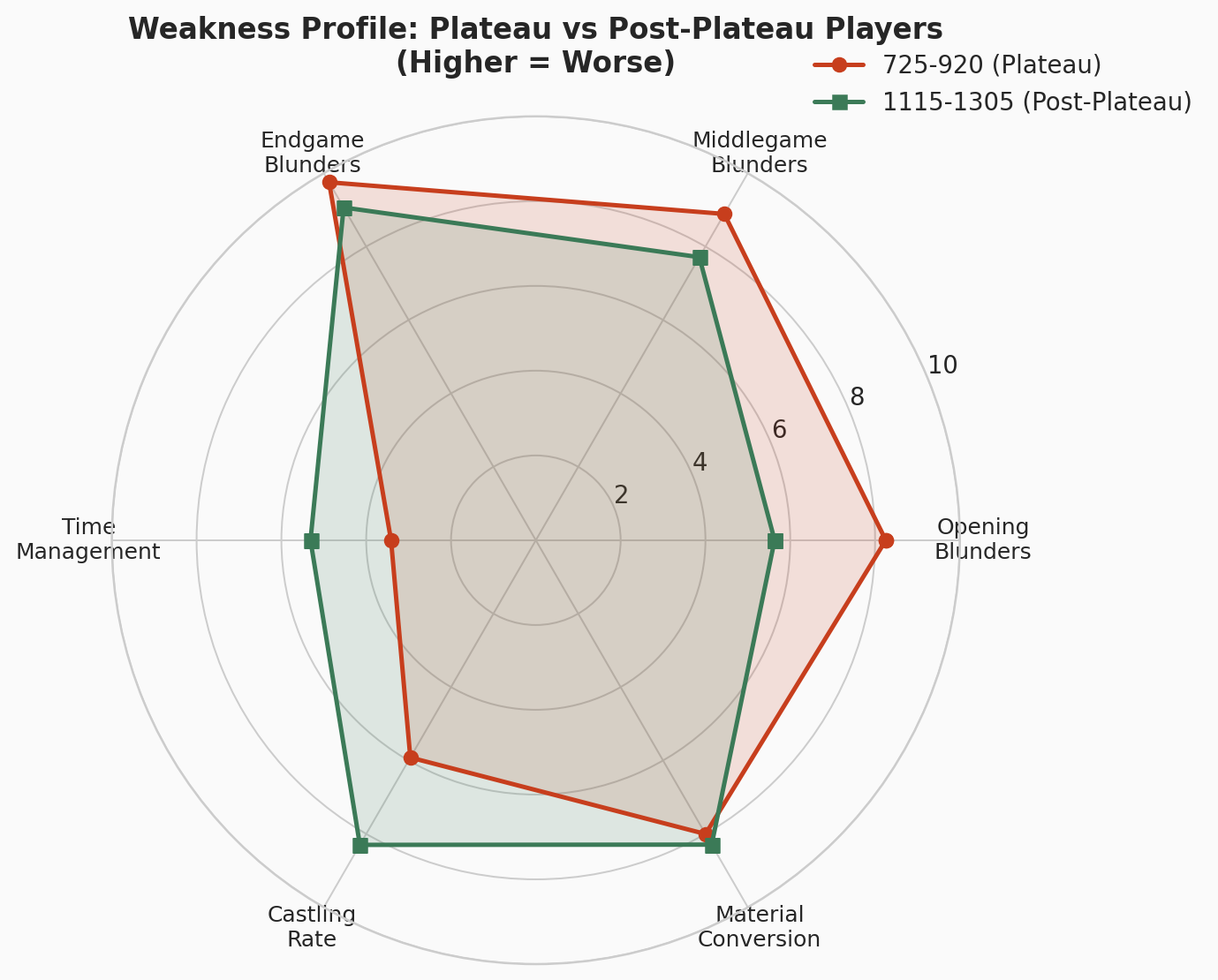
The post-plateau player has not eliminated blunders — the endgame and middlegame blunder rates remain stubbornly high. However, they have made targeted improvements in three specific areas:
Opening blunders are significantly reduced. The opening blunder rate drops from 16.2% to 11.0%, meaning the post-plateau player survives the opening more consistently and reaches playable middlegame positions.
Castling rate is dramatically higher. The post-plateau player castles in 60% of games (vs. 42.8%), indicating a much stronger commitment to king safety.
Material conversion is improved. The post-plateau player converts a minor piece advantage into a win 67.1% of the time (vs. 63.4%), reflecting better endgame technique and time management.
The Complete Improvement Roadmap
The following table summarizes the key metrics across all phases and the specific improvements needed to break through 1000 Elo.
| Area | Key Metric | 725-920 (Plateau) | 1115-1305 (Post-Plateau) | Priority |
|---|---|---|---|---|
| Opening | Blunder Rate | 16.2% | 11.0% | HIGH |
| Opening | Castling Rate | 42.8% | 60.0% | HIGH |
| Opening | First Blunder Move | Move 19.9 | Move 24.8 | HIGH |
| Middlegame | Blunder Rate | 40.8% | 35.4% | MEDIUM |
| Middlegame | "Winning" Blunders | 40.1% | 31.4% | MEDIUM |
| Endgame | Material Conversion (Pawn Up) | 55.3% | 57.3% | MEDIUM |
| Endgame | Material Conversion (Piece Up) | 63.4% | 67.1% | MEDIUM |
| Psychology | Tilt Resistance | 54.1% loss after 5-streak | ~54% | HIGH |
| Psychology | Games Ending in Equal Position | 53.7% | 53.1% | LOW |
The data is unambiguous: the fastest path to 1000 Elo in Bullet Chess is to (1) stop hanging pieces in the opening, (2) castle in every game, (3) drill basic tactics for instant pattern recognition, (4) learn to convert material advantages quickly, and (5) manage tilt by setting strict stop-loss rules.
Data and Methodology
This analysis is based on a sample of approximately 283,000 Bullet games played on Lichess.org, distributed across six rating bands from Lichess 975 to Lichess 2000 (approximately Chess.com 450 to Chess.com 1930). The data was collected and analyzed using the Grandmaster Guide MCP analytics platform, which provides pre-computed statistics on CPL, blunder rates, termination types, castling outcomes, streak effects, material conversion, and other metrics.
Because Lichess ratings are generally higher than Chess.com ratings for the same skill level, we applied a conversion mapping based on the official cross-platform rating comparison tables. All chart labels and in-text references use Chess.com Bullet ratings. The Lichess equivalents are provided in the introduction table for cross-reference.
The underlying raw data used to generate the charts and insights in this article can be found in the attached CSV files:
| Data File | Description | ||||||||||||||||||||||||||||||||||||||||||||||||
|---|---|---|---|---|---|---|---|---|---|---|---|---|---|---|---|---|---|---|---|---|---|---|---|---|---|---|---|---|---|---|---|---|---|---|---|---|---|---|---|---|---|---|---|---|---|---|---|---|---|
|
Average CPL and error rates by rating band | ||||||||||||||||||||||||||||||||||||||||||||||||
|
CPL, draw rate, and game length by time control | ||||||||||||||||||||||||||||||||||||||||||||||||
|
Blunder/mistake/inaccuracy rates by game phase | ||||||||||||||||||||||||||||||||||||||||||||||||
|
Blunder distribution by position evaluation | ||||||||||||||||||||||||||||||||||||||||||||||||
|
Impact of losing streaks on subsequent performance | ||||||||||||||||||||||||||||||||||||||||||||||||
|
Win rates when ahead in material | ||||||||||||||||||||||||||||||||||||||||||||||||
|
Castling frequency and win rates by scenario | ||||||||||||||||||||||||||||||||||||||||||||||||
|
Average move number of first blunder | ||||||||||||||||||||||||||||||||||||||||||||||||
|
Game length distribution statistics | ||||||||||||||||||||||||||||||||||||||||||||||||
|
Average absolute evaluation by game phase | ||||||||||||||||||||||||||||||||||||||||||||||||
|
Distribution of game-ending evaluations | ||||||||||||||||||||||||||||||||||||||||||||||||
|
Normal vs. time forfeit termination rates | ||||||||||||||||||||||||||||||||||||||||||||||||
|
Plateau duration and frequency statistics |
Chess Coach, April 14, 2026