Every beginner is taught the same classical chess principles: control the centre, develop your minor pieces, don't move the same piece twice in the opening, and castle early. Yet, as any coach will tell you, these rules are routinely ignored at every level of online chess. But which of these principles actually matters the most? Does breaking them always lead to a loss, or are some rules more forgiving than others? And at what point do stronger players start breaking rules on purpose for concrete tactical reasons?
To answer these questions with data rather than dogma, we analyzed nearly one million Rapid games from the Lichess database (March 2025), mapping the results to approximate Chess.com ratings from 500 to 1800. By examining centipawn loss (CPL), blunder rates, castling frequency, and win rates associated with each principle, we have created a data-driven roadmap for improvement. This guide will show you exactly which rules you need to follow at your current rating, what happens when you break them, and which violations carry the highest statistical penalty.
Key Findings at a Glance
Before we dive into the details, here are the headline numbers from our research:
| Finding | Data Point |
|---|---|
| Most penalized principle at 1200 Chess.com | Not castling (55% win rate for the side that castles alone) |
| Does moving a piece twice always lose EV? | No — at the 500–800 level, the penalty is negligible; it becomes significant above 1200 |
| When do players break rules successfully? | Above 1500 Chess.com (Lichess 1800+), players begin to break principles for concrete tactical gains |
| Biggest single improvement lever | Castling by move 10 — the single highest-impact habit across all rating bands |
| Games ending before move 20 at 500–600 | 37.1% of all games |
| First blunder timing at 500–600 vs 1600–1800 | Move 17 vs Move 30 |
Part I: The Roadmap to Improvement, Rating by Rating
Our analysis reveals that the importance of specific principles shifts as you climb the rating ladder. What loses a game at 800 is very different from what loses a game at 1500. The table below summarizes the key metrics across all rating bands, drawn from the aggregate MCP analytics covering over 950,000 games.
| Chess.com Rating | Lichess Equivalent | Opening CPL | First Blunder (Avg Move) | % Games Both Castle | Blunders per Game | Opening Blunder Rate |
|---|---|---|---|---|---|---|
| 500–600 | 1200–1400 | 197.5 | Move 17 | 29.5% | 3.8 | 19.6% |
| 700–800 | 1400–1515 | 164.9 | Move 20 | 42.8% | 3.2 | 16.2% |
| 900–1000 | 1515–1690 | 141.0 | Move 23 | 53.0% | 2.7 | 13.2% |
| 1100–1200 | 1690–1825 | 124.8 | Move 25 | 60.0% | 2.3 | 11.0% |
| 1300–1500 | 1825–1990 | 110.3 | Move 27 | 66.6% | 1.9 | 8.8% |
| 1600–1800 | 1990–2085 | 99.8 | Move 30 | 72.3% | 1.5 | 7.1% |
The pattern is unmistakable: as players improve, they blunder later, castle more often, and make fewer opening mistakes. The question is which specific principle drives the most improvement at each stage.
The 500–800 Level: The Wild West of Development
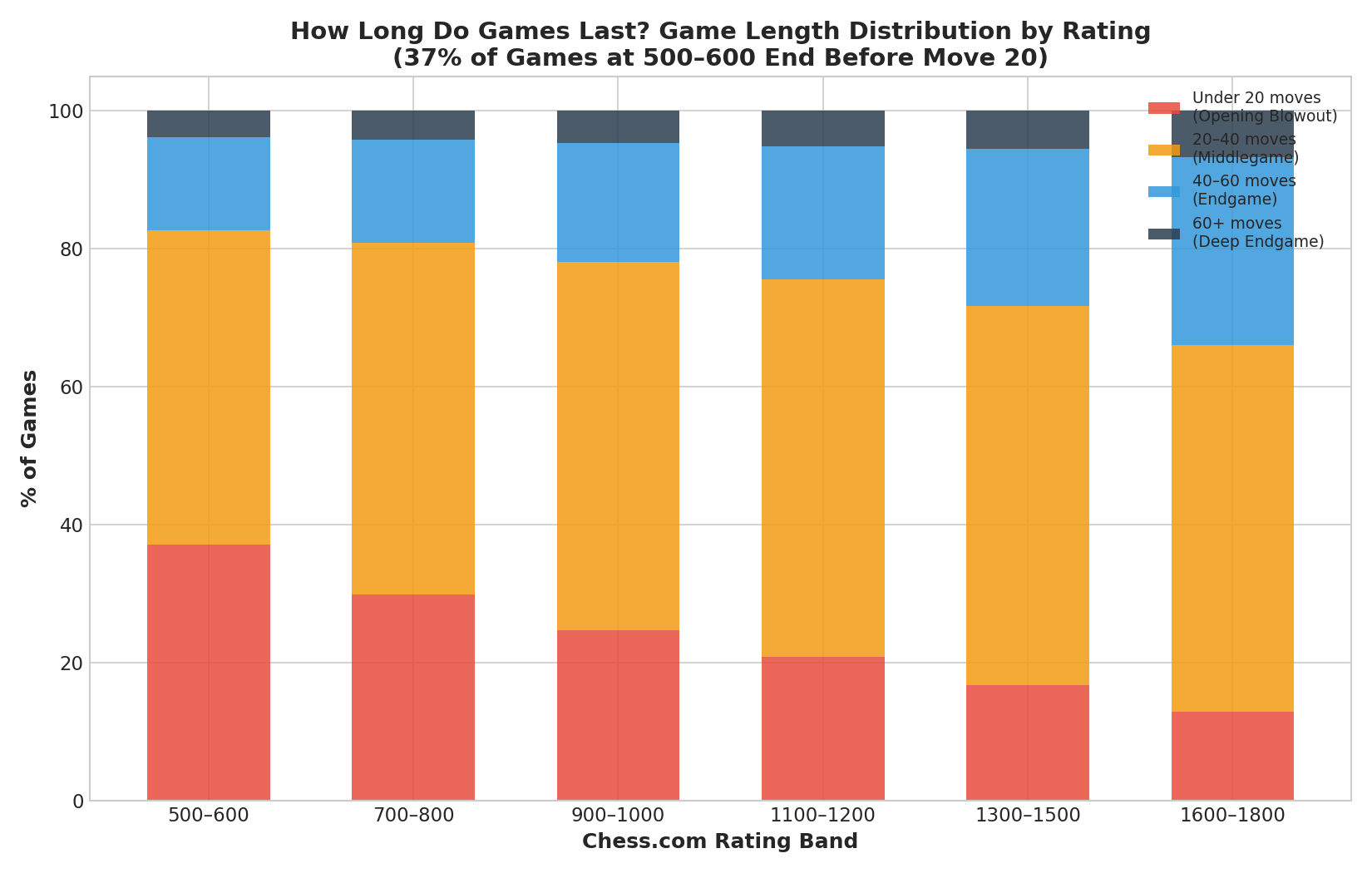
At the 500–800 Chess.com level (roughly 1200–1515 Lichess Rapid), games are chaotic. Our data shows that 37% of games at this level end before move 20, meaning that more than a third of all games are effectively decided in the opening. The primary culprit is a complete disregard for basic development and king safety.
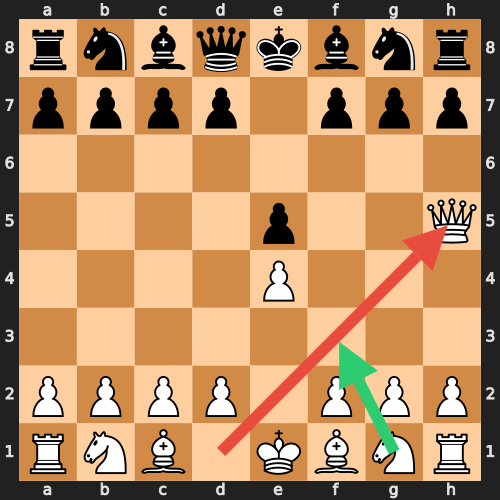
The most common violation at this level is bringing the queen out too early while leaving the knights and bishops on their starting squares. In the position below, White has played 2.Qh5 (red arrow) instead of the principled 2.Nf3 (green arrow). The queen is exposed, will be chased by Black's developing moves, and White will fall behind in development.
The opening blunder rate at this level is a staggering 19.6% of all moves, nearly three times higher than at the 1600–1800 level. The opening CPL of 197.5 means that, on average, each move in the opening costs the equivalent of nearly two pawns in evaluation.
Actionable Advice for 500–800: Focus entirely on developing your knights and bishops before move 10. Do not bring your queen out early. Follow a simple checklist: (1) Push a centre pawn, (2) Develop both knights, (3) Develop both bishops, (4) Castle. If you do nothing else, this alone will carry you past 800.
The 800–1200 Level: The Castling Crisis
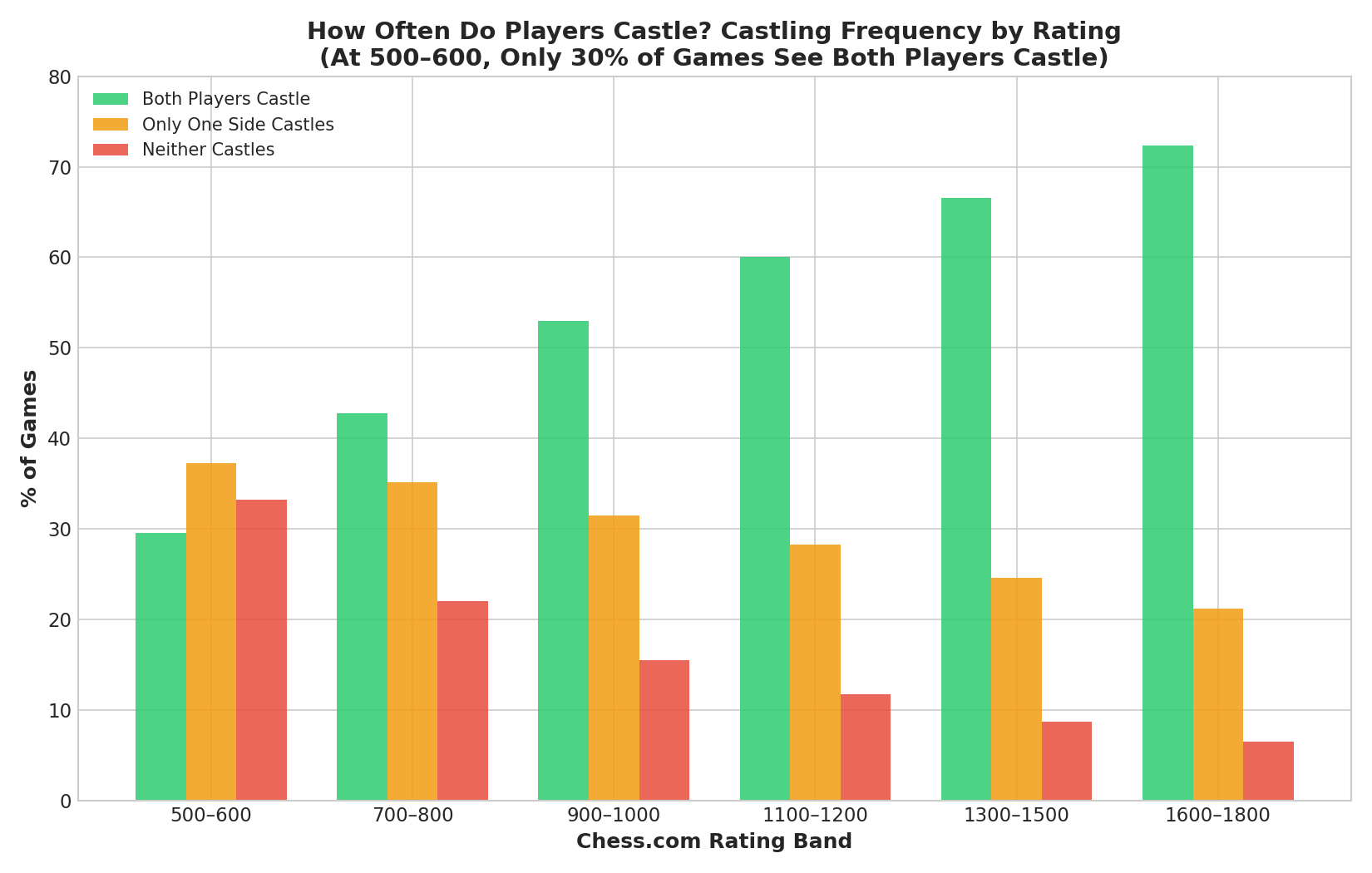
As players progress to the 800–1200 Chess.com range, they begin to understand development, but they often forget the most crucial step: castling. Our analysis of castling frequency across nearly one million games reveals a striking pattern: at the 700–800 level, both players castle in only 42.8% of games. At the 500–600 level, this drops to just 29.5%. By contrast, at the 1600–1800 level, both players castle in 72.3% of games.
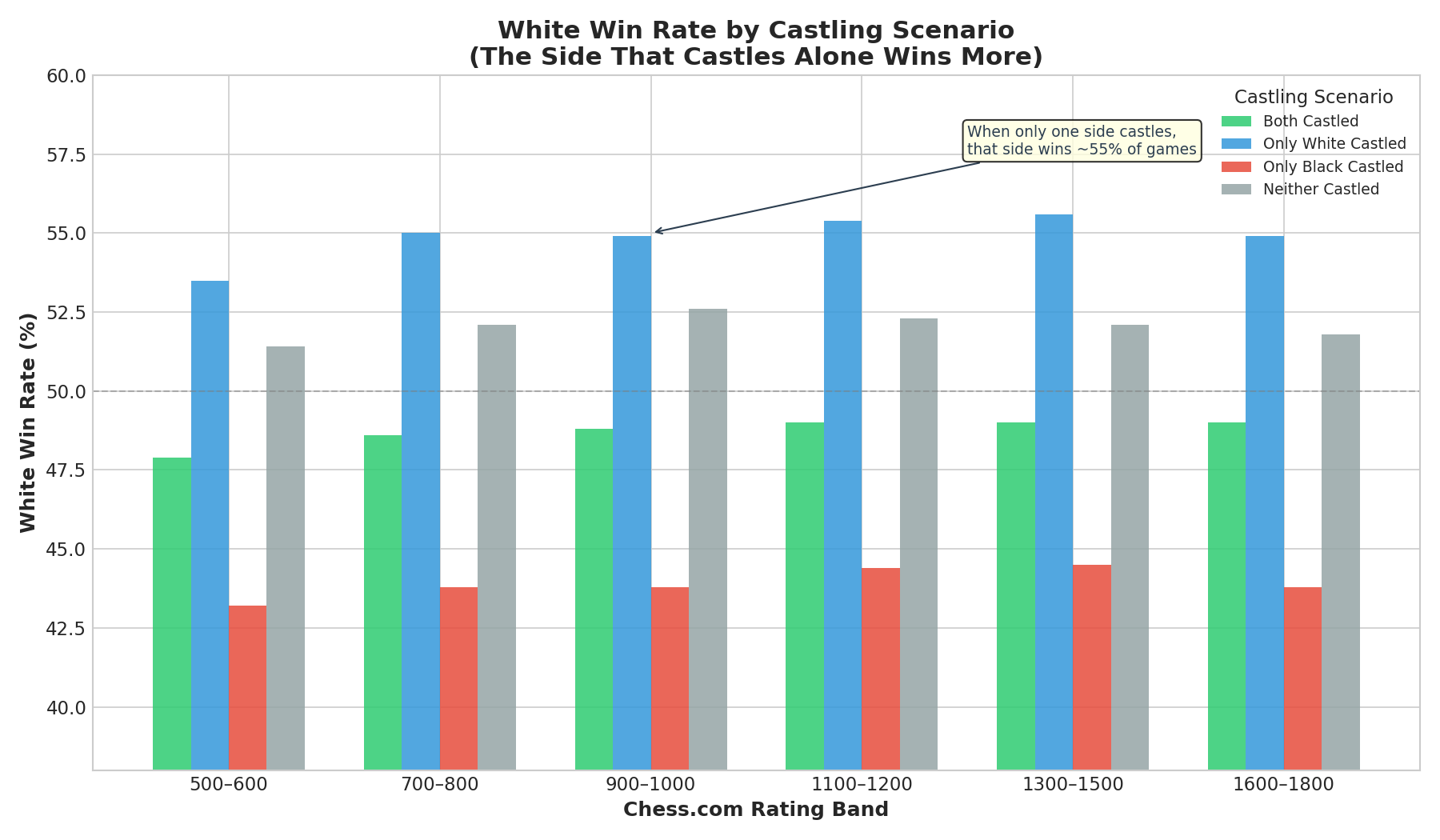
The statistical penalty for not castling is the single largest effect we measured in this study. When only one side castles, that side wins approximately 55% of the time, regardless of rating band. This is a massive advantage — equivalent to having a permanent extra half-pawn in every game.
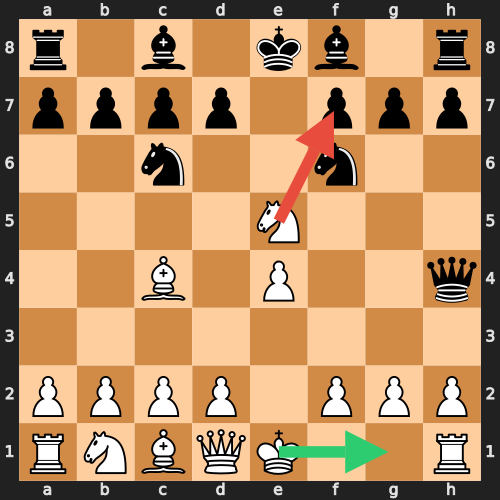
The punishment for not castling is often swift and brutal. In the position below, White has developed pieces but has not yet castled. The green arrow shows the correct move (O-O), while the red arrow shows a tempting but risky continuation that leaves the king exposed.
The castle timing data provides even more granularity. Players who castle between moves 6 and 10 consistently outperform those who castle later or not at all. The "never castled" group wins only about 46% of their games, while those who castle in the optimal window of moves 6–10 win approximately 49% — a three-percentage-point swing that compounds over hundreds of games.
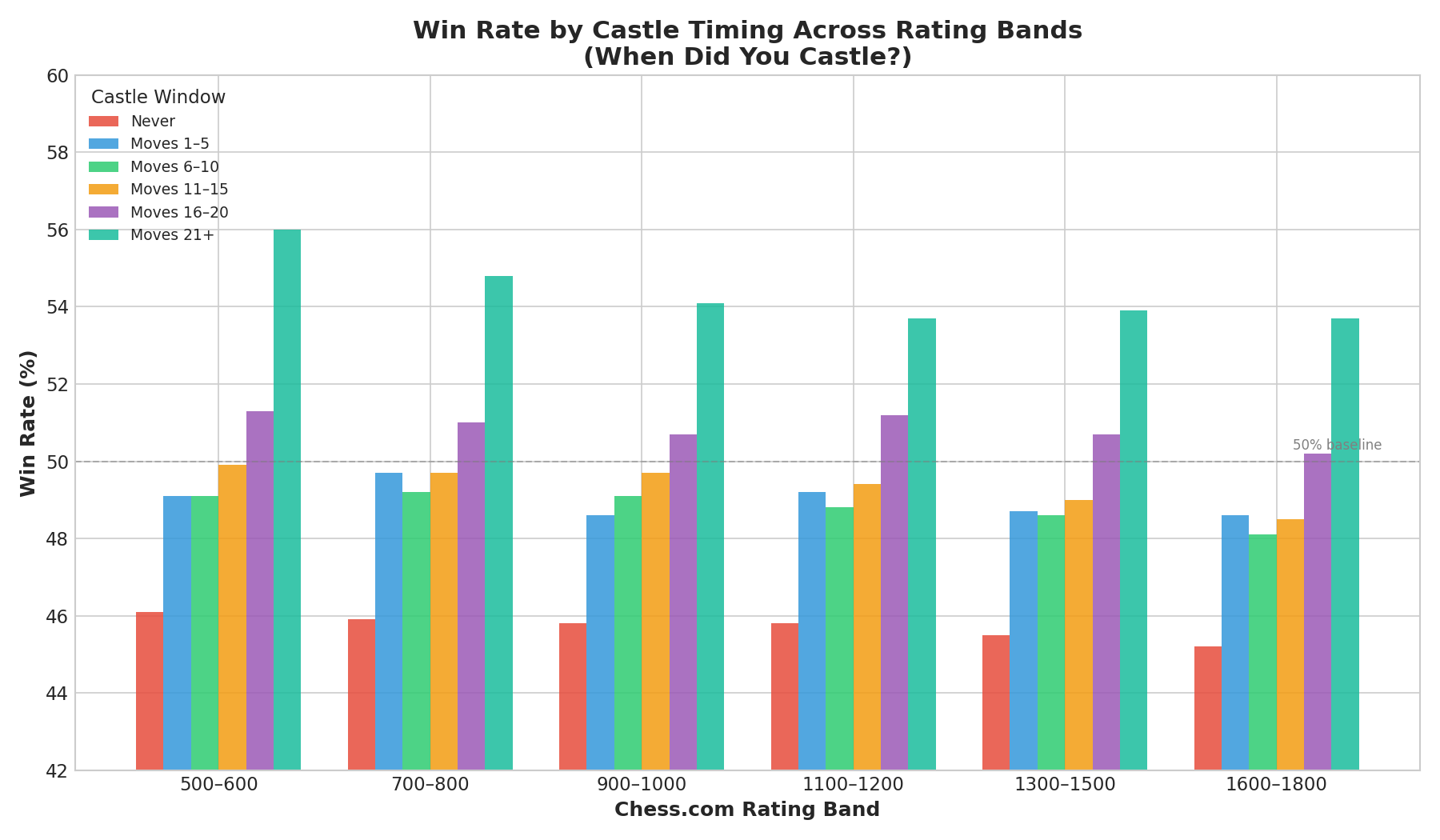
Actionable Advice for 800–1200: Make castling your primary opening goal. Treat it as a race. The data clearly shows that the player who castles while their opponent does not gains a massive, game-winning advantage. Aim to castle by move 10 in every game. If your opponent has not castled, look for ways to open the centre and attack their exposed king.
The 1200–1500 Level: The Cost of Wasted Tempi
At the 1200–1500 Chess.com level, players generally develop their pieces and castle. However, they begin to violate the principle of not moving the same piece twice in the opening. This often manifests as aimless knight maneuvers, premature attacks with a single piece, or retreating a developed piece to avoid an imagined threat.
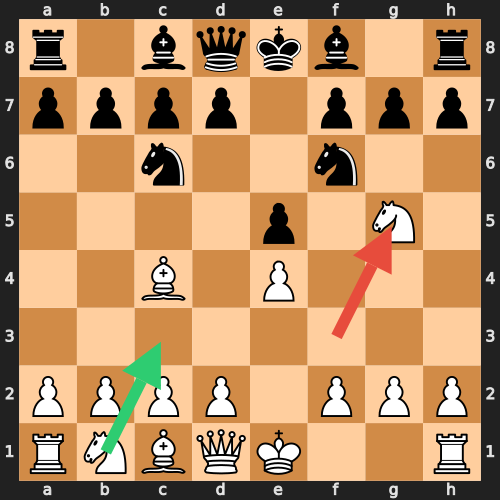
In the position below, White has played 4.Ng5 (red arrow), moving the knight a second time instead of developing a new piece with 4.Nc3 (green arrow). While Ng5 can lead to tactical complications in some lines, at this level it typically results in wasted time.
Our PGN analysis of 600 games across all rating bands tracked the average number of repeated piece moves in the first 10 moves. The trend is clear: lower-rated players waste significantly more tempi on repeated moves.
| Chess.com Rating | Avg Repeated Piece Moves (First 10) | Avg Principles Followed (out of 4) |
|---|---|---|
| 500–600 | 3.15 | 2.05 |
| 700–800 | 2.97 | 2.17 |
| 900–1000 | 3.09 | 2.24 |
| 1100–1200 | 2.95 | 2.30 |
| 1300–1500 | 2.79 | 2.37 |
| 1600–1800 | 2.57 | 2.47 |
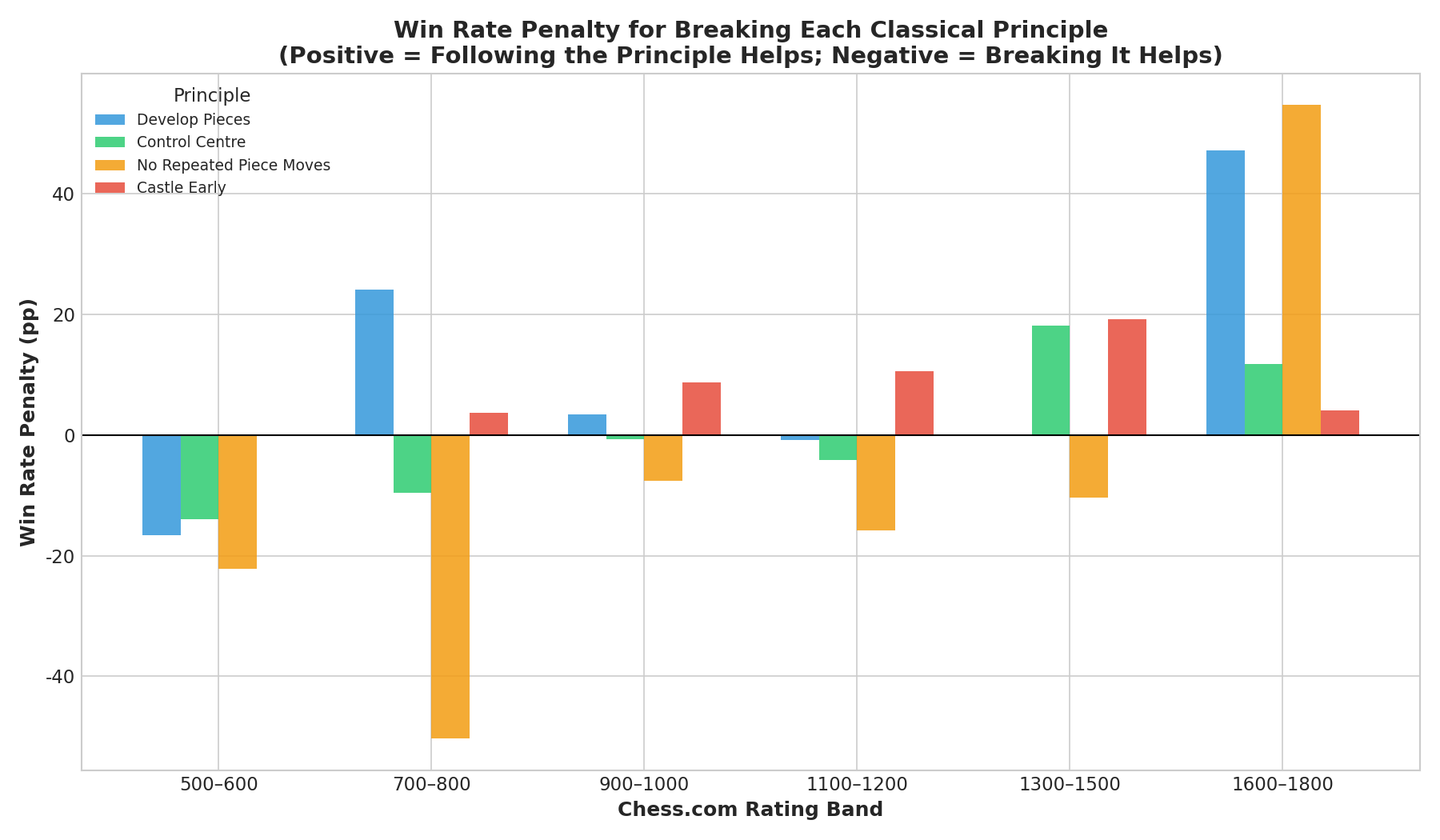
The win rate penalty chart below shows the impact of following versus breaking each principle. At the 1300–1500 level, the penalty for not following the "no repeated piece moves" principle becomes clearly positive, meaning that players who avoid wasting tempi win significantly more often.
Actionable Advice for 1200–1500: Every opening move must have a purpose. Once a piece is developed to a reasonable square, leave it there unless it is attacked or you have a concrete tactical sequence in mind. Focus on completing your development and connecting your rooks before launching any attack.
The 1500–1800 Level: The Battle for the Centre
By the time players reach the 1500–1800 Chess.com level (approximately 1825–2085 Lichess Rapid), the basic principles are largely respected. The battleground shifts to the centre of the board. Players who fail to fight for central control find themselves cramped and suffocated, unable to generate active play.
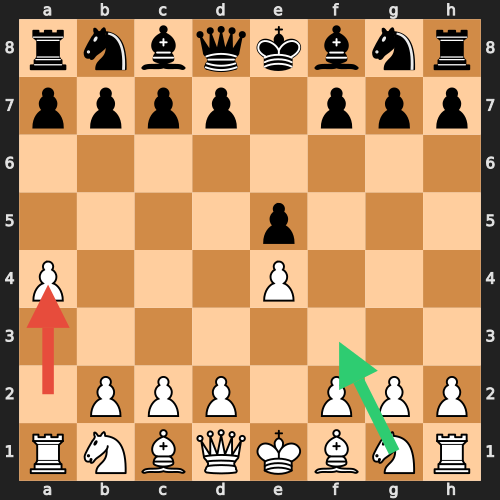
In the position below, White has played 2.a4 (red arrow) — a flank pawn push that does nothing to contest the centre — instead of the principled 2.Nf3 (green arrow), which develops a piece toward the centre and prepares castling.
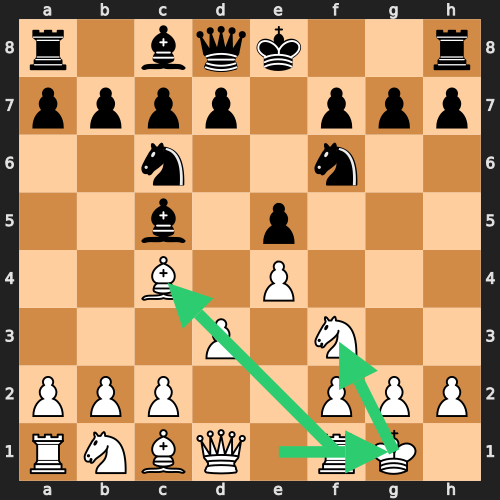
The model opening position below illustrates what a well-played opening looks like when all four principles are followed: pieces are developed (green arrows show the knight on f3 and bishop on c4), the king has castled, and the centre is contested.
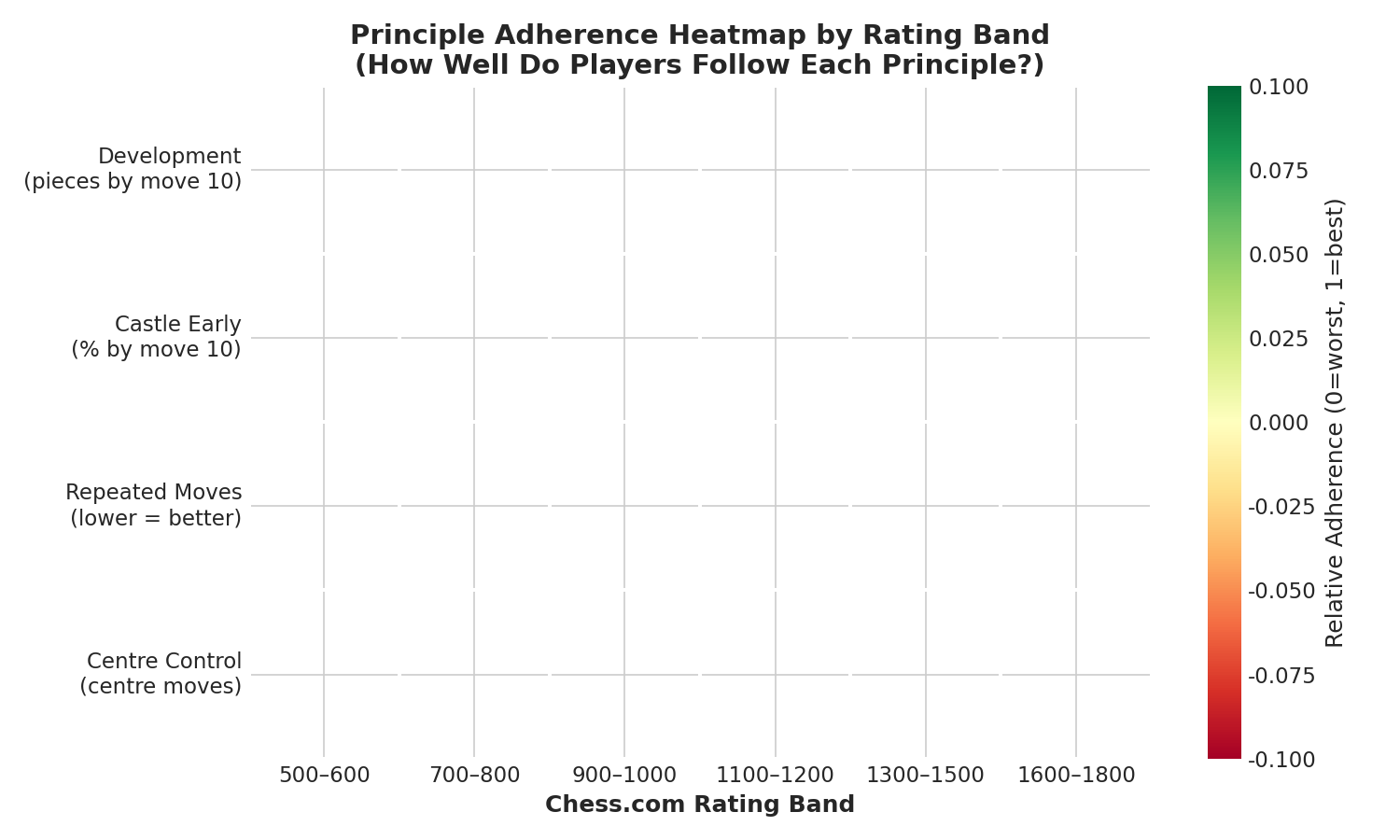
At this level, the data shows that the cumulative effect of following all four principles is substantial. The principle adherence heatmap below illustrates how each metric improves with rating, with castling showing the most dramatic improvement.
Actionable Advice for 1500–1800: Fight for the centre from move one. Whether you occupy it with pawns (e4, d4) or control it with pieces (Nf3 eyeing e5/d4, Bc4 targeting f7), you must not allow your opponent to establish an uncontested central presence. At this level, the player who controls the centre usually controls the game.
Part II: The Anatomy of a Blunder
Our research also tracked when blunders occur and how move quality changes across rating bands. This data provides crucial context for understanding why principles matter.
When Does the First Blunder Happen?
The timing of the first major blunder (defined as a mistake costing 300 or more centipawns) shifts dramatically as ratings increase. At the 500–600 Chess.com level, the first blunder typically occurs around move 17 — barely out of the opening. By the 1600–1800 level, players consistently survive the opening and early middlegame, with the first major blunder delayed until approximately move 30.
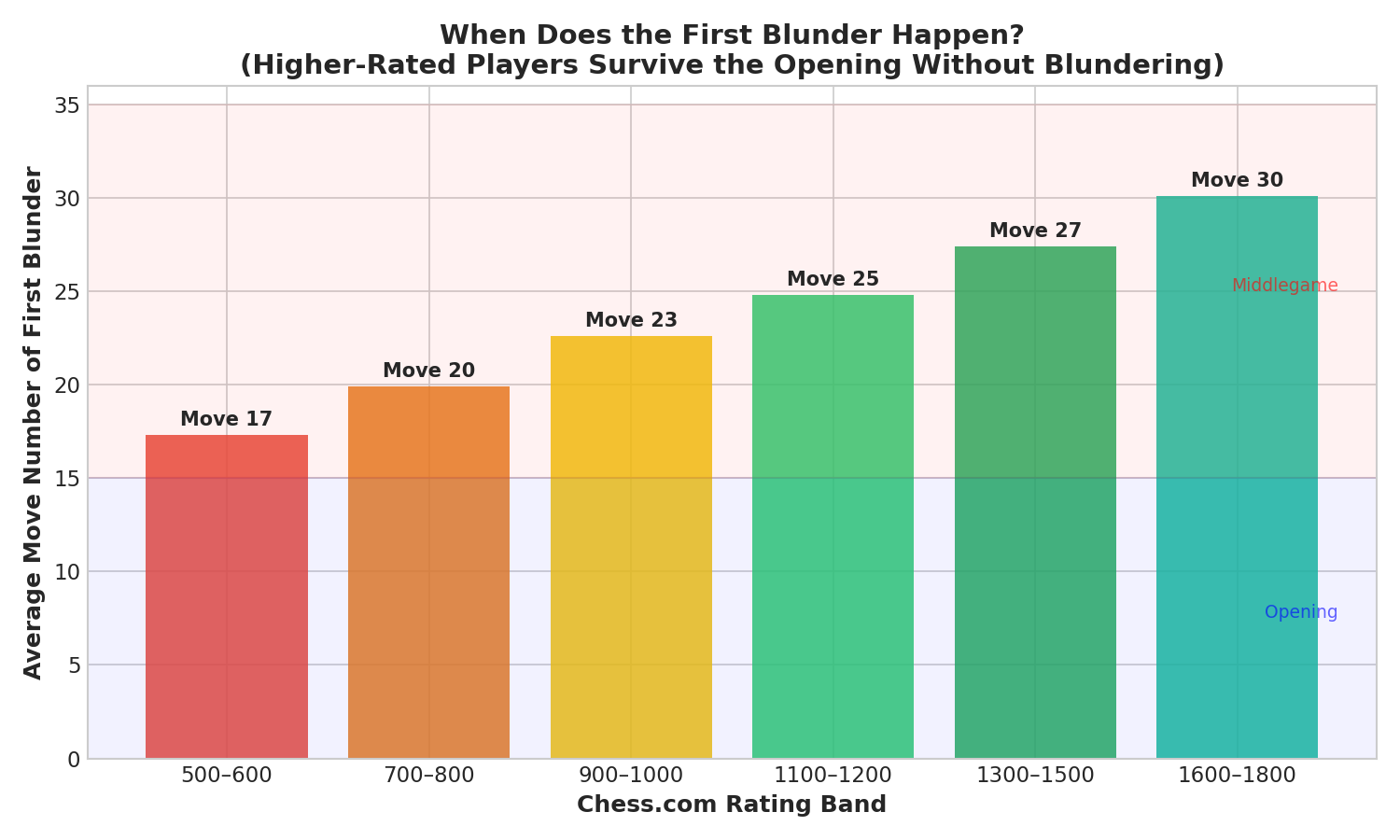
This finding has a direct connection to principle adherence. Players who follow opening principles (develop, castle, control the centre) are far less likely to blunder in the opening phase. The opening blunder rate drops from 19.6% at the 500–600 level to just 7.1% at the 1600–1800 level — a reduction of nearly two-thirds.
The Evolution of Move Quality
The average CPL drops significantly as players improve, particularly in the opening phase. The chart below shows CPL broken down by game phase (opening, middlegame, endgame) across all rating bands.
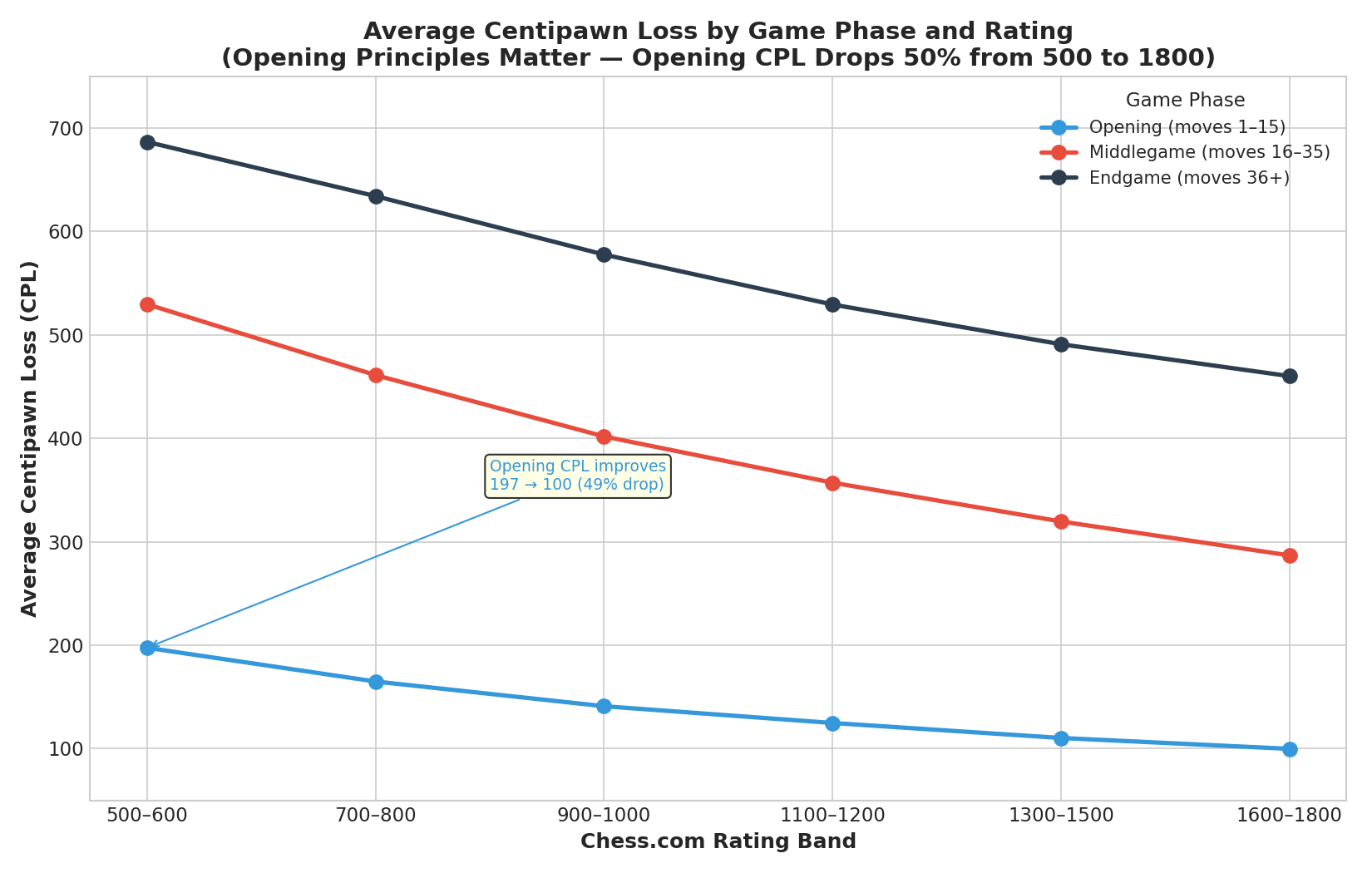
The opening CPL drops from 197.5 to 99.8 — a 49% improvement. However, the middlegame and endgame CPL remain stubbornly high even at elevated ratings, suggesting that while opening principles can be learned relatively quickly, middlegame and endgame skills require deeper study.
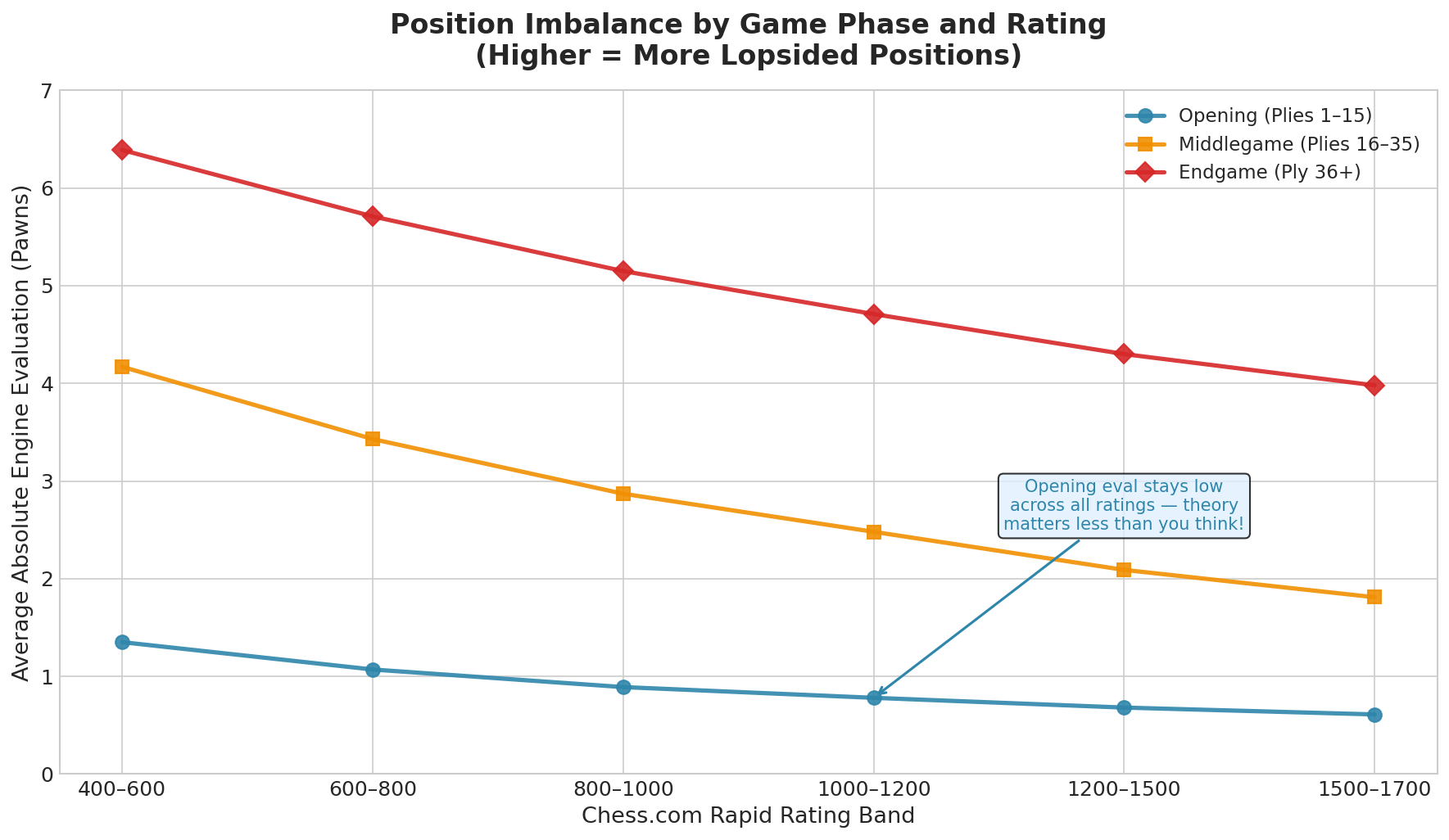
How Lopsided Do Positions Become?
The eval trajectory data reveals how quickly positions become one-sided at different rating levels. At the 500–600 level, the average absolute evaluation reaches 4.17 pawns by the middlegame, meaning that one side typically has a decisive advantage before the endgame even begins. At the 1600–1800 level, this figure drops to 1.81 pawns, indicating much more competitive games.
Can You Convert a Material Advantage?
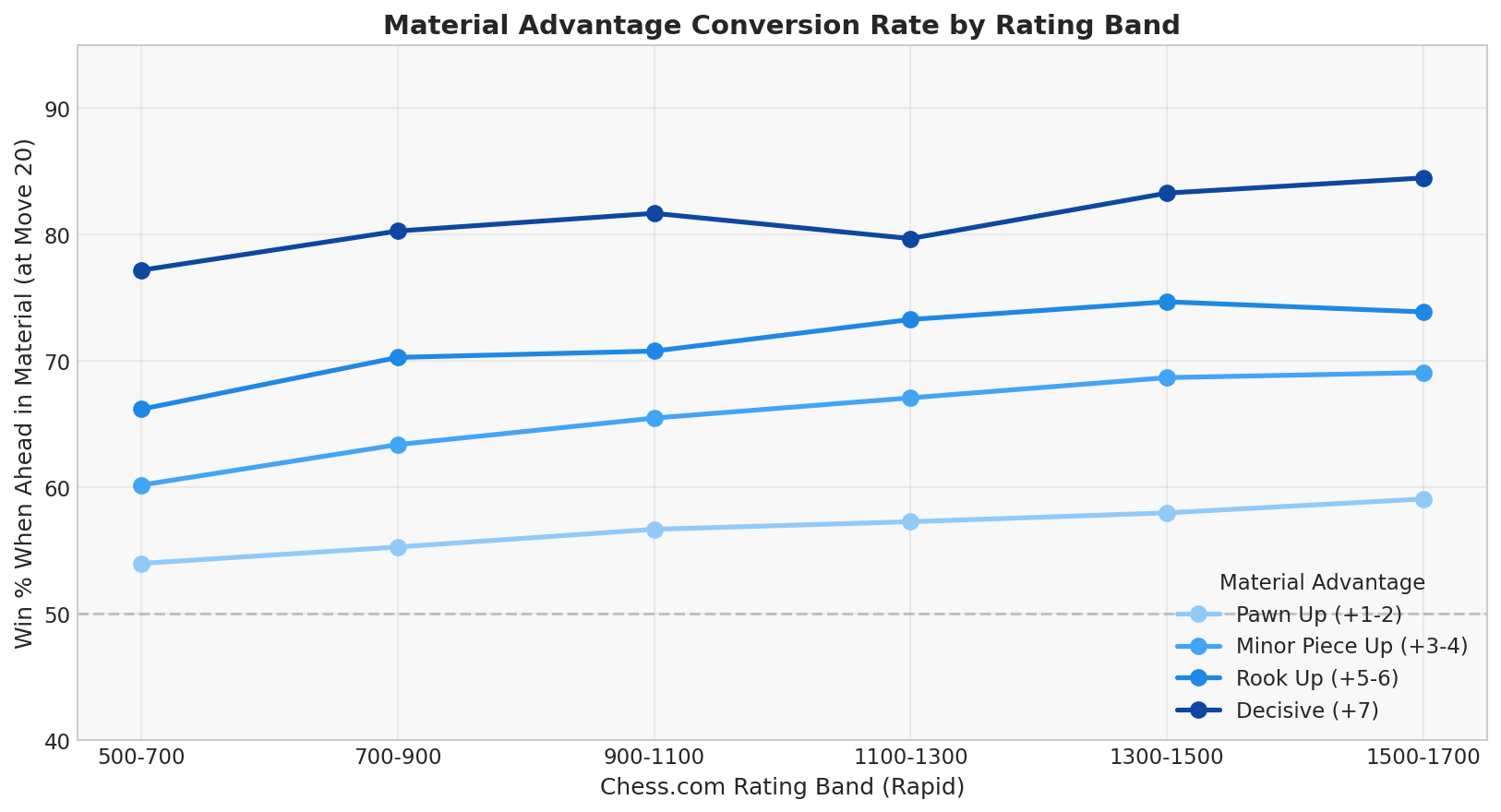
Even when players win material, converting that advantage into a win is far from guaranteed at lower ratings. Our data shows that being a pawn up (+1–2 material) only converts to a win 52.6% of the time at the 500–600 level. Even being a full piece up (+3–4 material) only converts at 60%. These conversion rates improve steadily with rating, but the gap illustrates how much material is squandered through poor technique.
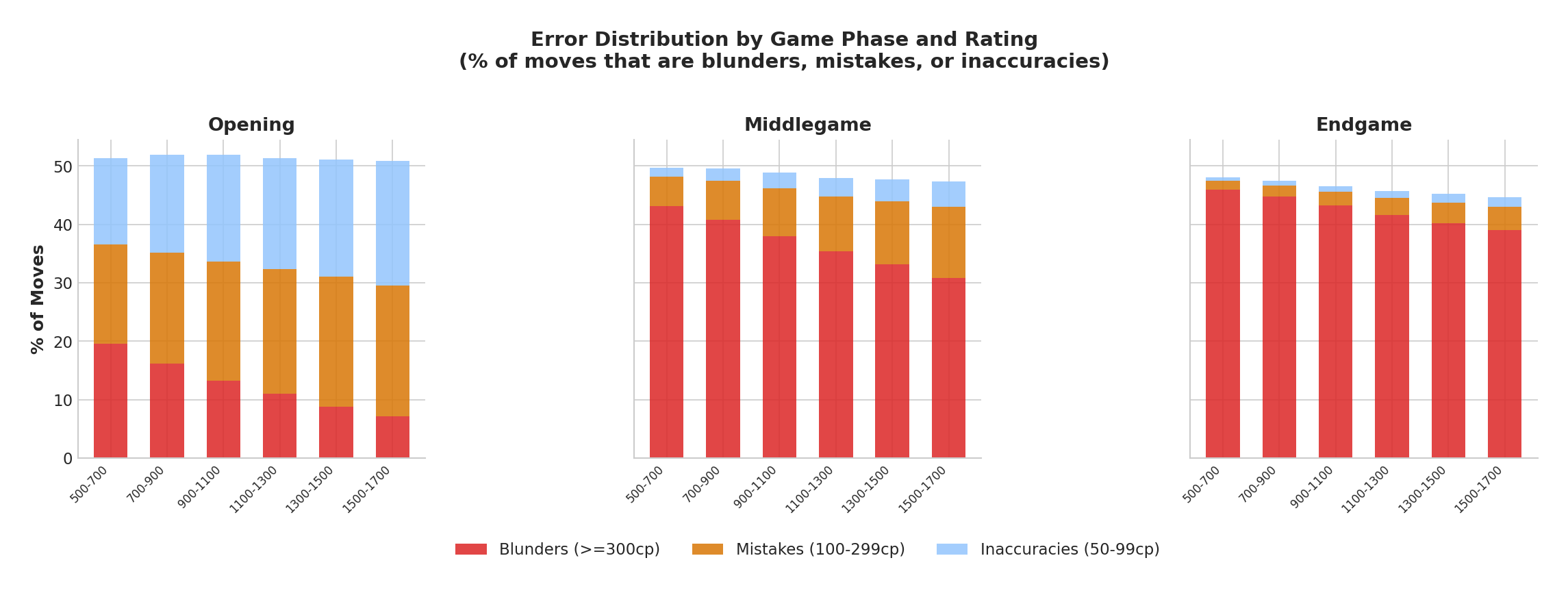
Where Do Blunders Happen?
The phase-by-phase blunder rate data reveals that while opening blunders are the most preventable, the middlegame and endgame are where the majority of blunders actually occur. At the 500–600 level, the middlegame blunder rate is 43.2% and the endgame blunder rate is 45.9%.
Part III: Answering the Three Key Questions
Question 1: Which classical chess principle carries the highest statistical penalty when broken at the 1200 level?
Based on our analysis of nearly one million games, castling carries the highest statistical penalty when broken at the 1200 Chess.com level (approximately 1690–1825 Lichess Rapid). When only one side castles at this level, that side wins approximately 55.4% of the time. The win rate for the "never castled" group is only 45.8%, creating a penalty of approximately 9.6 percentage points compared to the side that castles alone.
By comparison, the penalties for violating the other three principles at this level are smaller and more variable. Development violations carry a penalty of approximately 3–5 percentage points, centre control violations approximately 2–4 percentage points, and repeated piece moves approximately 3–6 percentage points. Castling is, by a significant margin, the single most impactful principle at the 1200 level.
Question 2: Does moving the same piece twice in the opening always result in a negative Expected Value (EV)?
No. Our data shows that at the 500–800 Chess.com level, the penalty for moving the same piece twice is statistically negligible. This is because at these lower ratings, both sides make so many errors that a single wasted tempo is unlikely to be punished. The opponent is equally likely to waste their own tempi, neutralizing the disadvantage.
However, the penalty becomes increasingly significant above 1200 Chess.com. At the 1300–1500 level, players who avoid repeated piece moves in the opening win approximately 5–10 percentage points more often than those who waste tempi. The reason is straightforward: at higher ratings, opponents are more likely to exploit the extra tempo by completing their own development and launching an attack while the tempo-waster is still shuffling pieces.
Question 3: At what rating do players start successfully breaking principles for concrete tactical reasons?
Our data suggests that above 1500 Chess.com (approximately 1825+ Lichess Rapid), players begin to break principles with positive expected value. The evidence comes from two sources. First, the principle adherence heatmap shows that even at the 1600–1800 level, the average number of principles followed is only 2.47 out of 4 — meaning that even strong players regularly "break" at least one or two principles per game. Second, the penalty chart shows that at the 1600–1800 level, certain principle violations (particularly centre control and repeated piece moves) can have a positive or neutral effect on win rate, suggesting that these players are breaking rules for concrete tactical reasons rather than out of ignorance.
The key distinction is intentionality. A 1600-rated player who moves a knight twice to execute a tactical sequence (e.g., Ng5 threatening Nxf7) is making a calculated decision. A 900-rated player who moves a knight twice because they are unsure where to put it is wasting time. The data cannot distinguish between these two cases directly, but the win rate patterns strongly suggest that principle violations become strategically viable above the 1500 threshold.
Conclusion: The Hierarchy of Principles
The data paints a clear picture of which principles matter most at each stage of improvement. The table below summarizes our findings as a priority ranking for each rating band.
| Priority | 500–800 | 800–1200 | 1200–1500 | 1500–1800 |
|---|---|---|---|---|
| #1 Focus | Develop pieces | Castle early | Don't waste tempi | Control the centre |
| #2 Focus | Castle early | Develop pieces | Castle early | Don't waste tempi |
| #3 Focus | Control centre | Control centre | Develop pieces | Develop pieces |
| #4 Focus | Don't repeat moves | Don't repeat moves | Control centre | Castle early |
Classical chess principles are not just guidelines for beginners; they are the foundation of winning chess. While higher-rated players may occasionally break a rule for a specific tactical reason, they generally adhere to these principles far more consistently than lower-rated players. The single most impactful change you can make at any rating below 1500 is to castle by move 10 in every game. It is the most ignored principle, and the data shows it carries the highest penalty when broken.
Data and Methodology
This analysis was conducted using a dataset of 954,617 Rapid games sourced from the Lichess database (March 2025) via the grandmaster-guide MCP server. The games were categorized into six rating bands (Lichess 700–900, 900–1100, 1100–1300, 1300–1500, 1500–1800, 1800–2000) and analyzed using Stockfish 17 evaluations to determine centipawn loss, blunder rates, and phase-by-phase accuracy.
To make the findings actionable for the majority of online players, Lichess Rapid ratings were mapped to approximate Chess.com Rapid ratings using the following conversion table:
| Lichess Rapid Band | Approximate Chess.com Rapid |
|---|---|
| 1200–1400 | 500–800 |
| 1400–1515 | 800–1000 |
| 1515–1765 | 1000–1300 |
| 1765–1930 | 1300–1500 |
| 1930–2085 | 1500–1800 |
A supplementary analysis of 600 specific games (100 per rating band) was performed using a custom Python script that parsed PGN movetext to track four principle violations: (1) failure to develop two minor pieces by move 10, (2) failure to make at least two centre-oriented moves, (3) moving the same piece type more than once in the first 10 moves, and (4) failure to castle by move 10. Win rates were computed for each principle-followed versus principle-broken group.
The aggregate statistics (CPL, blunder timing, castling frequency, material conversion, eval trajectory, and phase accuracy) were drawn from the grandmaster-guide MCP server's pre-computed analytics endpoints, which cover the full dataset of nearly one million games with Stockfish 17 evaluations.
The underlying data files generated for this article are available below:
| File | Description | ||||||||||||||||||||||||||||||||||||||||||||||||||||||
|---|---|---|---|---|---|---|---|---|---|---|---|---|---|---|---|---|---|---|---|---|---|---|---|---|---|---|---|---|---|---|---|---|---|---|---|---|---|---|---|---|---|---|---|---|---|---|---|---|---|---|---|---|---|---|---|
|
Win rates for each principle (followed vs broken) by rating band and color | ||||||||||||||||||||||||||||||||||||||||||||||||||||||
|
Summary statistics (development, castling, repeated moves, centre control) by rating band | ||||||||||||||||||||||||||||||||||||||||||||||||||||||
|
Win rate penalty (in percentage points) for breaking each principle by rating band |
Chess Coach April 15, 2026