Every chess player learns the classical principles early on: develop your pieces, control the center, don't move the same piece twice in the opening, and castle early. These rules form the foundation of solid play. However, in the chaotic world of Bullet chess—where the clock is as dangerous as the opponent's pieces—players frequently abandon these principles in favor of cheap tricks, fast development, or immediate attacks.
But what is the actual statistical cost of breaking these rules? Does ignoring the center always lead to a loss? Is moving the same piece twice a guaranteed blunder? To answer these questions, we analyzed nearly one million Lichess Bullet games (954,617 games to be exact), mapping the data to Chess.com rating bands between 800 and 1500. By examining win rates, centipawn loss (CPL), and blunder frequencies, we can definitively quantify which principles matter most and when you can start breaking them.
This guide serves as a roadmap for improvement, specifically targeting players looking to climb from the 800 to 1500 rating range on Chess.com.
The Hierarchy of Principles: Which Rule Matters Most?
Before diving into the specifics of each rating band, it is crucial to understand the overall impact of breaking classical principles. Our analysis reveals a clear hierarchy of which rules carry the highest statistical penalty when ignored.
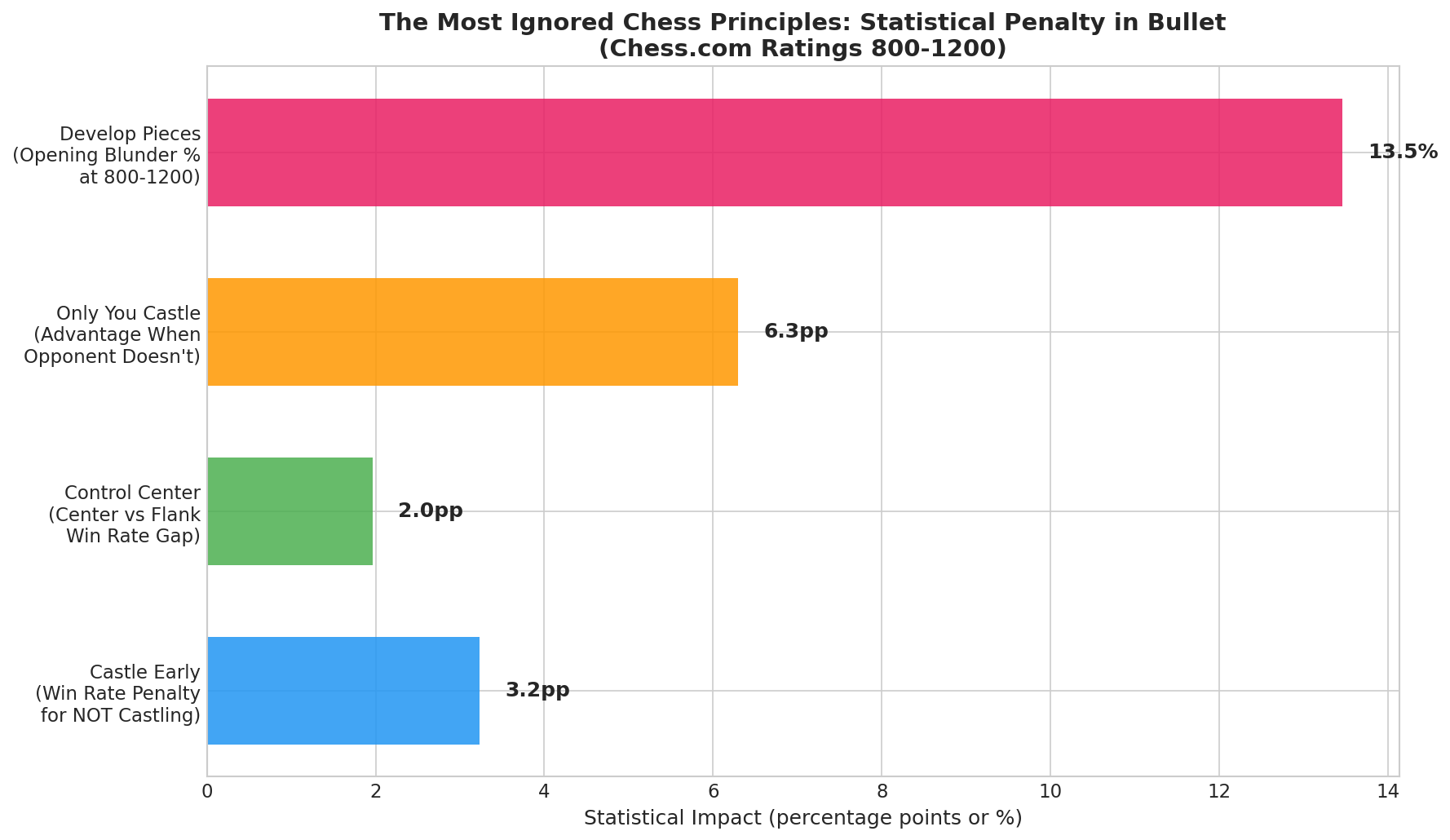
The data is unequivocal: King safety is paramount, even in Bullet chess. Failing to castle carries the most significant and consistent win rate penalty across all rating bands. Conversely, controlling the center with pawns becomes less critical as players improve their ability to control it with pieces.
Let us examine each principle in detail and how its importance evolves as you climb the rating ladder.
Principle 1: Castle Early (The Most Punished Violation)
The classical advice to "castle early and often" is frequently ignored in Bullet chess. Players often prioritize launching an immediate attack or grabbing a pawn, leaving their King stranded in the center. The data shows this is a critical mistake.
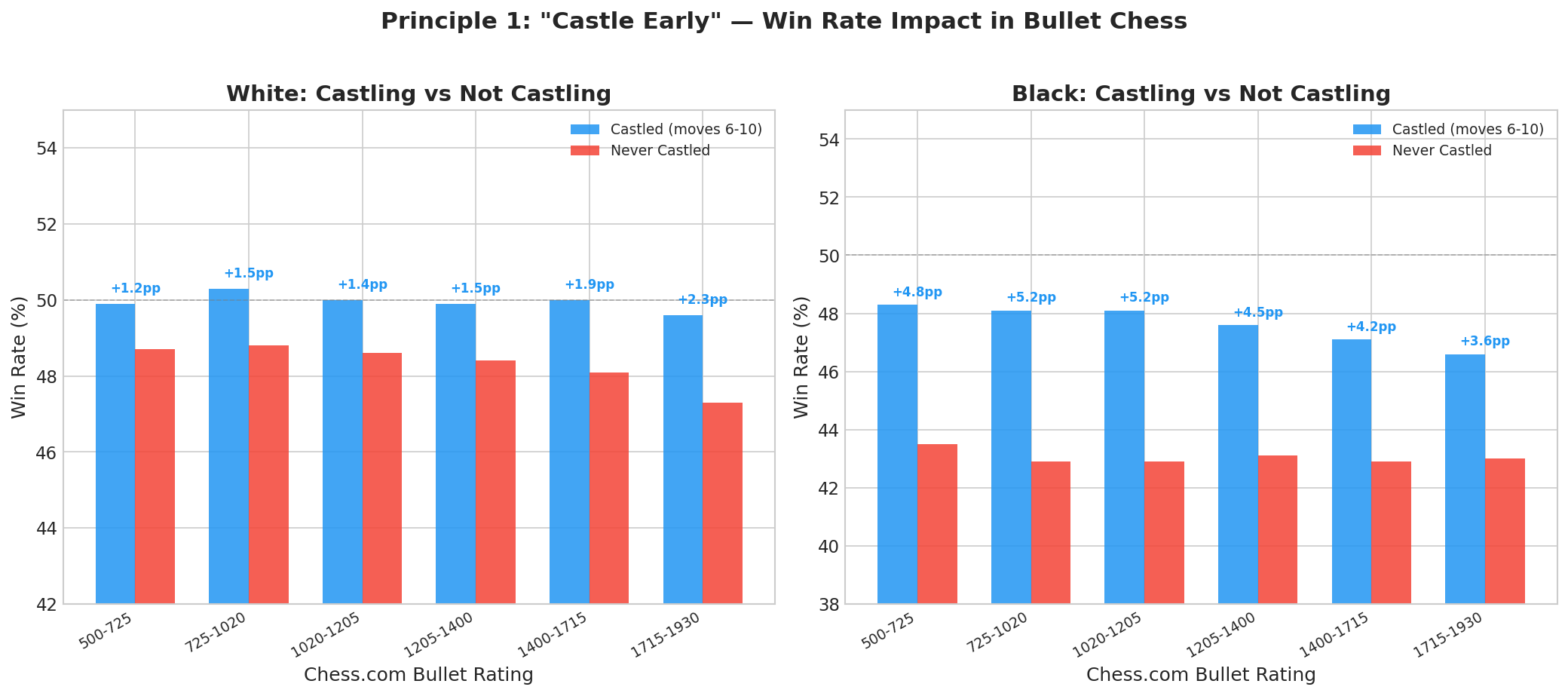
Across all rating bands from 800 to 1500, players who never castle suffer a significant win rate penalty compared to those who castle between moves 6 and 10. Interestingly, Black is punished far more severely for neglecting King safety than White. For Black, failing to castle results in a massive 4.5 to 5.2 percentage point drop in win rate. For White, the penalty is smaller (1.2 to 2.3 points) but still consistently negative.
The true power of castling, however, is revealed when we look at asymmetrical castling scenarios.
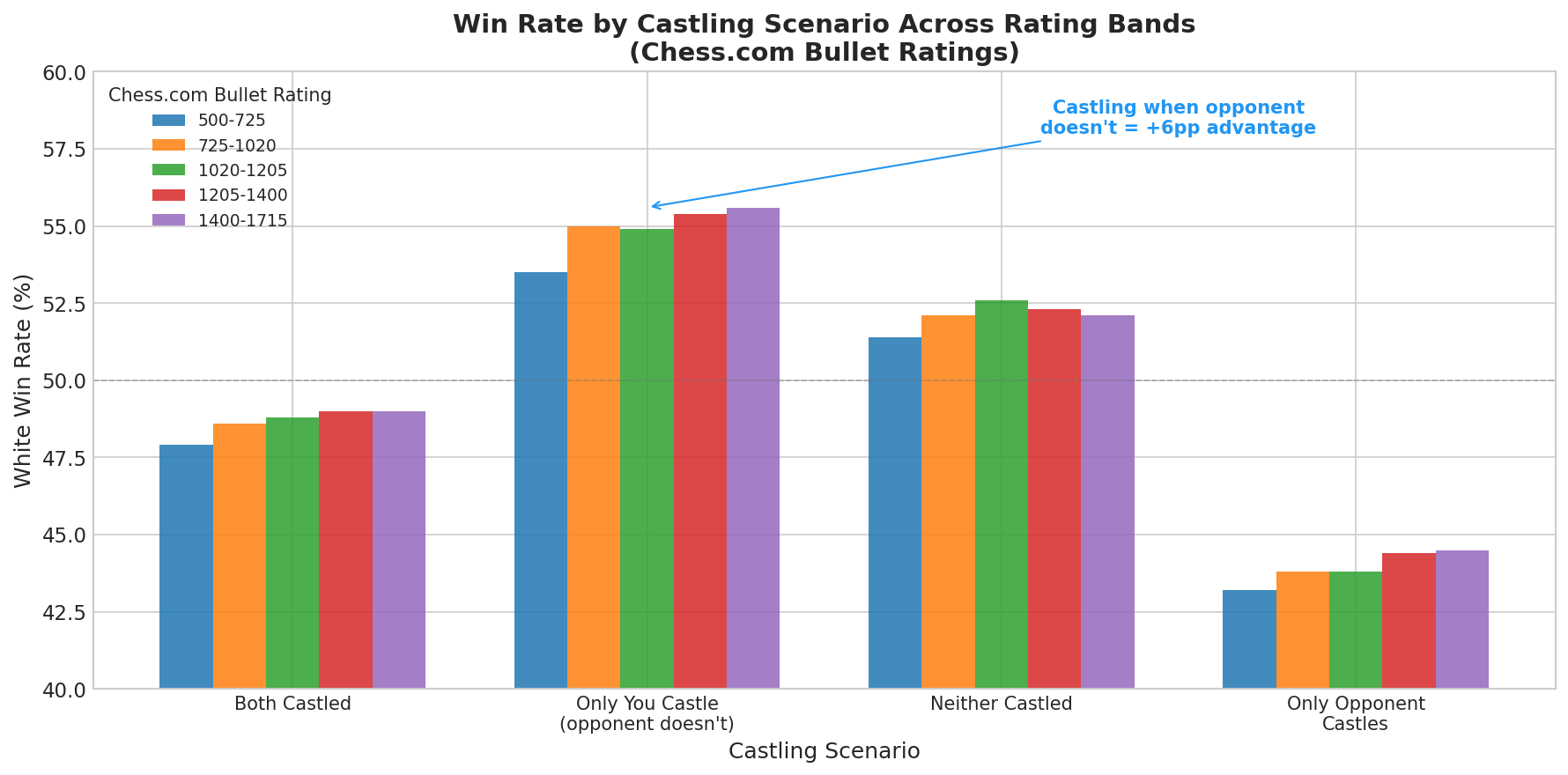
When you castle and your opponent does not, your win rate skyrockets. At the Chess.com 1020-1205 level, White wins 54.9% of games when only White castles, compared to just 48.8% when both players castle. This represents a massive +6.1 percentage point advantage simply for securing your King while your opponent neglects theirs.
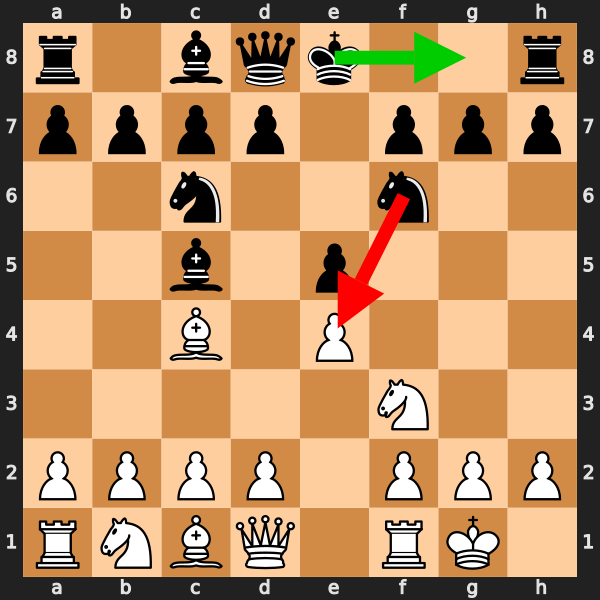
Actionable Advice (800-1200): Make castling a non-negotiable habit. Do not delay castling to grab a pawn or launch a premature attack. The statistical advantage of a safe King far outweighs the minor material gain.
Actionable Advice (1200-1500): Actively look to punish opponents who delay castling. If your King is safe and theirs is in the center, open lines and attack before they can secure their position.
Principle 2: Develop Your Pieces (The Accuracy Tax)
"Develop your pieces" is a broad principle, but it can be quantified by looking at opening accuracy and blunder rates. Bringing the Queen out too early or moving the same piece multiple times typically results in a higher Centipawn Loss (CPL) and a greater likelihood of blundering.
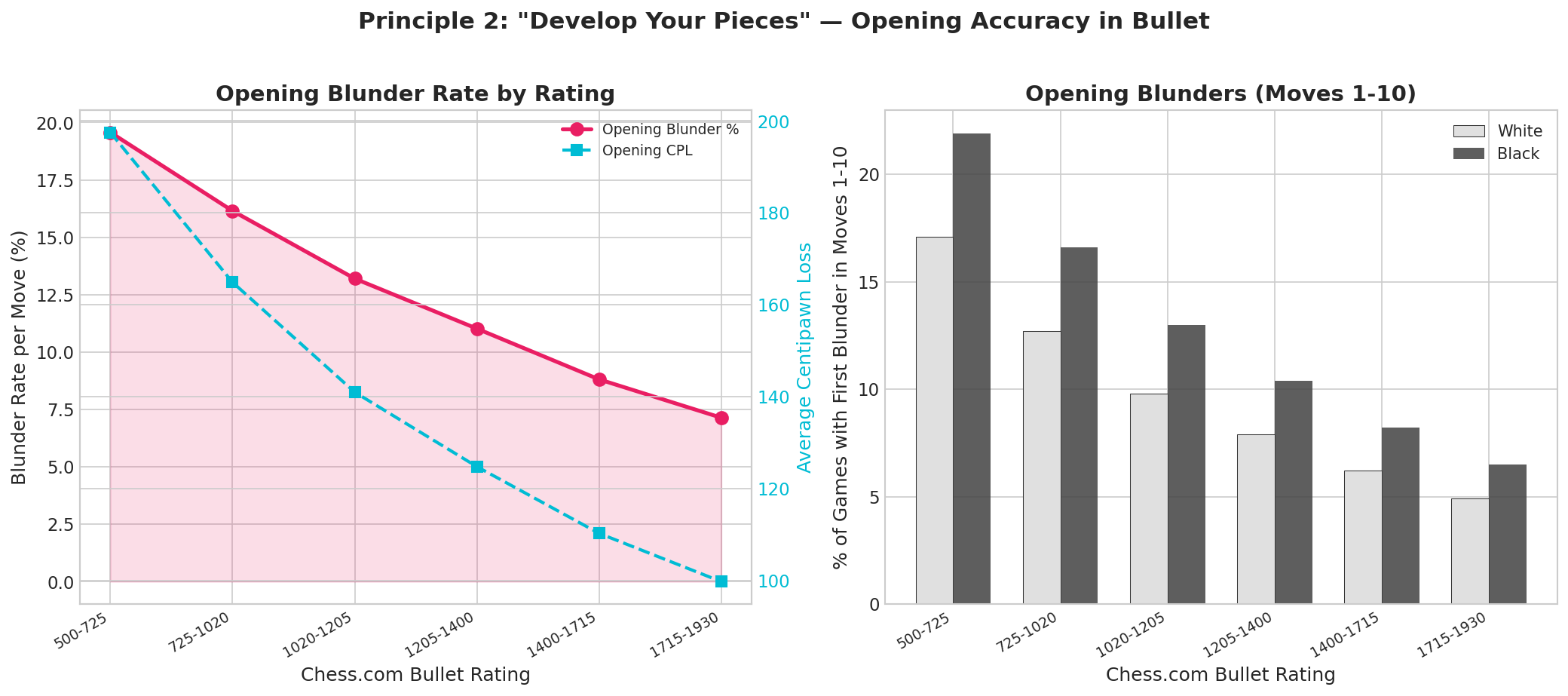
The data shows a dramatic improvement in opening accuracy as ratings increase. At the 500-725 level, players blunder in the opening (moves 1-15) in nearly 20% of their games, with an average opening CPL of 198. By the time players reach the 1400-1715 band, the opening blunder rate drops below 9%, and the CPL nearly halves to 110.
Moving the same piece twice in the opening is a common violation of this principle. While our specific PGN analysis of Bullet games showed that almost all games feature some repeated piece moves (often the Queen), the penalty is reflected in the overall opening accuracy.
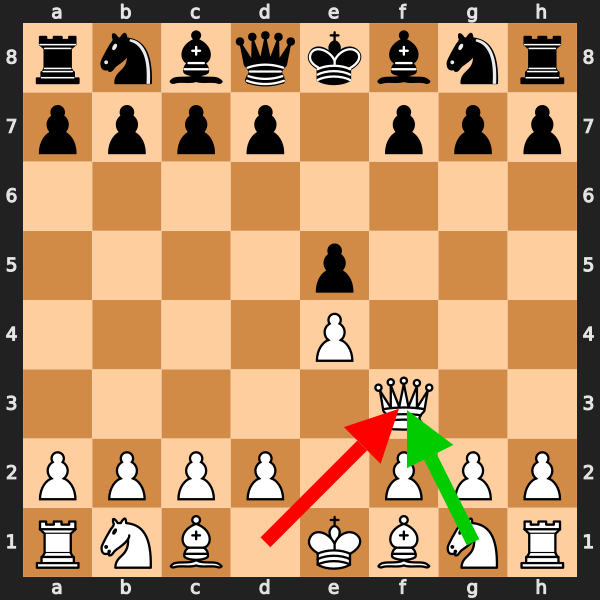
Bringing the Queen out early (e.g., the Napoleon Attack or Scholar's Mate attempts) often forces the player to move it again when attacked, violating the principle of developing new pieces. This leads to a loss of tempo and a higher likelihood of falling into a worse position.
Actionable Advice (800-1000): Focus on bringing all your minor pieces (Knights and Bishops) into the game before moving your Queen. Avoid one-move threats that can be easily parried while developing the opponent's pieces.
Actionable Advice (1000-1300): Start paying attention to the efficiency of your development. If you find yourself moving the same Knight three times in the first ten moves, you are likely falling behind in development and giving your opponent the initiative.
Principle 3: Control the Center (The Rule You Can Break Later)
Controlling the center with pawns (1.e4 or 1.d4) is the first lesson most chess players learn. However, our analysis reveals that this is the principle you can start breaking successfully as you climb the rating ladder.
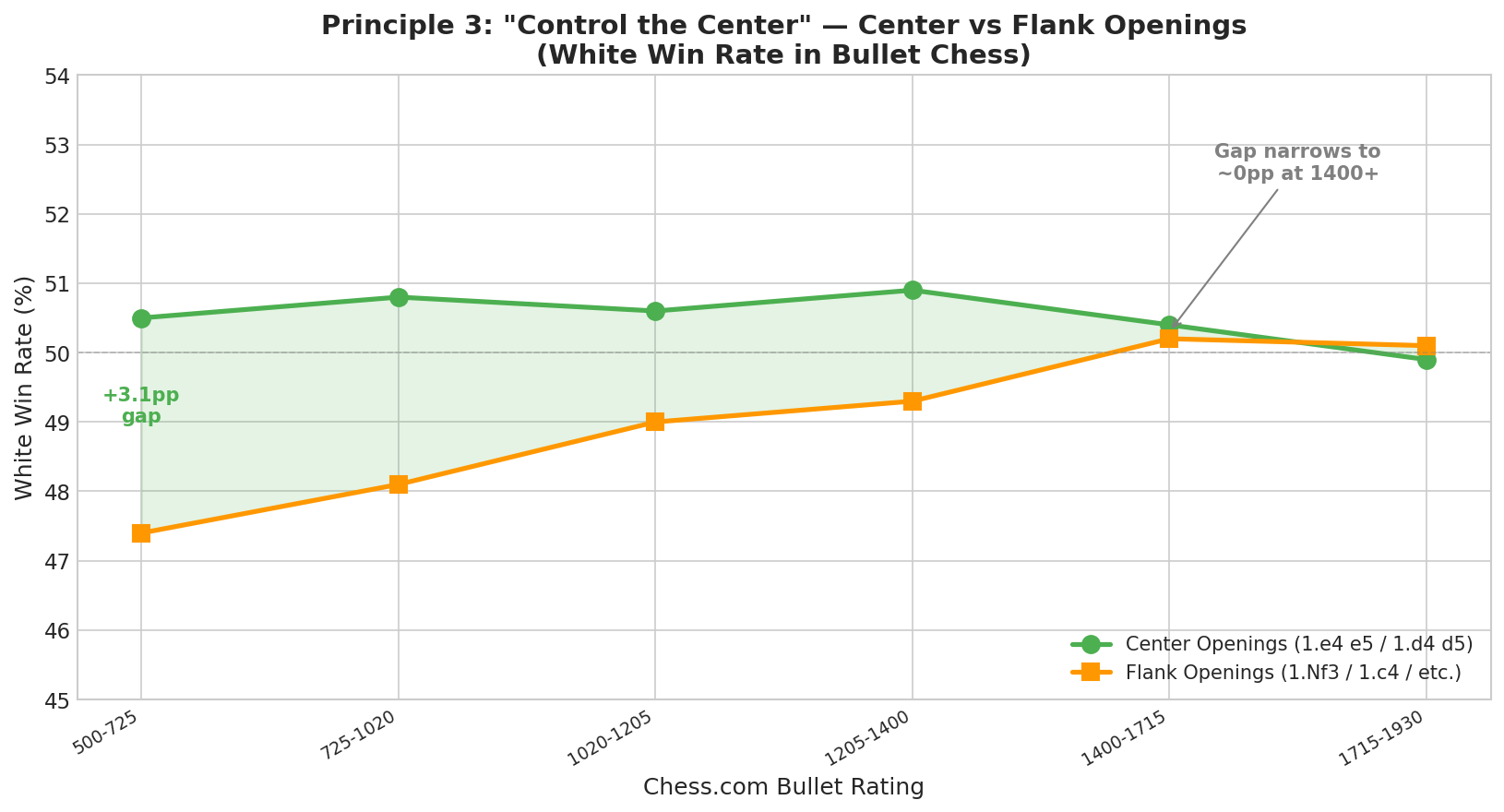
At lower ratings (500-1020), classical center occupation (1.e4 e5 or 1.d4 d5) significantly outperforms flank openings (like 1.Nf3 or 1.c4). The gap is as wide as +3.1 percentage points at the lowest bands. Beginners struggle to coordinate their pieces without the clear space advantage provided by central pawns.
However, as ratings increase, this gap narrows dramatically. By the time players reach the 1400-1715 band, the win rate difference between center and flank openings is a negligible +0.2 points. At the 1715-1930 level, flank openings actually slightly outperform classical center occupation.
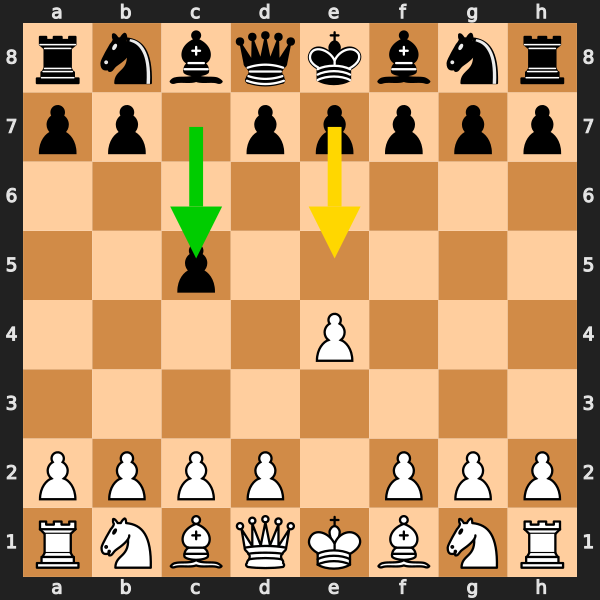
This indicates that higher-rated players understand how to control the center with pieces from afar (hypermodernism) rather than relying solely on pawn occupation. They can successfully break the "pawns in the center" rule because they understand the underlying concept of central control.
Actionable Advice (800-1200): Stick to classical principles. Open with 1.e4 or 1.d4 and fight for the center with your pawns. Flank openings require a deeper understanding of piece coordination that is often lacking at this level.
Actionable Advice (1300-1500): You can begin experimenting with hypermodern setups or flank openings if they suit your style. The statistical penalty for not occupying the center with pawns disappears in this rating range, provided you maintain control with your pieces.
The Bullet Chess Environment: Chaos and Conversion
Bullet chess is a unique environment where the clock is a constant factor. Our analysis uncovered several fascinating statistics specific to this time control that influence how principles are applied.
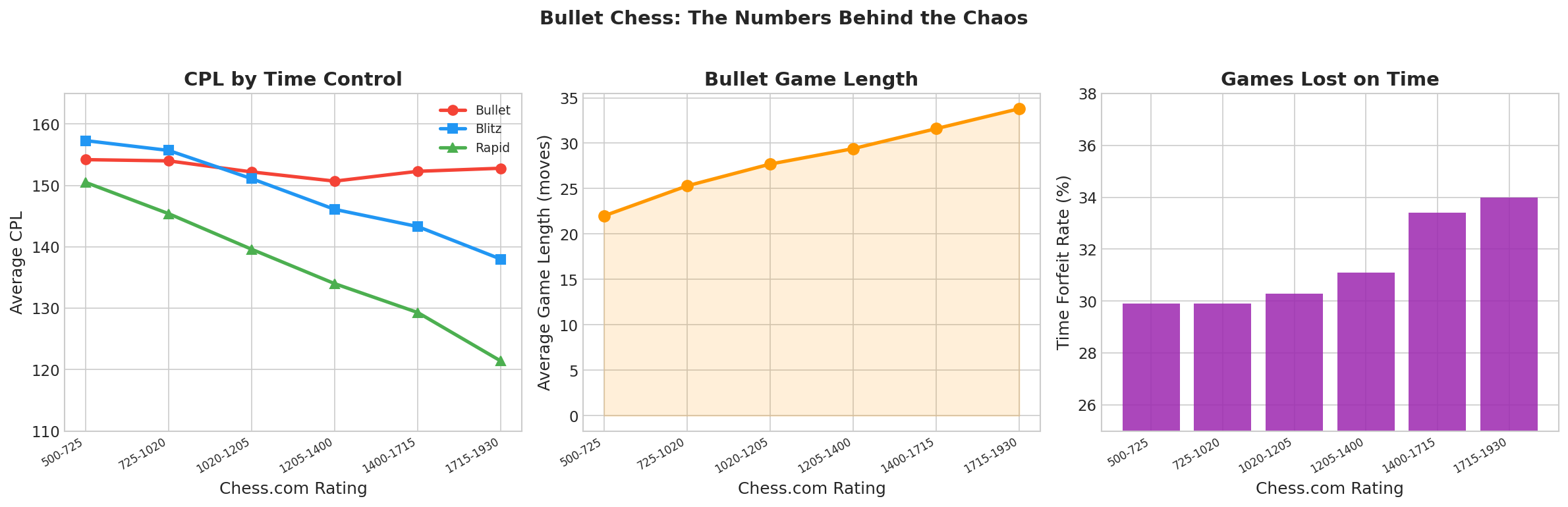
Surprisingly, the average Centipawn Loss in Bullet chess remains remarkably flat across all rating bands, hovering around 150-155. This suggests that the extreme time pressure equalizes the quality of play to some extent; even 1800-rated players make significant inaccuracies when given only 60 seconds.
However, the way games end changes drastically. The time forfeit rate increases steadily with rating, from 29.9% at the lowest bands to 34.0% at the highest. Higher-rated players are better at defending difficult positions, forcing the game to go longer (average game length increases from 22 to 34 moves) and increasing the likelihood of a flag.
Furthermore, the ability to convert a material advantage improves significantly with rating.
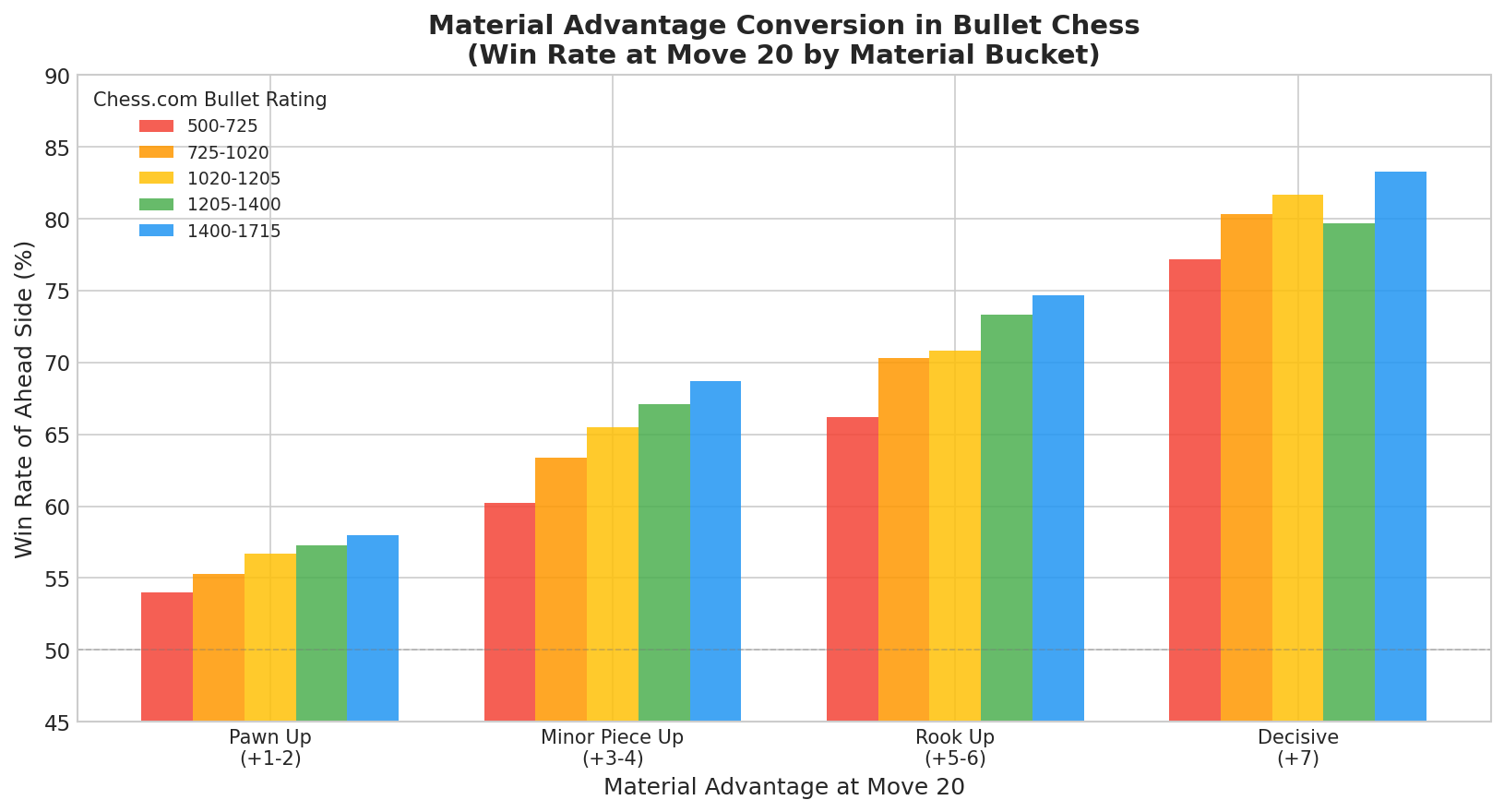
At the 725-1020 level, being up a full Rook (+5-6 points of material) only results in a win 70.3% of the time. At the 1400-1715 level, that conversion rate jumps to 74.7%. This highlights why breaking principles for minor material gain (like delaying castling to win a pawn) is a poor strategy at lower ratings: players lack the technique to consistently convert that small advantage in a Bullet time scramble.
Conclusion
The data from nearly a million Lichess Bullet games provides a clear roadmap for improvement. While all classical principles have value, they are not created equal in the fast-paced world of Bullet chess.
- King Safety is Non-Negotiable: Failing to castle carries the highest and most consistent statistical penalty. Make castling your top priority in the opening.
- Development Efficiency Matters: Avoid moving the same piece twice or bringing the Queen out early. The resulting loss of tempo leads to higher blunder rates and worse positions.
- Center Control Evolves: While crucial at lower ratings, the necessity of occupying the center with pawns diminishes as you approach the 1400-1500 level, where players learn to control the center with pieces.
By understanding the statistical weight of these principles, you can make more informed decisions in your Bullet games, knowing exactly when to follow the rules and when you can afford to break them.
Data and Methodology
This analysis was conducted using a dataset of 954,617 Lichess Bullet games, accessed via the Grandmaster Guide MCP API. The data includes comprehensive engine evaluations (100% coverage) and clock times (99.7% coverage).
To make the findings relevant to the target audience, Lichess rating bands were mapped to approximate Chess.com Bullet ratings using established conversion tables (e.g., Lichess 1100-1300 maps to Chess.com ~1020-1205).
The underlying CSV data files generated during this research are attached for further review:
castle_timing_analysis.csvcastle_outcome_analysis.csvphase_accuracy_analysis.csvcenter_control_analysis.csveval_trajectory_analysis.csvopening_blunder_timing.csvbullet_stats.csvtermination_analysis.csv
Chess Coach April 15, 2026