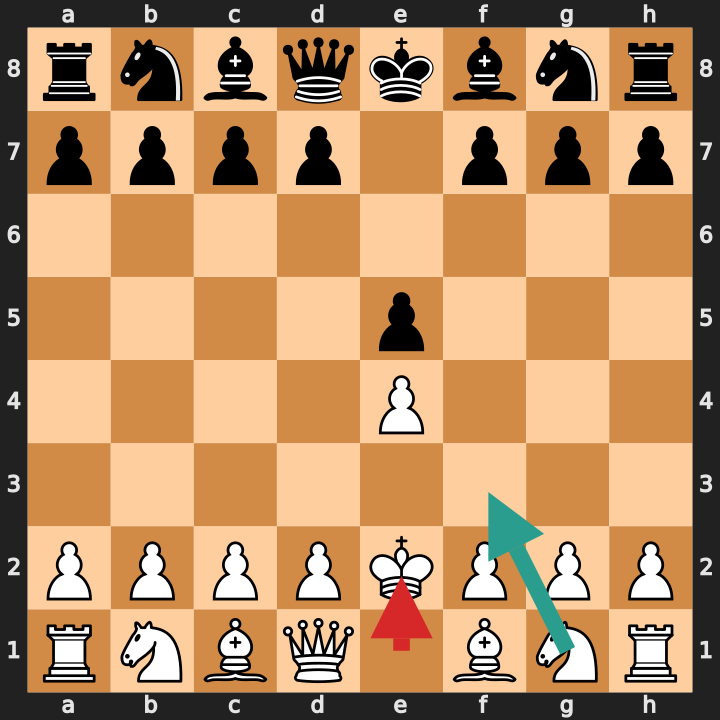
The "Bongcloud Attack" (1.e4 e5 2.Ke2) is chess's most infamous meme opening. Popularized by streamers and occasionally deployed by Grandmasters as a psychological weapon or a handicap, it deliberately violates every fundamental principle of chess strategy. By moving the king on move two, the player forfeits castling rights, blocks the development of the queen and bishop, and exposes the most important piece on the board to immediate attack.
But what happens when everyday players—specifically those in the Beginner to Intermediate rating bands (Chess.com 800 to 1500)—attempt to wield the Bongcloud in serious Rapid games? Does the psychological shock value compensate for the objective positional disaster?
To answer this, we analyzed a dataset of over 16,000 Rapid games played on Lichess, mapping the ratings to their Chess.com equivalents. We tracked every instance where a player voluntarily walked their king to e2 or e7 within the first 10 moves before castling. The results provide a clear, data-backed roadmap for players looking to climb the rating ladder.
1. The Rarity of the Bongcloud in the Wild
The first striking finding from the data is just how rarely the Bongcloud appears in serious Rapid play. While it may dominate chess content on YouTube and Twitch, everyday players are overwhelmingly playing standard, principled chess.
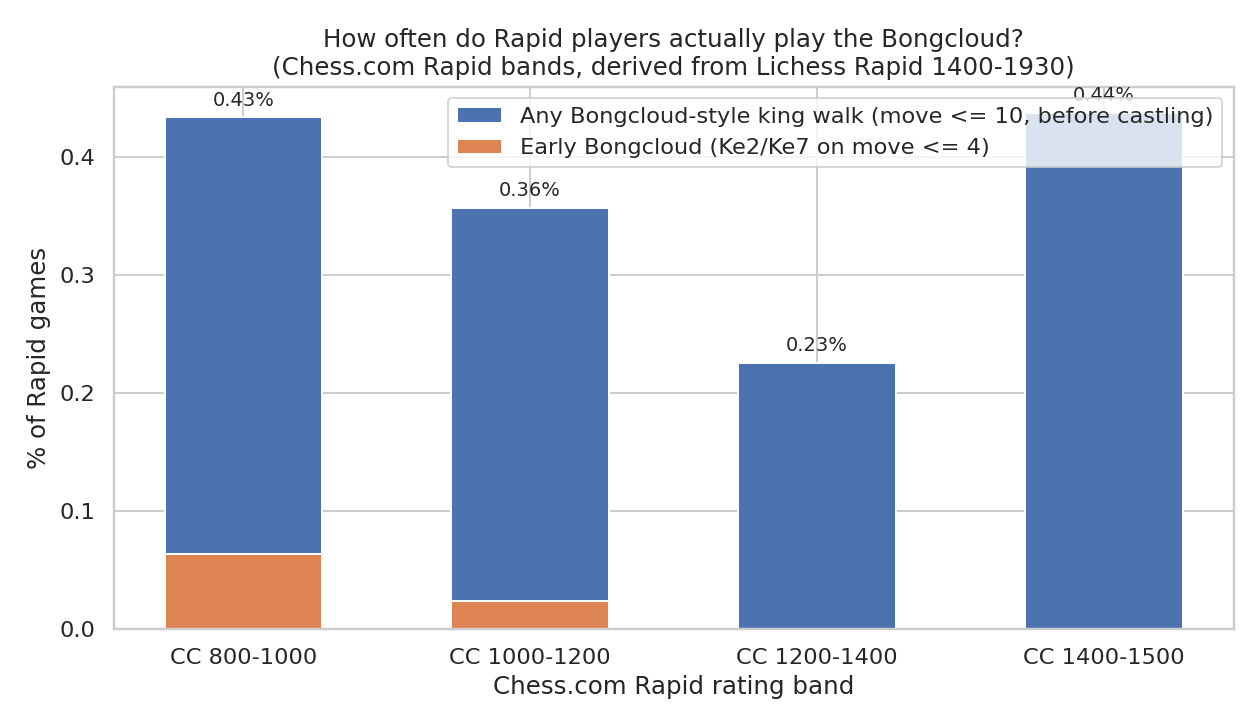
Across all rating bands from Chess.com 800 to 1500, any form of early, non-forced king walk (which we define broadly as Ke2 or Ke7 within the first 10 moves) occurs in less than 0.45% of games. The strict, classic Bongcloud (played on move 2) is practically non-existent, appearing in just 1 out of 16,462 analyzed games.
Actionable Advice for 800–1000 Players: Do not spend time studying how to refute the Bongcloud. The data shows you will face it in fewer than 1 in 200 games. Your time is far better spent mastering fundamental opening principles: controlling the center, developing your minor pieces, and castling early.
2. The Objective Reality: The Bongcloud is a Losing Strategy
When the Bongcloud is played, the objective evaluation of the position plummets immediately. Stockfish 12 evaluates the position after 1.e4 e5 2.Ke2 at -1.52 pawns [1]. In other words, playing the Bongcloud is mathematically equivalent to starting the game down a pawn and a half.
This objective disadvantage translates directly into real-world results. Across our entire dataset, players who deployed a Bongcloud-style king walk won only 30.0% of their games, compared to a baseline win rate of 46.4% for players playing standard openings with the same color.
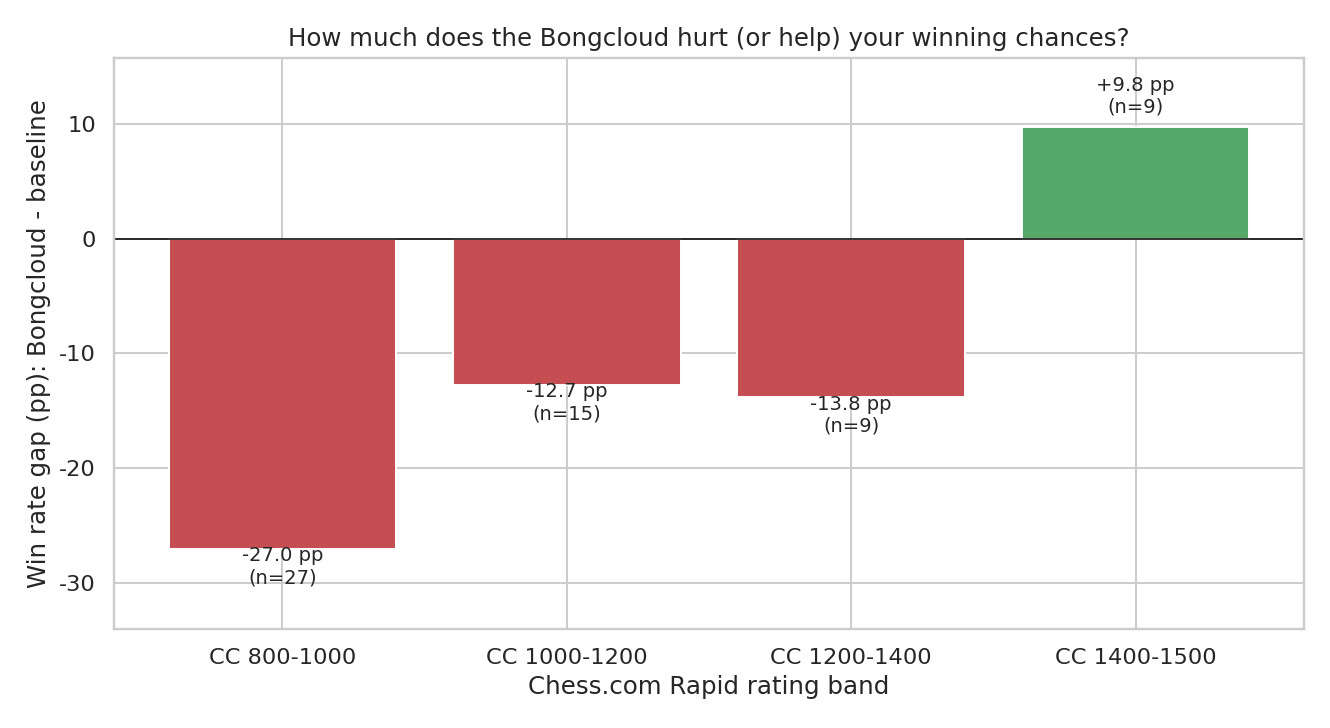
The performance gap is devastating. At the Chess.com 800–1000 level, Bongcloud players suffer a massive 27.0 percentage point drop in their expected win rate. The gap remains severe (-12.7 pp to -13.8 pp) through the 1000–1400 bands.
Actionable Advice for 1000–1200 Players: If you are playing to win and improve your rating, do not play the Bongcloud. The psychological confusion it might cause your opponent is entirely eclipsed by the structural damage you inflict upon your own position. You are spotting your opponent a massive advantage right out of the opening.
3. The "Mirrored" Bongcloud: A Curious Anomaly
One of the most fascinating anomalies in the data emerges when we split the results by color. While White Bongcloud players (playing Ke2) performed abysmally, Black Bongcloud players (playing Ke7) actually fared significantly better in our sample.
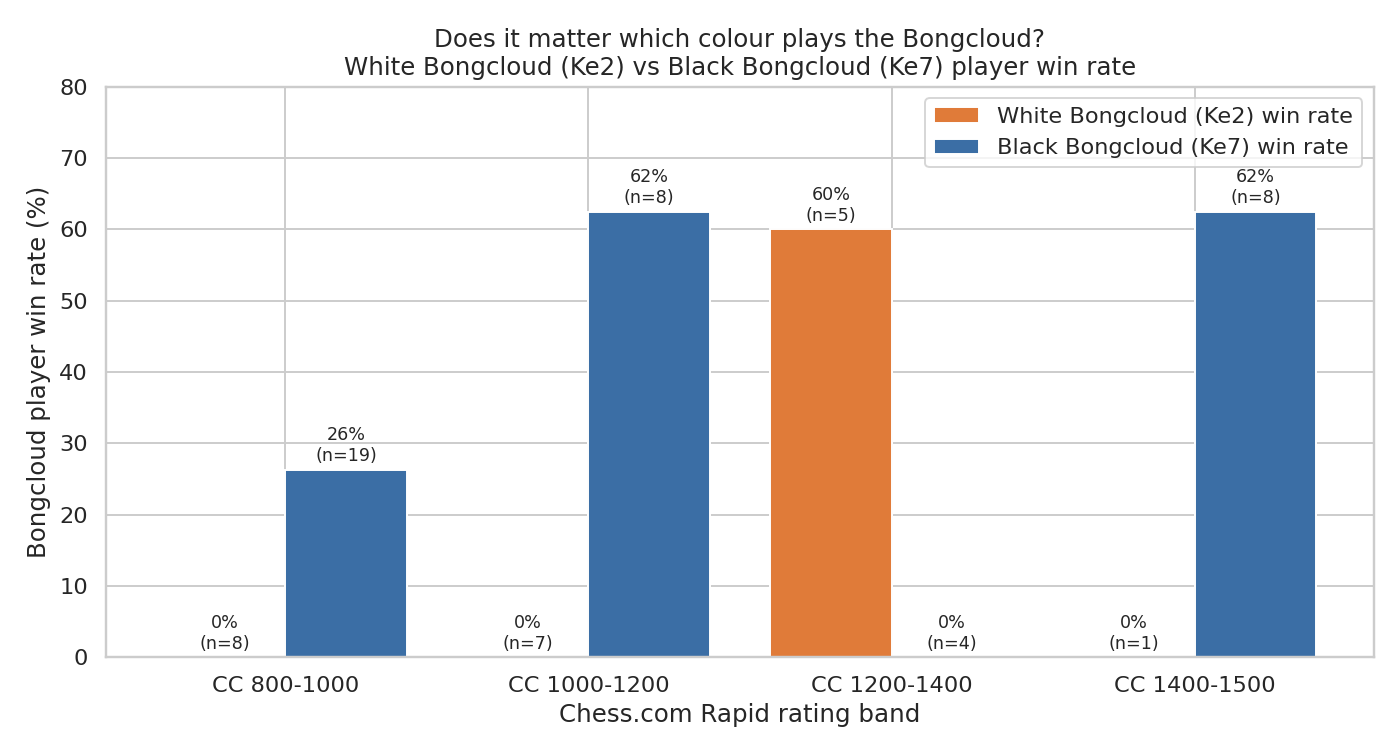
In our dataset, White Bongcloud players won only 14.3% of their games (3 wins, 18 losses). In contrast, Black Bongcloud players won 38.5% of their games (15 wins, 24 losses).
Why does Black perform better when playing a terrible opening? The answer likely lies in the nature of the positions where Black chooses to play Ke7. Often, these are not pre-planned "meme" openings, but rather desperate or confused reactions to aggressive early attacks by White.
Consider this real-world example from a game played at the Lichess 1406 Rapid level (roughly Chess.com 800):
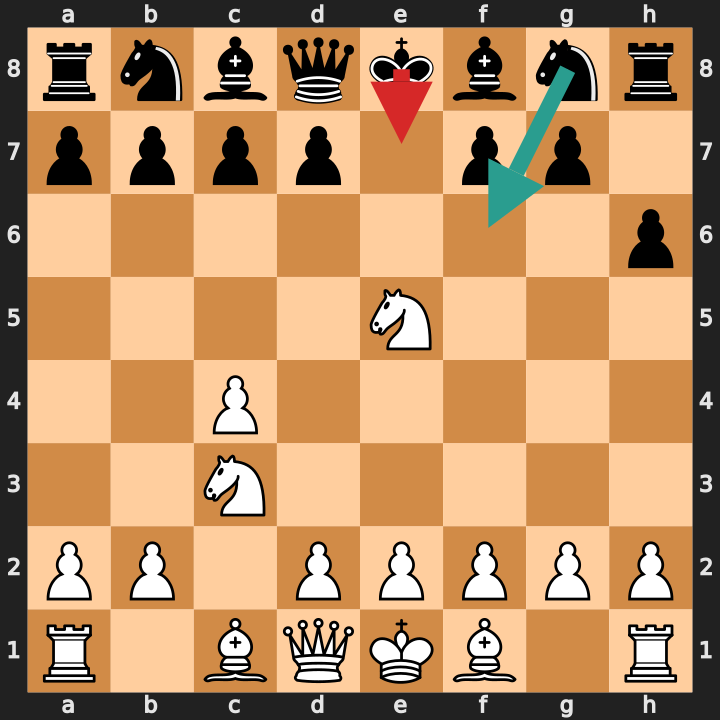
After 1.c4 e6 2.Nc3 e5 3.Nf3 h6 4.Nxe5, White has already won a pawn. Instead of playing the engine's recommended 4...Nf6 to develop and defend, Black plays the baffling 4...Ke7??. Black went on to lose this game. However, in other messy, chaotic positions where Black plays an early Ke7 to escape a perceived threat, the resulting complex, non-standard positions can sometimes induce blunders from White players who over-press their advantage.
Actionable Advice for 1200–1400 Players: When your opponent plays a terrible opening move like an early Ke2 or Ke7, do not panic and do not rush. The engine evaluation is in your favor, but the game is not automatically won. Continue to develop your pieces logically, secure your own king, and look for ways to open the center to expose their stranded king. The biggest mistake you can make against the Bongcloud is launching a premature, unsound attack that allows your opponent back into the game.
4. The Roadmap to 1500
The data from the Chess.com 1400–1500 band shows a bizarre statistical blip: Bongcloud players actually showed a positive win rate gap (+9.8 pp). However, this is entirely an artifact of a microscopic sample size (only 9 Bongcloud games out of 2,054 in this band).
The true takeaway for players approaching the 1500 mark is consistency. At this level, opponents are less likely to blunder away the massive advantage handed to them by a Bongcloud opening.
Actionable Advice for 1400–1500 Players: To break through the 1500 barrier, you must eliminate "hope chess" and meme openings from your repertoire. Relying on your opponent to get confused by a bad opening is not a sustainable strategy for rating growth. Stick to solid, principled openings that you understand deeply.
Data and Methodology
This analysis was conducted using a dataset of 16,462 Rapid chess games sourced from the Lichess open database via the Grandmaster Guide API.
- Rating Calibration: Lichess ratings were mapped to approximate Chess.com ratings using established conversion tables (e.g., Chess.com 1000 ≈ Lichess 1615).
- Bongcloud Definition: We defined a "Bongcloud" game as any game where a player voluntarily moved their king to e2 (White) or e7 (Black) within the first 10 moves, prior to castling, and not as a forced response to a check.
- Engine Evaluation: Positional evaluations were generated using Stockfish 12 (Classical) and the Theoria NNUE engine.
The underlying CSV data files containing the raw game classifications and aggregated statistics are attached for further review.
Chess Coach April 20, 2026
References
[1] Stockfish 12 Classical Evaluation via Grandmaster Guide API. Position: rnbqkbnr/pppp1ppp/8/4p3/4P3/8/PPPPKPPP/RNBQ1BNR b kq - 1 2. Evaluation: -1.52 pawns.