Bullet chess is a chaotic, high-speed variant where blunders are not just common—they are practically guaranteed. But what happens after the blunder? Does a dropped piece or a missed tactic spell the end of the game, or is it merely a bump in the road? More importantly, do stronger players convert these gifted advantages more reliably, or does the ticking clock level the playing field?
To answer these questions, we analyzed over 830,000 Lichess bullet games featuring Stockfish 17 evaluations, focusing on players with Chess.com ratings between 800 and 1500 (equivalent to roughly 1200–1800 on Lichess). By examining the data, we can uncover the true story of resilience, the frequency of "revenge blunders," and the surprisingly flat conversion rates of material advantages in the one-minute arena.
This article serves as a data-driven roadmap for improvement, offering actionable advice for players looking to climb the rating ladder by mastering the art of blunder recovery.
The Reality of Bullet Chess: Everyone Blunders
Before diving into recovery, we must first acknowledge the sheer volume of mistakes in bullet chess. The data reveals that a staggering 70% to 75% of all bullet games contain at least one major blunder (defined as a centipawn loss of 300 or more).
However, the timing of these blunders changes significantly as players improve.
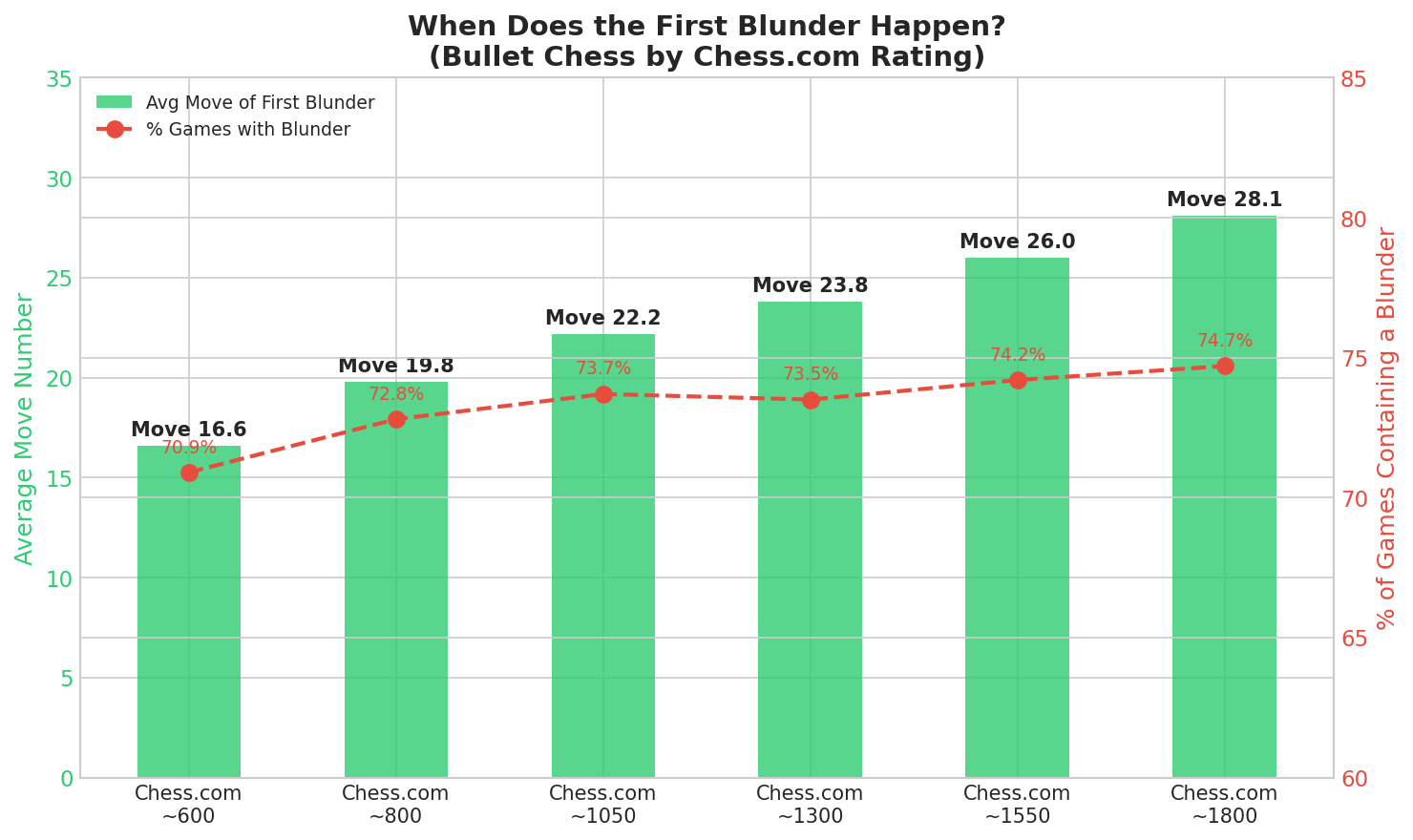
As the chart illustrates, a Chess.com ~800 player typically commits their first major blunder around move 20. By the time a player reaches ~1550, they manage to delay that first critical mistake until move 26. This six-move difference is substantial in a format where games average only 25 to 31 moves. Stronger players do not necessarily eliminate blunders; they simply survive the opening and early middlegame with greater consistency.
Actionable Advice for 800–1000 Players
Focus on solid, familiar openings. The data shows that early blunders dictate the outcome of many games at this level. By playing systems you know well, you can navigate the first 15 moves quickly and safely, forcing your opponent to be the first to crack under time pressure.
The "Revenge Blunder" Phenomenon
One of the most fascinating findings in our analysis is the prevalence of the "revenge blunder." When one player makes a catastrophic mistake, how often does the opponent immediately return the favor?
The answer is: almost always.
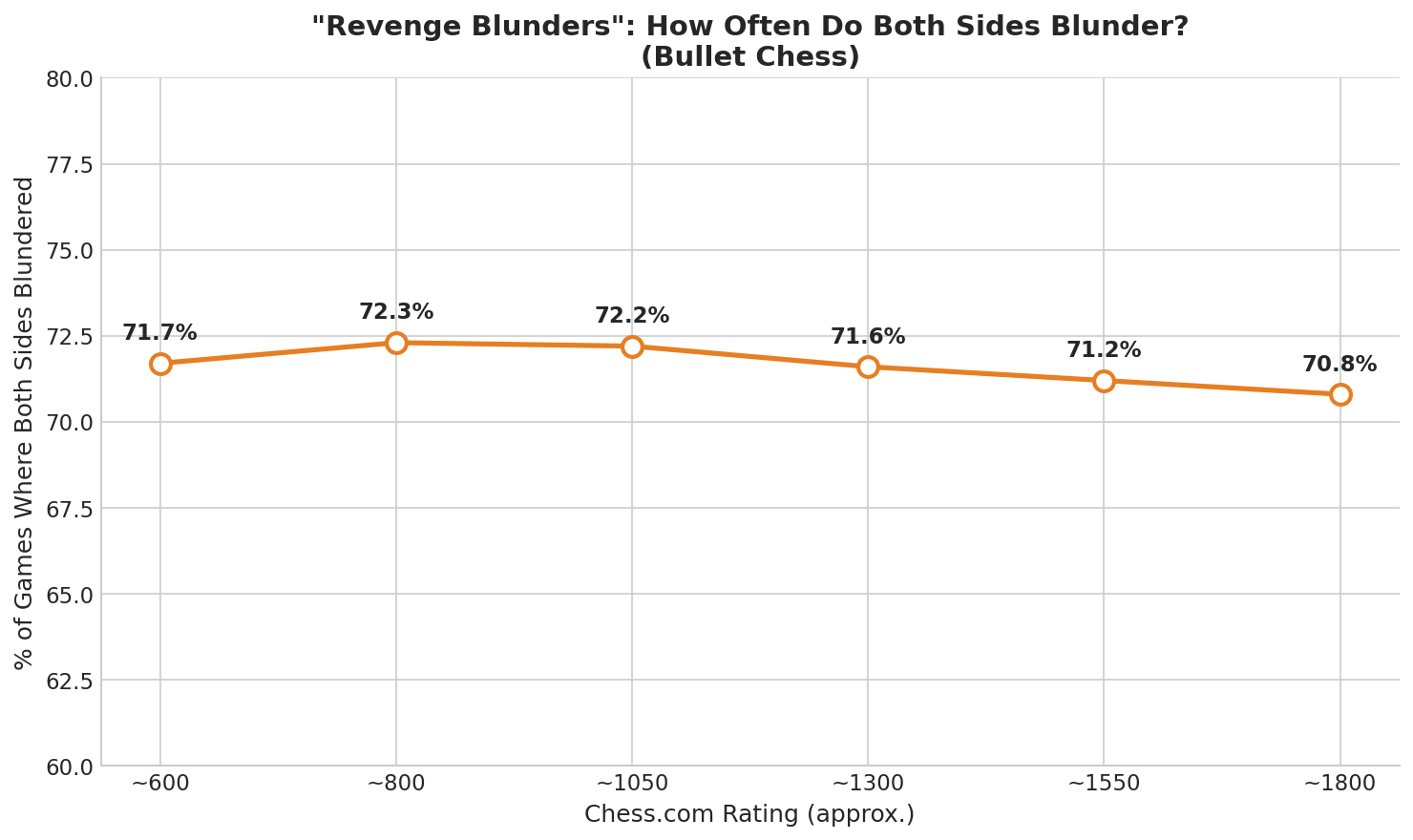
In games where at least one blunder occurs, both sides blunder in over 70% of cases. Remarkably, this percentage remains almost entirely flat across the 800 to 1500 rating spectrum. Whether you are rated 800 or 1500, if your opponent blunders, there is a massive probability that you will blunder back before the game concludes.
This phenomenon is unique to the extreme time constraints of bullet chess. When an opponent blunders, the position often changes drastically, requiring a recalculation that the clock simply does not permit. The resulting panic or overconfidence frequently leads to an immediate reciprocal mistake.
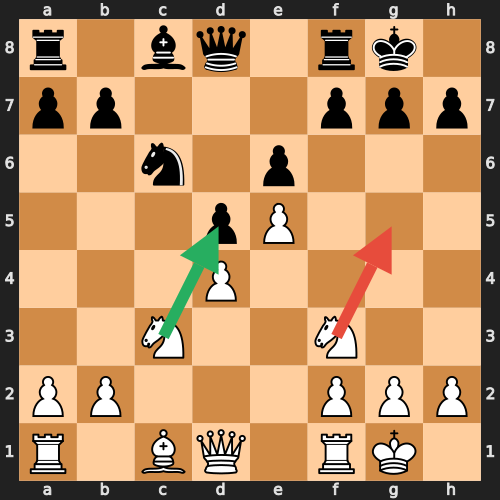 An example of a "revenge blunder" scenario. After Black blunders a pawn, White should calmly consolidate with c3d5 (green arrow). Instead, White gets greedy and overextends with f3g5 (red arrow), immediately returning the advantage.
Actionable Advice for 1000–1200 Players
When your opponent blunders, take a deep breath (or a half-second pause). The data proves that your opponent's mistake is often a trap for your own time management. Do not rush to punish them; instead, prioritize safe, consolidating moves that maintain your newly acquired advantage without complicating the position further.
Conversion Rates: The Myth of the Decisive Advantage
If you are gifted a clear advantage, how often do you actually win? We isolated games where only one side blundered to determine the true conversion rate of these gifted positions.
The results are highly counterintuitive.
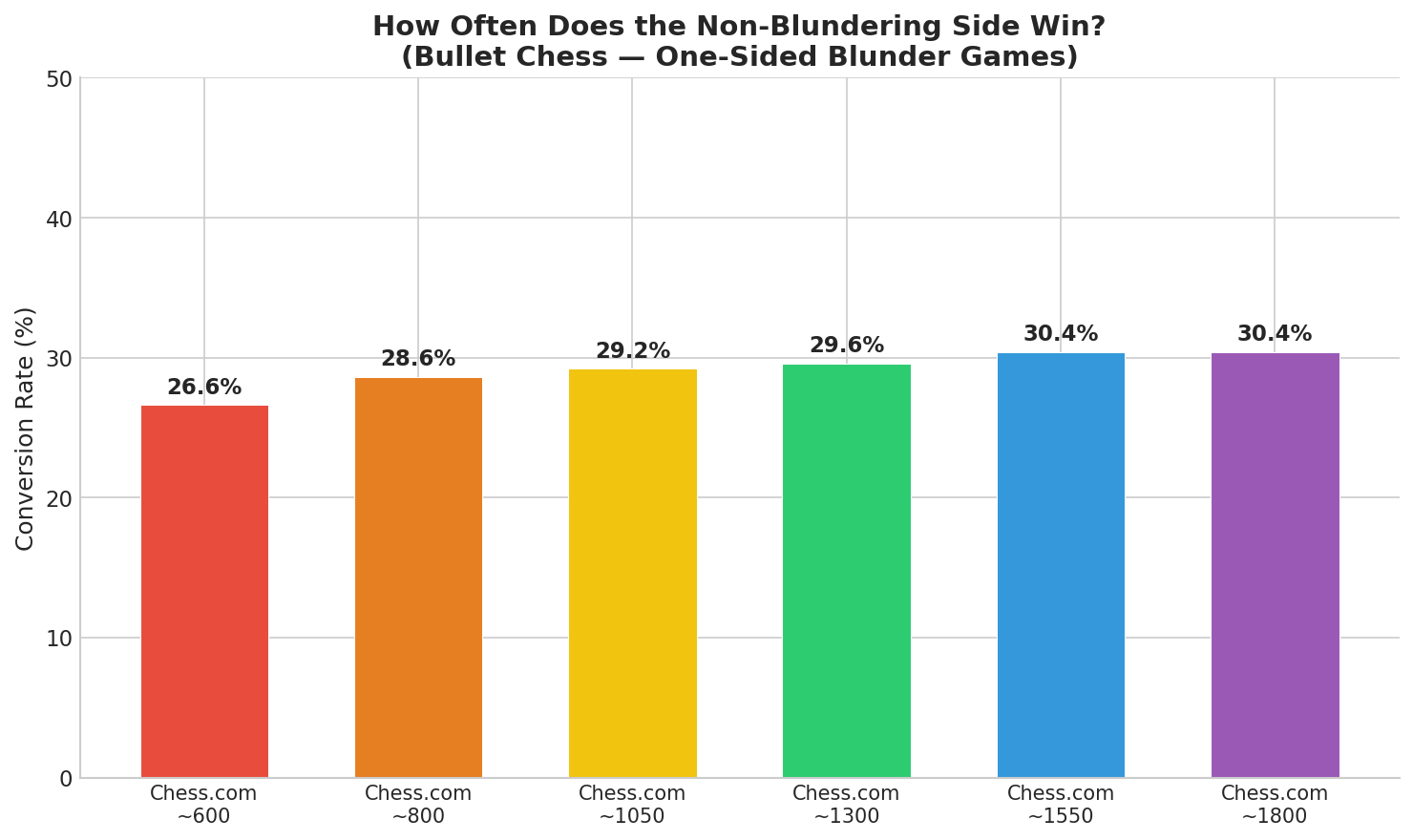
At the ~800 level, the non-blundering side wins only 28.6% of the time. Even at the ~1550 level, this conversion rate only creeps up to 30.4%.
Why are these numbers so low? The answer lies in the "fortressing effect" and the nature of engine evaluations. Many of these one-sided blunders occur in positions that are already completely lost. If a player is down a queen and blunders a rook, the engine registers a massive centipawn loss, but the outcome of the game was already decided. The player who was winning all along continues to win, skewing the data to make it appear as though the blunderer "survived."
However, when we look specifically at material advantages gained early in the game (by move 20), a clearer picture emerges.
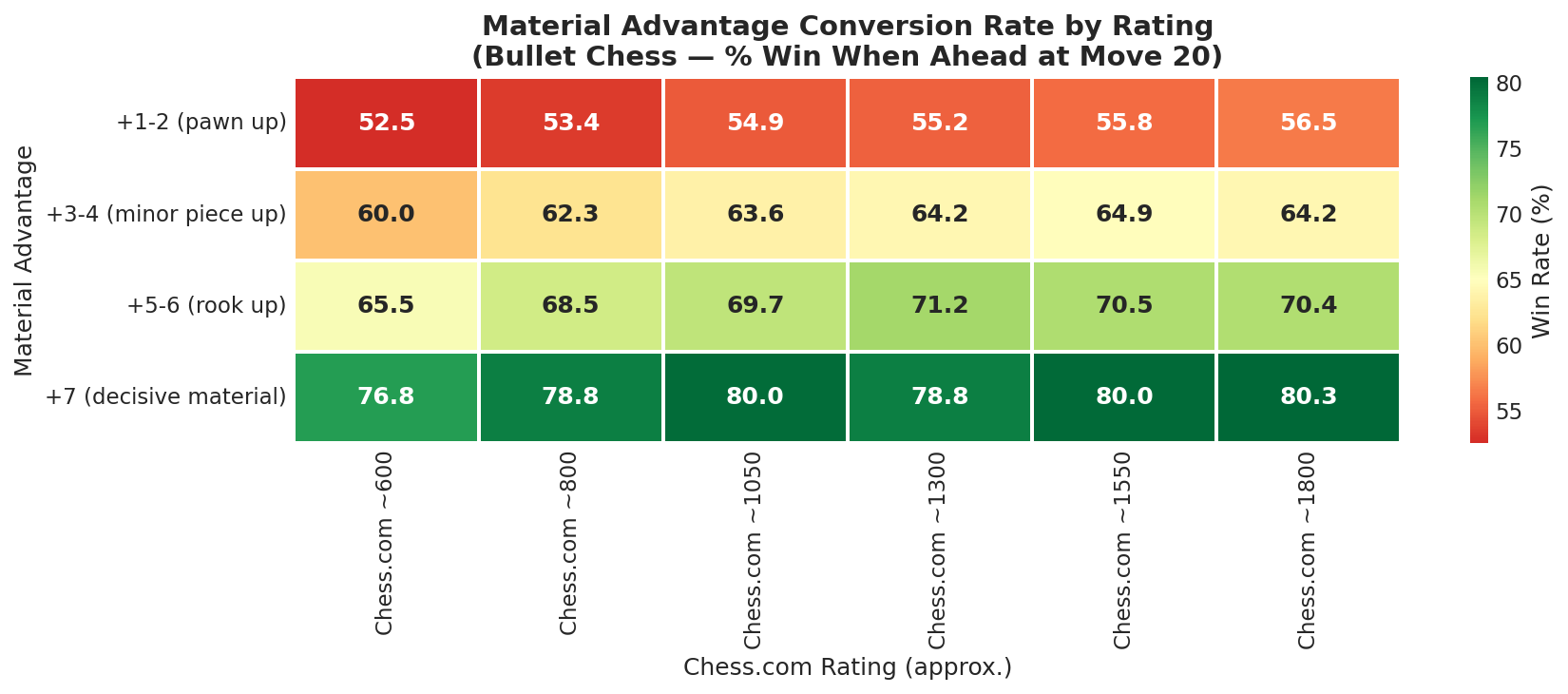
A one-to-two pawn advantage at move 20 translates to a win 53.4% of the time for an 800-rated player, and 55.8% for a 1550-rated player. Even a decisive material advantage (+7 or more) only converts at around 80% across all rating bands.
The ticking clock is the great equalizer. In bullet chess, a material advantage is only as valuable as the time you have left to execute the checkmate.
Actionable Advice for 1200–1400 Players
Stop resigning when you drop a piece. The data clearly shows that even a full rook advantage (+5-6) is only converted about 70% of the time at this level. Play quickly, complicate the position, and flag your opponent. Conversely, when you are ahead, simplify the position immediately. Trade pieces, not pawns, to reduce your opponent's counterplay and make your pre-moves safer.
The Anatomy of a Blunder
Not all blunders are created equal. We categorized blunders based on the engine evaluation at the exact moment the mistake was made.
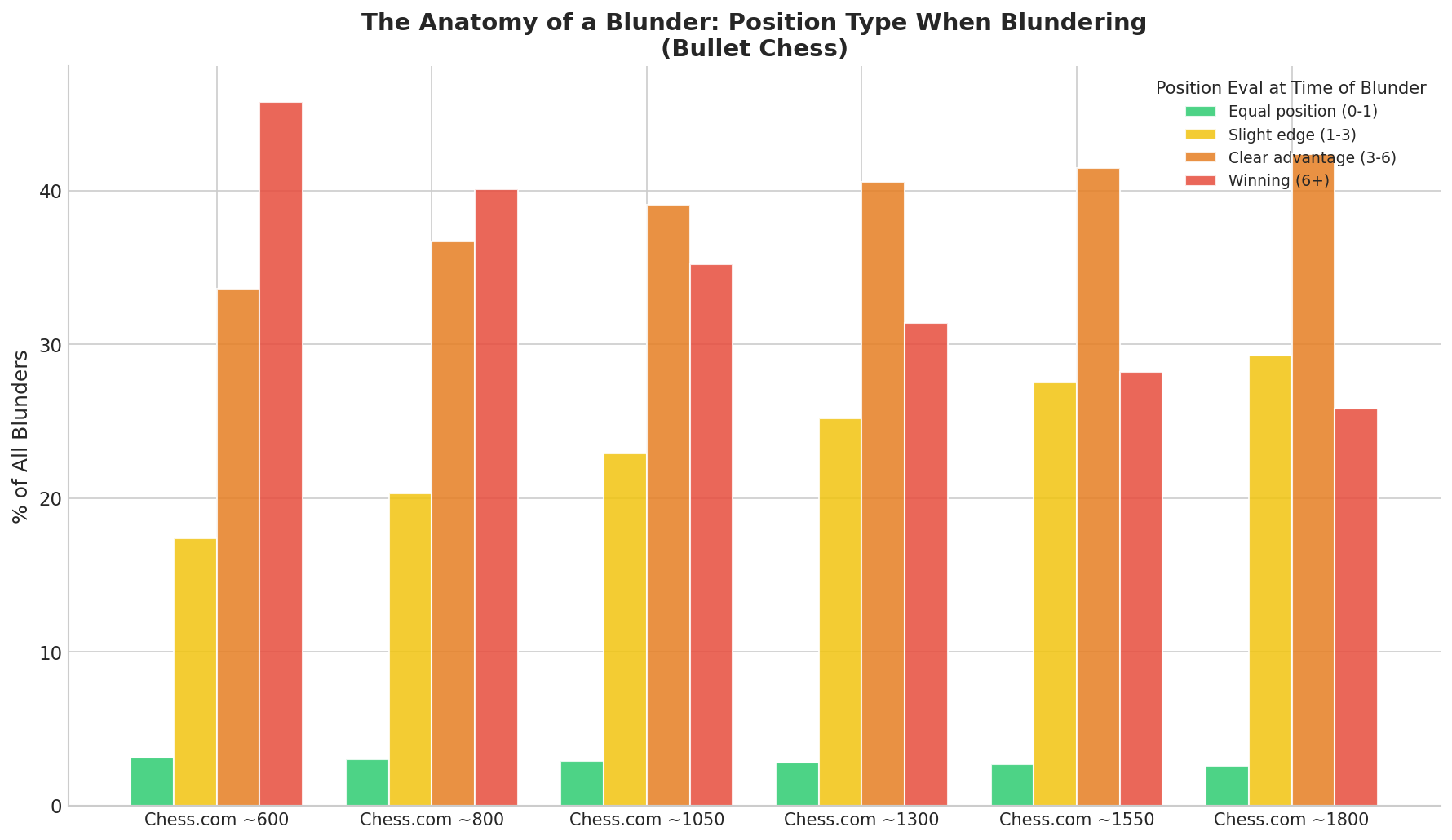
Lower-rated players (~800) commit 40.1% of their blunders in positions where they are already completely winning (+6 or more). They snatch defeat from the jaws of victory with alarming regularity.
As players improve toward the 1500 mark, this percentage drops significantly. Stronger players are much less likely to throw away a completely won game. Instead, their blunders shift toward "Slight edge" and "Clear advantage" positions, where the complexity of converting a small lead induces mistakes under time pressure.
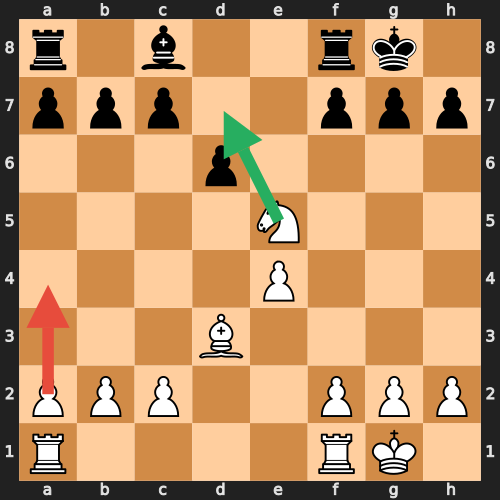 A classic missed conversion. White is up a piece and should consolidate with e5d7 (green arrow), forking the rook and bishop. Instead, White plays a passive pawn move a2a4 (red arrow), allowing Black back into the game.
Actionable Advice for 1400–1500+ Players
Your primary leak is no longer hanging pieces in the opening; it is failing to navigate the transition from a slight edge to a decisive advantage. Practice converting small advantages against the computer with a fast time control. Learn the specific techniques for shutting down counterplay when you are up an exchange or a minor piece.
The Resilience Index
To summarize our findings, we created a composite "Blunder Resilience Index." This metric combines three factors:
- How late in the game a player makes their first blunder.
- How effectively they convert advantages when their opponent blunders.
- How often they manage to punish an opponent who blunders from an equal or slightly worse position.
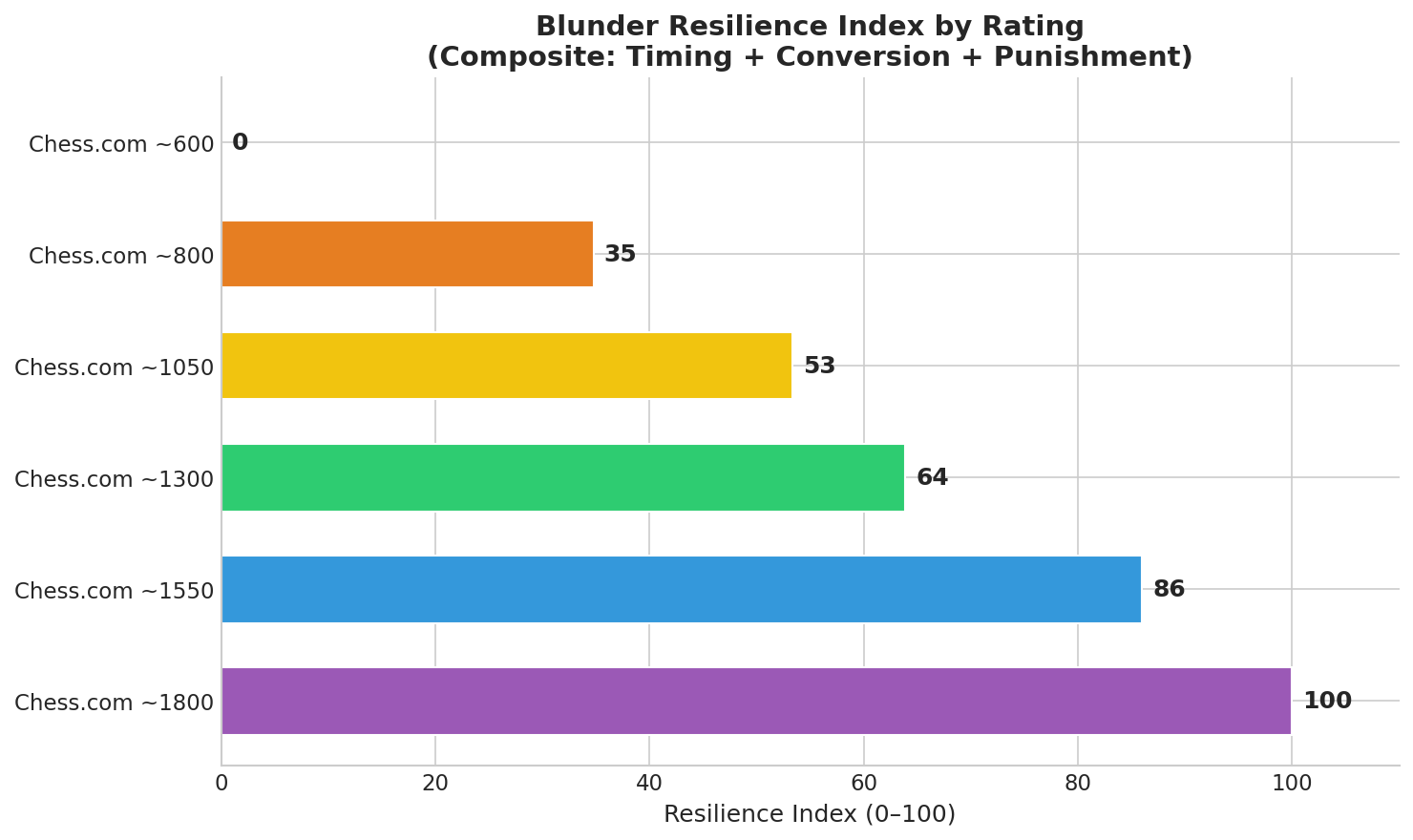
The index demonstrates a clear, measurable progression in resilience as ratings increase. The jump from 800 to 1050 shows the most significant improvement in basic board vision and opening safety. The progression from 1300 to 1550 reflects a growing ability to manage the clock while maintaining a slight edge, reducing the frequency of catastrophic throws in won positions.
Conclusion
Do better players bounce back faster after a mistake in bullet chess?
The data suggests a nuanced reality. Stronger players do not necessarily recover from blunders more miraculously than weaker players; rather, they are far better at not throwing away the games where their opponent blunders first. They delay their own mistakes, they simplify won positions more effectively, and they are slightly more clinical when gifted a material advantage.
However, the overarching theme of bullet chess remains chaos. With "revenge blunders" occurring in over 70% of games and decisive material advantages failing to convert 20% of the time, the ultimate skill in bullet chess is not perfect calculation—it is psychological resilience and clock management.
Play fast, never resign, and when your opponent blunders, take a breath before you move.
Chess Coach
April 15, 2026
Data and Methodology
This analysis was conducted using a dataset of over 830,000 Lichess bullet games, filtered for games containing Stockfish 17 evaluations. Lichess ratings were mapped to approximate Chess.com ratings using established conversion tables to ensure relevance for the target audience.
The underlying data files used to generate the charts in this article are available below:
View full data →ratingBand scenario whiteWinPct drawPct blackWinPct sampleGames chesscom_band chesscom_short 700-900 black_blundered_only 21.1 4.1 74.8 2664 445–725 ~600 700-900 both_blundered 60.8 5.1 34.1 100262 445–725 ~600 700-900 neither_blundered 18.6 3.7 77.7 34863 445–725 ~600 700-900 white_blundered_only 65.3 2.5 32.1 1991 445–725 ~600 900-1100 black_blundered_only 21.0 3.0 75.9 2582 725–920 ~800
View full data →ratingBand chesscom_band chesscom_short avg_conversion_rate white_blunder_black_converts black_blunder_white_converts both_blundered_pct blunderer_survival_rate white_blunder_white_survives black_blunder_black_survives sampleGames_one_sided sampleGames_both sampleGames_neither 700-900 445–725 ~600 26.6 32.1 21.1 71.7 70.0 65.3 74.8 4655 100262 34863 900-1100 725–920 ~800 28.6 36.2 21.0 72.3 69.0 62.1 75.9 4449 101065 34312 1100-1300 920–1205 ~1050 29.2 37.4 20.9 72.2 68.2 59.9 76.6 4382 100499 34246 1300-1500 1205–1400 ~1300 29.6 36.8 22.5 71.6 67.9 61.1 74.7 4435 98625 34708 1500-1800 1400–1715 ~1550 30.4 38.5 22.4 71.2 66.8 59.3 74.3 4053 94988 34362
View full data →ratingBand avgFirstBlunderMove gamesWithBlunderPct avgBlundersPerGame sampleGames chesscom_short 700-900 16.6 70.9 13.63 30549 ~600 900-1100 19.8 72.8 15.19 37053 ~800 1100-1300 22.2 73.7 16.13 41465 ~1050 1300-1500 23.8 73.5 16.63 43745 ~1300 1500-1800 26.0 74.2 17.71 46852 ~1550
View full data →ratingBand positionType blunderPct avgCpl sampleBlunders chesscom_short 700-900 Clear advantage (3-6) 33.6 914 841002 ~600 700-900 Equal position (0-1) 3.1 501 77206 ~600 700-900 Slight edge (1-3) 17.4 489 435735 ~600 700-900 Winning (6+) 45.8 1698 1145979 ~600 900-1100 Clear advantage (3-6) 36.7 910 933884 ~800
View full data →ratingBand materialBucket winPct chesscom_short 700-900 +1-2 (pawn up) 52.55 ~600 700-900 +3-4 (minor piece up) 59.95 ~600 700-900 +5-6 (rook up) 65.5 ~600 700-900 +7 (decisive material) 76.85 ~600 900-1100 +1-2 (pawn up) 53.4 ~800
View full data →ratingBand phase avgEvalAbsolute chesscom_short 700-900 opening 1.35 ~600 700-900 middlegame 4.17 ~600 700-900 endgame 6.39 ~600 900-1100 opening 1.07 ~800 900-1100 middlegame 3.43 ~800