A Data-Driven Guide to Resilience in Rapid Chess
Every chess player knows the sinking feeling in their stomach the moment they realize they've blundered. The evaluation bar plummets, the material advantage vanishes, and the game suddenly feels lost. But what happens next? Do you resign immediately, or do you fight on? More importantly, does your opponent actually have the technique to convert their newly acquired advantage?
To answer these questions, we analyzed a massive dataset of Rapid chess games, focusing on players with Chess.com ratings between 800 and 1500 (which corresponds roughly to Lichess ratings of 1100 to 1800). By examining how often players recover from severe mistakes, we can uncover the true value of resilience and provide actionable advice for climbing the rating ladder.
The Myth of the "Game-Ending" Blunder
The most striking finding from our data is that a blunder is rarely the end of the game, especially at lower and intermediate rating levels. When we look at games where only one player commits a severe blunder (defined as a move that drops the evaluation by 3.0 pawns or more), the results are counterintuitive.
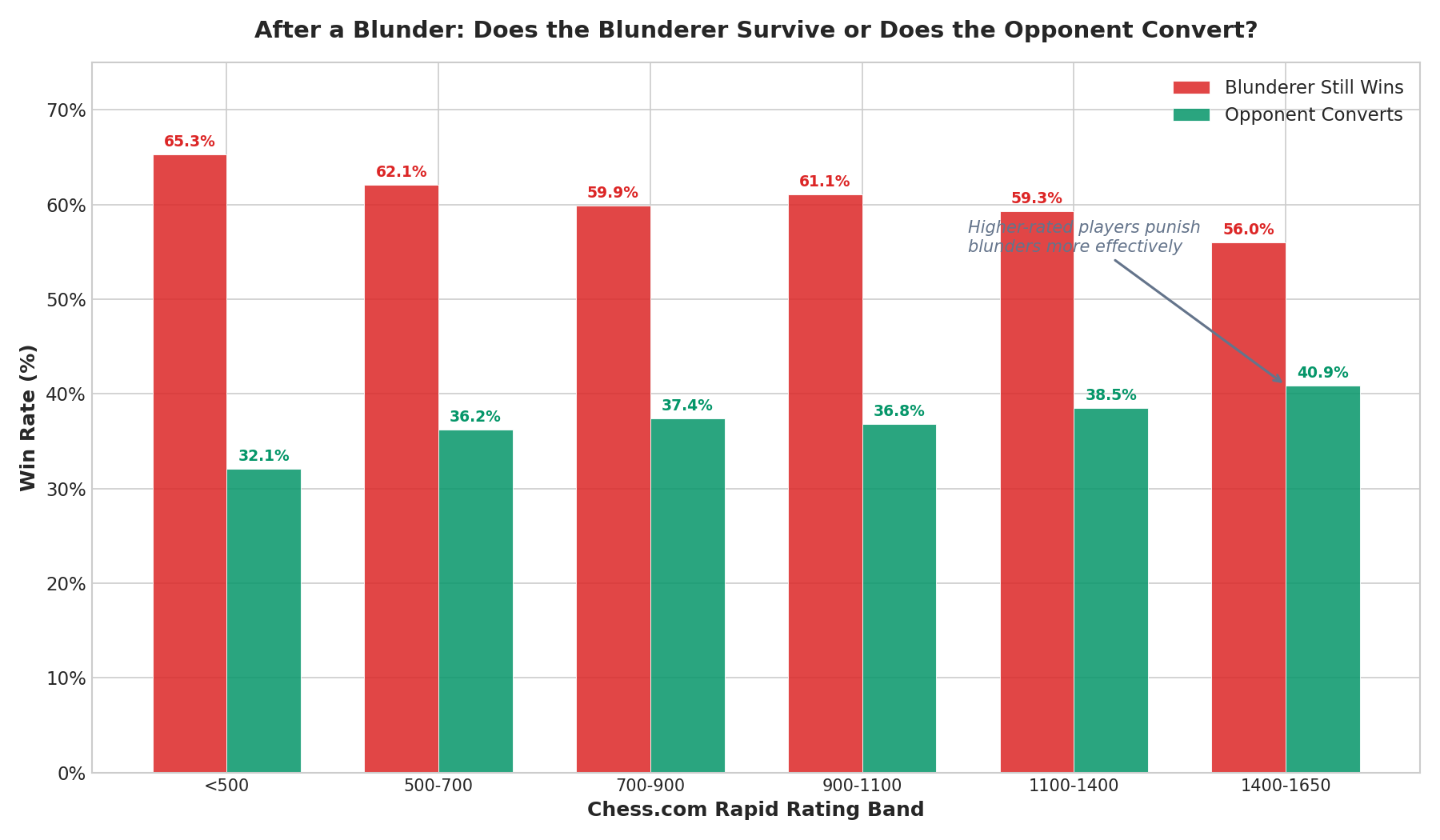
As the chart above illustrates, the player who blunders often still goes on to win the game. For players rated below 500 on Chess.com, the opponent only manages to convert the gifted advantage 32.1% of the time. Even in the 1400-1650 rating band, the conversion rate only rises to 40.9%.
Why does the blunderer survive so often? The answer lies in the "fortressing effect" and the nature of engine evaluations. A blunder that drops the evaluation from +6.0 to +2.0 is technically a severe mistake, but the player is still winning. Furthermore, at these rating levels, the opponent is highly likely to return the favor with a blunder of their own.
Actionable Advice for the 800-1000 Range
If you drop a piece or miss a tactic, do not resign. The data proves that your opponent will struggle to convert the advantage. Take a deep breath, play solid defensive moves, and wait for them to make a mistake. Your primary goal is to complicate the position and create practical problems for them to solve.
The Chaos Game: When Both Players Blunder
If you feel like your games are a rollercoaster of mistakes, you are not alone. Our analysis reveals that the vast majority of Rapid games feature severe blunders from both sides.
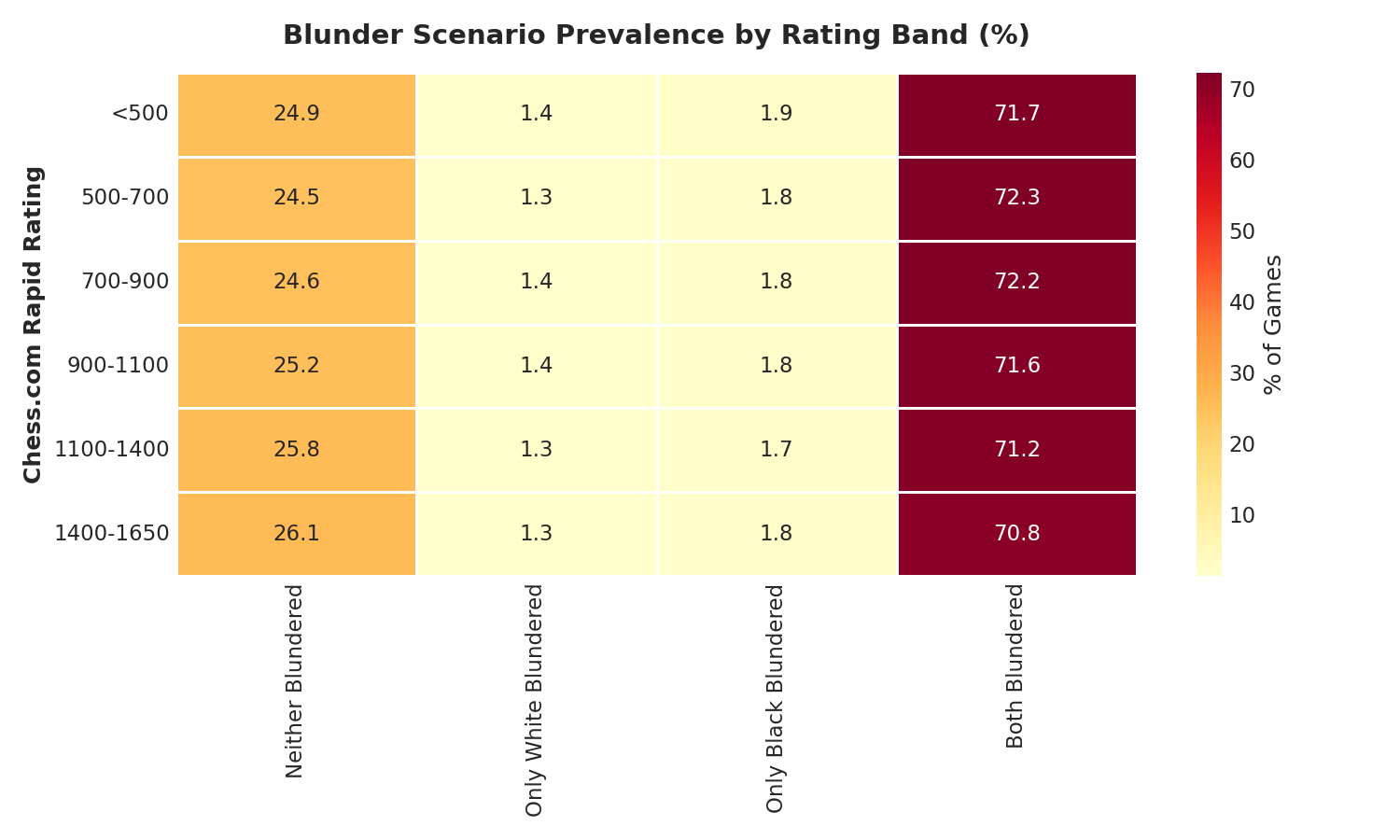
Across all rating bands studied, over 70% of games fall into the "Both Blundered" category. Games where neither player blunders account for roughly 25% of the dataset, while games where only one player blunders are exceedingly rare (less than 4% combined).
This phenomenon often manifests as the "revenge blunder." A player blunders a piece, their opponent gets excited, plays too quickly to grab the material, and immediately blunders right back.
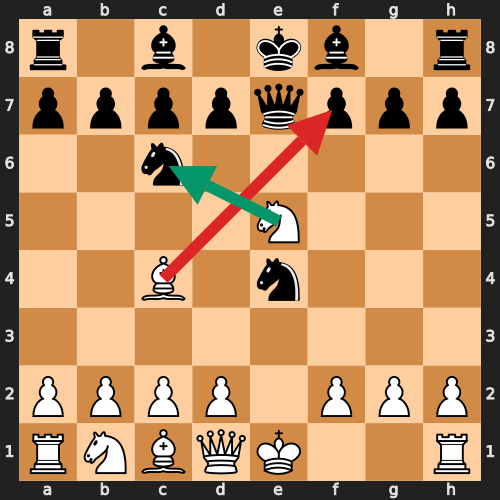
The Revenge Blunder: White gets greedy after Black's mistake, playing Bxf7+?? instead of the clean material win with Nxc6.
Actionable Advice for the 1000-1200 Range
When your opponent blunders, that is the moment you must be most careful. The adrenaline rush of winning material often leads to careless play. Before you grab the hanging piece, take ten seconds to ask yourself: "Is this a trap? Does this capture expose my king or leave another piece undefended?"
When Do Blunders Happen?
As players improve, they don't necessarily stop blundering entirely; rather, they delay their mistakes and avoid blundering in critical situations.
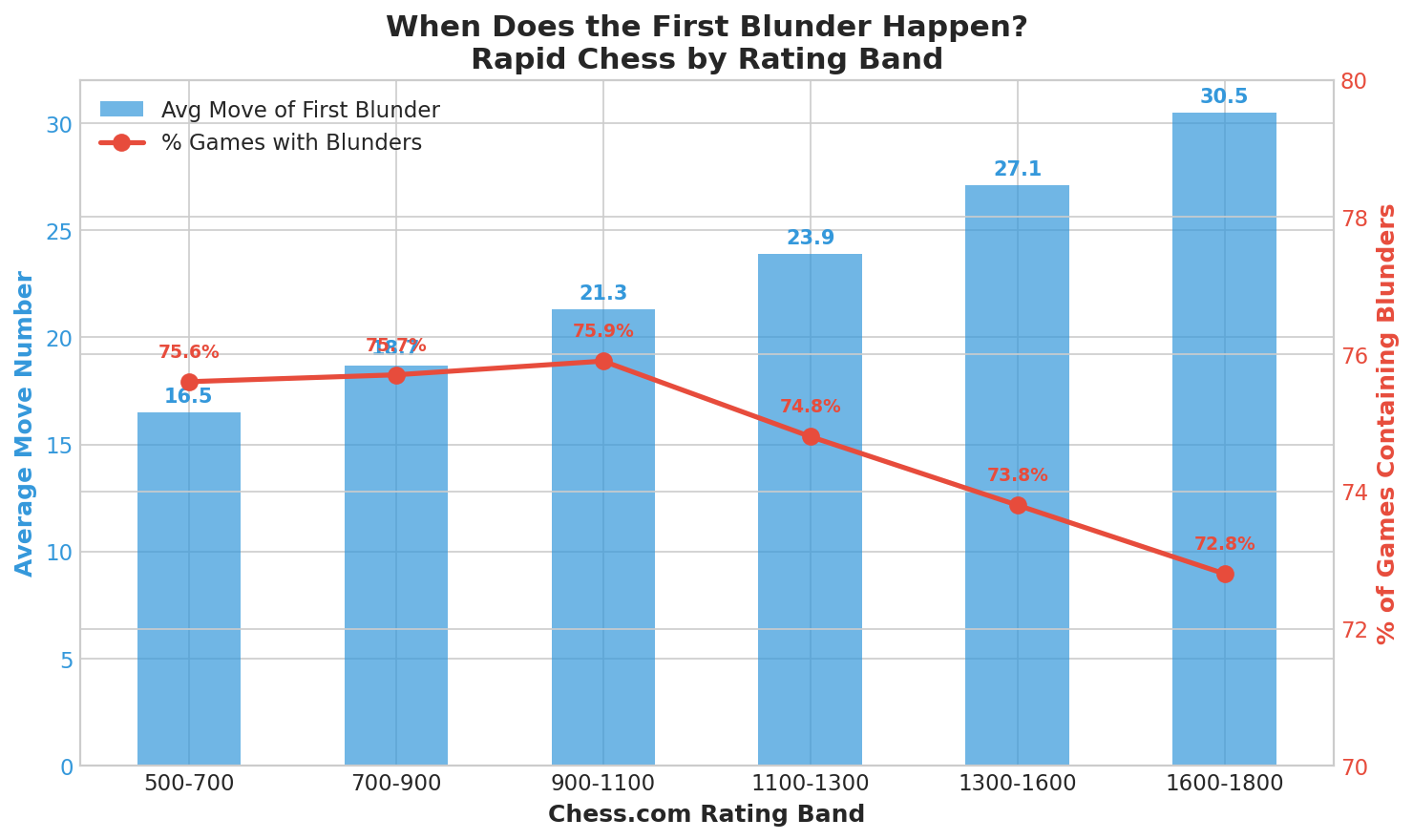
The average move number for the first blunder increases steadily with rating. Players below 500 typically make their first severe mistake around move 16, often right out of the opening. By the time players reach the 1400-1650 band, they are delaying their first major error until move 30, deep into the middlegame or early endgame.
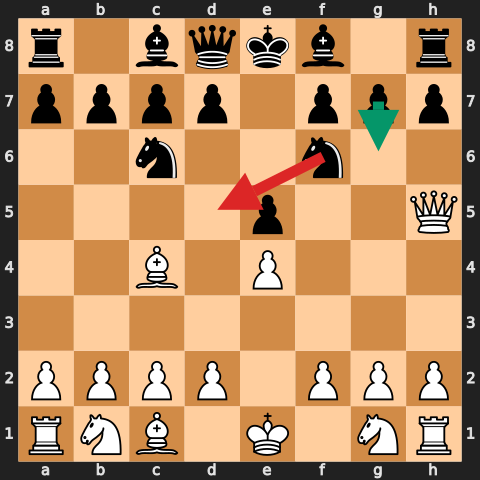
A typical early blunder: Black grabs a pawn with Nxe4??, missing the tactical consequences and failing to secure their king with castling.
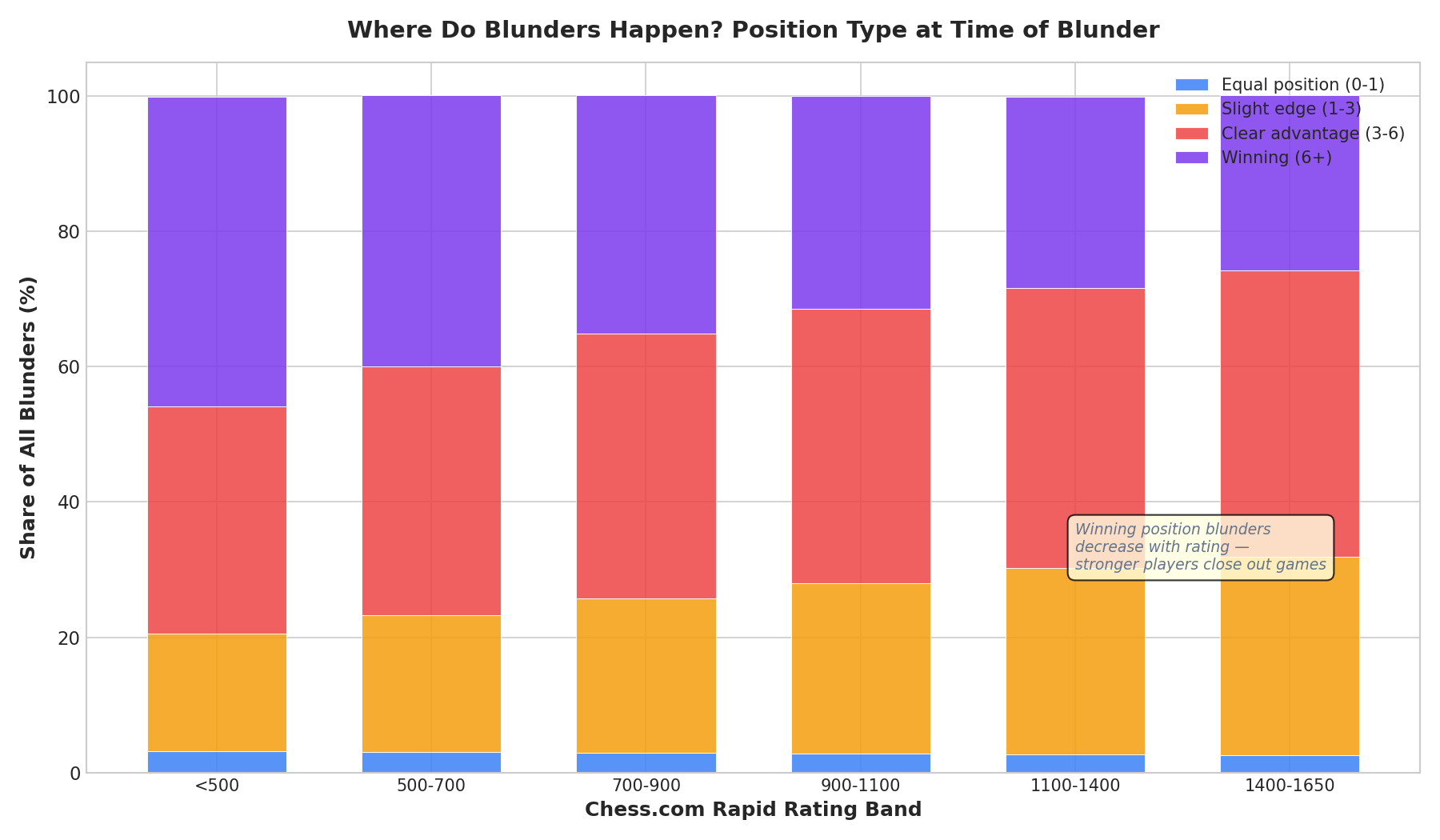
Furthermore, stronger players are much better at closing out games. The percentage of blunders that occur in already-winning positions (evaluation +6.0 or higher) drops from 45.8% for the lowest-rated players to 25.8% for the 1400-1650 group.
Actionable Advice for the 1200-1400 Range
Focus on your opening principles and early middlegame plans to push your first blunder deeper into the game. If you can consistently reach move 25 without a severe mistake, you will naturally outplay opponents who blunder earlier. Additionally, practice your endgame technique to ensure you don't throw away winning positions.
The Value of Material
How much is a pawn really worth? The data shows that the ability to convert a material advantage scales linearly with rating.
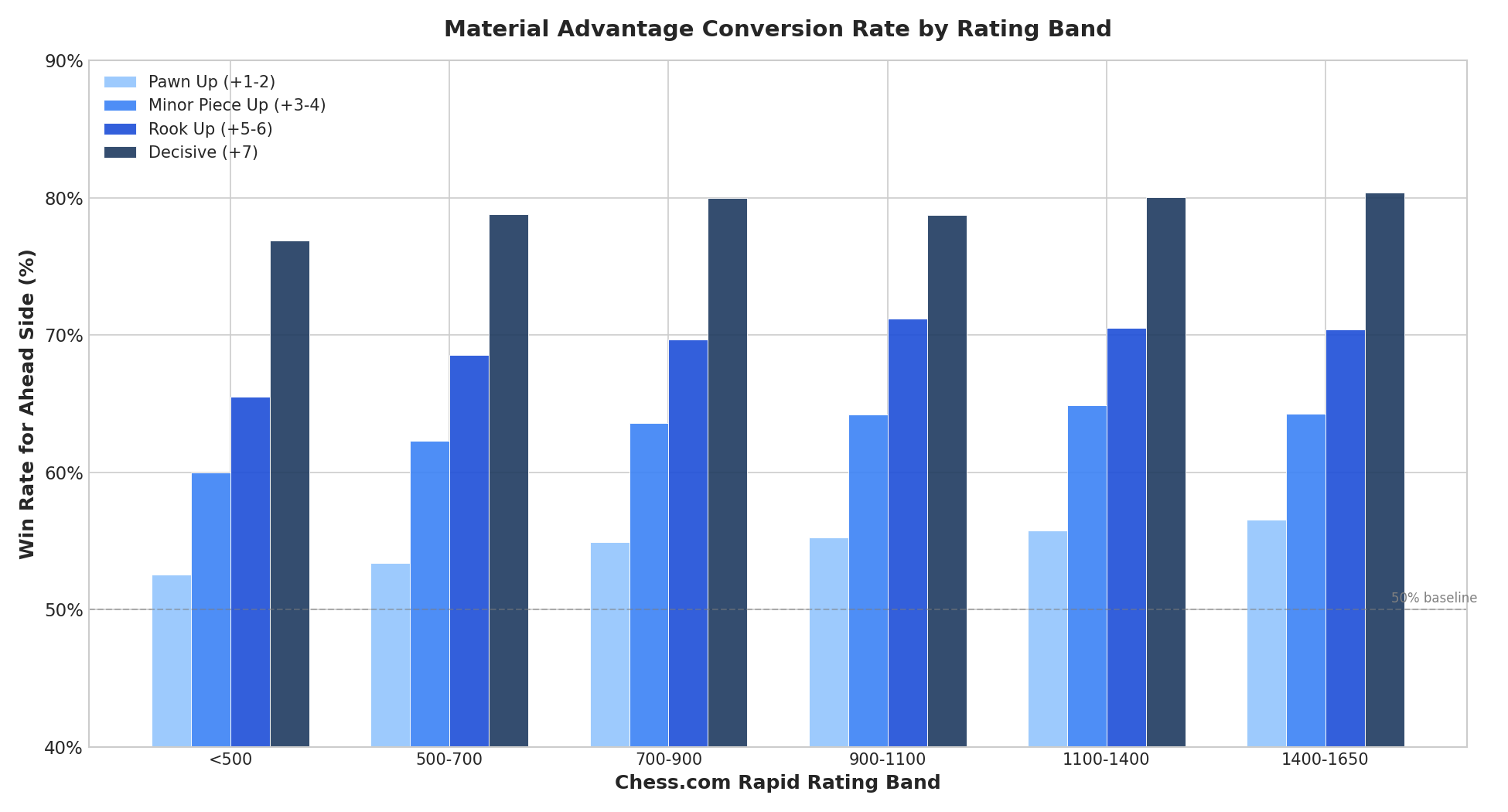
Being up a single pawn (+1-2 material advantage) only yields a win rate of 52.5% for players below 500. This gradually increases to 56.5% for the 1400-1650 band. Even a decisive material advantage of a full piece or more (+7) is not a guaranteed win, though the conversion rate does approach 80% for the highest-rated players in our study.
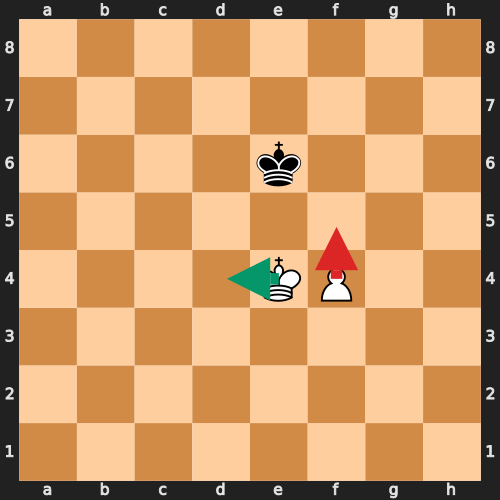
An endgame blunder: White pushes f5+?? too early, throwing away the win by allowing Black to gain the opposition.
Actionable Advice for the 1400-1500 Range
At this level, your opponents are becoming more resilient. You can no longer rely on them to simply collapse after losing a pawn. You must actively practice converting small advantages. Study pawn endgames and learn how to systematically trade down into winning positions when you have a material edge.
The Resilience Score
To summarize these findings, we created a composite "Resilience Score" that factors in a player's ability to punish opponent blunders, delay their own mistakes, and close out winning positions without blundering.
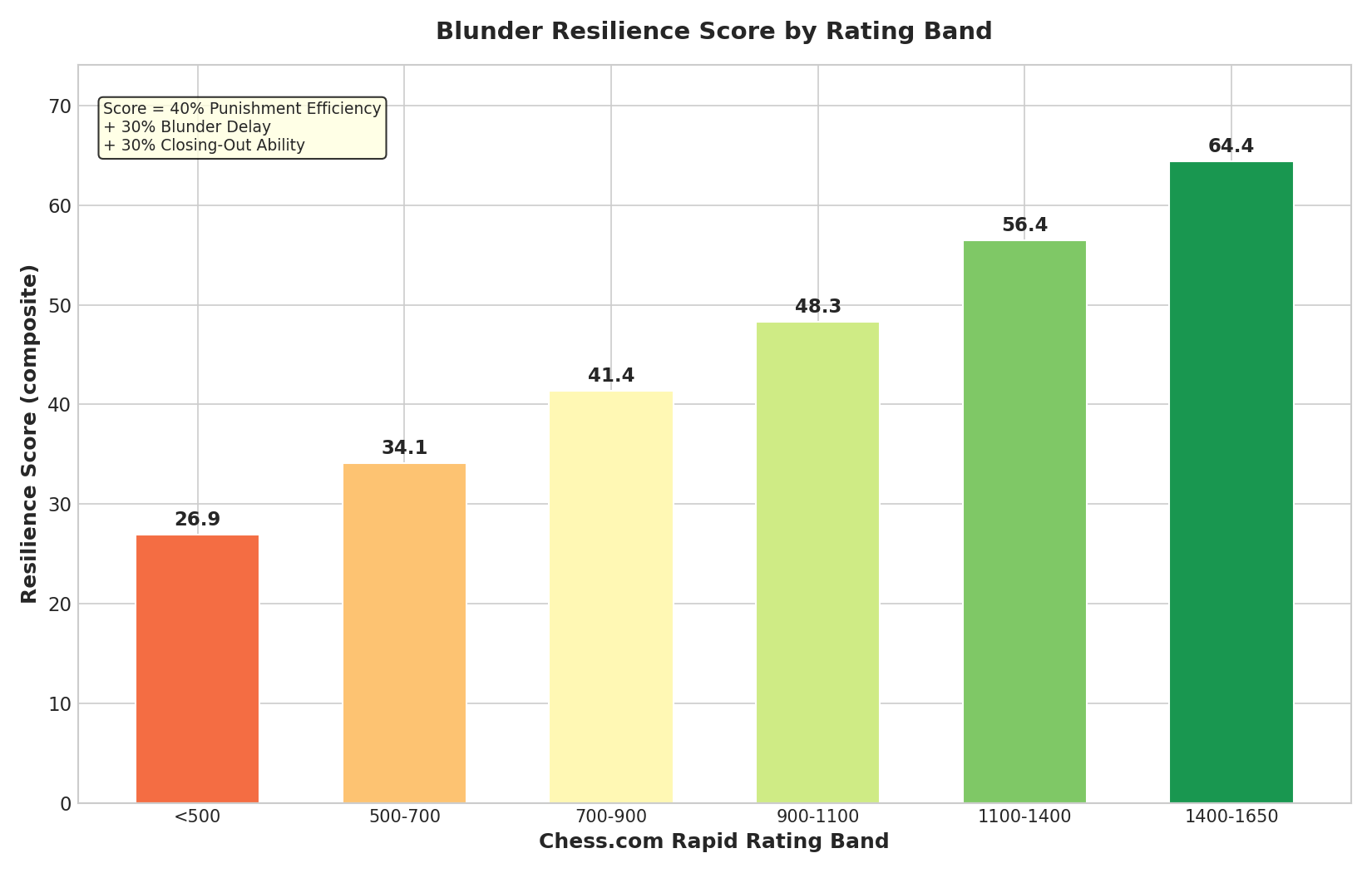
The Resilience Score demonstrates a clear, linear progression as ratings increase. Better players do indeed bounce back faster after a mistake, but more importantly, they are significantly better at ensuring their opponents do not bounce back.
Conclusion
The data paints a clear picture: chess is a game of mistakes, and resilience is a measurable skill. Up to the 1500 Chess.com rating level, a single blunder is rarely fatal. The players who climb the ranks are those who fight on in lost positions, remain vigilant when their opponents blunder, and systematically improve their ability to convert small advantages.
Chess Coach April 15, 2026
Data and Methodology
This analysis was conducted using a large sample of Rapid games sourced from the Lichess database via the Grandmaster Guide API. The dataset includes games played at various time controls classified as Rapid.
To make the findings relevant to the target audience, Lichess rating bands were mapped to approximate Chess.com equivalents based on established conversion tables. The analysis focused on severe blunders, defined as moves that resulted in an evaluation drop of 3.0 pawns or more.
The underlying data used to generate the charts in this article is available in the attached CSV files:
blunder_recovery_outcomes.csvfirst_blunder_timing.csvblunder_taxonomy.csvmaterial_conversion.csvconversion_rates.csv