A Data-Driven Guide to Resilience in Blitz Chess
Every chess player knows the sinking feeling in their stomach. You make a move, hit the clock, and instantly realize you've hung a piece or walked into a devastating tactic. The engine evaluation plummets. Your opponent pauses, noticing the gift you've just handed them.
What happens next? Do you resign immediately, assuming the game is lost? Or do you fight on, hoping your opponent will return the favor?
To answer these questions, we analyzed over 800,000 Lichess Blitz games (mapped to Chess.com ratings from 800 to 1700) using the Grandmaster Guide database. We tracked engine evaluations, material imbalances, and game outcomes to discover exactly how often players recover from massive blunders—and whether higher-rated players are actually better at converting these gifted advantages.
The data reveals a surprising truth about online blitz chess: blundering does not mean losing, and your opponent is far less likely to convert their advantage than you think.
The Blunderer's Advantage: A Statistical Anomaly
When we look at games where only one side makes a severe blunder (an evaluation drop of 3.0 pawns or more), we might expect the non-blundering side to win the vast majority of the time. The data tells a completely different story.
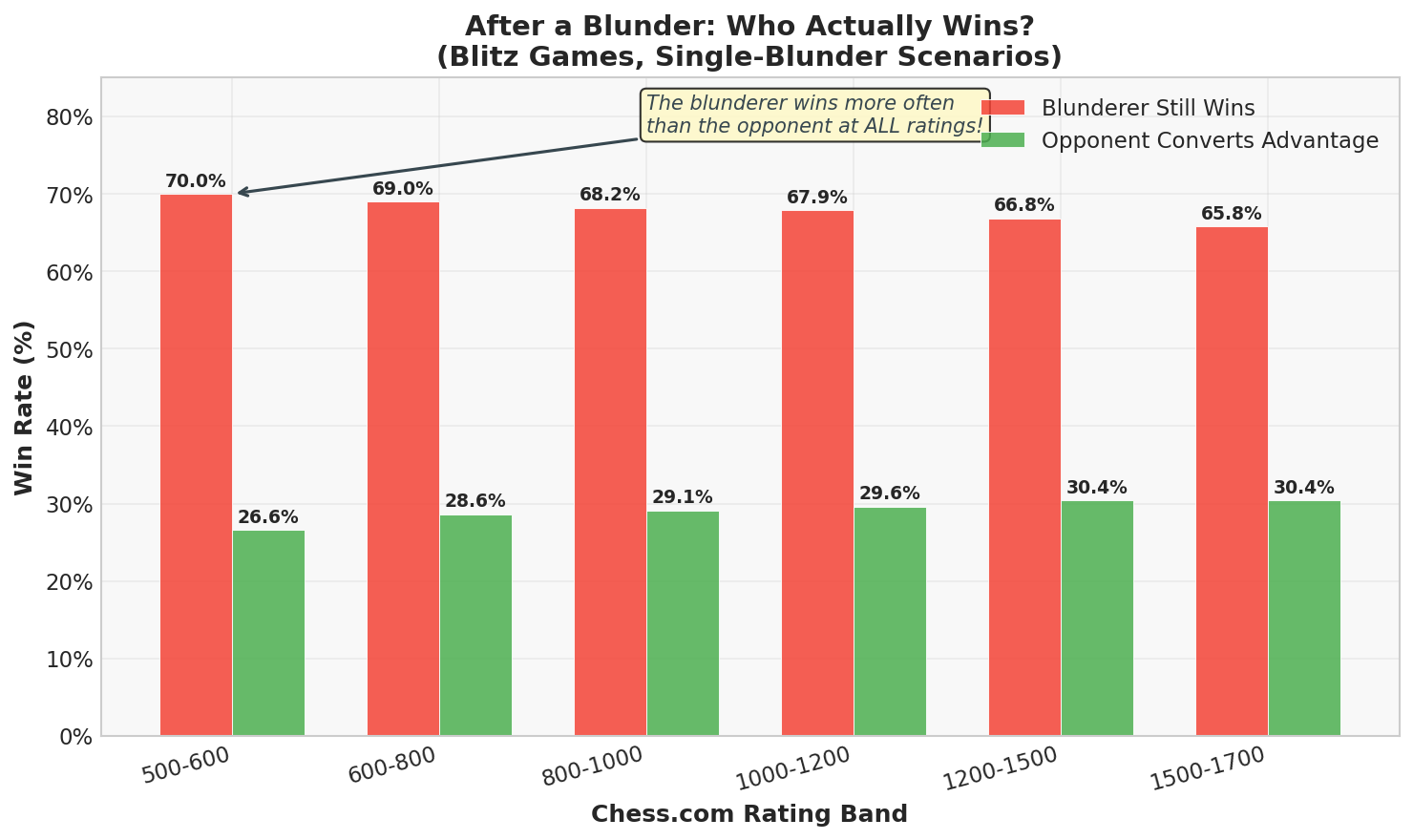
Astonishingly, across all rating bands from 800 to 1700, the player who blunders still wins the game more often than the player who receives the advantage.
At the 800-1000 level, if you make a massive blunder but your opponent plays a relatively clean game (no major blunders of their own), you still have a 68.2% chance of winning. Even at the 1500-1700 level, the blunderer wins 65.8% of the time.
How is this possible? The answer lies in the nature of blitz chess and the "fortressing effect." When a player blunders and falls into a losing position, the engine evaluation often remains extremely negative regardless of what they play. They are already lost, so their subsequent moves aren't flagged as new blunders. Meanwhile, the player with the advantage must navigate the psychological pressure of converting the win, often leading to time trouble or a catastrophic "revenge blunder" that swings the game back.
Actionable Advice for 800-1000 Players
Never resign after a single blunder. The data proves that your opponent is highly likely to misplay the resulting position. Take a deep breath, accept the material deficit, and focus entirely on creating complications. Play quickly, set traps, and force your opponent to prove they can convert the advantage.
The Conversion Struggle: Does Rating Help?
If lower-rated players struggle to convert gifted advantages, surely higher-rated players are more ruthless? We tracked the "Opponent Conversion Rate"—how often a player wins when their opponent hands them a massive advantage.

The improvement is shockingly small. A 1500-1700 rated player is only 1.3 percentage points better at converting a gifted advantage than an 800-1000 rated player (30.4% vs 29.1%).
This suggests that the psychological burden of being "winning" affects players across the intermediate spectrum almost equally. When handed a clear advantage, players often relax, play too passively, or burn too much time on the clock trying to find the "perfect" continuation.
Actionable Advice for 1000-1200 Players
Treat winning positions as dangerous. When your opponent blunders, your mindset should shift to maximum alertness, not relaxation. The data shows you are statistically likely to fail in converting this advantage. Focus on simplification: trade pieces (not pawns), secure your king, and avoid unnecessary tactical complications.
The Anatomy of a Blunder: Where Do Mistakes Happen?
To understand how to recover from blunders, we must first understand when and where they occur. We categorized every blunder based on the engine evaluation before the mistake was made.

The vast majority of blunders do not happen in equal, tense positions. Instead, they occur when a player already has a clear advantage (evaluation +3 to +6) or is completely winning (+6 or more).
At the 800-1000 level, 39% of all blunders happen when the player is already clearly ahead, and another 35% happen when they are completely winning. As players improve to the 1500-1700 level, blunders in winning positions decrease slightly (to 26%), but they remain a massive source of game-losing mistakes.
This is the "Revenge Blunder" phenomenon in action. Player A blunders, giving Player B a winning position. Player B, now relaxed and overconfident, immediately blunders back, returning the game to equality or worse.
Visual Evidence: The Revenge Blunder
Consider this typical scenario from a 1100-rated game. White has just been gifted a material advantage, but in their eagerness to press the attack, they play carelessly.
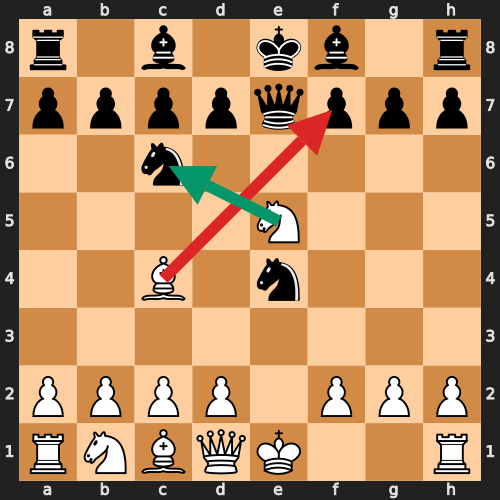 White plays Nxe5?? (red arrow), walking into a discovered attack, instead of the calm d3 (green arrow) to consolidate the advantage.
Actionable Advice for 1200-1500 Players
Beware the move after the blunder. The most dangerous moment in a chess game is immediately after your opponent makes a terrible mistake. Your adrenaline spikes, and the urge to immediately punish them can lead to hasty, uncalculated moves. Force yourself to spend an extra 5-10 seconds on the clock immediately after your opponent blunders to ensure you don't immediately return the favor.
The Timing of Mistakes: Pushing Blunders Later
As players improve, they don't necessarily stop blundering entirely—they just delay their mistakes until later in the game.

At the 800-1000 level, the average first blunder occurs on Move 23. By the time players reach 1500-1700, they have pushed their first major mistake back to Move 31.
This delay is crucial. An opening blunder often decides the game immediately, while a blunder on Move 30 usually occurs in a complex middlegame or endgame where both players are low on time, increasing the chances of a mutual mistake.

The heatmap clearly shows this progression. For 800-1000 players, the danger zone is Moves 11-20 (23.2% of first blunders). For 1500-1700 players, the danger zone shifts to the endgame, with 16.1% of first blunders happening after Move 41.
Actionable Advice for 1500-1700 Players
Manage your clock for the endgame. Since your blunders are now occurring primarily after Move 30, time management is your biggest enemy. If you consistently reach Move 30 with less than 30 seconds on your clock, you are guaranteeing that your inevitable blunder will happen when you have no time to calculate a recovery.
Material Conversion: The Reality of Being "Up a Piece"
Finally, we looked at how often players actually win when they secure a material advantage by Move 20.

The data is sobering. If you are up a full minor piece (+3-4 points of material) at the 800-1000 level, you only win 65.5% of the time. Even at the 1500-1700 level, being up a piece only guarantees a win 69.1% of the time.
It isn't until a player is up a full Rook (+5-6 points) or more that win rates begin to approach 80%.
Visual Evidence: The Winning Blunder
Why do players fail to convert these advantages? Often, it's because they stop calculating defensive threats once they are ahead on material.
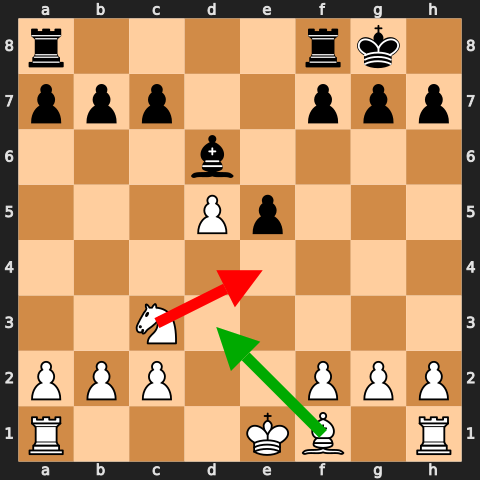 A 1300-rated player, up a pawn and completely winning, plays Ne4?? (red arrow), hanging the knight to the bishop on d6. The simple developing move Bd3 (green arrow) would have maintained a crushing advantage.
Conclusion: The Roadmap to Resilience
The data from over 800,000 games paints a clear picture: blitz chess is a game of mutual mistakes, and resilience is often more valuable than accuracy.
To climb the rating ladder from 800 to 1700, you must internalize these data-backed truths:
- Never resign early. Your opponent is statistically likely to fail in converting their advantage.
- Fear the winning position. The majority of blunders happen when a player is already ahead.
- Consolidate, don't complicate. When you gain an advantage, your primary goal is to simplify the position and avoid "revenge blunders."
- Push mistakes later. Improve your opening and early middlegame play to ensure your inevitable blunders happen when the position is complex and your opponent is low on time.
Chess is not a game of perfection; it is a game of managing imperfections. The player who bounces back fastest from their mistakes is the one who ultimately wins.
Data and Methodology
This analysis was conducted using the Grandmaster Guide MCP server, analyzing a dataset of Lichess Blitz games. Rating bands were adjusted to approximate Chess.com ratings based on standard conversion tables.
- Total Games Analyzed: ~847,000
- Time Control: Blitz (primarily 3+0 to 5+5)
- Evaluation Engine: Stockfish 17 (blunder defined as ≥300 centipawn loss)
Underlying Data Files:
View full data →lichess_band chesscom_band blunderer_still_wins_pct opponent_conversion_rate_pct both_blundered_white_win_pct both_blundered_draw_pct neither_blundered_white_win_pct neither_blundered_draw_pct both_blundered_n one_side_blundered_n 700-900 500-600 70.0 26.6 60.8 5.1 18.6 3.7 100262 4655 900-1100 600-800 69.0 28.6 61.6 4.1 17.7 3.3 101065 4449 1100-1300 800-1000 68.2 29.1 61.7 3.8 17.1 2.9 100499 4382 1300-1500 1000-1200 67.9 29.6 62.3 3.4 16.3 3 98625 4435 1500-1800 1200-1500 66.8 30.4 62.7 3.5 15.7 3.2 94988 4053
View full data →lichess_band chesscom_band position_type blunder_pct avg_cpl sample_blunders 700-900 500-600 Clear advantage (3-6) 33.6 914 841002 700-900 500-600 Equal position (0-1) 3.1 501 77206 700-900 500-600 Slight edge (1-3) 17.4 489 435735 700-900 500-600 Winning (6+) 45.8 1698 1145979 900-1100 600-800 Clear advantage (3-6) 36.7 910 933884
View full data →lichess_band chesscom_band avg_first_blunder_move games_with_blunder_pct avg_blunders_per_game sample_games 700-900 500-600 18 76.6 19.18 68678 900-1100 600-800 20.6 76.8 19.32 68203 1100-1300 800-1000 23.3 76.3 19.01 68351 1300-1500 1000-1200 25.8 75.8 18.48 69081 1500-1800 1200-1500 28.6 74.4 18.25 66704
View full data →lichess_band chesscom_band material_bucket side win_pct draw_pct loss_pct sample_positions 700-900 500-600 +1-2 (pawn up) ahead 54 6.8 39.2 12642 700-900 500-600 +1-2 (pawn up) behind 51.1 6.8 42.1 13212 700-900 500-600 +3-4 (minor piece up) ahead 60.2 6.8 33 8915 700-900 500-600 +3-4 (minor piece up) behind 59.7 6.1 34.2 9719 700-900 500-600 +5-6 (rook up) ahead 66.2 5.7 28.1 6212
View full data →lichess_band chesscom_band avg_cpl white_avg_cpl black_avg_cpl blunder_rate_per_game mistake_rate_per_game inaccuracy_rate_per_game sample_games 700-900 500-600 181.9 182.4 181.4 19.18 4.69 3.11 68678 900-1100 600-800 177.2 177.8 176.5 19.32 5.79 3.82 68203 1100-1300 800-1000 169 169.8 168.3 19.01 6.73 4.41 68351 1300-1500 1000-1200 161.2 162 160.4 18.48 7.6 4.87 69081 1500-1800 1200-1500 155.7 156.6 154.9 18.25 8.61 5.53 66704
Chess Coach 2026-04-15