Bullet chess is a chaotic, adrenaline-fueled variant where the clock is as much an opponent as the player sitting across the board. In this high-speed environment, mistakes are inevitable. But exactly how common are they? Does the definition of a "blunder" need to scale with rating to remain a useful metric? And how much does the blunder rate increase when players are under severe time pressure?
To answer these questions, we analyzed a massive dataset of Lichess bullet games played in March 2025, featuring Stockfish 17 evaluations. We mapped the Lichess rating bands to their approximate Chess.com equivalents to provide actionable insights for players looking to climb the rating ladder. This article serves as a roadmap for improvement, detailing the anatomy of blunders across different skill levels and offering data-backed advice for each rating segment.
The Blunder Paradox: More Blunders at Higher Ratings?
When we first looked at the data, the results were counterintuitive. The total number of blunders per game actually increases as ratings go up. Players in the 445–725 Chess.com range average 13.6 blunders per game (combined for both sides), while players in the 1510–1715 range average 18.7 blunders per game.
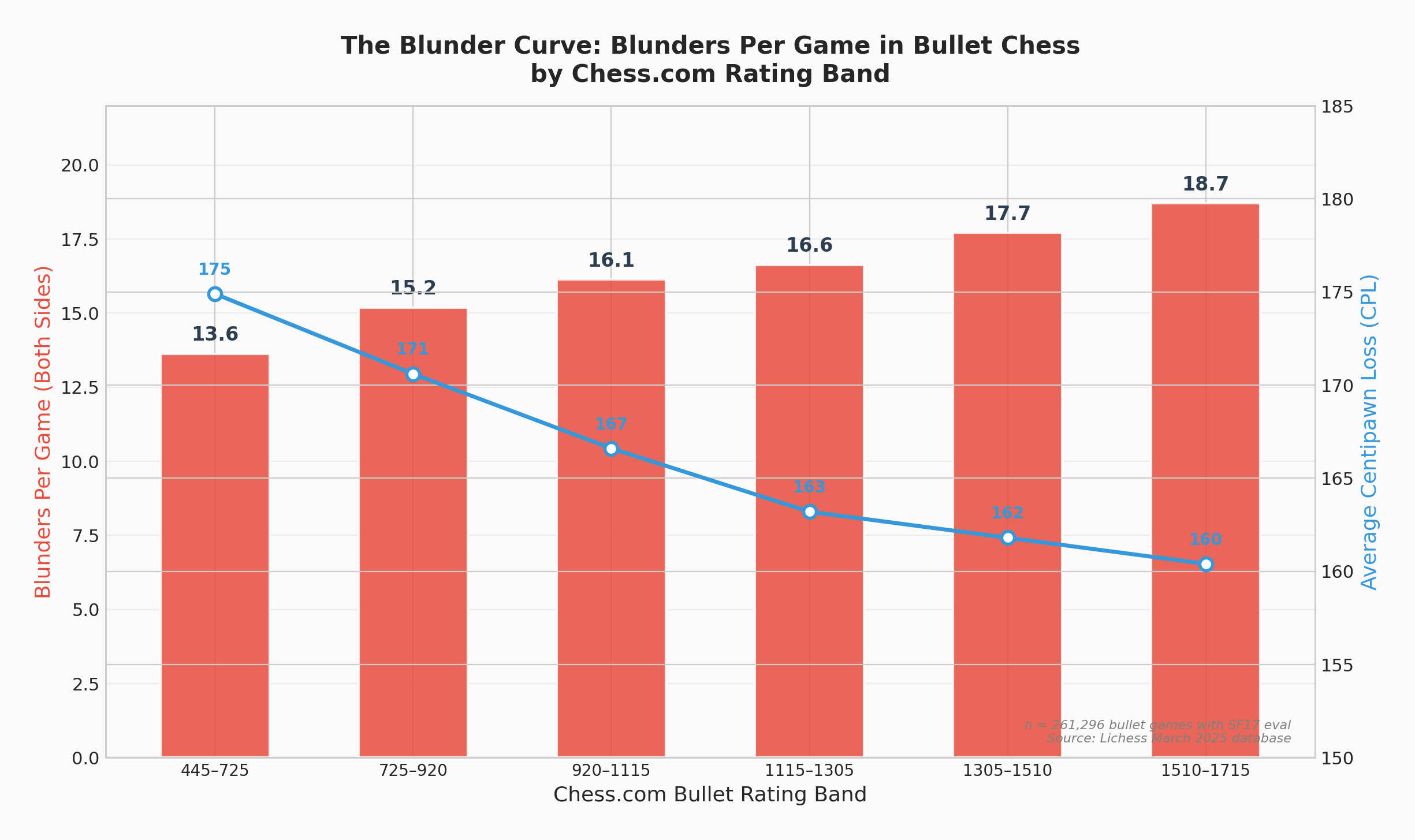
However, this paradox is easily explained by game length. Higher-rated players simply play longer games. At the 445–725 level, 41% of games end before move 20, often due to quick checkmates or early resignations. At the 1510–1715 level, only 12% of games end that quickly. When we look at the Average Centipawn Loss (CPL)—a measure of overall move quality—we see the expected trend: CPL improves steadily from 175 at the lowest ratings to 160 at the highest.
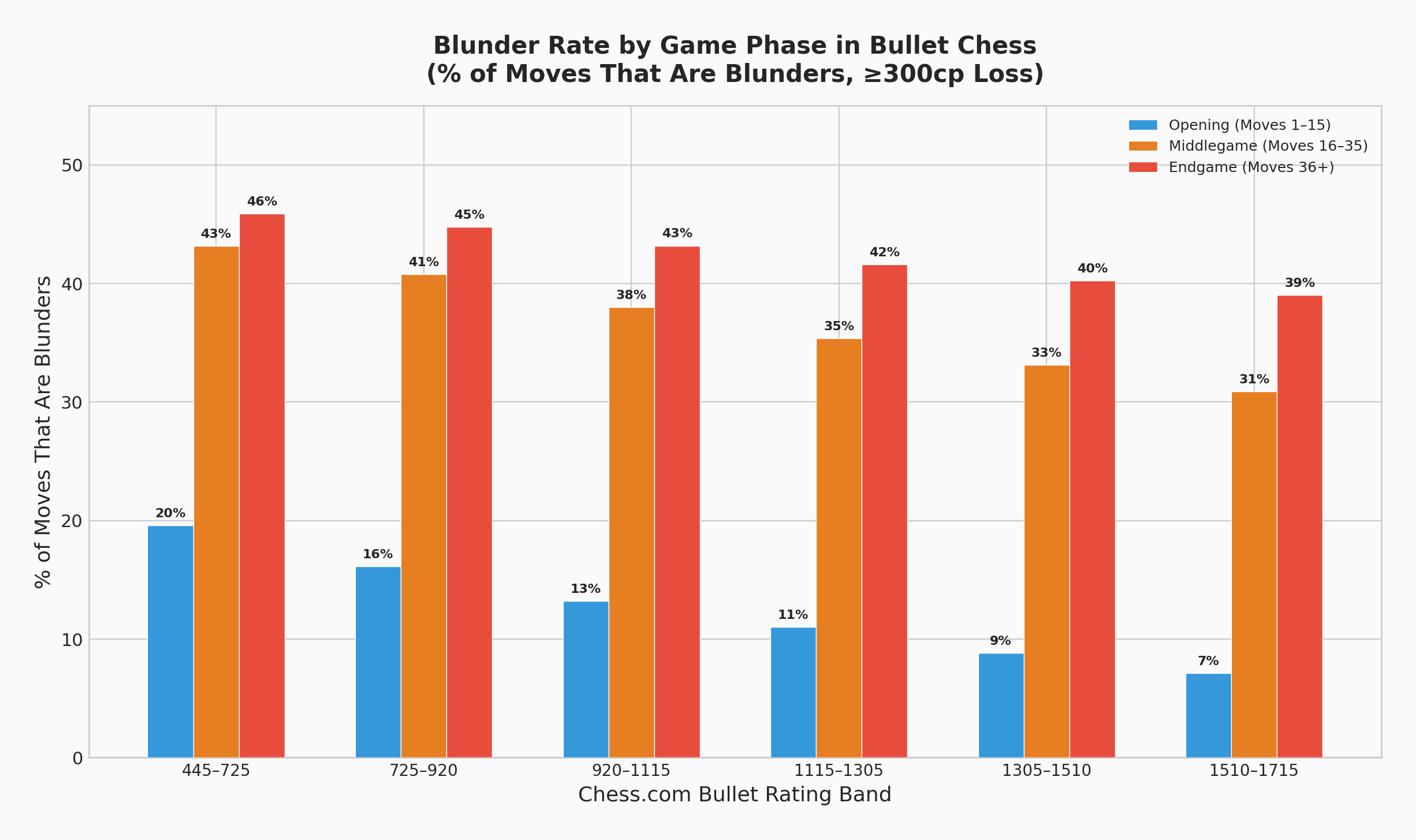
The true measure of accuracy is the per-move blunder rate. When we break down the data by game phase, we see that lower-rated players blunder on a higher percentage of their moves, particularly in the opening and middlegame.
The Anatomy of a Blunder
Not all blunders are created equal. A blunder in an equal position can instantly lose the game, while a blunder in a completely winning position might just prolong the inevitable. Our analysis of the "Blunder Taxonomy" reveals fascinating differences in when players make their biggest mistakes.

At the 445–725 level, a staggering 46% of all blunders occur in positions that are already completely winning (evaluation of +6 or more). This highlights a critical issue for beginners: the inability to convert winning advantages without throwing the game away. As players improve, this percentage drops significantly. By the 1510–1715 level, only 26% of blunders happen in winning positions, with the majority shifting to "Clear Advantage" (3–6) or "Slight Edge" (1–3) scenarios.
Interestingly, blunders in dead-equal positions (evaluation 0–1) are remarkably rare across all rating bands, accounting for only about 3% of all blunders. This suggests that players are generally cautious when the game is balanced, but become prone to errors when the position becomes imbalanced or chaotic.
The Impact of Time Pressure
Bullet chess is defined by time pressure, but does thinking longer actually lead to better moves? The data suggests that in bullet, the answer is a resounding "barely."
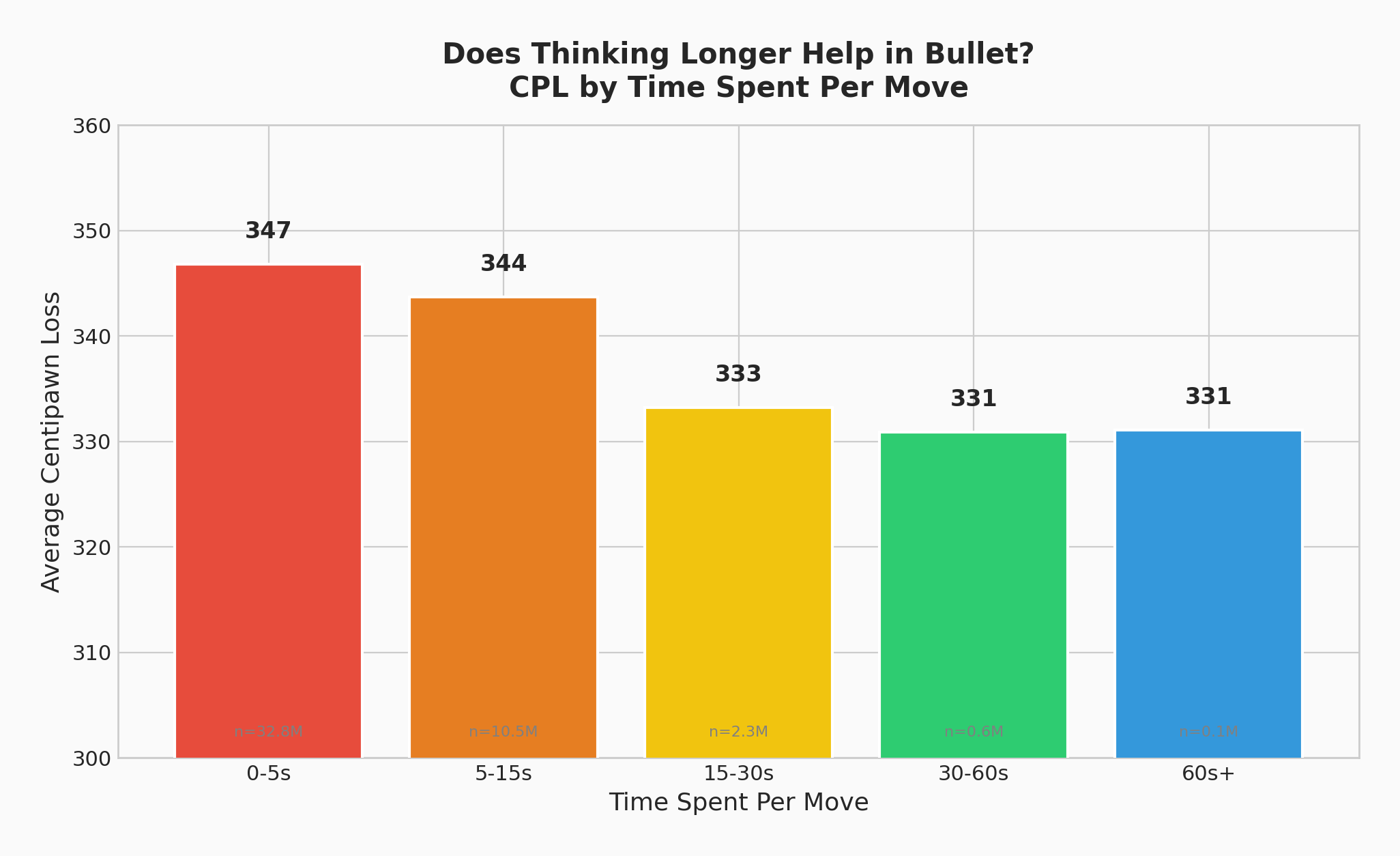
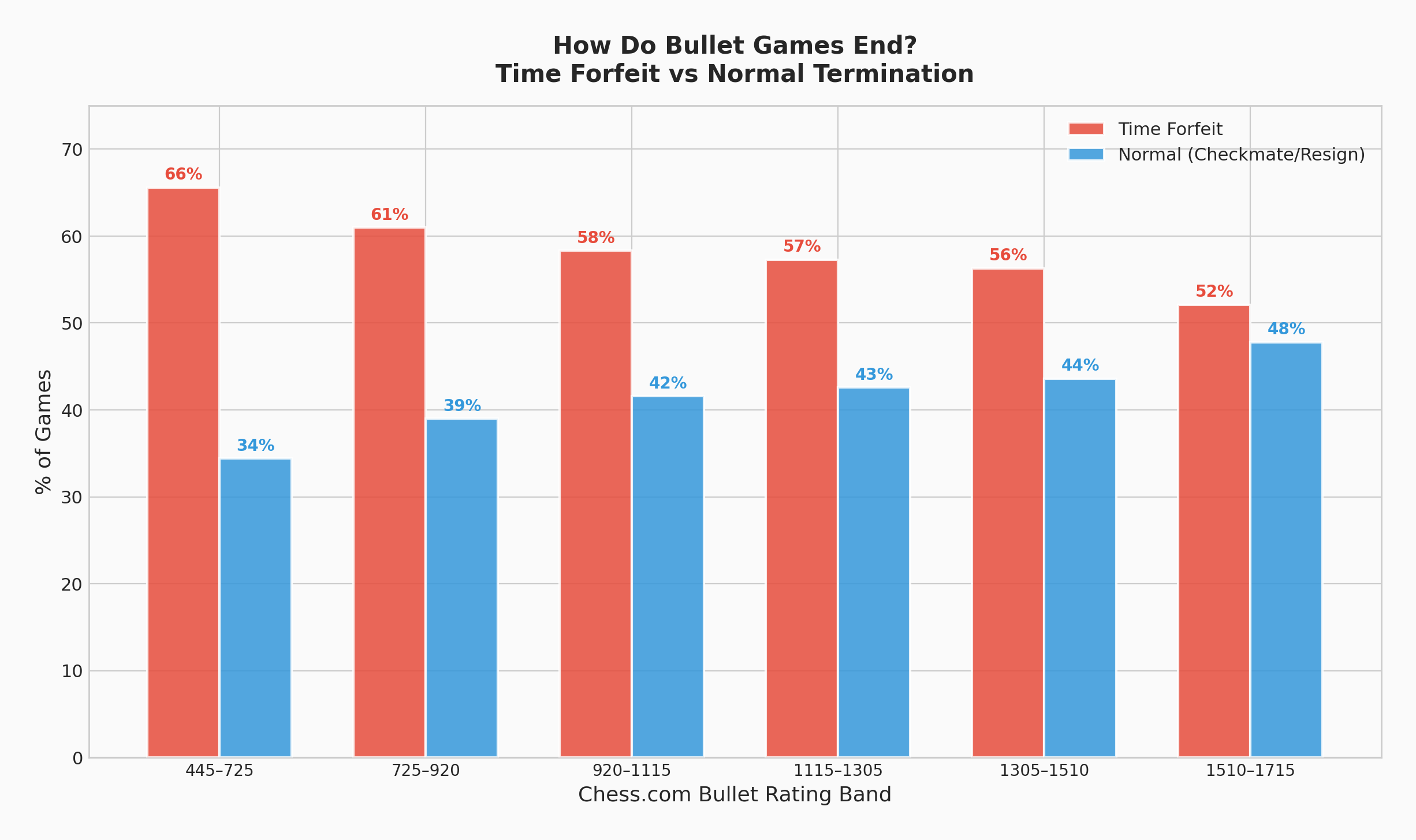
Moves played in 0–5 seconds result in an average CPL drop of 347. Moves played after 30–60 seconds of thought result in an average CPL drop of 331. The difference is marginal. In bullet chess, the clock is a weapon, and spending precious seconds searching for the perfect move often leads to a time forfeit later in the game. In fact, across all rating bands, between 52% and 66% of bullet games end in a time forfeit.
Roadmap for Improvement: Actionable Advice by Rating Band
Based on the data, here is a targeted guide for climbing the bullet chess rating ladder.
The Beginner Band: 445–725 Chess.com (1030–1200 Lichess)
The Data: Players in this band blunder on nearly 20% of their opening moves and 43% of their middlegame moves. A massive 46% of their blunders happen when they are already completely winning. Furthermore, 41% of their games end before move 20.
Actionable Advice:
- Stop the Bleeding: Your primary goal is simply to stop hanging pieces in the first 15 moves. You don't need brilliant tactics; you just need to ensure every piece is defended.
- Practice Conversion: You are getting winning positions, but you are throwing them away. Practice playing against the computer from positions where you are up a piece or a rook. Focus on safe, solid moves rather than flashy attacks.
- Play Faster: 66% of games at this level end in a time forfeit. If you are spending more than 3 seconds on a move in the opening, you are playing too slowly.
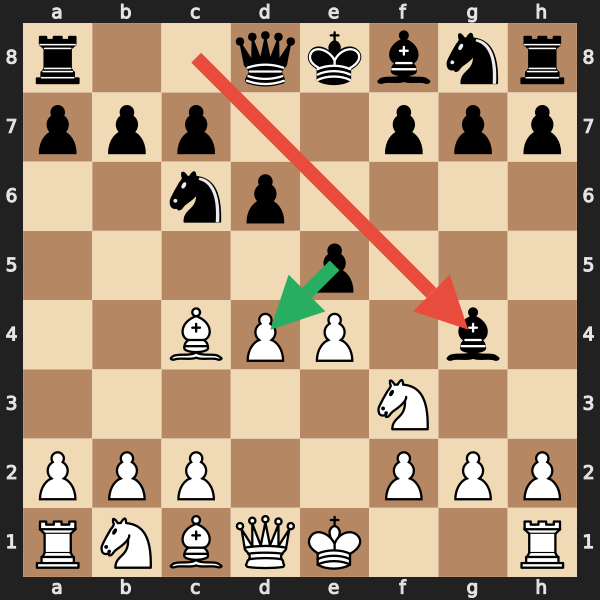 A typical opening blunder at this level: Black plays Bg4, completely missing that the bishop is undefended and can simply be captured by the white queen or knight.
The Intermediate Band: 725–1115 Chess.com (1200–1475 Lichess)
The Data: Move quality improves (CPL drops from 175 to 167), and games start lasting longer. The percentage of blunders in winning positions drops from 46% to 35%. However, the endgame remains a nightmare, with a 43–45% per-move blunder rate.
Actionable Advice:
- Tactical Awareness: Blunders here are less about leaving pieces completely undefended and more about missing simple 2-move tactics (forks, pins, discovered attacks). Daily puzzle practice is essential.
- Endgame Basics: The high endgame blunder rate often stems from a lack of basic knowledge. Learn how to checkmate with a King and Queen, and King and Rook. Understand the rule of the square for pawn endgames.
- Manage the Clock: Time forfeits are still the most common way games end (58–61%). You must learn to play the opening and early middlegame on autopilot to save time for critical calculations later.
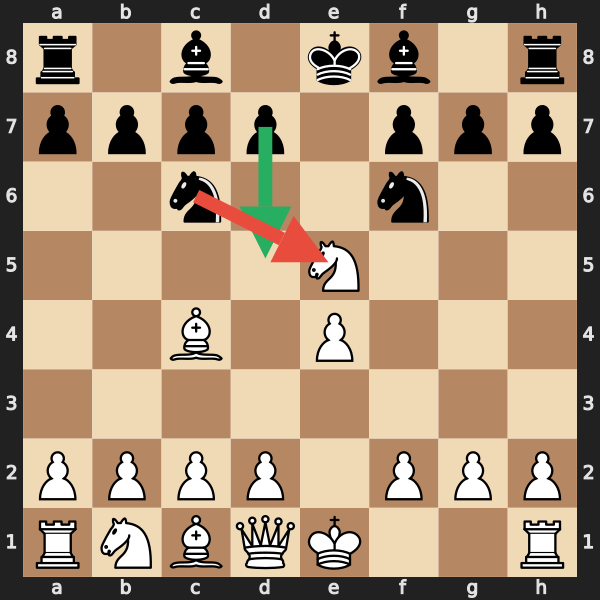 A typical middlegame blunder: Black plays Nxe5, grabbing a pawn but falling victim to a devastating fork after Bxf7+.
The Advanced Band: 1115–1510 Chess.com (1475–1845 Lichess)
The Data: The first blunder now happens significantly later in the game (around move 24–26). Players are much better at converting winning positions, with blunders in those scenarios dropping to 28%. The overall CPL improves to 162.
Actionable Advice:
- Positional Understanding: At this level, blunders are often positional rather than purely tactical. Creating permanent weaknesses (like doubled isolated pawns or a shattered king position) can be just as fatal as dropping a piece.
- Resilience: The data shows that even at this level, 74% of games contain at least one major blunder. If you make a mistake, do not immediately resign. Your opponent is highly likely to make a mistake of their own.
- Pre-moving: To survive the time scramble, you must master the art of safe pre-moving in the endgame.
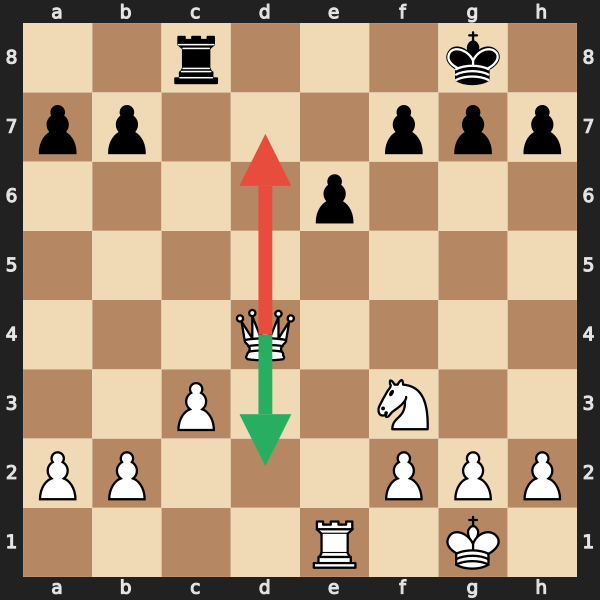 A classic "winning position" blunder: White is up a full rook and completely winning, but plays Qd7, hanging the queen to the discovered attack Rc1+.
The Expert Band: 1510–1715+ Chess.com (1845–2000+ Lichess)
The Data: Games are long and hard-fought. Only 12% of games end before move 20. The first blunder doesn't typically occur until move 28 or later. Time forfeits drop to 52%, indicating much better clock management.
Actionable Advice:
- Opening Preparation: Because games are longer and opponents are less likely to blunder early, having a solid, fast opening repertoire is crucial. You need to reach a playable middlegame with a time advantage.
- Endgame Technique: The endgame is where these games are decided. The per-move blunder rate in the endgame is still high (around 40%), mostly due to extreme time pressure. Superior endgame technique allows you to play fast and accurately when the clock is ticking down.
- Psychological Warfare: Use the clock to pressure your opponent. If you have a time advantage, sometimes playing a slightly suboptimal but complicated move is better than playing the objectively best move, as it forces your opponent to burn precious seconds.
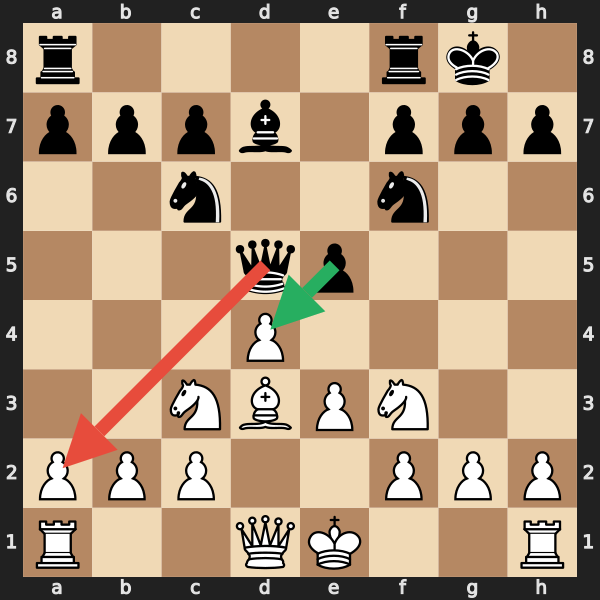 A time pressure blunder: In a complex position with seconds on the clock, Black grabs a pawn with Qxa2, missing that the queen is now trapped or lost to a discovered attack.
Conclusion
The "Blunder Curve" in bullet chess is a fascinating study in human error under pressure. While the total number of blunders per game increases with rating due to longer games, the actual per-move accuracy improves significantly. By understanding where and when players at your rating level make mistakes, you can tailor your training to address those specific weaknesses. Remember, in bullet chess, you don't have to play perfectly; you just have to play slightly better—and slightly faster—than the person sitting across from you.
Data and Methodology
This analysis was conducted using a dataset of bullet chess games played on Lichess in March 2025. The dataset includes games with Stockfish 17 evaluations, allowing for precise measurement of Centipawn Loss (CPL) and blunder rates. A blunder is defined as a move resulting in a CPL of 300 or more.
Lichess ratings were mapped to approximate Chess.com ratings using established community conversion tables to provide actionable advice for the broader chess community.
The underlying data files generated for this analysis are available below:
View full data →ratingBand avgCpl whiteAvgCpl blackAvgCpl blunderRatePerGame mistakeRatePerGame inaccuracyRatePerGame sampleGames chesscom_band chesscom_mid 700-900 174.9 174.9 174.8 13.63 4.34 3.1 30549 445–725 585 900-1100 170.6 170.9 170.3 15.19 5.36 3.7 37053 725–920 825 1100-1300 166.6 167.0 166.2 16.13 6.22 4.17 41465 920–1115 1020 1300-1500 163.2 163.7 162.8 16.63 6.74 4.38 43745 1115–1305 1210 1500-1800 161.8 162.3 161.2 17.71 7.51 4.69 46852 1305–1510 1400
View full data →ratingBand blunderBucket side gamePct gameCount chesscom_band 700-900 0 black 37.3 61310 445–725 700-900 1 black 8.2 13512 445–725 700-900 2 black 5.2 8487 445–725 700-900 3 black 4.1 6713 445–725 700-900 4 black 3.6 5908 445–725
View full data →ratingBand avgFirstBlunderMove gamesWithBlunderPct avgBlundersPerGame sampleGames chesscom_band chesscom_mid 700-900 16.6 70.9 13.63 30549 445–725 585 900-1100 19.8 72.8 15.19 37053 725–920 825 1100-1300 22.2 73.7 16.13 41465 920–1115 1020 1300-1500 23.8 73.5 16.63 43745 1115–1305 1210 1500-1800 26.0 74.2 17.71 46852 1305–1510 1400
View full data →ratingBand positionType blunderPct avgCpl sampleBlunders chesscom_band 700-900 Clear advantage (3-6) 33.6 914 841002 445–725 700-900 Equal position (0-1) 3.1 501 77206 445–725 700-900 Slight edge (1-3) 17.4 489 435735 445–725 700-900 Winning (6+) 45.8 1698 1145979 445–725 900-1100 Clear advantage (3-6) 36.7 910 933884 725–920
View full data →ratingBand phase avgCpl blunderPct mistakePct inaccuracyPct sampleMoves avgTimeSpentSec chesscom_band 700-900 opening 197.5 19.57 17.01 14.71 2513055 5.47 445–725 700-900 middlegame 529.6 43.15 5.06 1.5 3276179 7.03 445–725 700-900 endgame 686.5 45.89 1.54 0.66 1295246 3.86 445–725 900-1100 opening 164.9 16.15 19.03 16.77 2565446 4.61 725–920 900-1100 middlegame 461.1 40.79 6.63 2.11 3656537 6.48 725–920
View full data →ratingBand termination pctOfGames avgGameLength sampleGames chesscom_band 700-900 abandoned 0.5 3.0 755 445–725 700-900 normal 69.6 26.4 114336 445–725 700-900 other 0.0 15.0 1 445–725 700-900 rules_infraction 0.0 9.2 12 445–725 700-900 time_forfeit 29.9 26.0 49132 445–725
View full data →ratingBand pctEndingUnder20Moves pctEndingUnder30Moves pctEndingUnder40Moves pctReaching40PlusMoves pctReaching60PlusMoves decisiveAvgMoves drawAvgMoves normalTerminationPct timeForfeitPct sampleGames chesscom_band 700-900 41.1 82.5 95.0 5.0 0.6 21.7 40.9 34.4 65.6 34669 445–725 900-1100 27.8 71.2 91.2 8.8 1.0 25.0 43.9 39.0 61.0 41074 725–920 1100-1300 21.6 61.0 87.1 12.9 1.5 27.4 45.8 41.6 58.3 45388 920–1115 1300-1500 18.0 53.9 83.8 16.2 1.6 29.0 47.2 42.6 57.3 47397 1115–1305 1500-1800 14.3 44.9 77.5 22.5 2.0 31.2 49.0 43.6 56.3 49779 1305–1510
View full data →ratingBand phase avgEvalAbsolute sampleGames chesscom_band 700-900 opening 1.35 2036206 445–725 700-900 middlegame 4.17 2216379 445–725 700-900 endgame 6.39 2972861 445–725 900-1100 opening 1.07 2060335 725–920 900-1100 middlegame 3.43 2372952 725–920
View full data →timeSpentBucket avgCplDrop sampleMoves 0-5s 346.8 32774029 5-15s 343.7 10533160 15-30s 333.2 2284080 30-60s 330.9 589684 60s+ 331.1 105973
View full data →ratingBand evalBucket resignationPct sampleGames chesscom_band 700-900 0-1 (equal) 54.0 49465 445–725 700-900 1-3 (slight disadvantage) 1.3 1199 445–725 700-900 10+ (hopeless) 29.7 27207 445–725 700-900 3-6 (clear disadvantage) 4.5 4089 445–725 700-900 6-10 (lost position) 10.6 9703 445–725
Chess Coach <2026-04-15>