Every chess player knows the sinking feeling of realizing they have just blundered. Whether it is hanging a piece in the opening or missing a simple tactic in the endgame, blunders are an inescapable part of the game. However, the frequency, timing, and nature of these blunders change dramatically as players improve. This article presents a data-driven analysis of blunder rates across different rating bands in Blitz chess, providing a roadmap for improvement based on over 400,000 evaluated games.
By analyzing engine evaluations from real-world games, we can map the exact mathematical relationship between Elo rating and move quality. This analysis focuses primarily on Chess.com Blitz ratings, divided into bands of approximately 200 points, ranging from under 500 to 1700. The data reveals not only how often players blunder, but also when these blunders occur and what types of positions induce them.
The Blunder Curve: Move Quality by Rating
The most fundamental question is how move quality improves as rating increases. To measure this, we use Average Centipawn Loss (CPL), which quantifies how much worse a player's moves are compared to the engine's top choice. We also track the frequency of blunders (moves that lose 300 or more centipawns), mistakes (100–299 centipawns), and inaccuracies (50–99 centipawns).

The data shows a clear and consistent decline in Average CPL as rating increases. Players under 500 Chess.com Blitz (roughly equivalent to Lichess 700-900) have an average CPL of 181.9. By the time players reach the 1400–1700 Chess.com band (Lichess 1800-2000), their average CPL drops significantly to 149.7.
Interestingly, the absolute number of severe blunders (≥300cp) per game remains surprisingly flat across these rating bands, hovering around 18 to 19 per game. This counterintuitive finding suggests that the definition of a "blunder" as a fixed 300-centipawn loss may need to scale with rating to remain a perfectly precise metric. However, the composition of errors changes. As players improve, the frequency of smaller mistakes and inaccuracies increases relative to catastrophic blunders, indicating a shift from hanging full pieces to making positional or tactical errors that are less immediately fatal.

When Do Blunders Happen?
Understanding when blunders occur is crucial for targeted improvement. Does the game slip away in the opening, or is it lost in the complexities of the middlegame?

The timing of the first major blunder shifts later into the game as rating increases. For players under 500 Chess.com, the first blunder occurs, on average, at move 18.0. For players in the 1400–1700 band, the first blunder is delayed until move 31.6. This indicates that higher-rated players are much better at navigating the opening and early middlegame without making catastrophic errors.
Furthermore, the percentage of games containing at least one blunder decreases slightly from 76.6% in the lowest band to 73.6% in the highest band. While blunders remain common, stronger players are marginally more likely to play a "clean" game.

Breaking down blunder rates by game phase reveals a stark contrast. The opening phase sees the lowest blunder rates across all ratings, but this is also where the most significant improvement occurs. The opening blunder rate drops from nearly 20% for players under 500 to just 7.1% for players between 1400 and 1700.

Conversely, the endgame is a minefield for players of all levels. The blunder rate spikes dramatically in the endgame, reaching over 45% for the lowest-rated players and remaining near 39% even for the 1400–1700 group. This highlights the endgame as a critical area for study, as fatigue and time pressure often lead to severe mistakes.
The Anatomy of a Blunder
What types of positions are most likely to induce a blunder? The data categorizes the position evaluation immediately before a blunder into four types: Equal (0-1), Slight Edge (1-3), Clear Advantage (3-6), and Winning (6+).

A fascinating trend emerges: lower-rated players are highly prone to blundering when they are already in a winning position. For players under 500 Chess.com, nearly 46% of all blunders occur when they have a decisive advantage (eval 6+). This suggests a tendency to relax or lose focus when ahead. As rating increases, this percentage drops significantly, falling to 25.8% for the 1400–1700 band. Stronger players are much better at converting winning advantages without throwing the game away.
Time Pressure and Move Quality
Blitz chess is inherently stressful, and the clock plays a major role in move quality. Analyzing the relationship between time spent per move and Average CPL reveals the impact of time management.

The data shows that taking more time generally leads to better moves, but with diminishing returns. Moves played in 0-5 seconds have the highest average CPL drop (346.8). Spending 15-30 seconds on a move reduces the CPL drop to 333.2. However, spending more than 60 seconds does not yield further significant improvements in Blitz, likely because such long thinks often occur in overly complex or already lost positions, or they lead to severe time trouble later.
Comparing different time controls further illustrates the effect of time pressure.

Across all rating bands, Classical and Rapid games show significantly lower Average CPL than Blitz and Bullet games. The gap between Rapid and Blitz CPL widens as rating increases, suggesting that stronger players are better able to utilize the extra time in Rapid to find higher-quality moves, whereas lower-rated players may still struggle with fundamental errors regardless of the clock.
Visualizing Common Blunders
To make these statistics concrete, let us examine some typical blunders that plague different rating levels.
The Opening Piece Hang (Typical <800 Chess.com)
In the lowest rating bands, blunders often involve simply moving a piece to an undefended square or missing a direct threat.

In this position, Black plays Nd4, completely ignoring that the e5 pawn is now undefended and can be captured by the White knight. Developing the knight to a5 to challenge the bishop would have been a much stronger continuation.
The Middlegame Fork (Typical 800-1100 Chess.com)
As players progress, they stop hanging pieces outright but often fall victim to simple two-move tactics like forks.

Here, White plays Qe2, a passive move that blocks the king and fails to address the tension. This allows Black to play Nxe5, winning a pawn and simultaneously attacking the White queen.
The Endgame Stalemate (Common across all sub-1500 levels)
The endgame is where blunder rates are highest, and one of the most tragic errors is stalemating a lone king when up massive material.

White, up a full queen, carelessly plays Qf7, trapping the Black king without putting it in check, resulting in a draw. The simple Qf6 would have delivered checkmate.
Blundering in a Winning Position
As the data showed, lower-rated players frequently blunder when they have a decisive advantage.
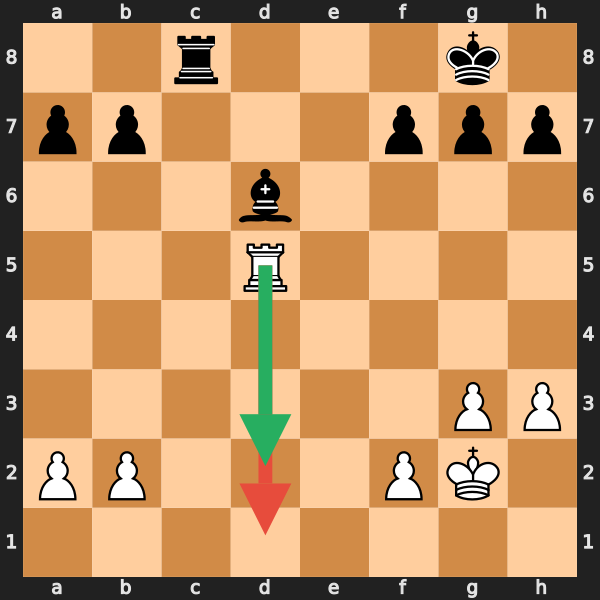
White is up a full rook and should be cruising to victory. However, playing Rd1 allows Black to play Bb1, trapping the rook and complicating a completely won game. Keeping the rook active with Rd2 was the correct approach.
Actionable Advice by Rating Band
Based on the data, here is a roadmap for improvement tailored to specific Chess.com Blitz rating bands.
Under 500: Stop the Bleeding
At this level, games are decided by who gives away the most material. Your primary goal is to reduce catastrophic, one-move blunders.
- Actionable Advice: Before every move, perform a "blunder check." Ask yourself: "Is the square I am moving to defended?" and "Did my opponent's last move attack anything?"
- Focus Area: Do not worry about deep opening theory. Focus on basic opening principles (control the center, develop pieces, castle) to survive the first 15 moves, where your blunder rate is currently highest.
500–900: Tactical Awareness
You are hanging fewer pieces outright, but you are still falling for simple tactics like forks, pins, and skewers.
- Actionable Advice: Incorporate daily tactical puzzles into your routine. Focus on recognizing patterns rather than calculating deep variations.
- Focus Area: Pay special attention to the endgame. The data shows your blunder rate spikes dramatically after move 35. Practice basic checkmates (King and Queen vs. King, King and Rook vs. King) until they are automatic, ensuring you do not stalemate winning positions.
900–1300: Solidifying the Opening and Middlegame
Your opening play is improving, with the first blunder pushed back past move 25. However, you still struggle to convert winning advantages.
- Actionable Advice: When you achieve a winning position (eval 6+), do not relax. The data shows a high percentage of blunders occur here. Play solid, forcing moves and prioritize king safety over grabbing additional, unnecessary material.
- Focus Area: Start analyzing your games to understand why you made a mistake. Was it a miscalculation, or did you simply miss an opponent's threat?
1300–1700: Refining Move Quality
You are now a solid intermediate player. Your Average CPL is dropping, and your opening blunder rate is impressively low (under 9%). The challenge now is reducing smaller mistakes and inaccuracies.
- Actionable Advice: Time management becomes critical. The data shows that spending 15-30 seconds on critical decisions significantly improves move quality. Avoid playing instantly unless you are in a known theoretical line or a forced sequence.
- Focus Area: Deepen your endgame knowledge. While your opening play is strong, your endgame blunder rate remains near 40%. Studying theoretical endgames (e.g., basic pawn endings, rook endgames) will provide a significant edge over your peers.
Data and Methodology
This analysis is based on a sample of 416,429 Blitz games played on Lichess, utilizing Stockfish 17 engine evaluations to determine centipawn loss and blunder rates. The data was collected and aggregated using the Grandmaster Guide MCP server.
To make the findings applicable to a broader audience, Lichess rating bands were mapped to approximate Chess.com Blitz ratings using established community conversion estimates. The analysis focuses on games with complete evaluation data to ensure accuracy.
The underlying CSV data files generated for this research are available for review:
View full data →lichess_band chesscom_band avg_cpl white_avg_cpl black_avg_cpl blunders_per_game mistakes_per_game inaccuracies_per_game sample_games 700-900 Under 500 181.9 182.4 181.4 19.18 4.69 3.11 68678 900-1100 500–700 177.2 177.8 176.5 19.32 5.79 3.82 68203 1100-1300 700–900 169 169.8 168.3 19.01 6.73 4.41 68351 1300-1500 900–1100 161.2 162 160.4 18.48 7.6 4.87 69081 1500-1800 1100–1400 155.7 156.6 154.9 18.25 8.61 5.53 66704
View full data →lichess_band chesscom_band blunder_bucket side game_pct game_count 700-900 Under 500 0 black 37.3 61310 700-900 Under 500 1 black 8.2 13512 700-900 Under 500 2 black 5.2 8487 700-900 Under 500 3 black 4.1 6713 700-900 Under 500 4 black 3.6 5908
View full data →lichess_band chesscom_band avg_first_blunder_move games_with_blunder_pct avg_blunders_per_game sample_games 700-900 Under 500 18 76.6 19.18 68678 900-1100 500–700 20.6 76.8 19.32 68203 1100-1300 700–900 23.3 76.3 19.01 68351 1300-1500 900–1100 25.8 75.8 18.48 69081 1500-1800 1100–1400 28.6 74.4 18.25 66704
View full data →lichess_band chesscom_band move_bucket side pct_of_games sample_games 700-900 Under 500 1-10 black 21.9 35998 700-900 Under 500 11-20 black 23.2 38117 700-900 Under 500 21-30 black 9.7 15911 700-900 Under 500 31-40 black 4.3 7012 700-900 Under 500 41+ black 3.6 5888
View full data →lichess_band chesscom_band position_type blunder_pct avg_cpl sample_blunders 700-900 Under 500 Clear advantage (3-6) 33.6 914 841002 700-900 Under 500 Equal position (0-1) 3.1 501 77206 700-900 Under 500 Slight edge (1-3) 17.4 489 435735 700-900 Under 500 Winning (6+) 45.8 1698 1145979 900-1100 500–700 Clear advantage (3-6) 36.7 910 933884
View full data →lichess_band chesscom_band phase avg_cpl blunder_pct mistake_pct inaccuracy_pct sample_moves avg_time_spent_sec 700-900 Under 500 opening 197.5 19.57 17.01 14.71 2513055 5.47 700-900 Under 500 middlegame 529.6 43.15 5.06 1.5 3276179 7.03 700-900 Under 500 endgame 686.5 45.89 1.54 0.66 1295246 3.86 900-1100 500–700 opening 164.9 16.15 19.03 16.77 2565446 4.61 900-1100 500–700 middlegame 461.1 40.79 6.63 2.11 3656537 6.48
View full data →lichess_band chesscom_band time_class avg_cpl draw_rate avg_game_length sample_games 700-900 Under 500 blitz 157.3 4.7 27.8 79460 700-900 Under 500 bullet 154.2 1.4 22 34669 700-900 Under 500 classical 105.3 5.8 22.4 325 700-900 Under 500 rapid 150.5 5.9 26.7 49133 900-1100 500–700 blitz 155.7 3.9 29.5 77662
View full data →time_spent_bucket avg_cpl_drop sample_moves 0-5s 346.8 32774029 5-15s 343.7 10533160 15-30s 333.2 2284080 30-60s 330.9 589684 60s+ 331.1 105973
Chess Coach 2026-04-15