A Data-Driven Guide for Chess.com Players (800-1500 Rating)
In the chaotic, time-scrambled world of bullet chess, players often rely on intuition, premoves, and raw speed. While tactical vision and opening traps dominate the conversation around improvement, positional concepts are frequently ignored. One such concept is piece mobility—specifically, the scope of the bishops.
Does having "good" bishops with open diagonals actually translate to a higher win rate when you only have 60 seconds on the clock? Or is bullet chess too chaotic for such classical positional principles to matter?
To answer this, we analyzed 1,500 bullet games (over 80,000 individual positions) across five rating bands, mapping Lichess data to Chess.com ratings between 500 and 1500. By calculating the exact number of legal moves available to every bishop at every ply, we uncovered fascinating trends about how piece activity correlates with winning—and how this relationship changes as you climb the rating ladder.
This article serves as a roadmap for improvement, providing data-backed actionable advice for each rating segment.
The Core Finding: Mobility Matters, But Skill Dictates How Much
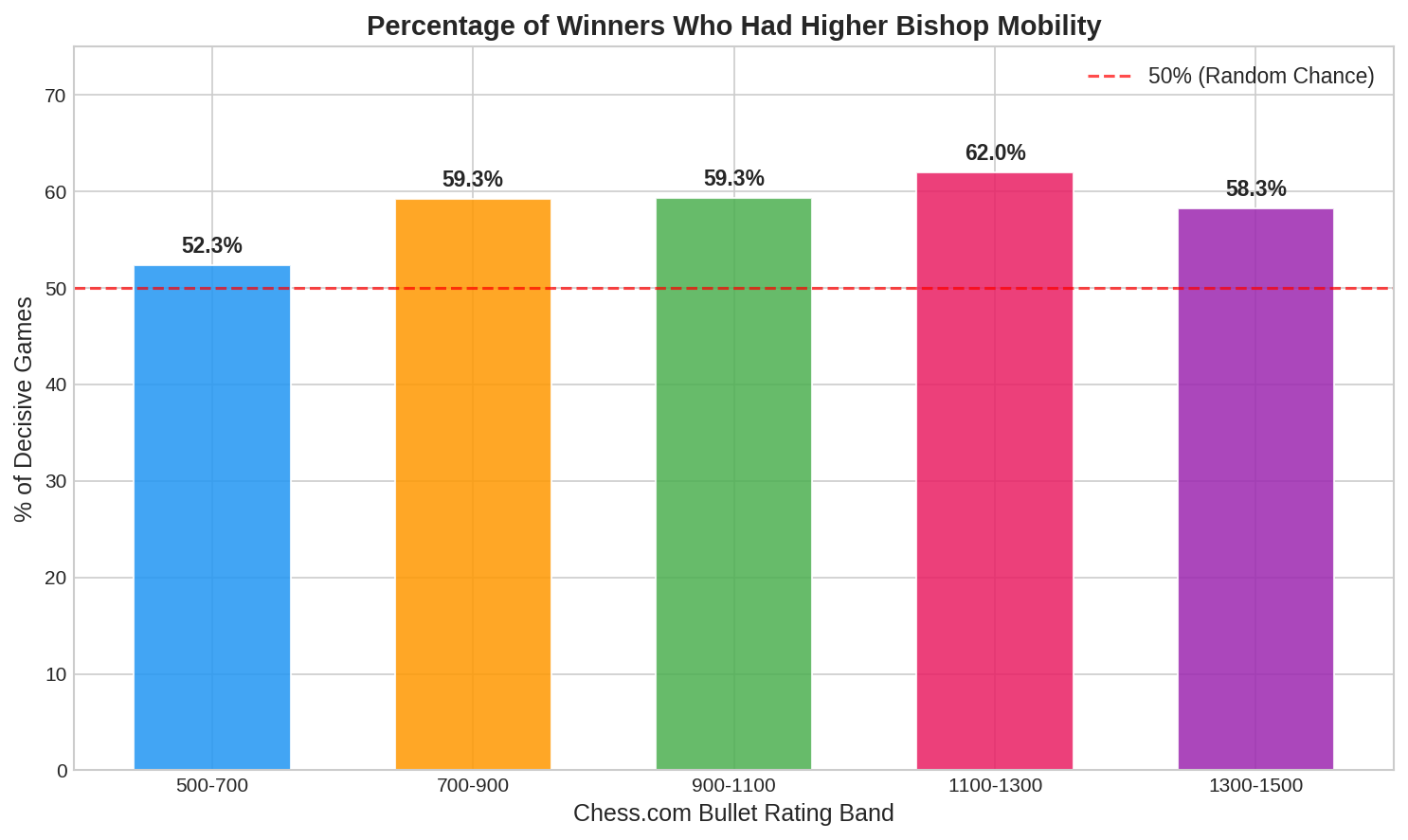
The data reveals a clear, undeniable trend: the player with higher average bishop mobility wins more often. Across all rating bands analyzed, 58.2% of decisive games were won by the player whose bishops had more legal moves on average throughout the game.
However, the strength of this correlation is not uniform. It follows a distinct curve as players improve.
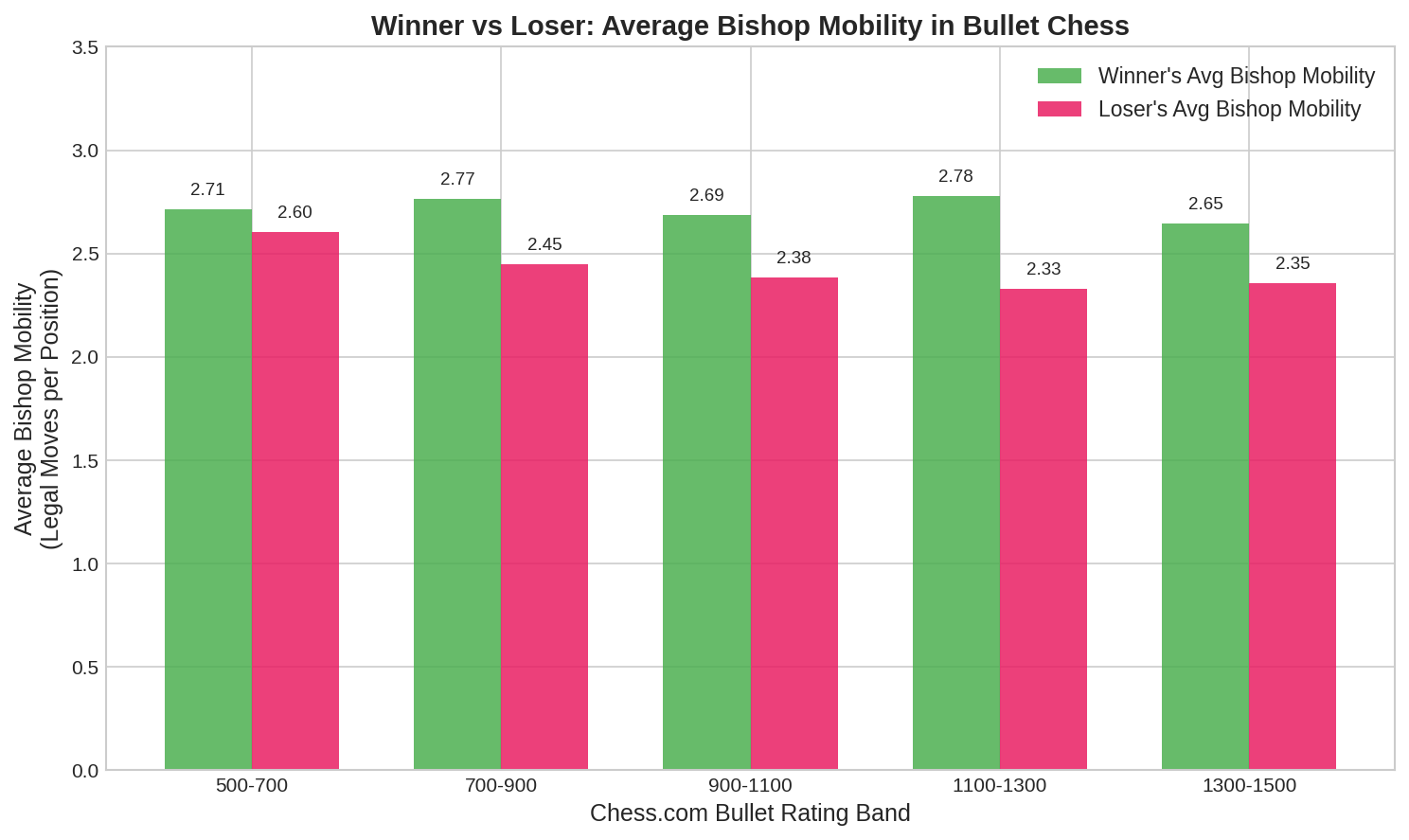
As the chart above demonstrates, winners consistently maintain higher bishop mobility than losers. But notice the gap between the green and pink bars. At the 500-700 level, the difference is marginal (2.71 vs 2.60 moves). By the 1100-1300 level, the gap widens significantly (2.78 vs 2.33 moves).
This suggests a crucial insight: At lower ratings, games are decided by blunders, making positional advantages irrelevant. At intermediate ratings, players are good enough to leverage positional advantages, but not yet good enough to defend against them.
The "Mobility Ladder": Win Rates by Bishop Scope
To understand the practical impact of bishop mobility, we bucketed the average legal moves available to a player's bishops and calculated the corresponding win rate. The results are striking.
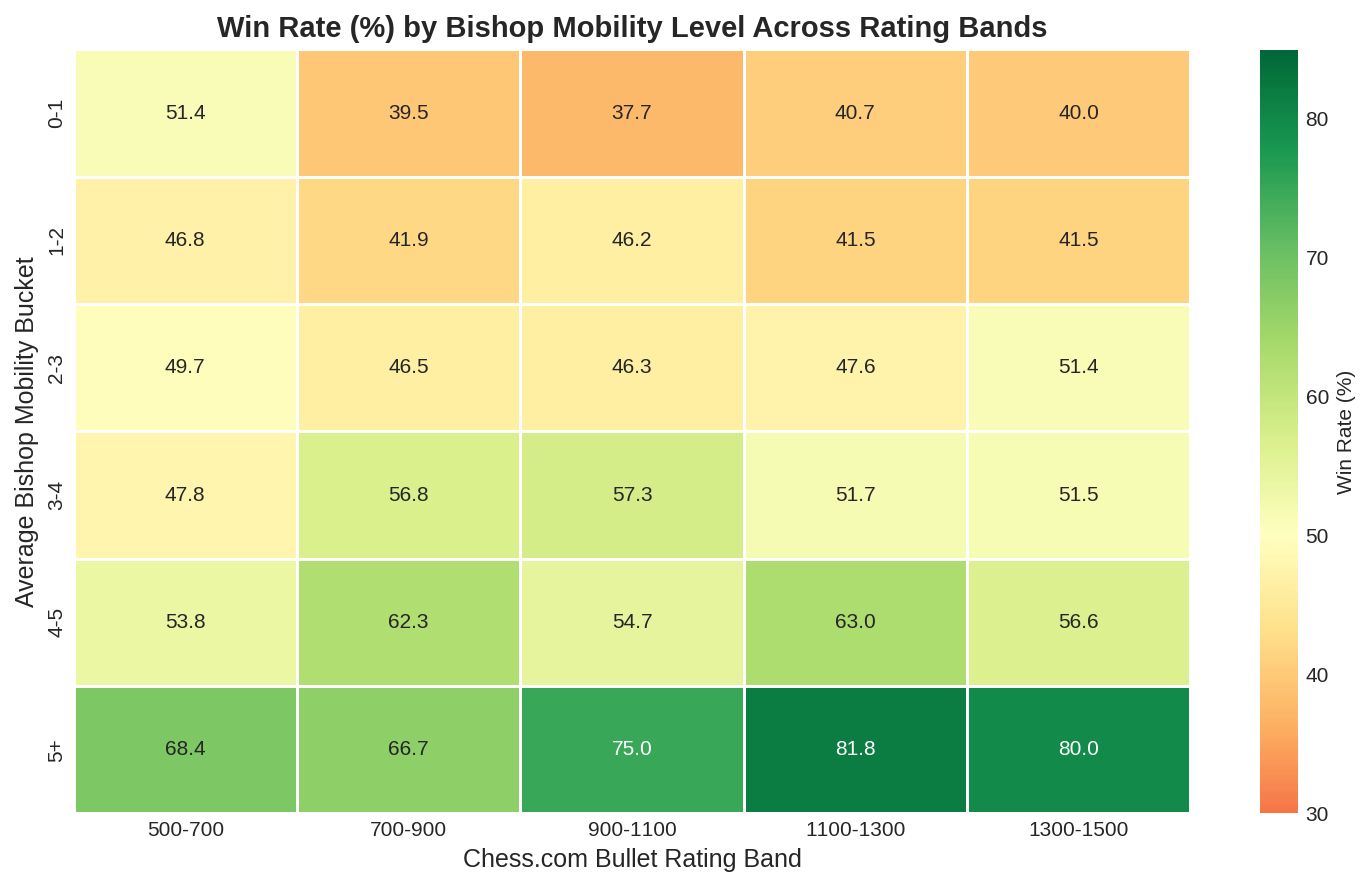
The heatmap illustrates a steep gradient. If your bishops average only 0-1 legal moves per position (essentially trapped or severely restricted), your win rate hovers around 40%. If you can increase that average to 3-4 moves, your win rate jumps to over 50%. If your bishops dominate the board with 5+ average moves, your win rate skyrockets to 66-81%.
The Anatomy of a Trapped Bishop
To visualize what restricted mobility looks like in practice, consider this position from a 700-900 rated game.
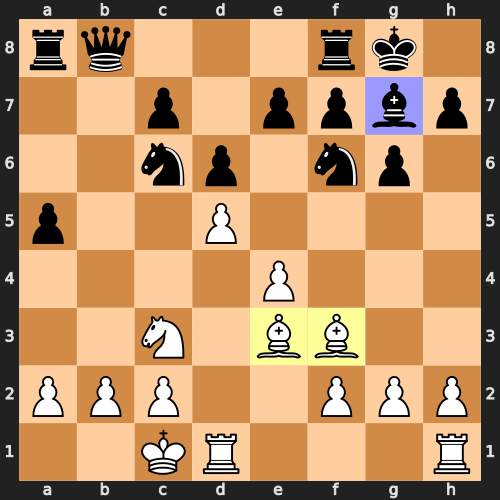
In this position, White's bishops on e3 and f3 (highlighted yellow) are severely restricted by their own pawn structure. Despite being materially equal, White's lack of piece activity contributes to a dismal -5.56 engine evaluation. Black's bishop on g7 is also restricted, but Black's overall position is superior.
Roadmap to Improvement: Actionable Advice by Rating Band
Based on the data, here is a tailored guide on how to treat your bishops as you climb the Chess.com rating ladder.
The Beginner Stage: 500-900 Chess.com (Lichess ~1030-1335)
The Data: At the 500-700 level, the player with higher bishop mobility wins only 52.3% of the time—barely better than a coin flip. By 700-900, this jumps to 59.3%. Interestingly, players at this level experience the highest rate of "trapped bishop" positions, averaging nearly 23 positions per game where a bishop has zero legal moves.
The Reality: In this rating bracket, bullet games are decided by one-move blunders, hanging pieces, and missed mate-in-ones. You can have the most beautifully placed fianchettoed bishop in the world, but if you hang your queen on the next move, the bishop's scope is irrelevant.
Actionable Advice:
- Don't obsess over diagonals yet. Your primary focus should be board vision and avoiding one-move blunders.
- Avoid self-trapping. The most common mobility issue at this level is players trapping their own bishops behind their pawn chains. Before pushing a pawn, quickly check if it entombs your bishop.
- Develop and forget. Get your bishops off the back rank to control central squares, but don't spend precious clock time trying to optimize their placement.
The Intermediate Climb: 900-1300 Chess.com (Lichess ~1335-1635)
The Data: This is the "sweet spot" for bishop mobility. At the 1100-1300 level, the correlation peaks: 62.0% of games are won by the player with higher bishop mobility. The gap between the winner's average mobility (2.78) and the loser's (2.33) is the widest of any rating band.
The Reality: Players in this bracket have stopped hanging pieces every other move. Games last longer, and positional advantages start to compound. If you secure a strong, active bishop while restricting your opponent's, you are highly likely to convert that advantage into a win, because your opponent lacks the defensive technique to neutralize it.
Actionable Advice:
- Prioritize the "Good Bishop." Actively trade off your bad bishop (the one restricted by your own pawns) for your opponent's good bishop.
- Open the center for the Bishop Pair. If you possess both bishops, aggressively seek pawn breaks to open the position. The data shows that retaining the bishop pair at move 20 provides a +4.3% win rate advantage at the 1100-1300 level.
- Target the opponent's scope. Look for pawn pushes that blunt the diagonals of your opponent's most active pieces.
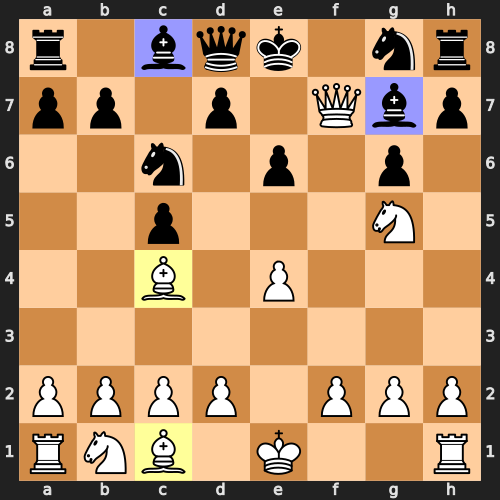
A stark contrast in mobility. White's bishop on c4 (yellow) controls 8 squares (green arrows), dominating the center. Black's bishop on g7 (blue) is completely blocked by its own pawn on e6 and White's pawn on e4. White has a massive positional advantage.
The Advanced Threshold: 1300-1500+ Chess.com (Lichess ~1635-1930+)
The Data: Fascinatingly, the correlation between bishop mobility and winning decreases as players approach 1500. The percentage of winners with higher mobility drops from 62.0% to 58.3%. Furthermore, the advantage of holding the bishop pair at move 20 actually becomes slightly negative (-2.5%) in our sample for the 1300-1500 band.
The Reality: Why does mobility matter less here? Because defense improves. A 1400-rated player knows how to construct solid pawn formations that neutralize an active bishop. They are willing to accept a passive bishop if it serves a critical defensive function. Furthermore, in bullet chess at this level, time management and initiative often trump static positional advantages.
Actionable Advice:
- Function over Scope. A bishop with only two legal moves is perfectly fine if those moves defend a critical weakness or support a devastating pawn break. Don't sacrifice structural integrity just to give a bishop more squares.
- The Bishop Pair is a double-edged sword. While powerful in open positions, retaining both bishops often means you haven't traded them for knights. In the time scrambles typical of 1400+ bullet games, tricky knights can often outmaneuver long-range bishops.
- Focus on the Endgame. The data shows that bishop mobility in the endgame (moves 31+) remains a strong predictor of success across all levels. Ensure your bishops have targets when the board clears.
The Lifecycle of a Bishop
To further understand how bishop activity flows through a game, we tracked the average mobility across move numbers.
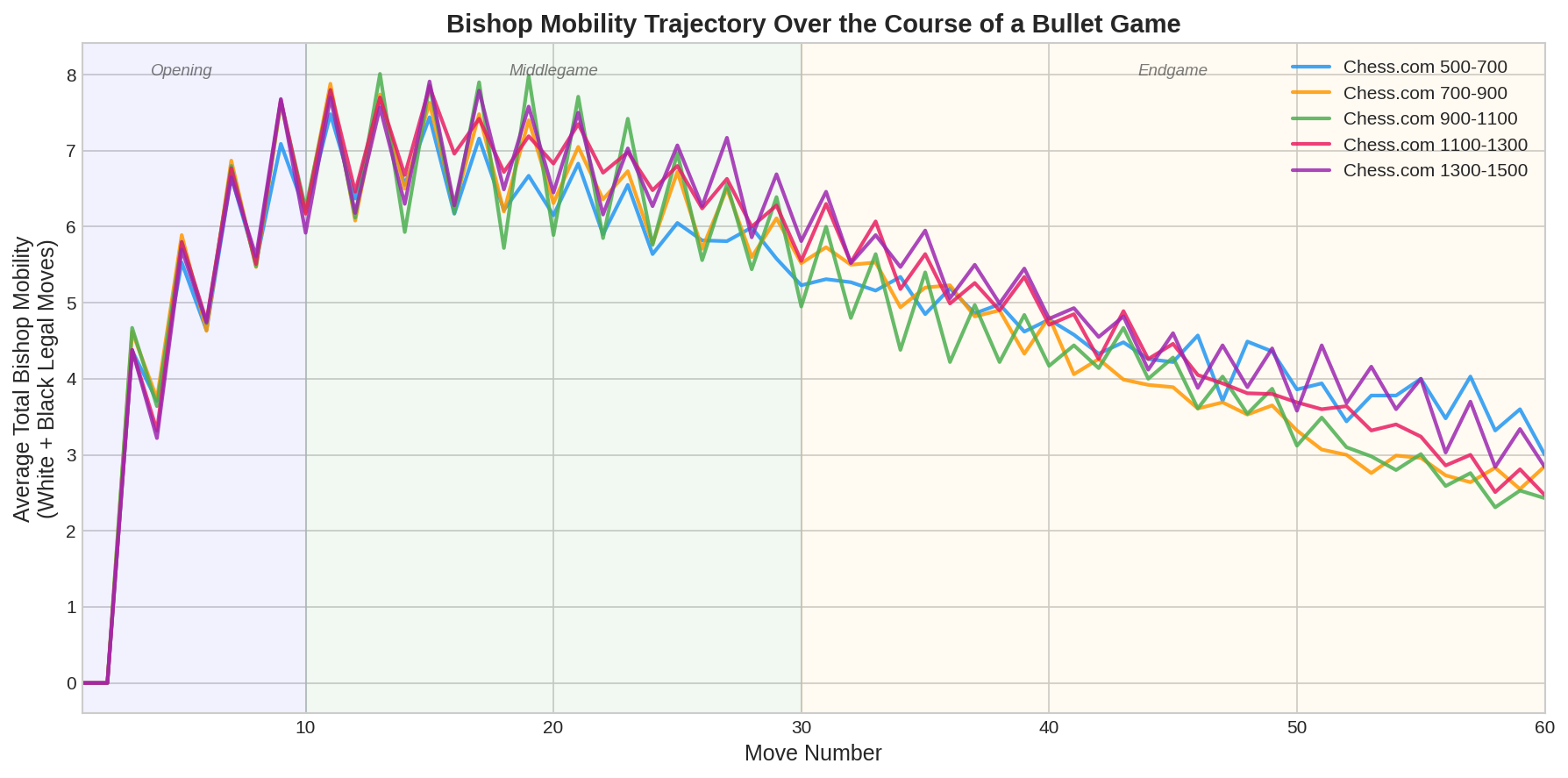
The trajectory is remarkably consistent across all rating bands. Bishops start with zero mobility, rapidly gain scope during the opening (moves 1-10) as pawns are pushed and pieces developed, and peak in the early middlegame (moves 10-15).
As the middlegame progresses and the board becomes cluttered with complex pawn structures and piece tension, mobility steadily declines. Finally, in the endgame, mobility drops further as pieces are traded off and the remaining bishops are often relegated to defensive duties or restricted by endgame pawn chains.
Conclusion
In bullet chess, speed is king, but positional principles are not dead. The scope of your bishops is a reliable barometer of your position's health, particularly if you are rated between 900 and 1300 on Chess.com.
By consciously avoiding self-trapping in the opening, actively seeking open diagonals in the middlegame, and understanding when to trade scope for structural solidity, you can leverage this classical concept to win more games—even when you only have 60 seconds on the clock.
Data and Methodology
This analysis was conducted using a dataset of 1,500 Lichess bullet games (time controls under 3 minutes), comprising over 80,000 individual board positions. The games were sampled across five Lichess rating bands, which were then mapped to their approximate Chess.com equivalents for relevance to the target audience.
For every position in every game, we used Python and the python-chess library to calculate the exact number of legal moves available to the bishops of both colors. This data was then aggregated by game phase, rating band, and game outcome to produce the statistics presented above.
Underlying Data Files:
View full data →game_id band_key chesscom_band avg_rating result winner total_moves white_avg_bishop_mobility black_avg_bishop_mobility mobility_advantage_white white_opening_bishop_mob black_opening_bishop_mob white_middlegame_bishop_mob black_middlegame_bishop_mob white_endgame_bishop_mob black_endgame_bishop_mob white_max_bishop_mobility black_max_bishop_mobility white_trapped_bishop_positions black_trapped_bishop_positions white_has_bishop_pair_m20 black_has_bishop_pair_m20 zfO14jjq 700-900 500-700 806 1-0 white 11 3.18 0.55 2.64 2.7 0.6 8.0 0.0 9 4 6 9 e8SlXb6M 700-900 500-700 856 0-1 black 16 3.5 1.75 1.75 3.2 0.5 4.0 3.83 9 9 9 12 OfPbWTYb 700-900 500-700 704 0-1 black 30 4.47 1.93 2.53 2.5 1.9 5.45 1.95 13 9 16 17 1 0 eAZ0oD8k 700-900 500-700 812 1-0 white 47 1.98 2.11 -0.13 1.8 1.1 1.95 3.6 2.12 0.94 9 8 27 22 0 0 F5GPLzj1 700-900 500-700 833 1-0 white 33 1.91 3.15 -1.24 2.7 2.0 1.55 3.8 1.67 2.67 8 12 23 19 0 1
View full data →game_id band_key chesscom_band avg_rating move_num phase white_bishop_moves black_bishop_moves white_bishop_count black_bishop_count bishop_mobility_diff eval result winner fen zfO14jjq 700-900 500-700 806 1 opening 0 0 2 2 0 -0.38 1-0 white rnbqkbnr/pppppppp/8/8/4P3/8/PPPP1PPP/RNBQKBNR b KQkq - 0 1 zfO14jjq 700-900 500-700 806 2 opening 0 0 2 2 0 0.35 1-0 white rnbqkbnr/pp1ppppp/8/2p5/4P3/8/PPPP1PPP/RNBQKBNR w KQkq - 0 2 zfO14jjq 700-900 500-700 806 3 opening 5 0 2 2 5 -0.4 1-0 white rnbqkbnr/pp1ppppp/8/2p5/4P3/5N2/PPPP1PPP/RNBQKB1R b KQkq - 1 2 zfO14jjq 700-900 500-700 806 4 opening 0 0 2 2 0 0.44 1-0 white r1bqkbnr/pp1ppppp/2n5/2p5/4P3/5N2/PPPP1PPP/RNBQKB1R w KQkq - 2 3 zfO14jjq 700-900 500-700 806 5 opening 5 0 2 2 5 -0.09 1-0 white r1bqkbnr/pp1ppppp/2n5/2p5/2B1P3/5N2/PPPP1PPP/RNBQK2R b KQkq - 3 3
View full data →band n_games n_decisive n_draws avg_winner_mob avg_loser_mob mobility_diff t_stat p_value cohens_d significant 500-700 300 298 2 2.715 2.603 0.112 1.148 0.25144 0.094 No 700-900 300 297 3 2.766 2.45 0.316 3.232 0.0013 0.266 Yes 900-1100 300 295 5 2.685 2.383 0.302 3.048 0.00241 0.251 Yes 1100-1300 300 292 8 2.78 2.331 0.449 4.516 1e-05 0.374 Yes 1300-1500 299 290 9 2.645 2.355 0.29 2.975 0.00305 0.247 Yes
View full data →band mob_bucket win_rate n_observations 1100-1300 0-1 40.7 59 1100-1300 1-2 41.5 164 1100-1300 2-3 47.6 185 1100-1300 3-4 51.7 116 1100-1300 4-5 63.0 54
Chess Coach
April 14, 2026