As chess players progress from beginner to intermediate levels, the nature of their games fundamentally changes. Early blunders become less frequent, games last longer, and the endgame emerges as a critical battleground. Among the various endgame scenarios, the Bishop and Pawn endgame stands out as a unique test of positional understanding, calculation, and technique.
This data-driven guide explores the frequency, outcomes, and critical patterns of Bishop and Pawn endgames across intermediate rating bands (Chess.com 800 to 1500). By analyzing nearly one million Rapid games from the Lichess database, we uncover actionable insights to help you navigate these complex positions and convert advantages into victories.
The Rising Importance of the Endgame
Before diving into specific endgame types, it is essential to understand how the overall game structure evolves with rating. Our analysis reveals a clear trend: as players improve, their games are increasingly likely to reach the endgame phase.
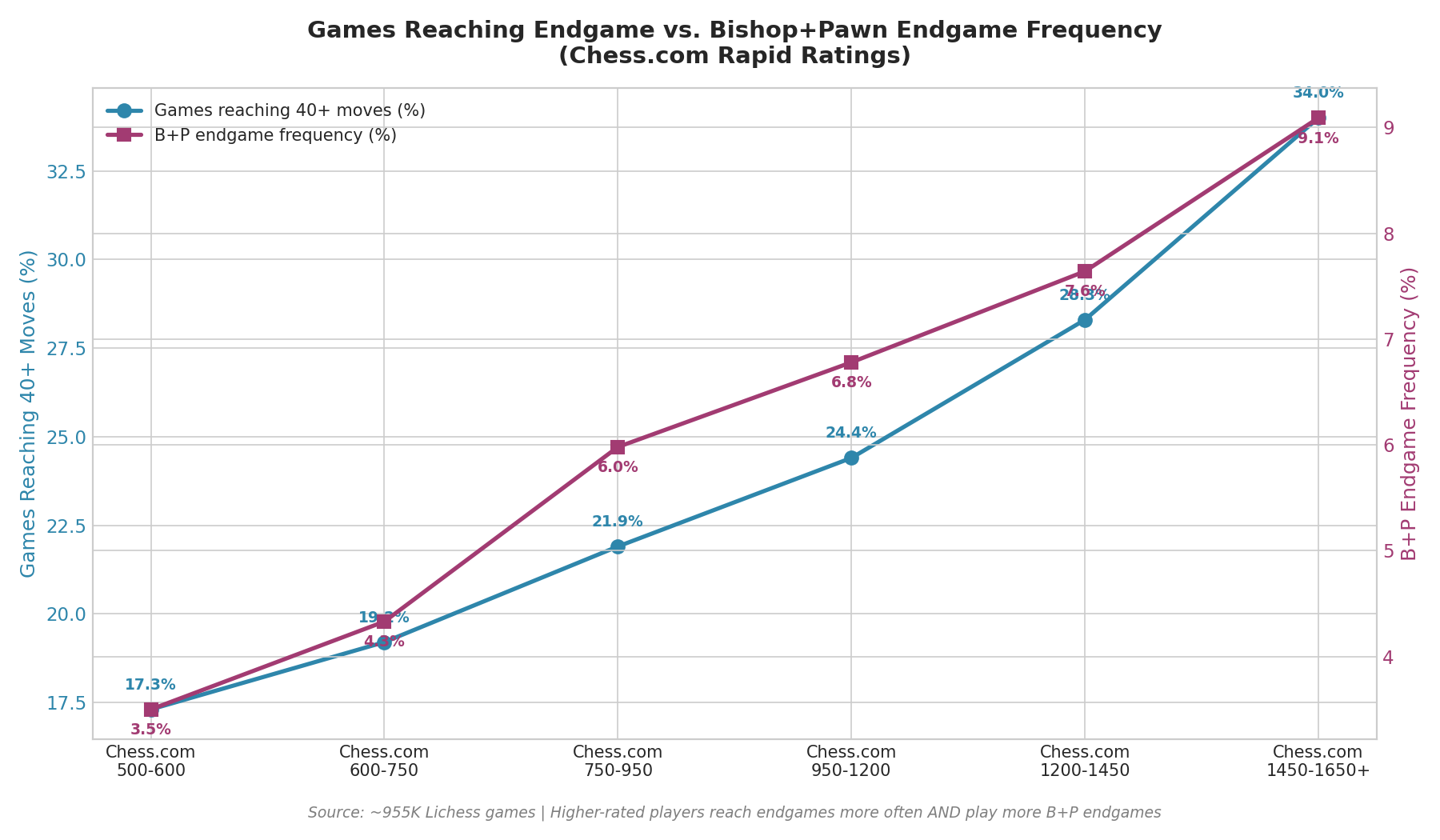
At the Chess.com 500-600 level (Lichess ~800-1000), only 17.3% of Rapid games reach move 40. However, by the time players reach the Chess.com 1450-1650+ bracket (Lichess 1800+), this figure doubles to 34.0%. This shift is driven by a significant reduction in early blunders and a better understanding of defensive principles, forcing games into deeper waters.
Consequently, the frequency of Bishop and Pawn endgames also rises steadily. While they occur in just 3.5% of games at the lowest rating band, they appear in 9.1% of games at the highest intermediate level. This means that an intermediate player will encounter a Bishop and Pawn endgame in roughly one out of every eleven games.
| Chess.com Rating | Lichess Equivalent | Games Reaching 40+ Moves | B+P Endgame Frequency |
|---|---|---|---|
| 500-600 | 800-1000 | 17.3% | 3.5% |
| 600-750 | 1000-1200 | 19.2% | 4.3% |
| 750-950 | 1200-1400 | 21.9% | 6.0% |
| 950-1200 | 1400-1600 | 24.4% | 6.8% |
| 1200-1450 | 1600-1800 | 28.3% | 7.6% |
| 1450-1650+ | 1800+ | 34.0% | 9.1% |
The Anatomy of Bishop and Pawn Endgames
Bishop and Pawn endgames are not monolithic; they encompass a variety of material imbalances and structural nuances. Our data categorizes these endgames into several distinct subtypes, revealing how their complexity grows with player skill.
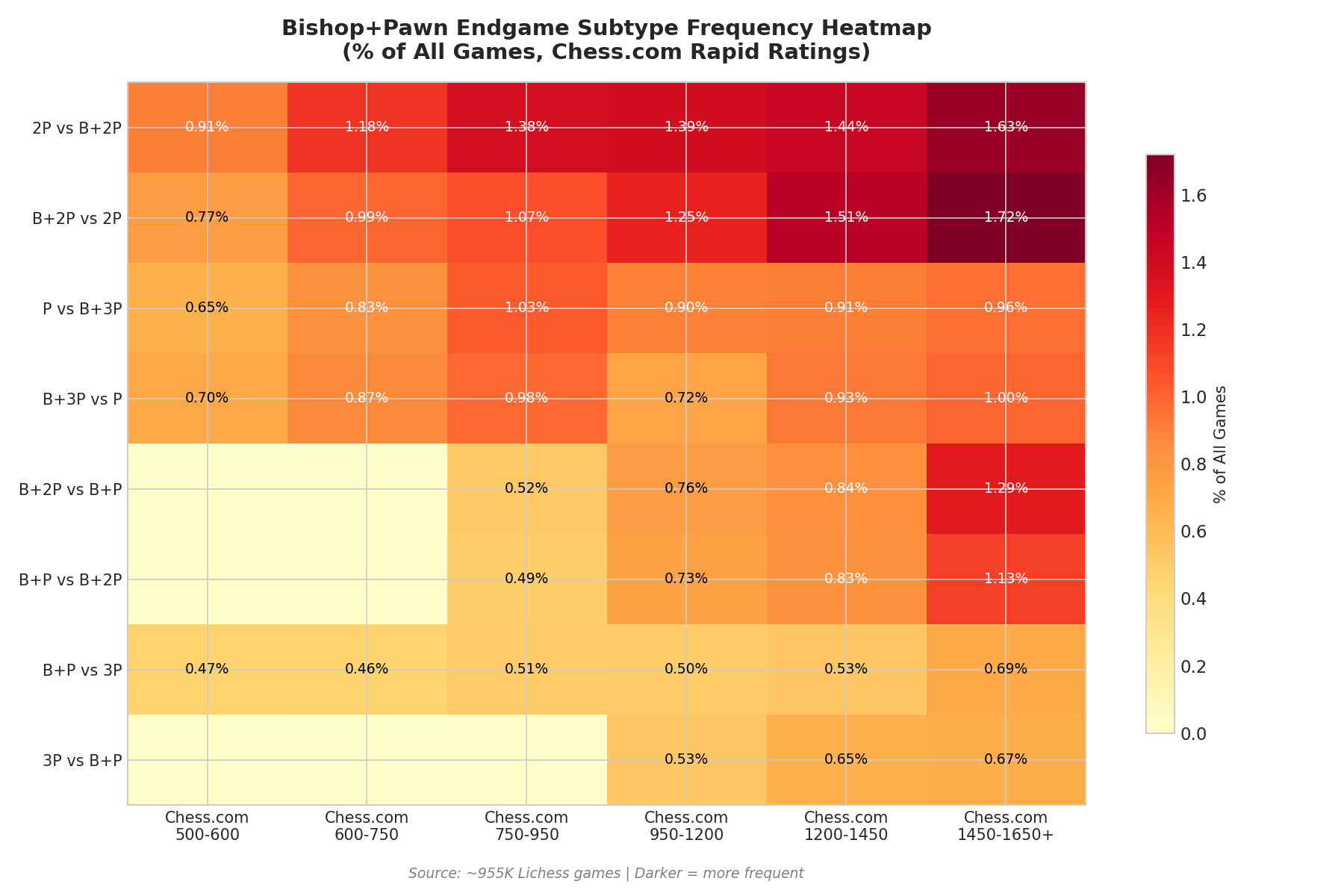
The heatmap above illustrates the distribution of Bishop and Pawn endgame subtypes across rating bands. The most common scenarios involve asymmetric pawn structures, such as "Bishop + 2 Pawns vs. 2 Pawns" or "Bishop + 3 Pawns vs. Pawn." Interestingly, endgames where both sides possess a bishop (e.g., "Bishop + 2 Pawns vs. Bishop + Pawn") only become prevalent at higher ratings (Chess.com 1200+), suggesting that lower-rated players are more likely to exchange or lose their bishops earlier in the game.
Actionable Advice: Chess.com 800-1000
At this level, the primary challenge is basic endgame technique and avoiding catastrophic blunders. The data shows that the side with a material advantage wins only 29.7% of the time, while a staggering 35.1% of games end in a draw.
Focus Area: The Wrong-Color Bishop Trap
One of the most common pitfalls in Bishop and Pawn endgames is the "wrong-color bishop" scenario. This occurs when a player has a rook pawn (an a-pawn or h-pawn) and a bishop that does not control the pawn's promotion square.
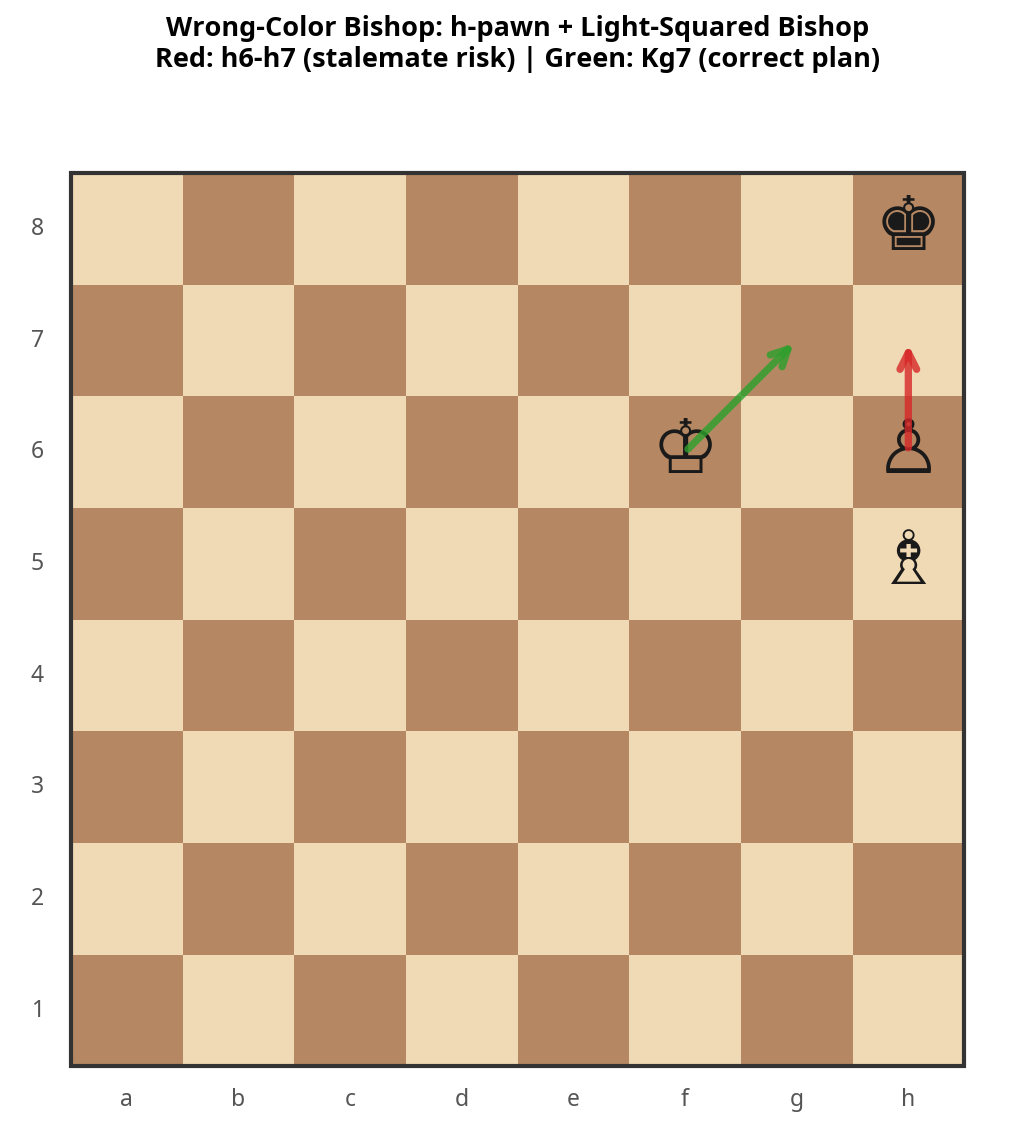
In the position above, White has an extra pawn and a bishop, but the bishop operates on light squares, while the h8 promotion square is dark. If White hastily pushes the pawn to h7 (the red arrow), Black's king is stalemated, resulting in a draw. The correct technique (the green arrow) involves using the king to control the promotion square and carefully maneuvering the bishop to support the advance.
Key Takeaway: Always check the color of your bishop relative to the promotion square of your rook pawns. If they do not match, you must rely on your king to secure the promotion.
Actionable Advice: Chess.com 1000-1200
As players cross the 1000 threshold, their conversion rates improve significantly. The win rate for the materially advantaged side jumps to 37.0%, while the draw rate drops to 27.6%. This indicates a growing familiarity with basic endgame principles.
Focus Area: Active vs. Passive Bishops
A critical concept at this stage is the activity of the bishop. An active bishop can dominate the board, restricting the opponent's king and supporting pawn advances, while a passive bishop is often relegated to defensive duties.
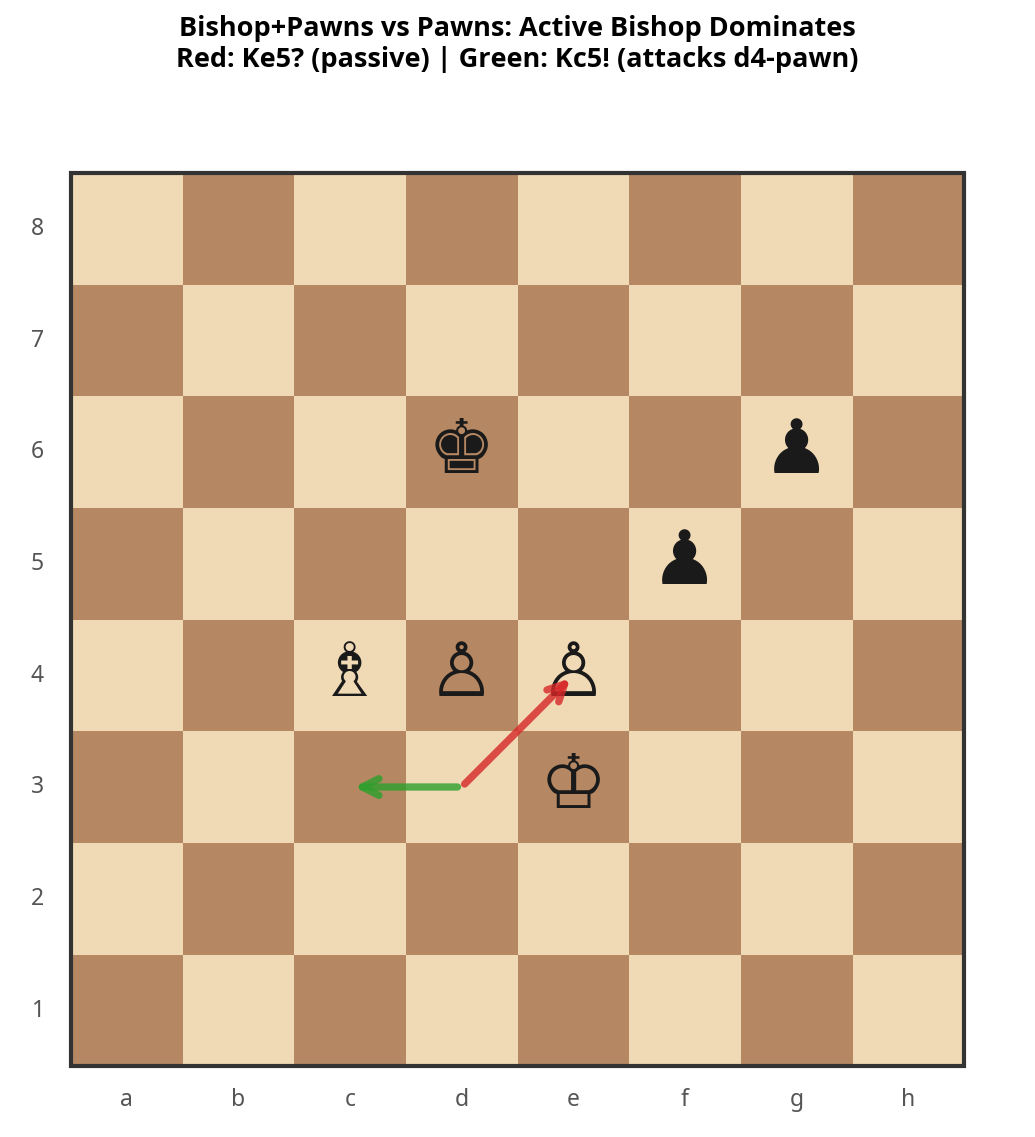
Consider the position above. White's bishop on c4 is highly active, controlling key central squares and eyeing Black's pawns. If Black plays passively with Ke5 (the red arrow), White maintains a strong grip on the position. However, if Black plays actively with Kc5 (the green arrow), attacking the bishop and the d4 pawn, the dynamics change entirely.
Key Takeaway: Prioritize piece activity over material preservation. An active bishop is often worth more than a passive pawn.
Actionable Advice: Chess.com 1200-1400
In this rating band, the complexity of endgames increases, and players must navigate more nuanced positional imbalances. The win rate remains stable at 37.3%, but the loss rate (where the materially advantaged side blunders the game away) peaks at 41.9%.
Focus Area: Opposite-Color Bishops
Endgames with opposite-color bishops are notorious for their drawing tendencies, even when one side has a material advantage. The defending side can often set up an impenetrable blockade on the squares controlled by their bishop.
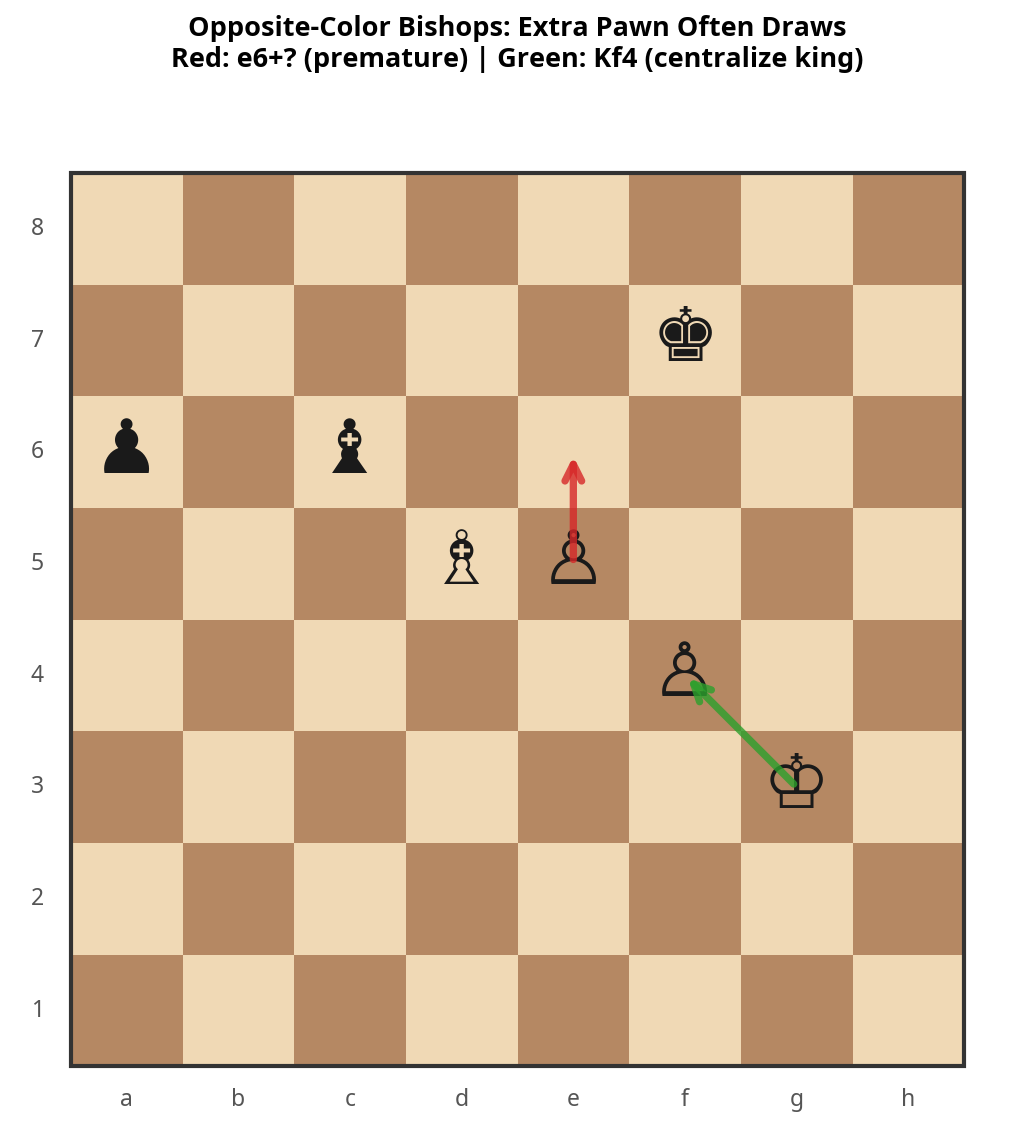
In this example, White has an extra pawn, but the bishops are of opposite colors. If White prematurely pushes the e-pawn (the red arrow), Black's bishop and king can easily blockade the advance on the dark squares. The correct approach (the green arrow) is to centralize the king and prepare a coordinated breakthrough.
Key Takeaway: When facing opposite-color bishops, an extra pawn is rarely enough to win on its own. You must create weaknesses on both sides of the board to stretch the defender's resources.
Actionable Advice: Chess.com 1400-1500+
At the highest intermediate levels, players demonstrate a deeper understanding of pawn structures and long-term planning. The win rate for the advantaged side reaches its peak at 41.6% in the 1200-1450 band, reflecting improved technique and calculation.
Focus Area: Good vs. Bad Bishops
The distinction between a "good" and a "bad" bishop becomes paramount in these endgames. A good bishop operates on squares of the opposite color to its own pawns, allowing it to move freely. A bad bishop is restricted by its own pawn structure.
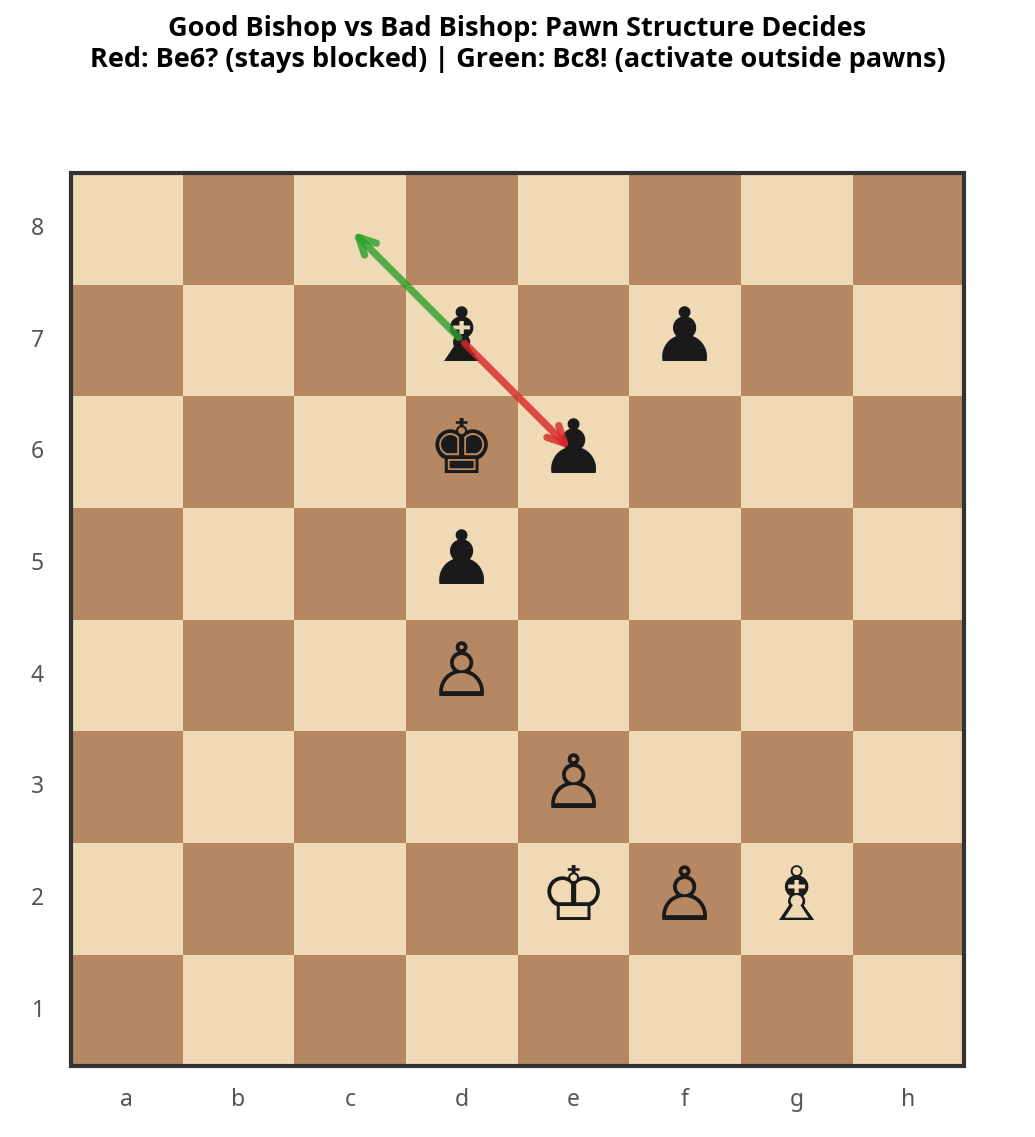
In the position above, White has a good bishop (pawns on dark squares, bishop on light), while Black has a bad bishop (pawns on light squares, bishop on light). If Black's bishop remains passive (the red arrow), White will slowly squeeze the position. Black must seek counterplay by activating the bishop outside the pawn chain (the green arrow).
Key Takeaway: Always evaluate your pawn structure relative to your bishop. Strive to place your pawns on the opposite color of your bishop to maximize its mobility and attacking potential.
Conclusion
The Bishop and Pawn endgame is a fascinating and complex phase of chess that becomes increasingly relevant as you climb the rating ladder. By understanding the statistical trends and mastering key concepts—such as the wrong-color bishop trap, piece activity, opposite-color bishops, and pawn structures—you can significantly improve your endgame conversion rates.
Remember, the endgame is not just about calculation; it is about recognizing patterns and applying fundamental principles. As you study these positions, focus on the underlying logic rather than memorizing specific moves. With practice and patience, the Bishop and Pawn endgame will transform from a daunting challenge into a powerful weapon in your chess arsenal.
Data and Methodology
This analysis is based on a dataset of approximately 955,000 Rapid games from the Lichess database, accessed via the Grandmaster Guide MCP server. The data was filtered to focus on intermediate rating bands, with Lichess ratings mapped to their approximate Chess.com equivalents for clarity.
The underlying data files used for this analysis are available below:
- Bishop+Pawn Frequency Data
- Bishop+Pawn Conversion Rates
- Endgame Category Distribution
- Game Phase Distribution
- Endgame Accuracy Metrics
Chess Coach April 14, 2026