Time is a piece. In blitz chess, it might be the most important piece on the board.
Every chess player has experienced the sinking feeling of looking at the clock, realizing they have 15 seconds left while their opponent has two minutes, and knowing that even a completely winning position might not be enough to secure the point. But how often does this actually happen? Does spending more time on a move actually improve its quality? And what separates the clock management of an 800-rated player from a 1500-rated player?
To answer these questions, we analyzed over 465,000 blitz games from the Lichess database, mapping the ratings to their Chess.com equivalents (approximately 200-300 points lower) to provide actionable insights for players climbing the ranks from 800 to 1500. We also conducted a deep dive into 564 specific games to track move-by-move clock usage, time trouble frequency, and the correlation between even time distribution and win rates.
Here is what the data reveals about the players who manage their clock best—and how you can join them.
The Cost of Time Trouble
The most immediate consequence of poor clock management is time trouble. We define "time trouble" as entering the final 30 seconds of the game, and "severe time trouble" as dropping below 10 seconds.
The data shows a clear and punishing penalty for falling into time trouble. Across all rating bands, players who drop below 30 seconds suffer a significant drop in their win rate compared to players who keep their clock above that threshold.
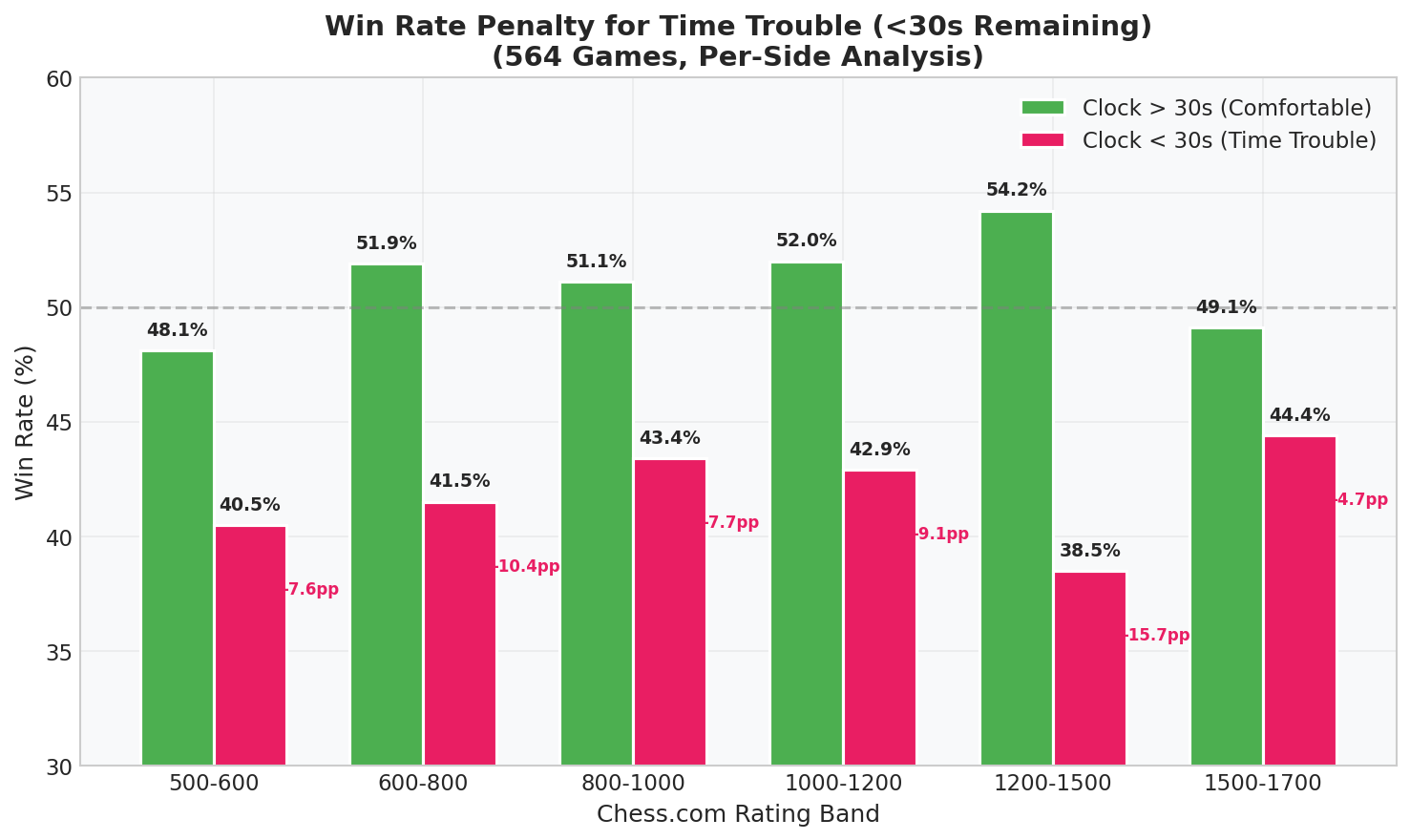
At the 800-1000 level, players who avoid time trouble win 51.1% of their games, while those who fall below 30 seconds win only 43.4%—a penalty of 7.7 percentage points. This penalty grows as ratings increase. By the 1200-1500 level, the penalty expands to 15.7 percentage points.
Why does the penalty increase at higher ratings? Because stronger opponents are better equipped to exploit your time pressure. An 800-rated player might blunder their queen even with two minutes on the clock, allowing you to win despite having only 15 seconds. A 1500-rated player, however, will actively complicate the position, play forcing moves, and flag you.
The Tragedy of the Winning Position Lost on Time
Perhaps the most frustrating way to lose a chess game is to outplay your opponent, build a completely winning position, and then lose on time. How common is this tragedy?
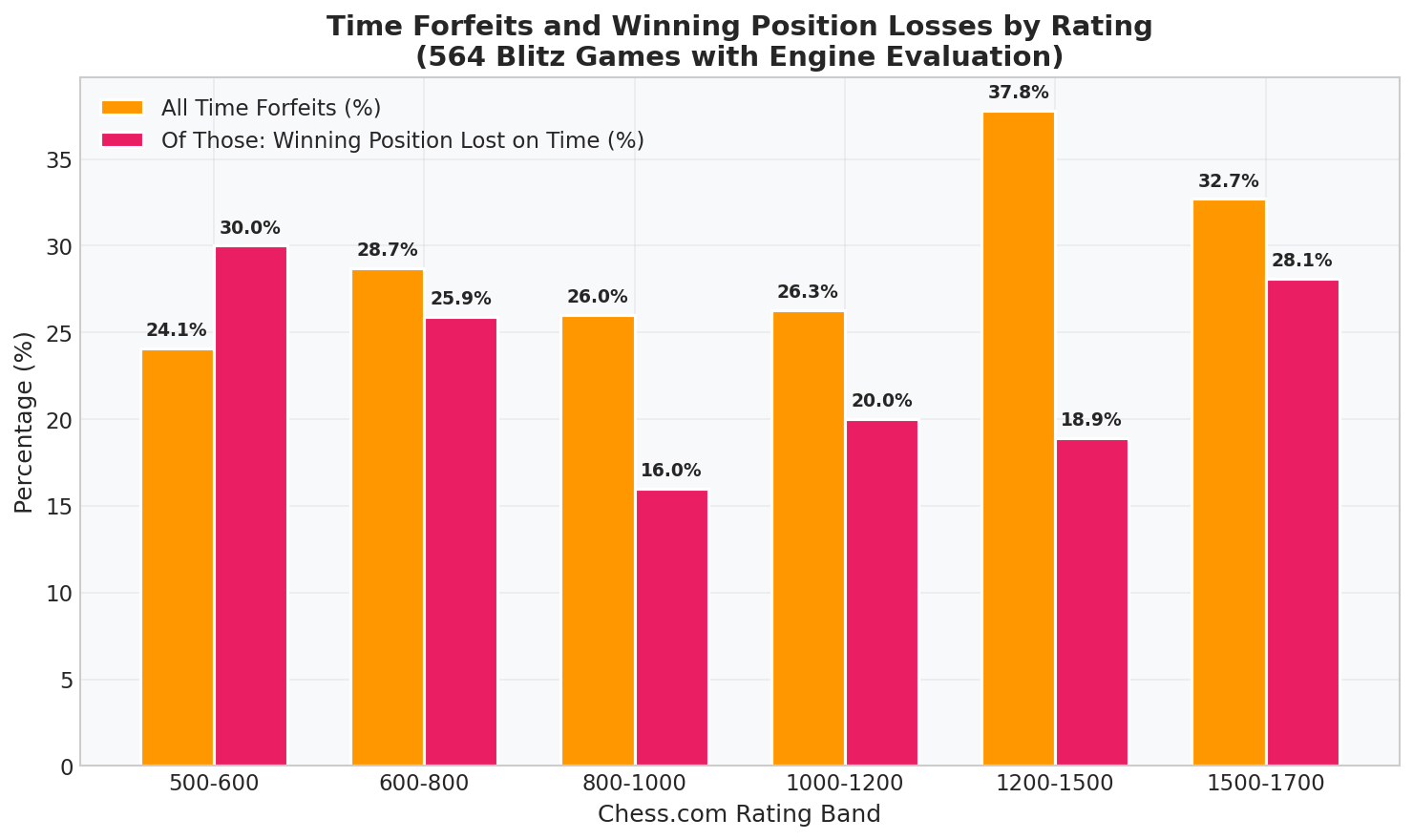
Time forfeits account for roughly 25% to 35% of all decisive results in blitz chess. Of those time forfeits, a heartbreaking percentage occur when the losing player actually had a winning position (defined as an engine evaluation of +1.5 or better for the side that flagged).
At the 1200-1500 level, nearly 19% of all time forfeits involve the flagging player throwing away a winning position. This means that roughly 1 in every 15 games you play at this level will end with someone losing on time despite being objectively winning on the board.
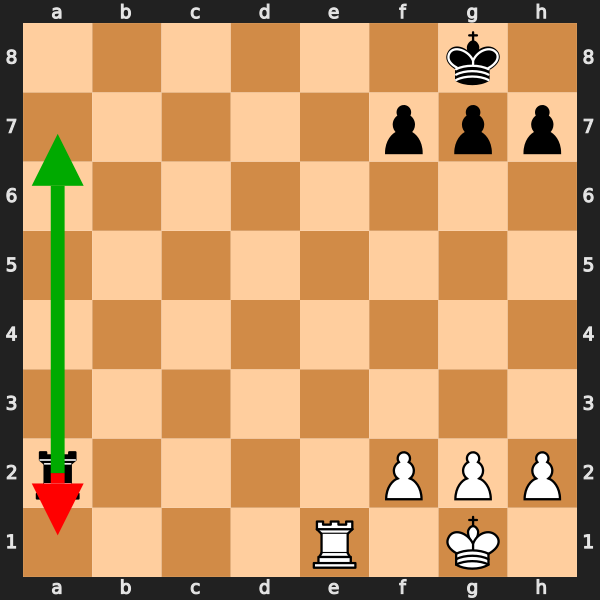 A classic tragedy: Black is up a full rook and completely winning, but with only 3 seconds left, panics and plays Ra1?? instead of keeping the rook active with Ra7. White wins on time.
Does Thinking Longer Actually Help?
If time trouble is so punishing, the obvious solution is to play faster. But playing faster comes with its own cost: decreased move quality.
We analyzed the relationship between the time spent on a single move and the resulting centipawn loss (CPL) across 46.3 million individual moves. The results reveal a clear "diminishing returns" curve for thinking time in blitz chess.
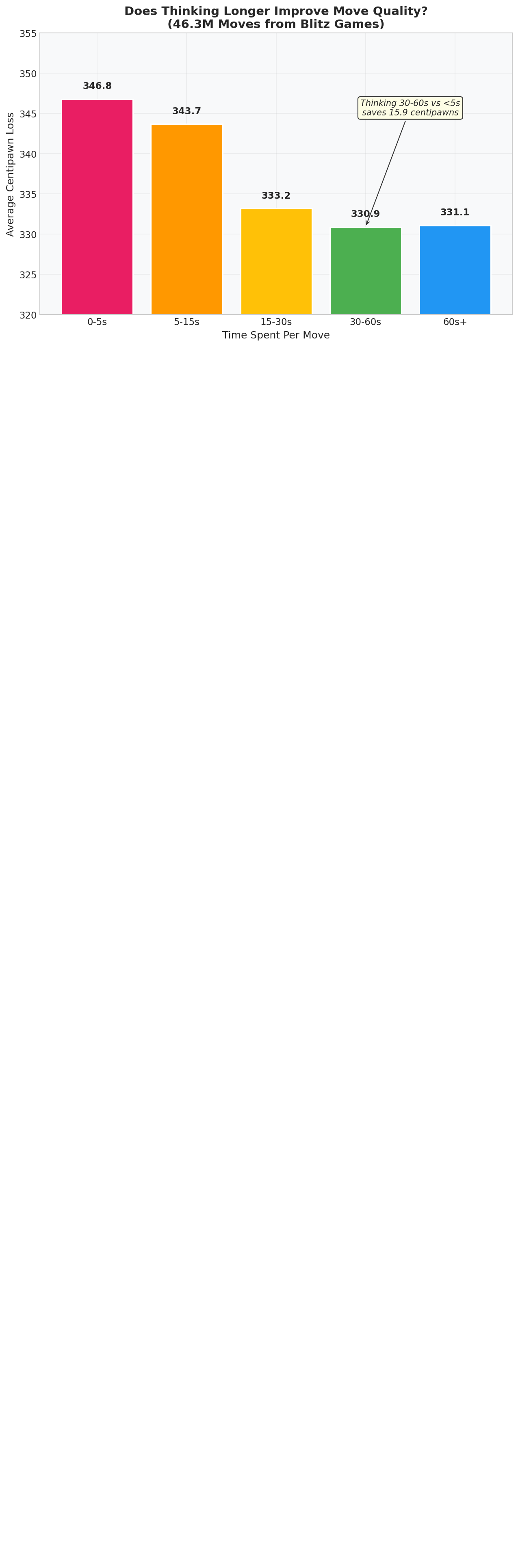
The data shows that taking an extra 10-20 seconds on a critical move does improve accuracy, saving an average of 10-15 centipawns compared to a move played in under 5 seconds. However, thinking for more than 30 seconds in a blitz game yields almost no additional improvement in move quality.
This is the core dilemma of blitz chess: you must spend time to find good moves, but spending too much time on any single move guarantees time trouble later, which will force you to play terrible moves at the end of the game.
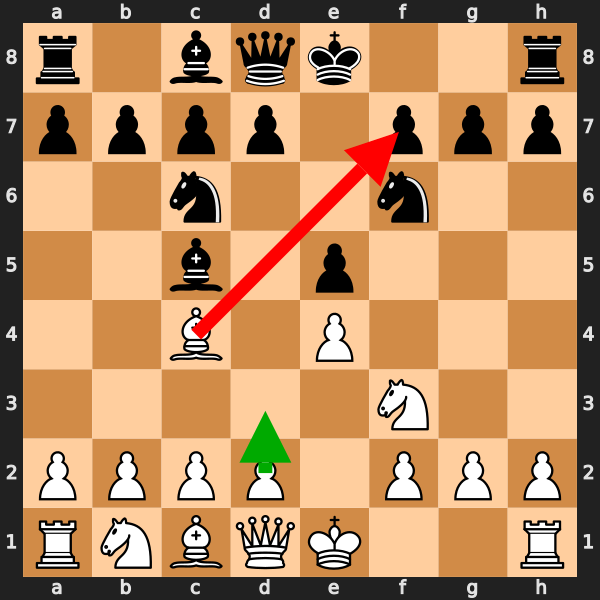 A common mistake at lower ratings: White spends 90 seconds calculating the complex but flawed Bxf7+ sacrifice, burning crucial time early in the game instead of playing the solid, developing move d3.
The Anatomy of Clock Management by Rating
How does clock management evolve as players improve? We tracked how players distribute their total time across the three phases of the game: the opening (first third of moves), the middlegame (second third), and the endgame (final third).
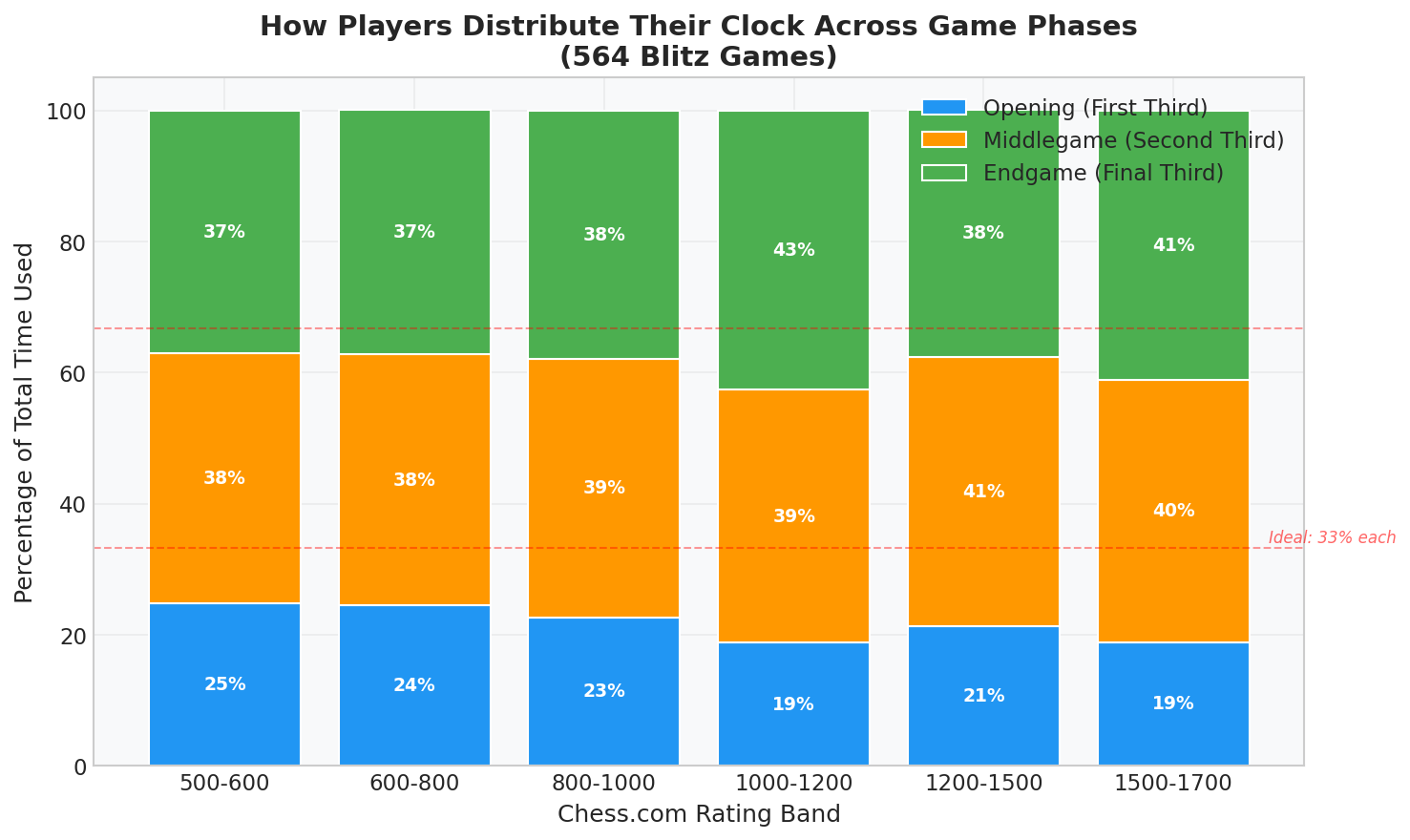
A clear pattern emerges as ratings increase:
- Faster Openings: Players at the 500-600 level spend 25% of their time in the opening. By the 1500-1700 level, this drops to 19%. Higher-rated players have better opening knowledge and rely on intuition for the first 10 moves, banking time for later.
- More Time for the Endgame: Lower-rated players often never reach the endgame, or reach it with no time left. Higher-rated players reserve over 40% of their clock for the final phase of the game, where precise calculation is often required to convert an advantage.
The "Even Time" Advantage
We also measured the "evenness" of a player's time usage using the coefficient of variation (CV) of their move times. Players who use their time evenly (a low CV) rarely spend more than 10-15 seconds on any single move. Players with uneven time usage (a high CV) play most moves instantly but occasionally "dump" 45-60 seconds on a single complex decision.
The data strongly favors the even-time approach. Across our deep-dive sample, players who maintained an even distribution of time won significantly more often than those who spiked their time usage on individual moves.
When you dump a minute on a single move in a 5-minute game, you are betting that the move you find will be so good that it wins the game outright. If it doesn't, you will have to play the rest of the game on increment, drastically increasing your blunder rate.
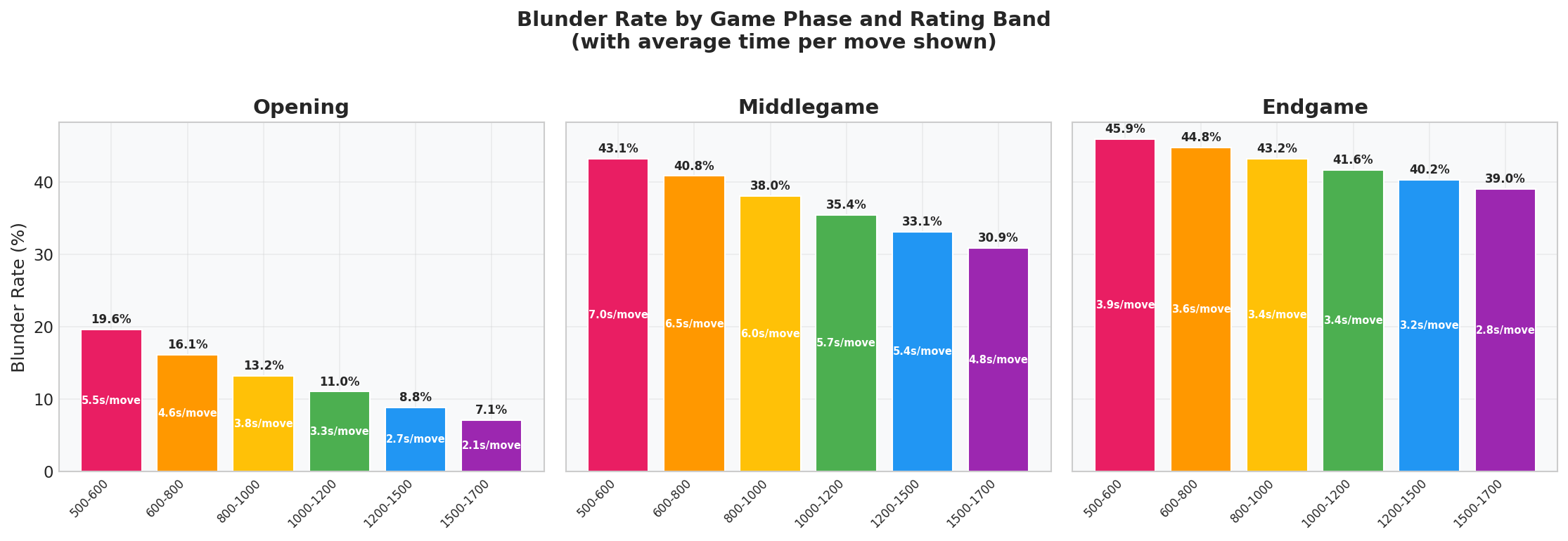
As the chart above shows, blunder rates skyrocket in the endgame across all rating bands. This is partly due to the complexity of endgames, but largely due to the fact that players are operating on fumes. At the 800-1000 level, players average just 3.6 seconds per move in the endgame, leading to a staggering 44.7% blunder rate.
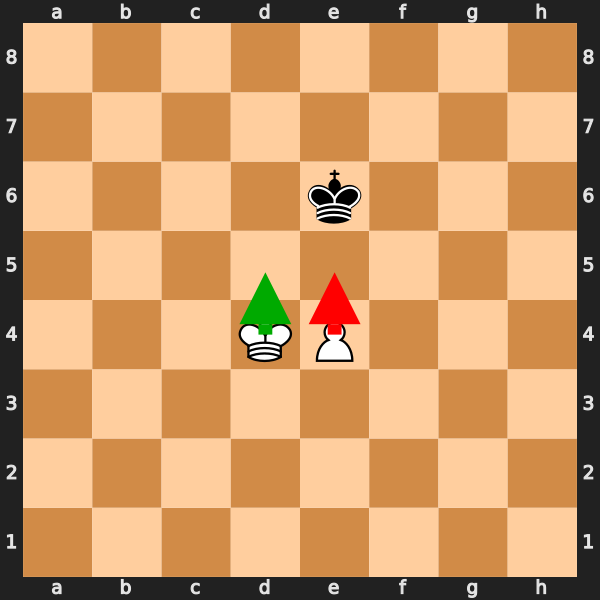 With 15 seconds left, White panics and plays e5??, allowing a draw by stalemate or losing the pawn. With just 10 more seconds on the clock, White would easily find Kd5, securing the win.
Actionable Advice by Rating Band
Based on the data, here is a roadmap for improving your clock management as you climb the Chess.com rating ladder.
800 - 1000: Stop the Early Time Dumps
At this level, the biggest clock management flaw is spending 45+ seconds on a single move in the opening or early middlegame.
- The Data: Players in this band spend 23-25% of their time in the opening, leaving them starved for time later.
- Actionable Advice: Set a hard limit of 15 seconds per move for the first 10 moves. If you don't know the theory, play a solid, principled developing move (like Bd3 or d3) rather than trying to calculate a complex tactical sequence from scratch.
1000 - 1200: The 30-Second Rule
This is the rating band where opponents start actively trying to flag you if they notice you are low on time.
- The Data: The win rate penalty for falling below 30 seconds jumps to 9.1 percentage points at this level.
- Actionable Advice: Treat the 30-second mark on your clock as a hard floor. Your goal is to finish the game before your clock hits 0:30. If you find yourself consistently dropping below this mark, you need to play faster in the middlegame, even if it means accepting a slightly lower centipawn accuracy.
1200 - 1500: Banking Time for the Endgame
At this level, games are longer, and endgames are more common. You cannot survive a 1200+ endgame with 10 seconds on the clock.
- The Data: Players at this level who reserve 40%+ of their time for the endgame perform significantly better. However, nearly 40% of players still enter time trouble (<30s).
- Actionable Advice: Practice playing your opening repertoire quickly and confidently. You should aim to reach move 15 having spent no more than 45-60 seconds of your total time. Bank that time so you have at least 90 seconds remaining when the queens come off the board.
Data and Methodology
This analysis was conducted using a dataset of 465,320 Lichess blitz games played in March 2025. Engine evaluations (Stockfish 17) and clock annotations were extracted to compute centipawn loss and time usage per move.
For the deep clock analysis, a representative sample of 564 games was parsed move-by-move to calculate phase distributions, time trouble frequencies, and the coefficient of variation for move times.
Note on Ratings: All data was sourced from Lichess. To make the insights actionable for the broader chess community, rating labels in the text and charts have been mapped to their approximate Chess.com equivalents (e.g., Lichess 1100-1300 is presented as Chess.com 800-1000).
Underlying Data Files:
View full data →ratingBand timeSpentBucket avgCplDrop sampleMoves sampleGamesTotal 700-900 0-5s 346.8 32774029 5000 700-900 5-15s 343.7 10533160 5000 700-900 15-30s 333.2 2284080 5000 700-900 30-60s 330.9 589684 5000 700-900 60s+ 331.1 105973 5000
View full data →ratingBand termination pctOfGames avgGameLength sampleGames 700-900 abandoned 0.5 3 755 700-900 normal 69.6 26.4 114336 700-900 other 0 15 1 700-900 rules_infraction 0 9.2 12 700-900 time_forfeit 29.9 26 49132
View full data →ratingBand pctEndingUnder20Moves pctEndingUnder30Moves pctEndingUnder40Moves pctReaching40PlusMoves pctReaching60PlusMoves decisiveAvgMoves drawAvgMoves normalTerminationPct timeForfeitPct sampleGames 700-900 33.4 60.6 79.5 20.5 4.2 26.7 49.9 74.7 25.1 79460 900-1100 28.2 56.1 77.1 22.9 4.8 28.6 52.2 76.3 23.5 77662 1100-1300 24 51.9 74.1 25.9 5.7 30.3 53.3 76.9 22.9 76494 1300-1500 20.5 48 71.6 28.4 6.5 31.8 54.1 76.8 23 76220 1500-1800 16.8 43.4 68.4 31.6 7.1 33.3 54.9 74.7 24.9 72505
View full data →lichessBand chesscomBand totalGames totalSides timeForfeitPct winningPosTimeLosses winningPosTimeLossPct avgFinalClock medianFinalClock avgMoveTime medianCV trouble30Pct trouble10Pct evenTimeWinRate unevenTimeWinRate evenTimeSample unevenTimeSample behind120WinRate behind120Sample trouble30WinRate noTrouble30WinRate trouble30Sample noTrouble30Sample avgOpeningPct avgMiddlePct avgEndgamePct 1100-1300 800-1000 96 192 26.0 4 16.0 191.8 118.0 6.69 0.956 27.6 15.6 100.0 48.7 1 191 26.3 19 43.4 51.1 53 139 22.7 39.4 37.9 1300-1500 1000-1200 95 190 26.3 5 20.0 142.6 68.5 5.27 1.001 33.2 18.9 0 48.9 0 190 10.0 10 42.9 52.0 63 127 18.8 38.6 42.6 1500-1800 1200-1500 98 196 37.8 7 18.9 115.4 42.0 4.64 1.023 39.8 23.0 0 48.0 0 196 17.6 17 38.5 54.2 78 118 21.3 41.1 37.7 1800-2000 1500-1700 98 196 32.7 9 28.1 102.9 34.5 4.24 1.058 45.9 21.9 0 46.9 0 196 62.5 8 44.4 49.1 90 106 18.9 40.0 41.1 700-900 500-600 83 166 24.1 6 30.0 192.8 139.5 6.57 0.921 22.3 14.5 50.0 46.3 2 164 46.2 13 40.5 48.1 37 129 24.8 38.2 37.0
Chess Coach <2026-04-15>