In Lichess arena tournaments, players are offered a tantalizing gamble: the Berserk button. By clicking it before making their first move, a player voluntarily halves their starting time and forfeits any increment. In exchange, a victory yields an extra tournament point.
For Rapid chess—where the standard time control is 10 minutes per side—berserking means playing a 5-minute game against an opponent who has 10 minutes. Is the extra point worth the severe time handicap? Does the math change as you climb the rating ladder?
To answer these questions, we analyzed over 17,000 recent Lichess Rapid arena games. We mapped the Lichess ratings to their approximate Chess.com equivalents to provide actionable advice for players looking to climb from the 800 to 1500 rating bands.
1. The Baseline: How Often Do Players Berserk?
Before evaluating whether berserking is a good idea, it is helpful to see how often players actually do it. In Rapid arenas, berserking is relatively rare compared to Blitz or Bullet, primarily because losing 5 minutes of clock time is a massive concession.
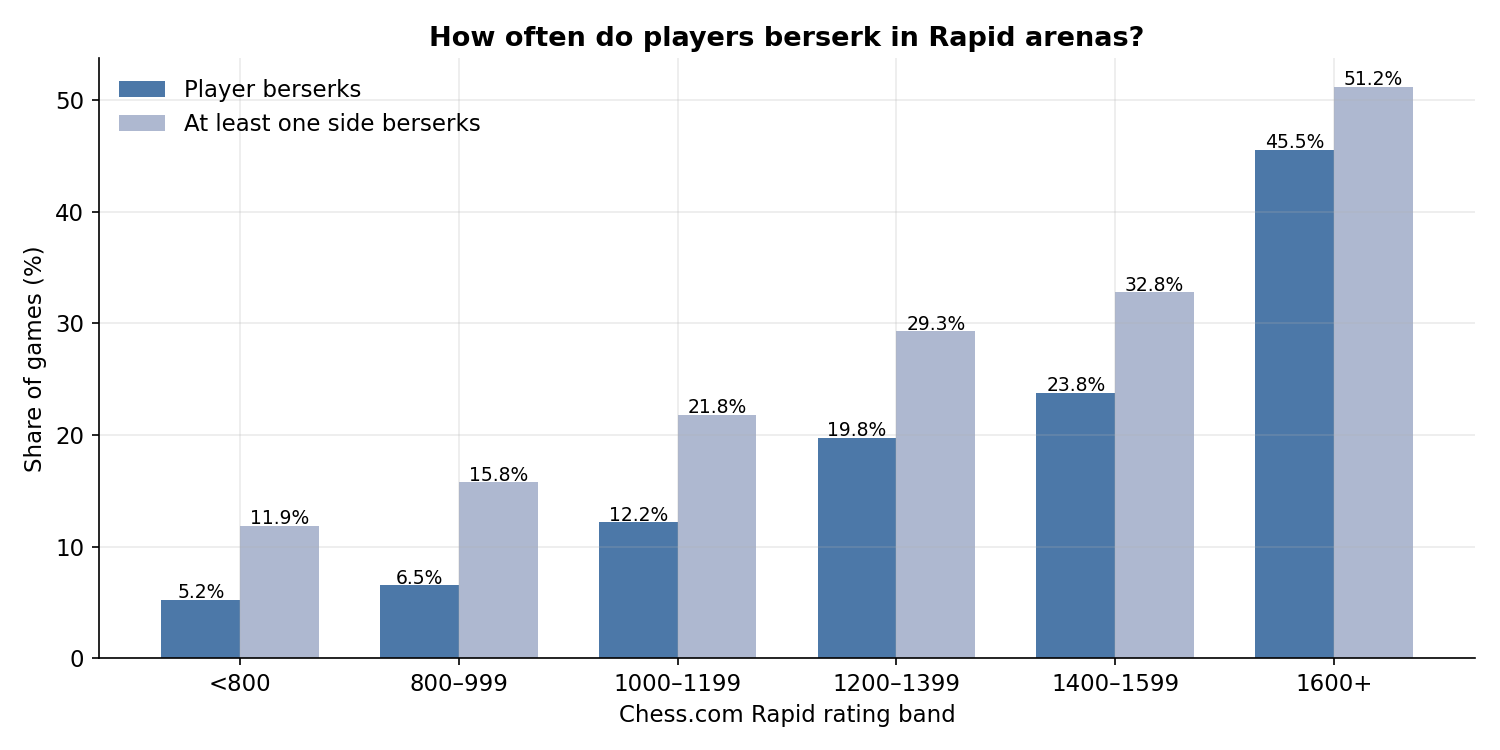
As the data shows, berserking is a strategy heavily favored by stronger players. In the Chess.com <800 band, only about 5% of players choose to berserk. By the time we reach the Chess.com 1400–1599 band, nearly 24% of players are hitting the berserk button.
2. The Expected Value (EV) of Berserking
In a standard Lichess arena, a win is worth 2 points, a draw is 1 point, and a loss is 0 points. If you berserk, a win is worth 3 points, while a draw remains 1 point.
To determine if berserking "pays off," we calculate the Expected Value (EV) in tournament points per game. If the EV of berserking is higher than the EV of playing normally, then berserking is mathematically optimal for maximizing tournament score.
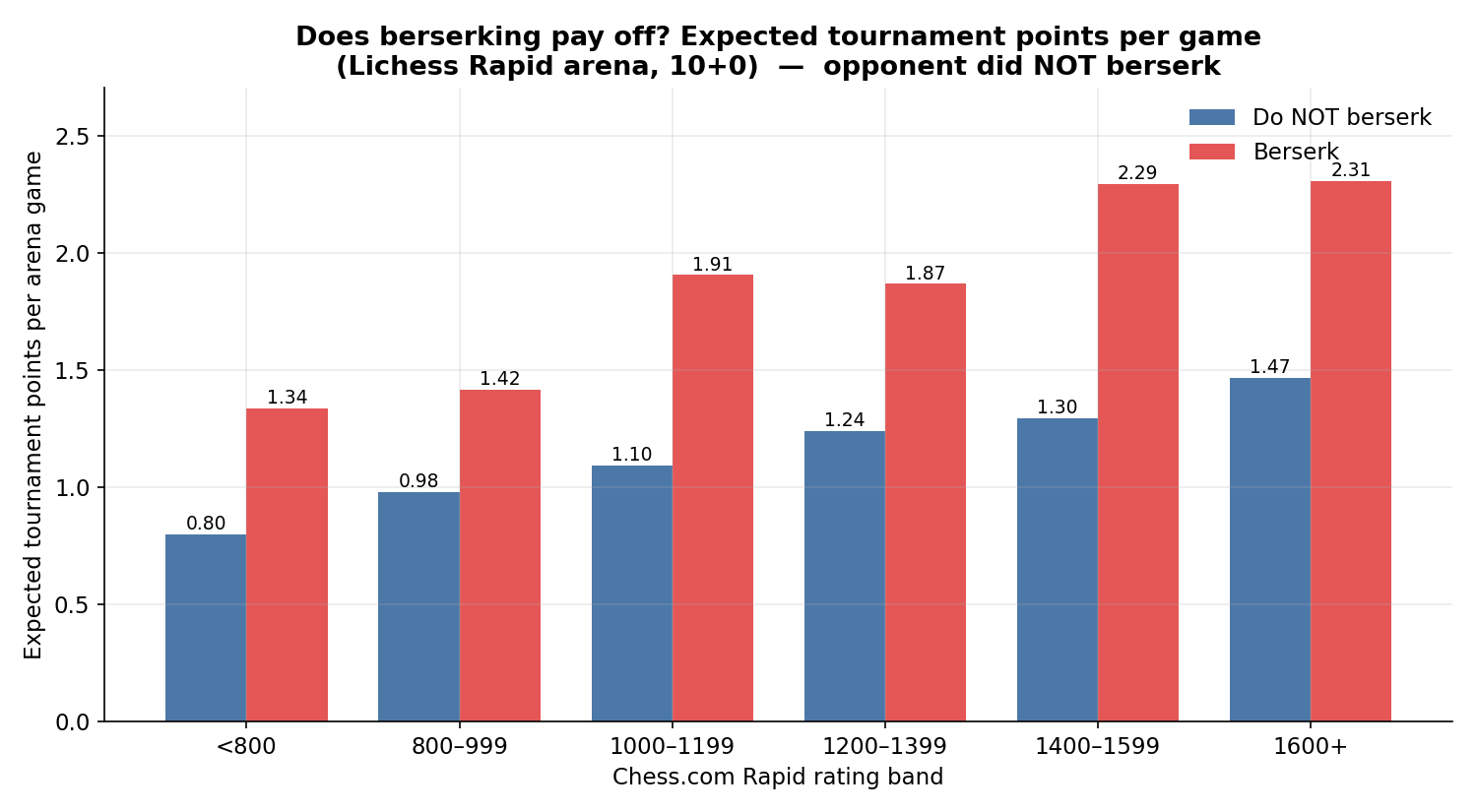
Surprisingly, the raw data suggests that berserking yields a higher expected point return across all rating bands.
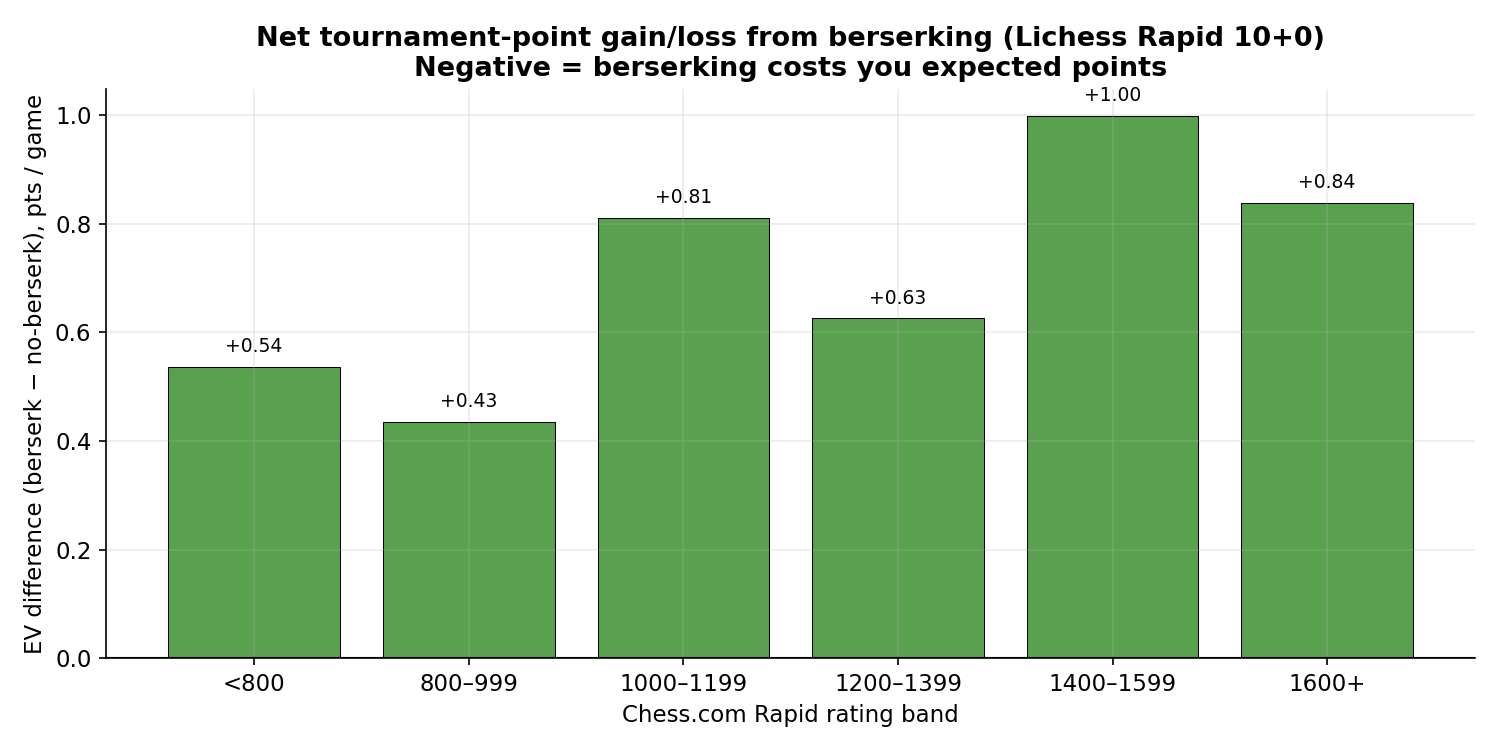
On average, players who berserk earn between +0.43 and +1.00 extra tournament points per game compared to those who do not. However, this raw comparison hides a critical confounding variable: self-selection bias. Stronger, more confident players are the ones choosing to berserk. To get the true picture, we must look at how berserking affects individual players.
3. Controlling for Player Strength: The Within-Player Analysis
To eliminate the bias of stronger players skewing the berserk statistics, we isolated players who played at least three games with berserk and at least three games without berserk in our dataset. We then compared their performance against themselves.
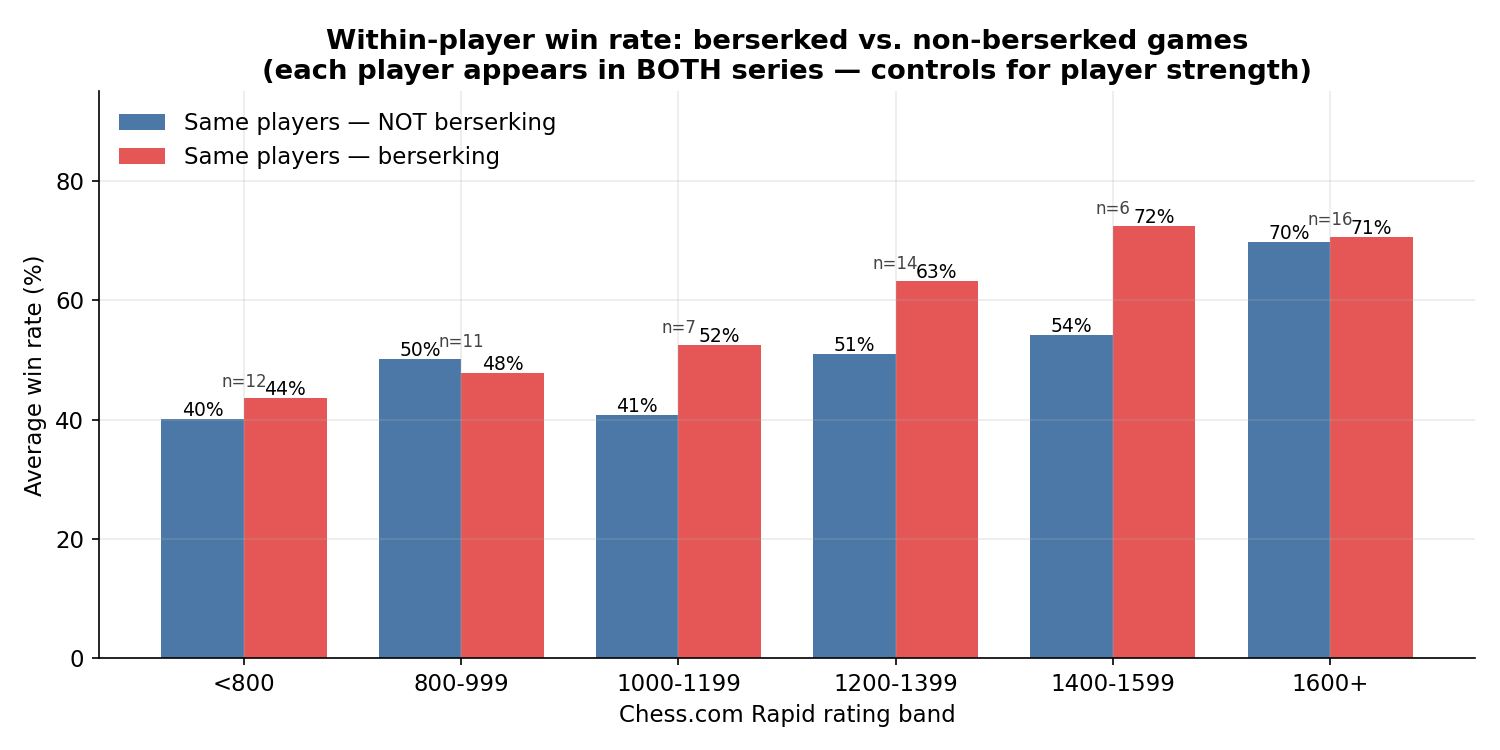
When we control for player strength, the narrative shifts. For players in the Chess.com 800–999 band, berserking actually decreases their average win rate from 50% to 48%. The time pressure induces blunders that cost them games they would have otherwise won.
However, as players cross the Chess.com 1000 threshold, a fascinating trend emerges: their win rate actually increases when they berserk. How is this possible?
- Psychological Pressure: Berserking signals extreme confidence. It often intimidates the opponent, causing them to play overly passively or burn their own clock double-checking variations.
- Opening Preparation: Players who berserk often steer the game into sharp, heavily prepared opening lines where they can blitz out the first 10-15 moves, effectively neutralizing the opponent's time advantage.
The Anatomy of a Berserk Blunder
At lower ratings, the halved clock often leads to panic. Consider this typical scenario from our dataset:
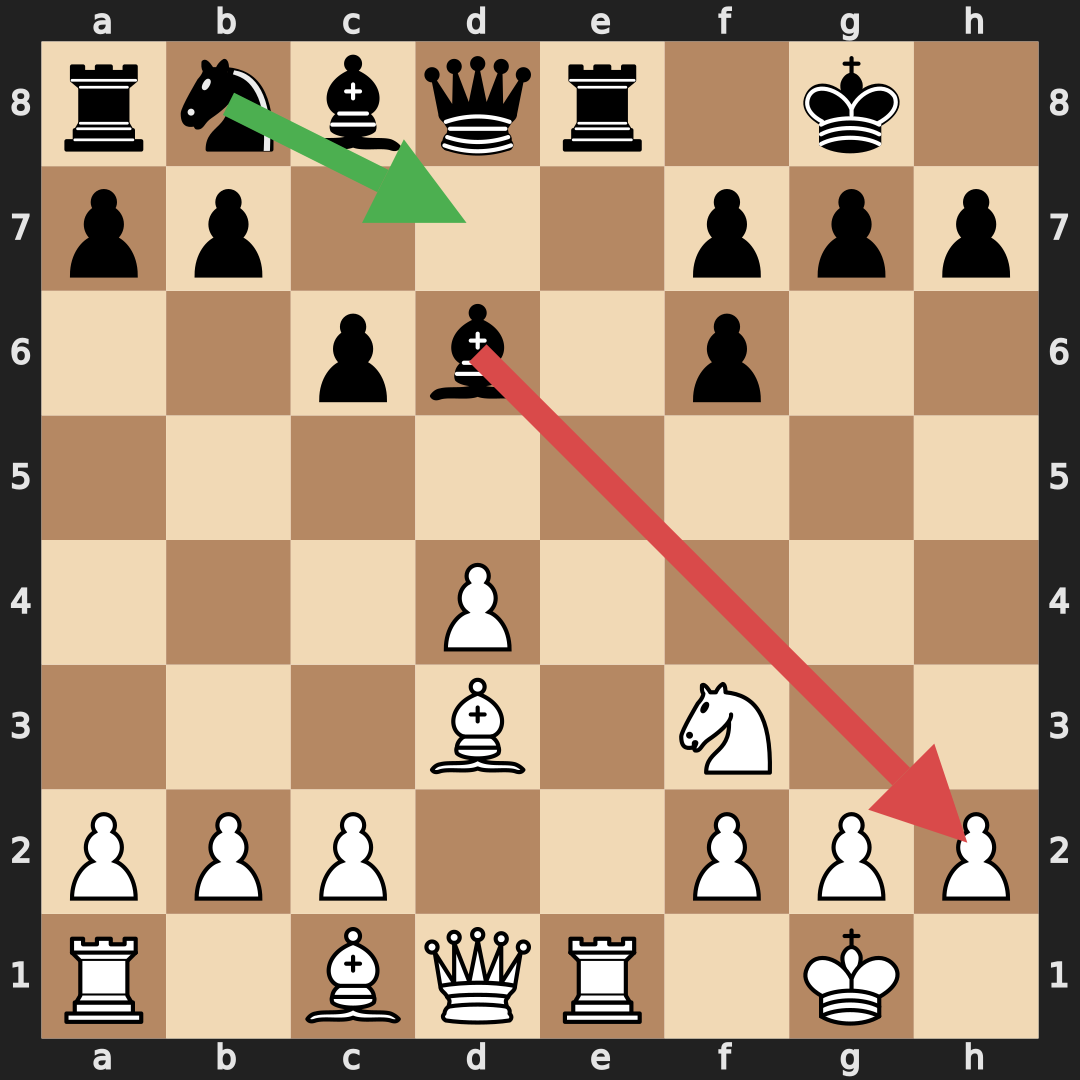
Berserked Black, feeling the pressure of a 5-minute clock, plays 17…Bxh2+ (red) seeking a quick tactical knockout. The engine's best move 17…Nd7 (green) keeps equality; instead, Black loses the bishop after 18.Kxh2 and goes on to lose the game.
The Time Scramble
Even when the berserker outplays their opponent, the lack of increment makes converting winning endgames perilous.
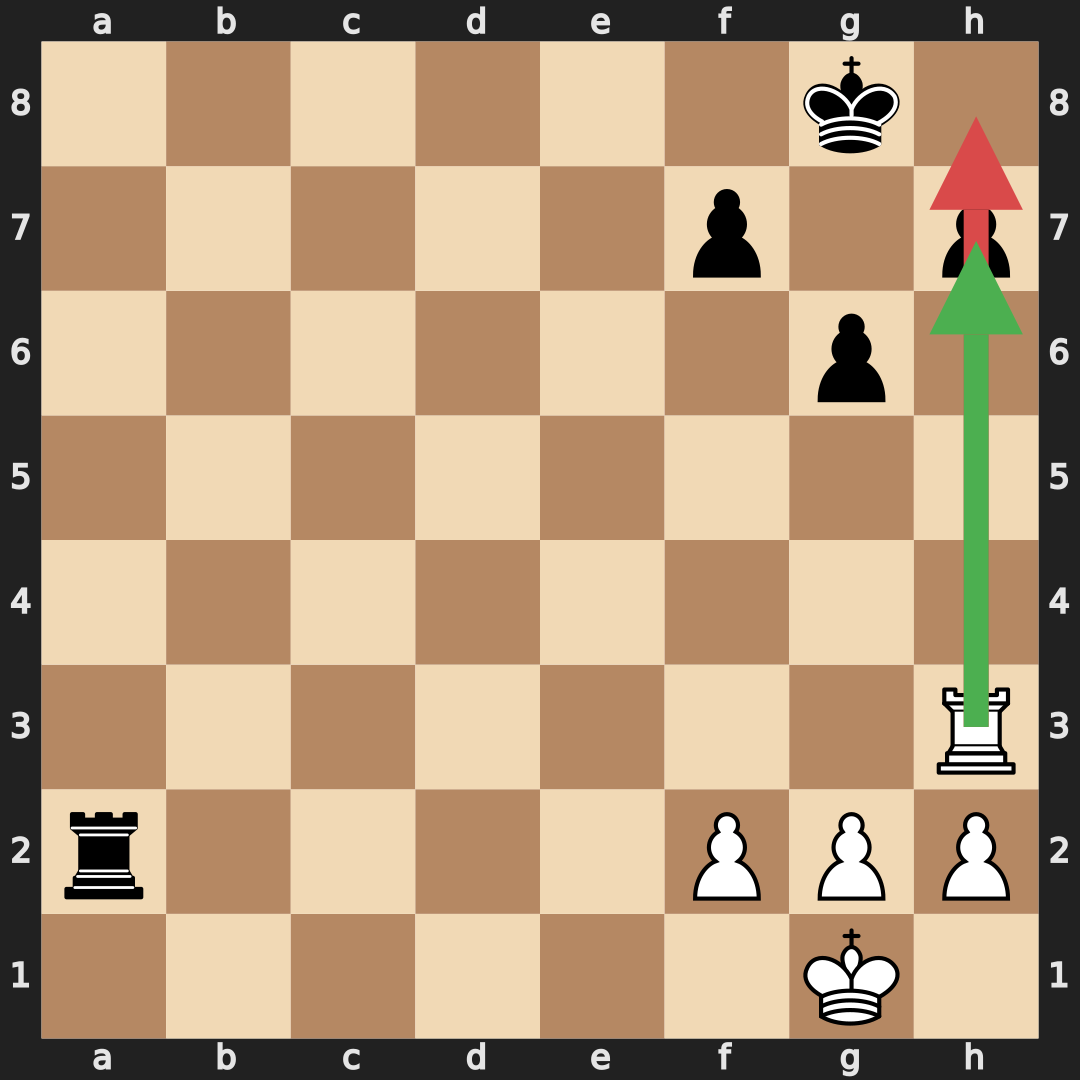
In this Rook endgame, White has a trivially winning position but only ~5 seconds left on a berserked clock. White plays the flashy Rh8+?? (red), losing the h3-rook and the game. The engine prefers the quiet Rxh7 (green).
4. Roadmap for Improvement: Actionable Advice by Rating Band
Based on the data, here is a roadmap for when and how to use the berserk feature as you climb the rating ladder.
Chess.com <800 (Lichess <1400)
- The Data: Berserking provides a slight EV boost (+0.50 pts/game) but introduces high variance. Win rates remain relatively flat.
- Actionable Advice: Do not berserk. At this level, games are decided by one-move blunders. Having 10 minutes instead of 5 allows you to perform basic blunder-checks. The extra tournament point is not worth the developmental cost of playing rushed, low-quality chess.
Chess.com 800–999 (Lichess 1400–1614)
- The Data: This is the only band where within-player win rates actually drop when berserking (from 50% to 48%). The EV gain is the lowest of any band (+0.42 pts/game).
- Actionable Advice: Avoid berserking. You are beginning to grasp positional concepts and multi-move tactics, but you need time to calculate them. Halving your clock forces you back into "hope chess."
Chess.com 1000–1199 (Lichess 1615–1764)
- The Data: A turning point. Players here see a massive +11% jump in win rate when berserking, yielding a strong +0.72 EV gain.
- Actionable Advice: Experiment with berserking selectively. Use it only when you have the White pieces and plan to play an opening you know intimately. If you can blitz out the first 10 moves, you transfer the time pressure to your opponent.
Chess.com 1200–1399 (Lichess 1765–1879)
- The Data: Berserking is highly profitable here (+0.89 EV gain). Players maintain a 63% win rate even with half the time.
- Actionable Advice: Berserk against lower-rated opponents. In arena pairings, you will often face players 100-200 points below you. Use the berserk button to maximize points in these favorable matchups, but play standard time against your peers.
Chess.com 1400–1500+ (Lichess 1880–1930+)
- The Data: Berserking is a dominant strategy. Over 93% of players in this band who berserk see a positive EV return, gaining over +1.1 tournament points per game.
- Actionable Advice: Berserk aggressively to win arenas. At this level, you possess the board vision to play 5-minute chess at a high level. To place on the podium in Rapid arenas, berserking is practically mandatory to keep pace with the leaders.
Data and Methodology
This research analyzed 17,640 Lichess Rapid arena games (10+0 time control) played in April 2026.
- Data Collection: Games were sourced via the Lichess API from official and team-created Rapid arenas.
- Rating Conversion: Lichess Rapid ratings were mapped to Chess.com Rapid ratings using established community conversion tables (e.g., Lichess 1615 ≈ Chess.com 1000).
- Analysis: We computed Expected Value (EV) based on standard Lichess arena scoring (Win=2, Draw=1, Loss=0; Berserk Win=3). Streak bonuses were excluded to isolate the pure effect of the berserk decision.
- Bias Control: The "Within-Player" analysis isolated 66 players who played at least 3 berserked and 3 non-berserked games, comparing their performance across both regimes to eliminate self-selection bias.
Underlying Data Files:
View full data →tournament_id game_id created_at tc_base tc_inc tc_label white black white_rating black_rating avg_rating rating_band winner status white_berserk black_berserk ply_count iuUuzVDs TNUJ2d6E 1776750880762 600 0 10+0 fmohammedismail123 Samar_7 1641 1355 1498.0 chesscom_800_1000 black timeout 0 0 10 iuUuzVDs KSajCi86 1776750770271 600 0 10+0 Vihan2010 Mahyma15 1667 1376 1521.5 chesscom_1000_1200 white mate 0 0 47 iuUuzVDs l9WyGeTW 1776750717023 600 0 10+0 KayNguyen captainpedzi 1474 1529 1501.5 chesscom_800_1000 white noStart 0 0 1 iuUuzVDs HkUQ8q0k 1776750657620 600 0 10+0 Ashwathika Avaneesh_Kamat 1599 1528 1563.5 chesscom_1000_1200 black mate 0 0 32 iuUuzVDs TKPhpiez 1776750657620 600 0 10+0 w910w Lechti17 1381 1428 1404.5 chesscom_800_1000 white noStart 0 0 1 - Player Summary Data (CSV)
- Paired Within-Player Analysis (CSV)
Chess Coach
April 21, 2026