The Benoni Defense is one of the most dynamic and double-edged responses to 1.d4. Characterized by an early ...c5 challenging White's center, it leads to complex asymmetrical pawn structures that test both players' strategic understanding. For intermediate players climbing the rating ladder, understanding the nuances of the Benoni structure is crucial.
This article presents a comprehensive data-driven analysis of the Benoni pawn structure, specifically focusing on White's win rate across intermediate rating bands (Chess.com ~600 to ~1750). By analyzing hundreds of Lichess Rapid games and evaluating them with Stockfish 17, we uncover the statistical realities of this opening and provide actionable advice for players looking to improve their handling of these positions.
The Classic Benoni Structure
Before diving into the data, it is essential to understand the defining characteristics of the Benoni pawn structure. The classic formation arises after the sequence 1.d4 Nf6 2.c4 c5 3.d5 e6 4.Nc3 exd5 5.cxd5 d6.
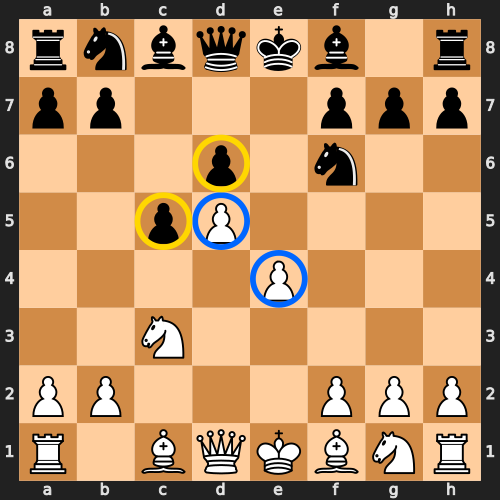
In this position, White enjoys a significant space advantage due to the pawn on d5, which cramps Black's position and controls key central squares. White typically aims to expand further with e4 and prepare a central breakthrough with f4 and e5. Black, on the other hand, possesses a queenside pawn majority (a7, b7, c5 vs a2, b2) and seeks active counterplay on the queenside, often preparing the ...b5 pawn break. Black's dark-squared bishop on g7 (after ...g6) becomes a powerful piece, exerting pressure along the long diagonal.
Statistical Overview: The Benoni vs. The Baseline
To understand how the Benoni performs at different skill levels, we compared White's win rate in Benoni variations against a baseline of all 1.d4 openings. The data reveals a fascinating trend that shifts dramatically as players improve.
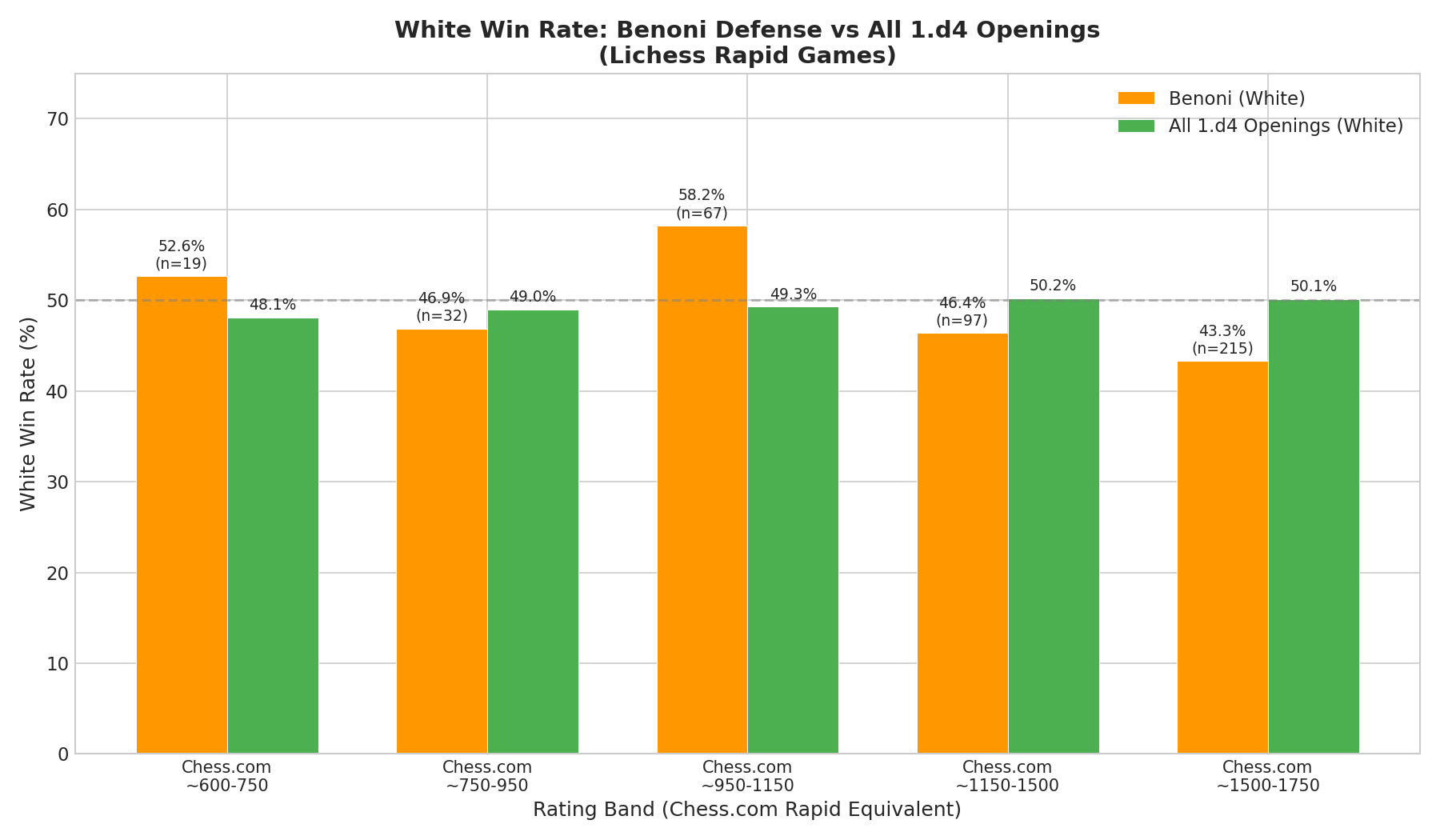
At the lower end of the intermediate spectrum (Chess.com ~600-750), White scores a solid 52.6% win rate in the Benoni, outperforming the 48.1% baseline for all 1.d4 openings. This advantage peaks in the ~950-1150 range, where White achieves a dominant 58.2% win rate compared to the 49.3% baseline.
However, as we move up the rating ladder, the narrative flips. In the ~1150-1500 band, White's win rate drops to 46.4%, falling below the 50.2% baseline. This decline continues into the ~1500-1750 range, where White scores only 43.3% against the Benoni, while the baseline remains steady at 50.1%.
This data suggests that the Benoni is a highly effective weapon for Black at higher intermediate levels, but it can be a liability for less experienced players who struggle to navigate its complexities.
The Anatomy of the Shift: Why Does Black Improve?
The shift in win rates can be attributed to several factors related to the inherent characteristics of the Benoni structure and how players at different levels handle them.
1. Navigating the Space Advantage
At lower ratings, White's space advantage is often enough to secure a victory. The cramped nature of Black's position makes it difficult to coordinate pieces, leading to passive play and eventual blunders. White players can often build up a strong center and launch a devastating attack without facing significant resistance.
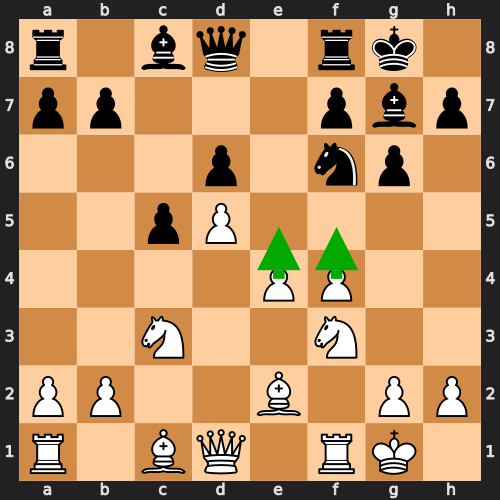
As players improve, they learn how to handle cramped positions more effectively. Black players in the ~1500-1750 range are better equipped to maneuver their pieces, find active squares, and generate counterplay. They understand the importance of the ...b5 break and the power of the g7 bishop, allowing them to turn the tables on White.
2. The Complexity of Counterplay
The Benoni requires Black to play actively and seek counterplay, primarily on the queenside. This involves preparing the ...b5 break, often supported by ...a6 and ...Rb8.
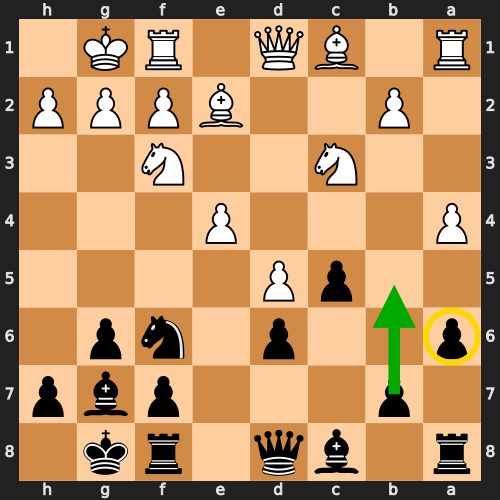
Executing this counterplay requires precise timing and calculation. Lower-rated players often struggle to coordinate this attack, either pushing ...b5 prematurely or failing to generate enough pressure. Higher-rated players, however, are more adept at executing this plan, creating significant problems for White on the queenside while White is trying to organize a central or kingside attack.
3. Tactical Pitfalls and Blunders
The asymmetrical nature of the Benoni leads to sharp, tactical positions where a single mistake can be fatal. Our analysis of Centipawn Loss (CPL) and blunders per game highlights this reality.
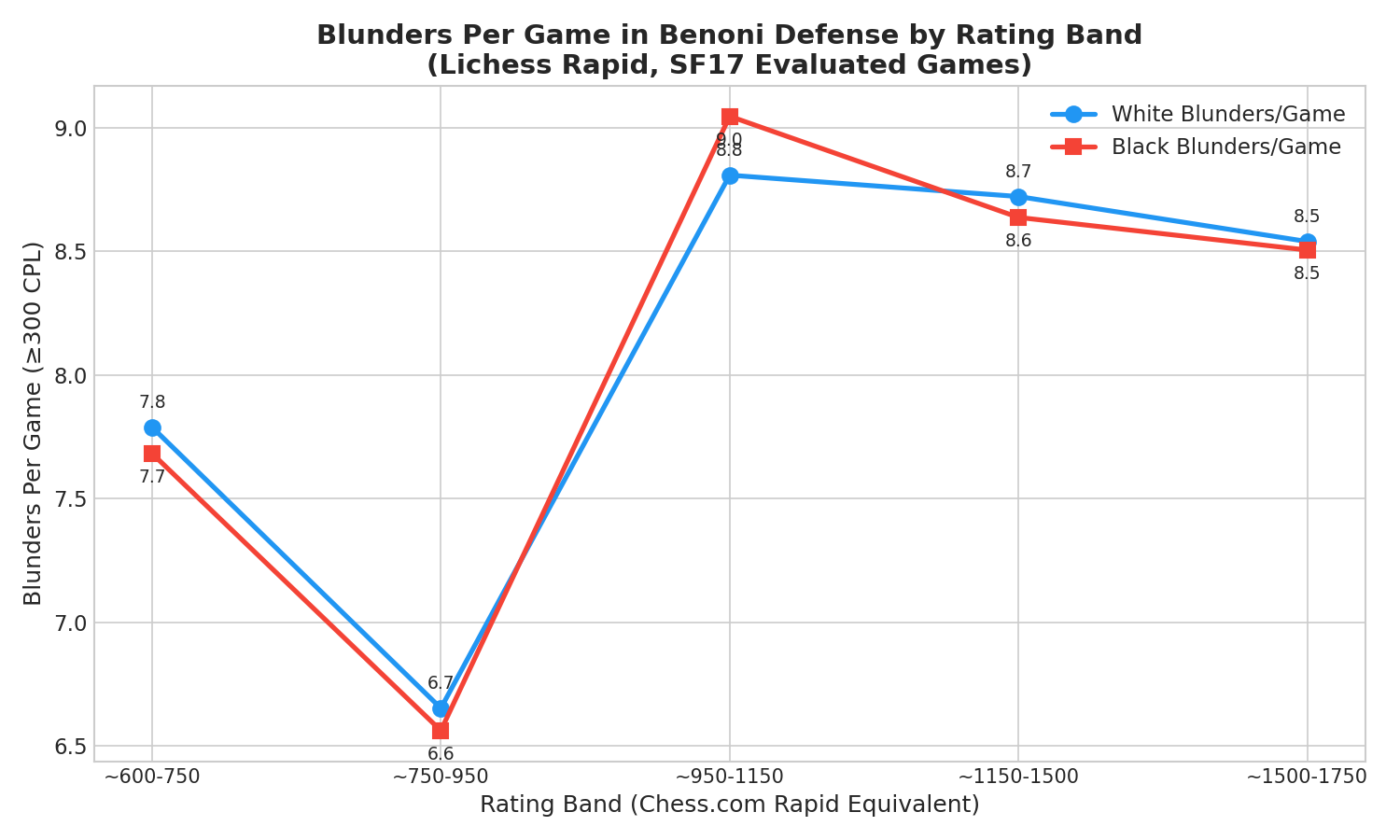
Across all rating bands, both White and Black average a high number of blunders (defined as a mistake costing 300+ centipawns) per game, ranging from 6.6 to 9.0. This indicates that the Benoni is a minefield for both sides.
A common tactical error for Black is the premature capture on e4.
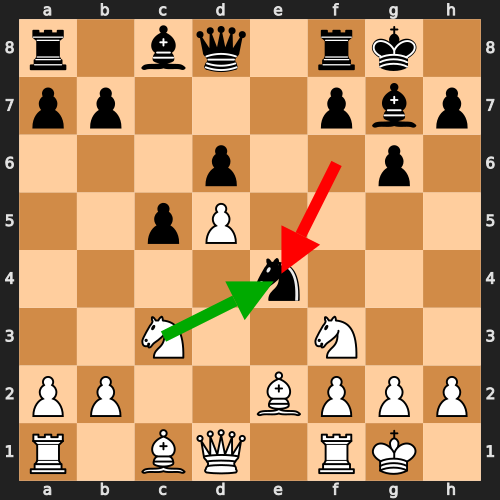
In this position, Black plays ...Nxe4, hoping to exploit a perceived tactical opportunity. However, White simply recaptures with Nxe4, maintaining a strong position and often gaining a decisive advantage. Higher-rated players are less likely to fall for these traps, contributing to Black's improved performance at the upper end of the intermediate spectrum.
Variation Analysis: The King's Pawn Line vs. The Modern Benoni
The Benoni encompasses several variations, each with its own unique characteristics. Our data highlights the performance of three primary lines: the King's Pawn Line (A65), the Modern Benoni (A60), and the Semi-Benoni (A44).
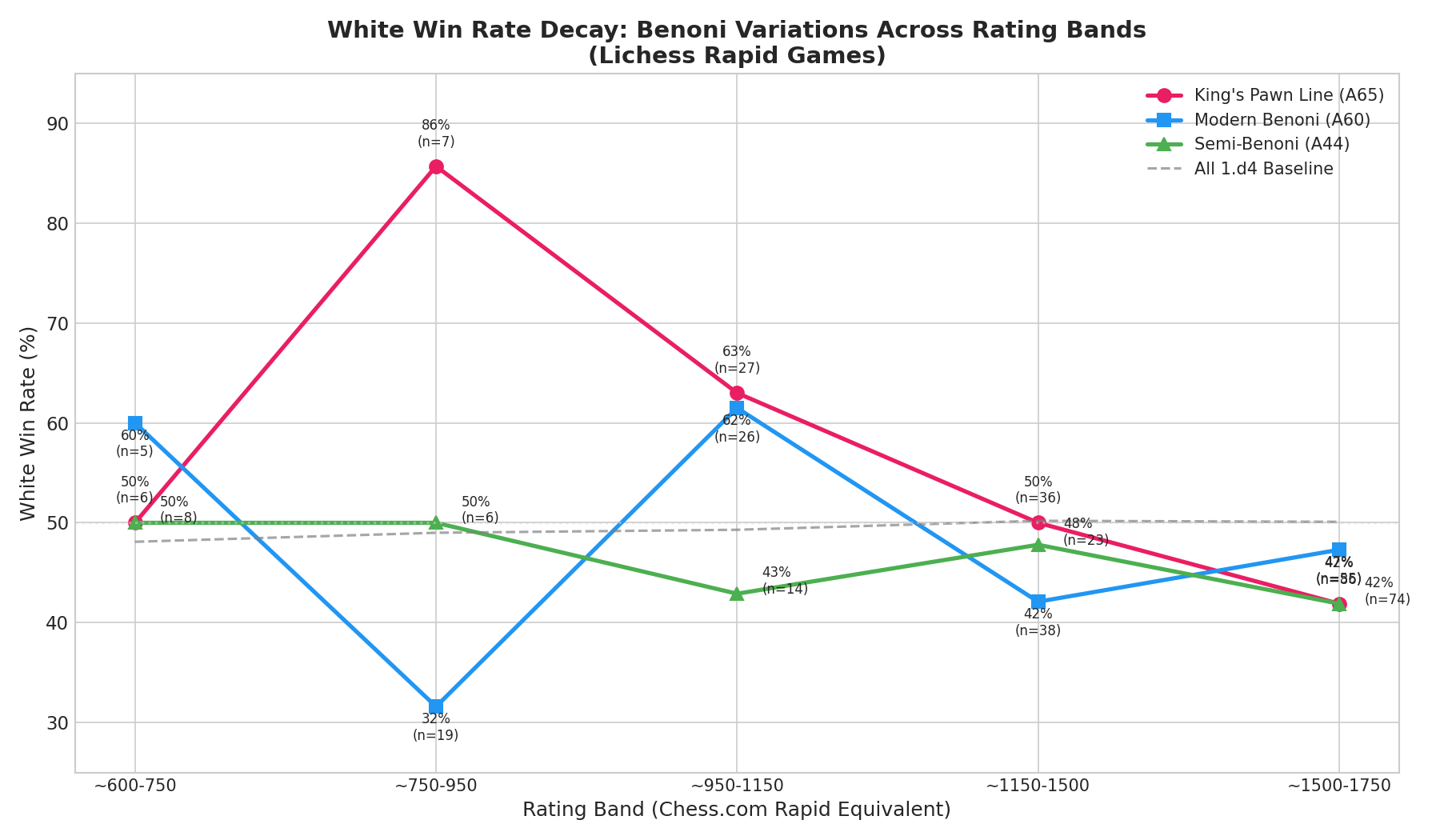
The King's Pawn Line (A65) exhibits the most dramatic decay in White's win rate. At the ~750-950 level, White scores an overwhelming 86% win rate. However, this plummets to just 42% in the ~1500-1750 range. This suggests that the King's Pawn Line is highly effective against less experienced opponents but loses its sting as Black players learn the appropriate defensive setups.
The Modern Benoni (A60) shows a more erratic pattern but ultimately follows the same downward trend for White, dropping from 60% at ~600-750 to 47% at ~1500-1750. The Semi-Benoni (A44), characterized by a more closed center, remains relatively stable, hovering near the 50% mark across most rating bands.
Actionable Advice for Intermediate Players
Based on the data and positional analysis, here is a roadmap for improving your play in the Benoni structure, tailored to your rating band.
For Players in the ~600-1150 Range (Chess.com)
Playing White:
- Embrace the Space: Your primary advantage is space. Focus on developing your pieces actively behind your strong pawn center (d5, e4).
- Prepare the f4 Break: The key to breaking Black's position is often the f4 pawn push, followed by e5. Do not settle for passive setups like Bd3 if f4 is available and strong.
- Watch for Tactics: The Benoni is sharp. Always double-check your calculations, especially when Black challenges your center or pushes ...b5.
Playing Black:
- Prioritize Development: Do not get bogged down in complex maneuvering before your pieces are developed. Get your king to safety and activate your minor pieces.
- Understand the g7 Bishop: Your dark-squared bishop is your best piece. Ensure it has open diagonals and use it to pressure White's queenside and center.
- Don't Rush ...b5: Counterplay is essential, but premature attacks will backfire. Prepare the ...b5 break carefully with ...a6 and ...Rb8.
For Players in the ~1150-1750 Range (Chess.com)
Playing White:
- Respect Black's Counterplay: You can no longer rely solely on your space advantage. Be acutely aware of Black's queenside plans and take prophylactic measures to slow them down.
- Control the Center: Maintain a firm grip on the center. If Black successfully challenges your d5 or e4 pawns, your position can collapse quickly.
- Improve Endgame Technique: As the data shows, game length increases at higher ratings. Be prepared to transition into endgames where your space advantage might translate into a superior pawn structure or better piece activity.
Playing Black:
- Master the Maneuvers: Learn the typical piece maneuvers in the Benoni, such as routing the knight to c7 or e5, and utilizing the e8 square for the rook.
- Exploit White's Overextension: If White pushes too aggressively (e.g., an ill-timed f4 or e5), be ready to counterattack and exploit the weaknesses left behind.
- Study Master Games: The Benoni is a favorite of many dynamic players, including Mikhail Tal and Garry Kasparov. Studying their games will provide invaluable insights into the strategic and tactical nuances of the opening.
Conclusion
The Benoni pawn structure offers a rich and complex battleground for intermediate chess players. The data clearly demonstrates that while White enjoys a significant advantage at lower ratings due to the space advantage, Black's dynamic counterplay becomes increasingly potent as players improve. By understanding the statistical trends, recognizing the key positional features, and applying the actionable advice provided in this guide, you can elevate your understanding of the Benoni and improve your results, regardless of which side of the board you are playing.
Data and Methodology
This analysis is based on a dataset of Lichess Rapid games, specifically focusing on the Benoni Defense (ECO codes A44, A60, A65, and A70-A79). The data was collected using the grandmaster-guide MCP server, which provides deep statistical insights and Stockfish 17 evaluations.
The rating bands used in the analysis are based on Lichess Rapid ratings. To make the findings more accessible to a broader audience, these bands have been approximated to Chess.com Rapid ratings using a standard conversion formula.
- Total Benoni Games Analyzed: 430
- Baseline 1.d4 Games Analyzed: >200,000
- Evaluation Engine: Stockfish 17
The underlying CSV data files and high-resolution charts used in this article are attached for further review.
View full data →Lichess_Rating_Band ChessCom_Approx White_Win_Pct Draw_Pct Black_Win_Pct Total_Games Avg_Game_Length White_Avg_CPL Black_Avg_CPL White_Blunders_Per_Game Black_Blunders_Per_Game 700-900 ~500-600 41.7 0.0 58.3 12 24.5 265.6 263.1 10.34 10.42 900-1100 ~600-750 52.6 0.0 47.4 19 22.3 249.3 245.0 7.79 7.68 1100-1300 ~750-950 46.9 0.0 53.1 32 26.6 194.4 192.0 6.65 6.56 1300-1500 ~950-1150 58.2 3.0 38.8 67 28.6 214.8 212.3 8.81 9.05 1500-1800 ~1150-1500 46.4 3.1 49.5 97 32.5 193.7 192.4 8.72 8.64
View full data →Lichess_Rating_Band ChessCom_Approx White_Win_Pct Draw_Pct Black_Win_Pct Total_Games Avg_Game_Length White_Avg_CPL Black_Avg_CPL 900-1100 ~600-750 50.0 0.0 50.0 6 23.5 253.6 250.7 1100-1300 ~750-950 85.7 0.0 14.3 7 30.3 225.5 222.6 1300-1500 ~950-1150 63.0 3.7 33.3 27 29.8 189.1 186.8 1500-1800 ~1150-1500 50.0 5.6 41.7 36 35.0 211.1 210.6 1800-2000 ~1500-1750 41.9 4.7 53.5 86 33.4 202.9 201.0
View full data →Lichess_Rating_Band ChessCom_Approx White_Win_Pct Draw_Pct Black_Win_Pct Total_Games Avg_Game_Length White_Avg_CPL Black_Avg_CPL 700-900 ~500-600 50.0 0.0 50.0 4 28.9 189.1 188.2 900-1100 ~600-750 60.0 0.0 40.0 5 16.8 261.8 249.5 1100-1300 ~750-950 31.6 0.0 68.4 19 23.9 189.5 187.8 1300-1500 ~950-1150 61.5 0.0 38.5 26 26.4 229.0 228.5 1500-1800 ~1150-1500 42.1 0.0 57.9 38 30.9 175.1 173.9
View full data →Lichess_Rating_Band ChessCom_Approx White_Win_Pct Draw_Pct Black_Win_Pct Total_Games Avg_Game_Length White_Avg_CPL Black_Avg_CPL 700-900 ~500-600 37.5 0.0 62.5 8 22.3 303.9 300.6 900-1100 ~600-750 50.0 0.0 50.0 8 24.9 238.2 237.9 1100-1300 ~750-950 50.0 0.0 50.0 6 31.1 173.8 169.7 1300-1500 ~950-1150 42.9 7.1 50.0 14 30.5 237.9 231.6 1500-1800 ~1150-1500 47.8 4.3 47.8 23 31.1 197.1 194.5
Chess Coach <2026-04-14>