By Chess Coach
For intermediate chess players looking to climb the rating ladder, the endgame often feels like a distant concern—especially in Bullet chess, where games are frequently decided by tactical blunders or time scrambles. However, our analysis of over 5,500 Lichess Bullet games reveals a hidden strategic factor that quietly dictates the outcome of countless matches: the backward pawn.
This article serves as a roadmap for players rated between 600 and 1500 on Chess.com (roughly 975 to 1770 on Lichess). By examining real-world data, we will uncover how often backward pawns lead to lost endgames, why their impact grows as you improve, and what actionable steps you can take to turn this knowledge into rating points.
The Anatomy of a Backward Pawn
Before diving into the data, we must define our terms. A backward pawn is one that has fallen behind its adjacent peers, cannot be safely advanced because the square in front of it is controlled by enemy pawns, and cannot be defended by friendly pawns.
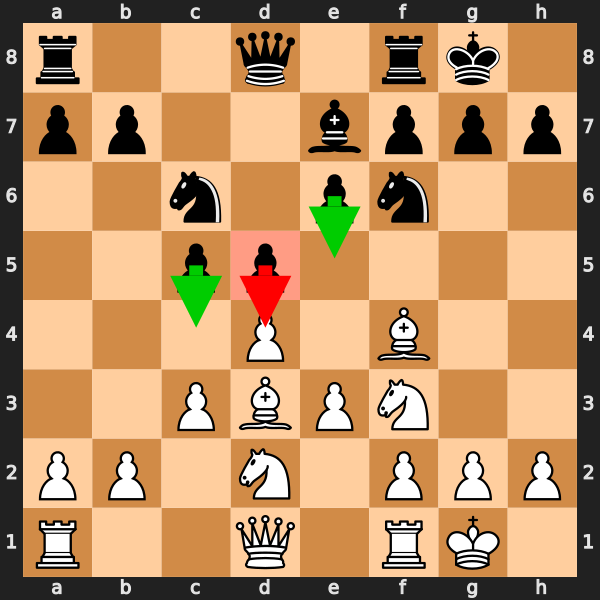
In slower time controls, a backward pawn is a well-known long-term weakness. It requires constant defense, tying down valuable pieces, and often provides the opponent with a permanent outpost directly in front of it. But does this strategic nuance matter in the chaotic 60-second arena of Bullet chess? The data says yes.
The Ubiquity of the Backward Pawn
Our first major finding is just how common backward pawns are in intermediate Bullet games. Across all rating bands analyzed, a staggering 92.4% of games featured at least one backward pawn at some point.
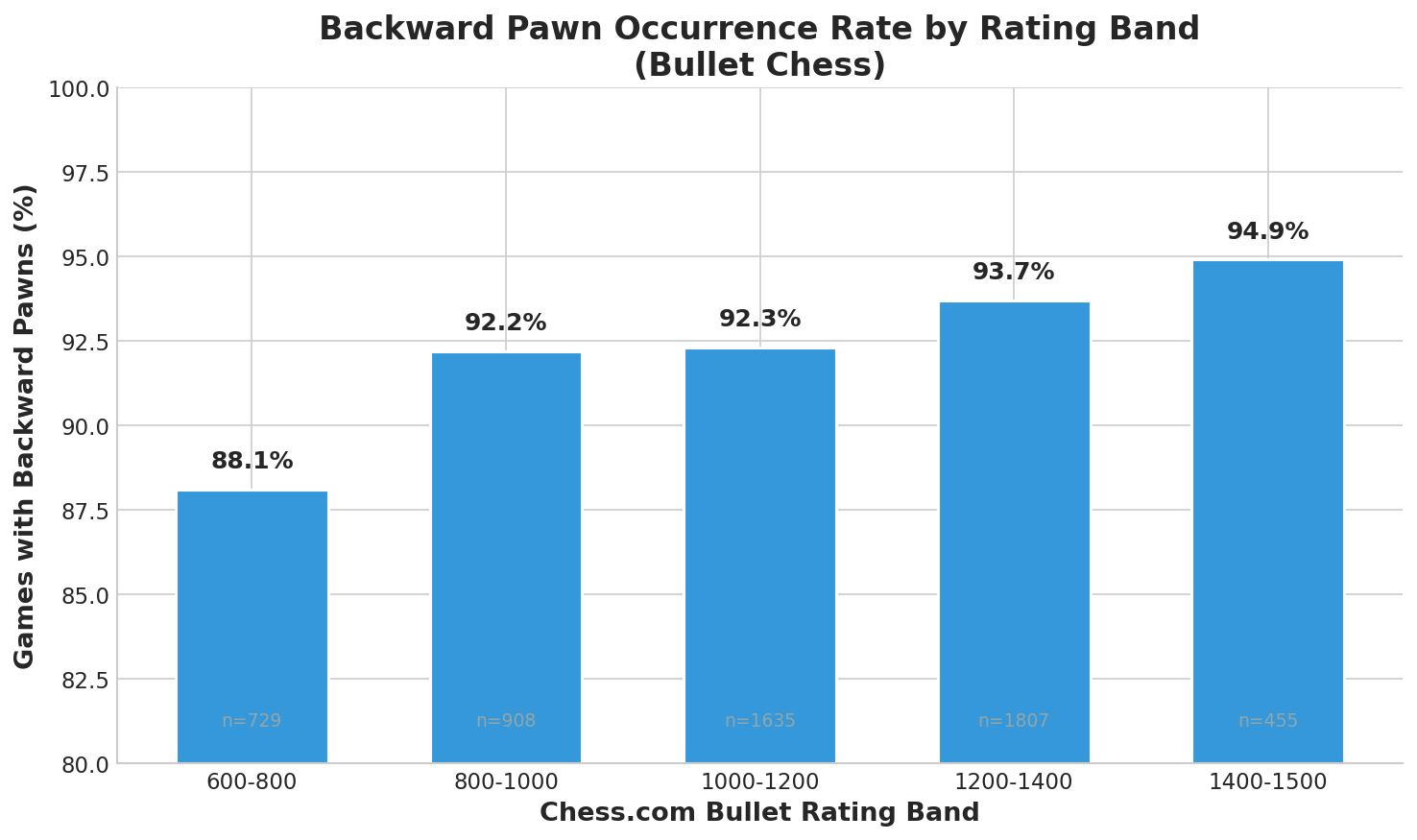
This near-universal occurrence means that mastering the play with—and against—backward pawns is not a niche skill; it is a fundamental requirement for consistent success. Furthermore, our analysis shows that backward pawns typically appear very early in the game, on average around move 6 or 7, often as a result of standard opening exchanges or premature pawn pushes.
Reaching the Endgame in Bullet
A common misconception among intermediate players is that Bullet games rarely reach the endgame. While it is true that many games end in quick checkmates or early resignations, a significant portion do transition into the final phase.
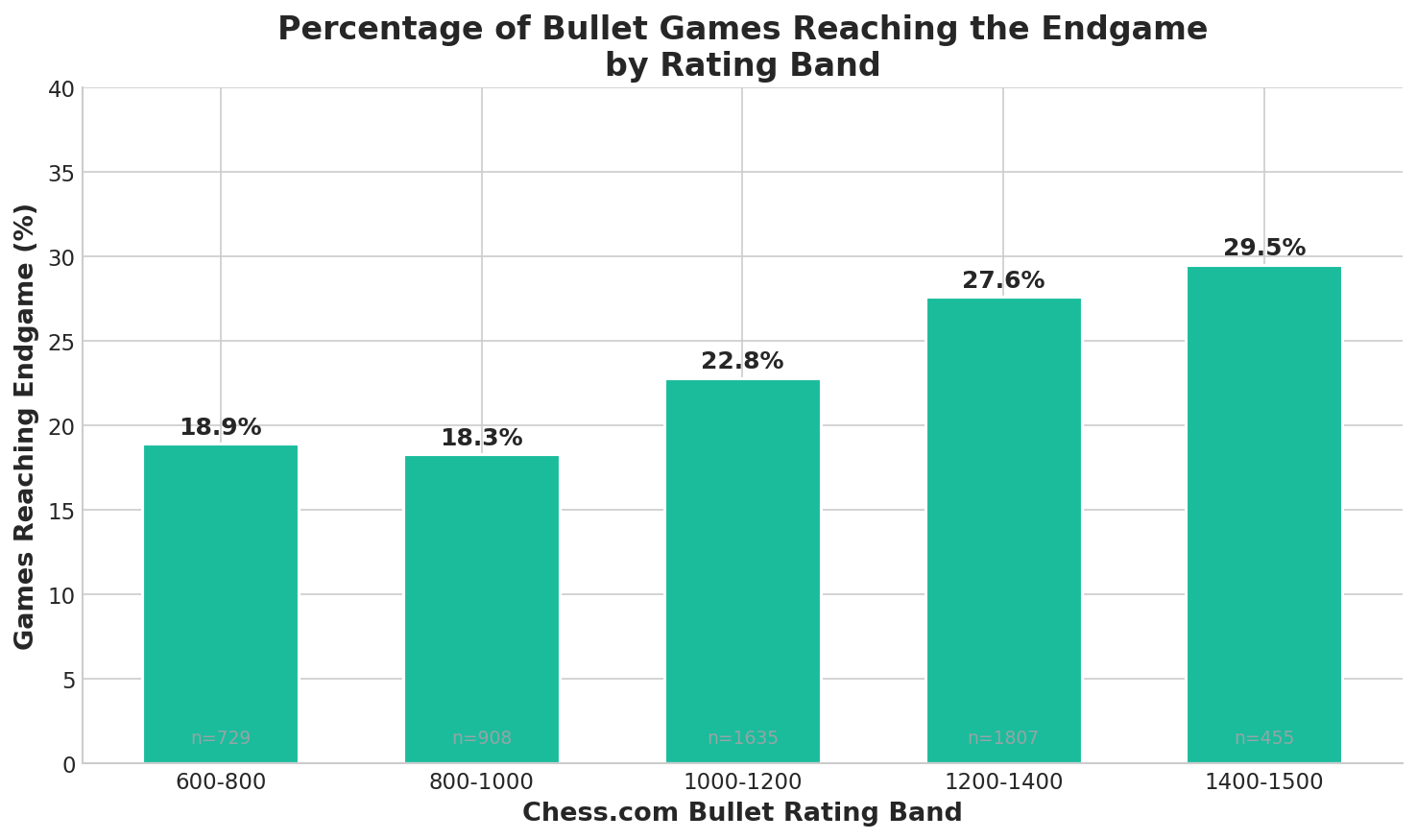
As the chart above illustrates, the likelihood of reaching an endgame increases steadily with player strength. For players in the 600-800 Chess.com range, only 18.9% of games reach the endgame. However, by the time players reach the 1400-1500 bracket, nearly 30% of games enter this critical phase. This trend highlights a crucial truth: as you climb the rating ladder, your opponents will blunder less in the opening and middlegame, forcing you to prove your technique in the endgame.
The Growing Penalty of the Backward Pawn
The most compelling insight from our data is how the impact of a backward pawn changes as players improve. At lower ratings, holding a backward pawn in the endgame is practically a coin flip. But as ratings increase, the backward pawn transforms from a minor inconvenience into a fatal liability.
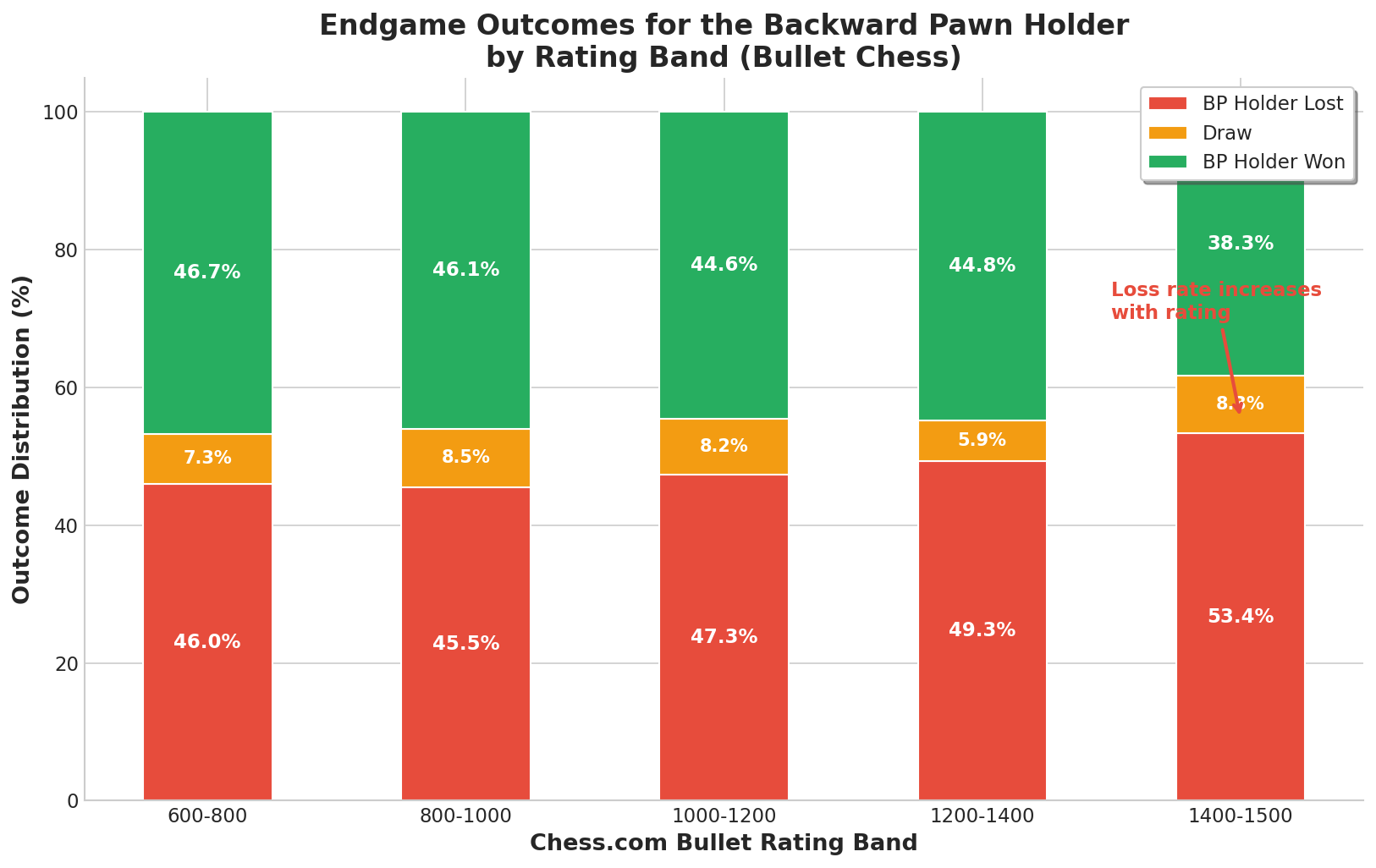
For players in the 600-1000 Chess.com range, the win/loss ratio for the player holding the backward pawn is nearly even (roughly 46% win, 46% loss). At this level, games are still largely decided by hanging pieces or running out of time, masking the strategic disadvantage of the pawn structure.
However, a clear shift occurs as we move up the rating bands. By the 1200-1400 range, the loss rate for the backward pawn holder climbs to 49.3%. In the 1400-1500 bracket, it spikes to 53.4%, while their win rate plummets to 38.3%.
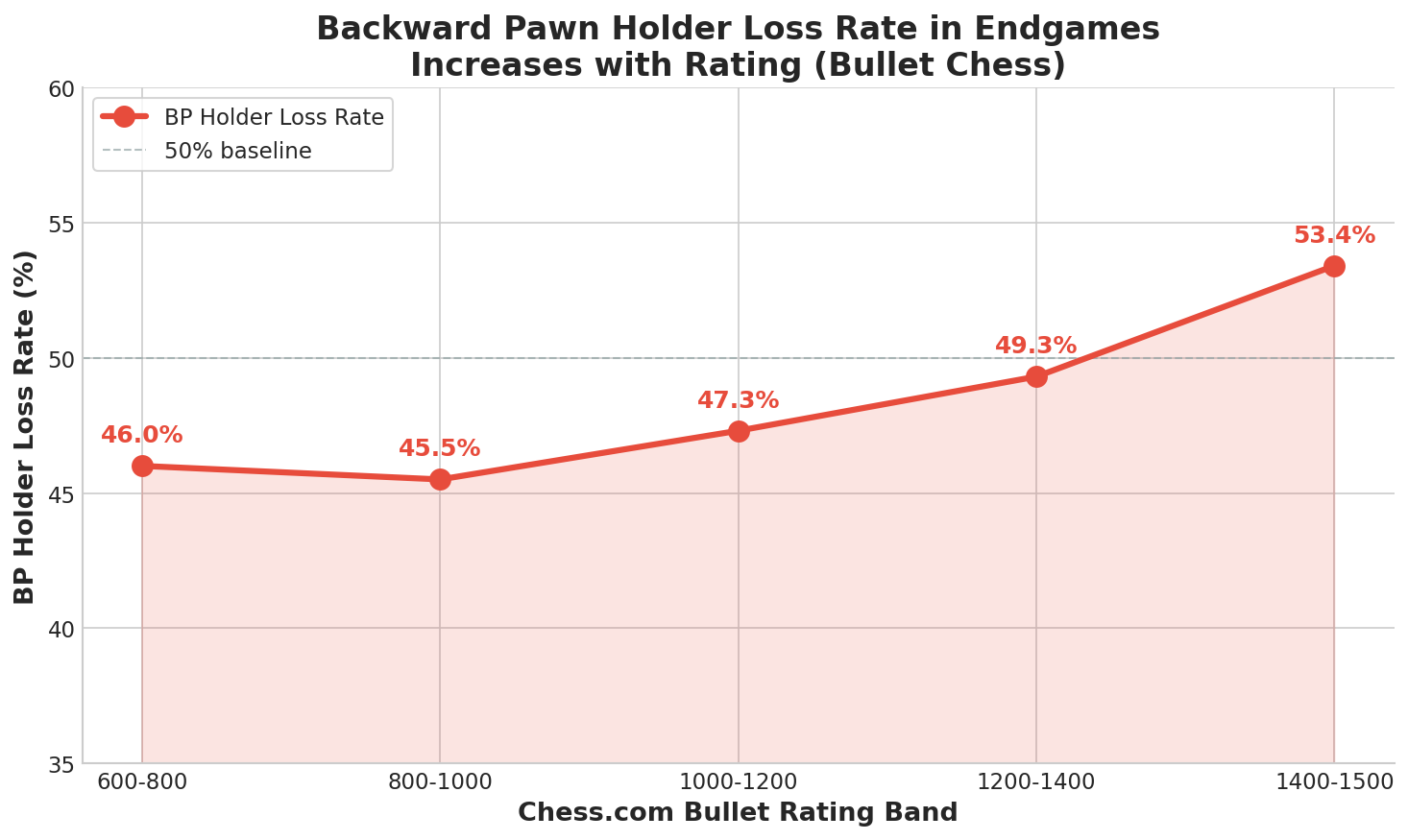
This trend demonstrates that intermediate players are increasingly capable of exploiting structural weaknesses, even with only seconds on the clock. The backward pawn becomes a permanent target, forcing the defending player into passive positions that are difficult to maintain under time pressure.
Visualizing the Struggle
To understand why backward pawns are so detrimental in the endgame, let us examine a few typical scenarios from our dataset.
Scenario 1: The Tied-Down Defender
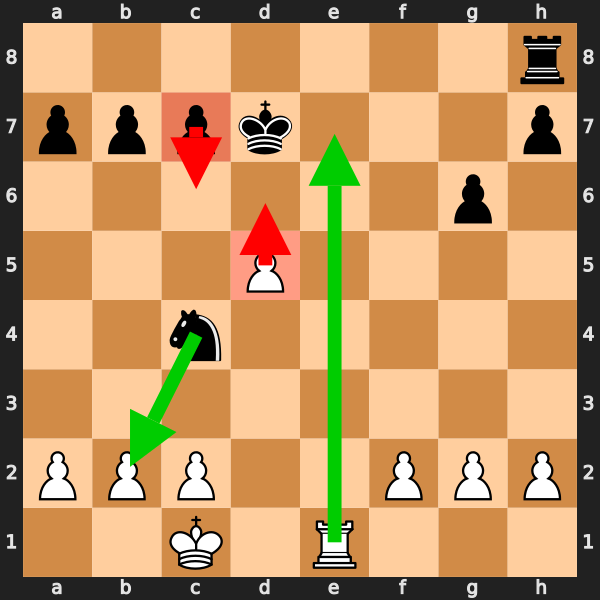 Figure 2: Black's backward c7 pawn and White's backward d5 pawn.
In this Rook and Knight versus Rook endgame, both sides suffer from backward pawns. However, notice how these pawns dictate the placement of the pieces. The rooks are often forced into passive defensive roles, while the attacking pieces (like Black's knight) enjoy active outposts. In Bullet chess, the player forced to defend passively is far more likely to blunder or lose on time.
Scenario 2: The King and Pawn Endgame
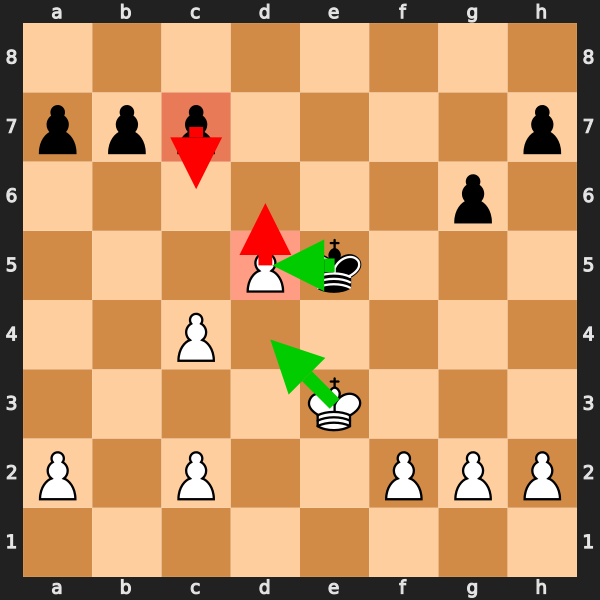 Figure 3: A King and Pawn endgame where backward pawns create critical targets.
In pure pawn endgames, a backward pawn is often fatal. It cannot defend itself, meaning the King must remain nearby to protect it. This allows the opposing King to infiltrate other areas of the board, creating passed pawns and securing the win.
Actionable Advice by Rating Band
Based on our findings, here is a roadmap for improvement tailored to your current rating.
For the 600-1000 Player (Chess.com)
- The Reality: At this level, your backward pawns are not losing you games—blunders and time management are. The 46% loss rate indicates that structural weaknesses are overshadowed by tactical errors.
- Actionable Advice: Do not obsess over pawn structure just yet. Focus on board vision, avoiding one-move blunders, and playing quickly. If you have a backward pawn, do not panic; your opponent is unlikely to exploit it systematically.
For the 1000-1200 Player (Chess.com)
- The Reality: You are entering the transition zone. Games are reaching the endgame more frequently (22.8%), and the penalty for structural weaknesses is beginning to show (47.3% loss rate).
- Actionable Advice: Start paying attention to your pawn pushes in the opening. Avoid creating unnecessary backward pawns, particularly on the d-file or e-file. If your opponent has a backward pawn, practice targeting it with your heavy pieces to tie down their defenders.
For the 1200-1500 Player (Chess.com)
- The Reality: Structural integrity now matters significantly. With nearly 30% of games reaching the endgame and a loss rate exceeding 53% for backward pawn holders, this weakness is actively costing you rating points.
- Actionable Advice:
- Prevention: Be highly critical of pawn exchanges that leave you with a backward pawn on a semi-open file.
- Liquidation: If you are saddled with a backward pawn, prioritize advancing and trading it off, even if it requires a temporary tactical sacrifice.
- Exploitation: When your opponent has a backward pawn, fix it in place (prevent it from advancing), attack it with your rooks, and use the square in front of it as an outpost for your knights.
Conclusion
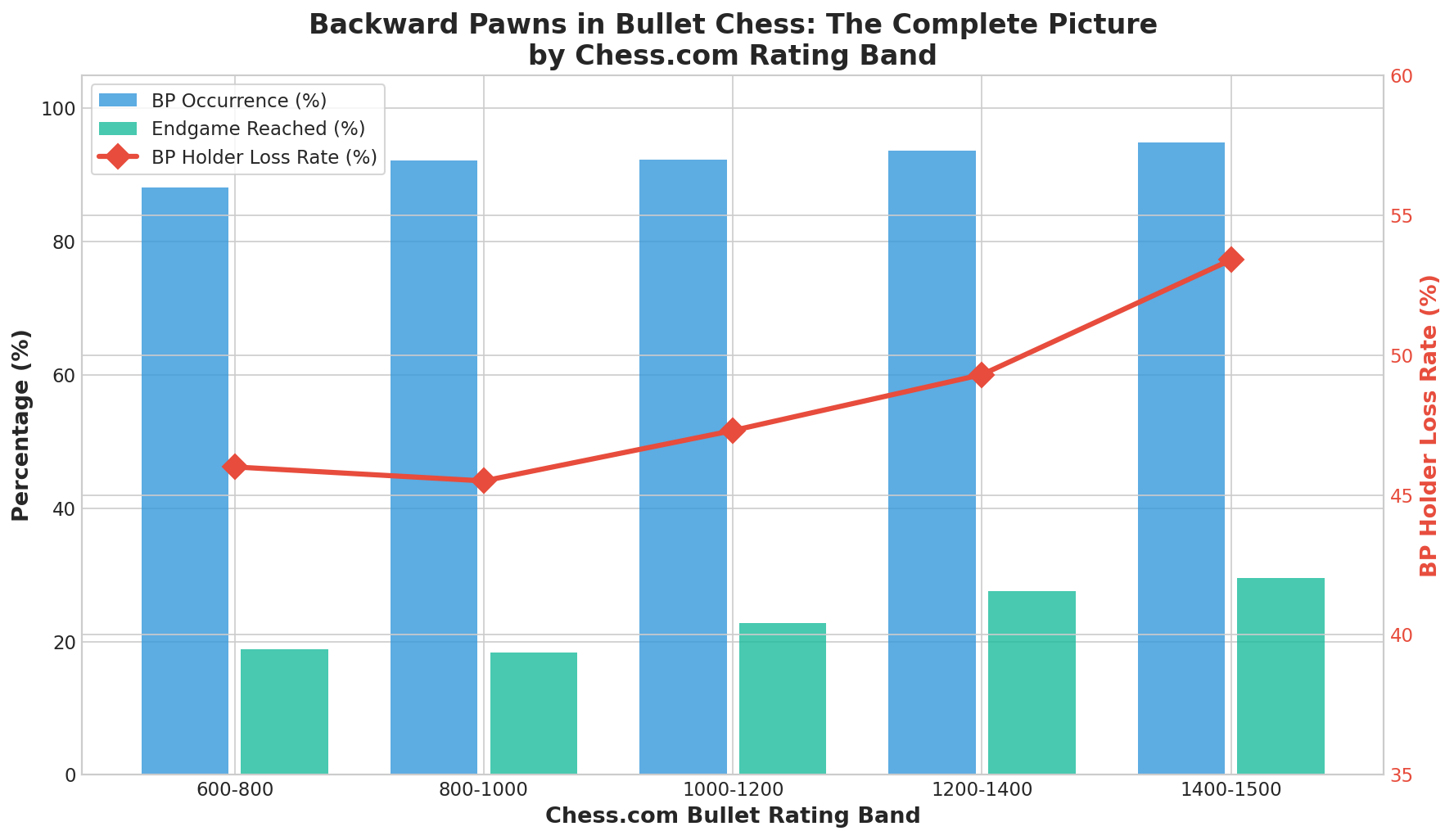
The data is clear: while Bullet chess is fast and chaotic, fundamental chess principles still apply. Backward pawns are incredibly common, and as you progress through the intermediate ranks, they increasingly become the anchor that drags down your endgame prospects. By recognizing this structural weakness and adjusting your play accordingly, you can turn a hidden liability into a consistent advantage.
Data and Methodology
This analysis was conducted using a dataset of 5,534 Lichess Bullet games, specifically filtered for players with average ratings corresponding to the Chess.com 600-1500 range.
- Data Source: Games were collected via the Lichess public API and the Grandmaster Guide MCP server analytics endpoints.
- Rating Calibration: Lichess Bullet ratings were mapped to approximate Chess.com Bullet ratings to ensure relevance for the target audience.
- Detection: Backward pawns were identified programmatically using the
python-chesslibrary, defining them as pawns lacking adjacent friendly support and facing enemy control on their advance square. - Endgame Definition: Endgames were defined as positions where the total non-pawn material value for both sides combined was 13 points or less.
Raw Data Files:
View full data →avg_rating_lichess band_chesscom has_backward_pawn max_bp_count bp_first_move reached_endgame endgame_start_move bp_in_endgame winner status bp_holder_color total_moves 1720.5 1200-1400 True 3 7 False False white outoftime white 85 1704.0 1200-1400 True 6 5 False False white outoftime black 59 1766.0 1200-1400 True 3 5 False False black outoftime white 70 1677.5 1200-1400 True 4 5 False False black outoftime white 56 1704.0 1200-1400 True 2 5 False False black outoftime white 48
View full data →band_chesscom total_games games_with_bp bp_pct games_reaching_endgame endgame_pct bp_games_reaching_endgame bp_endgame_pct bp_holder_lost_endgame bp_holder_lost_pct bp_holder_won_endgame bp_holder_won_pct bp_holder_drew_endgame bp_holder_drew_pct no_bp_endgame_lost no_bp_endgame_won no_bp_endgame_drew no_bp_loss_rate avg_bp_first_move time_forfeit_with_bp time_forfeit_without_bp 1000-1200 1635 1509 92.3 373 22.8 368 24.4 174 47.3 164 44.6 30 8.2 2 3 0 40.0 6.4 900 20 1200-1400 1807 1694 93.7 499 27.6 495 29.2 244 49.3 222 44.8 29 5.9 3 0 1 75.0 6.5 1006 18 1400-1500 455 432 94.9 134 29.5 133 30.8 71 53.4 51 38.3 11 8.3 0 1 0 0.0 6.8 245 6 600-800 729 642 88.1 138 18.9 137 21.3 63 46.0 64 46.7 10 7.3 1 0 0 100.0 6.8 432 27 800-1000 908 837 92.2 166 18.3 165 19.7 75 45.5 76 46.1 14 8.5 0 1 0 0.0 6.4 505 16
Chess Coach <2026-04-14>