By Chess Coach April 20, 2026
The back-rank checkmate is one of the first tactical patterns a chess player learns. The concept is simple: a king trapped behind its own pawns on the first or eighth rank is mated by a rook or queen. Yet, despite its simplicity, players continue to fall victim to it well into the intermediate ranks.
To understand exactly when players learn to create "luft" (breathing room for the king), we analyzed a sample of 18,000 Blitz games from Lichess, mapped to Chess.com rating bands between 800 and 1500. The data reveals a clear progression in board awareness, but also highlights a persistent blind spot that costs players hundreds of rating points.
The Data: Back-Rank Mates by Rating
We categorized the games into four 200-point Chess.com rating bands (800-999, 1000-1199, 1200-1399, and 1400-1599). For this analysis, a back-rank mate is strictly defined as a checkmate delivered by a major piece on the king's home rank, where the king is blocked from escaping to the adjacent rank by its own pawns.
The frequency of back-rank checkmates shows a steady, linear decline as players improve:
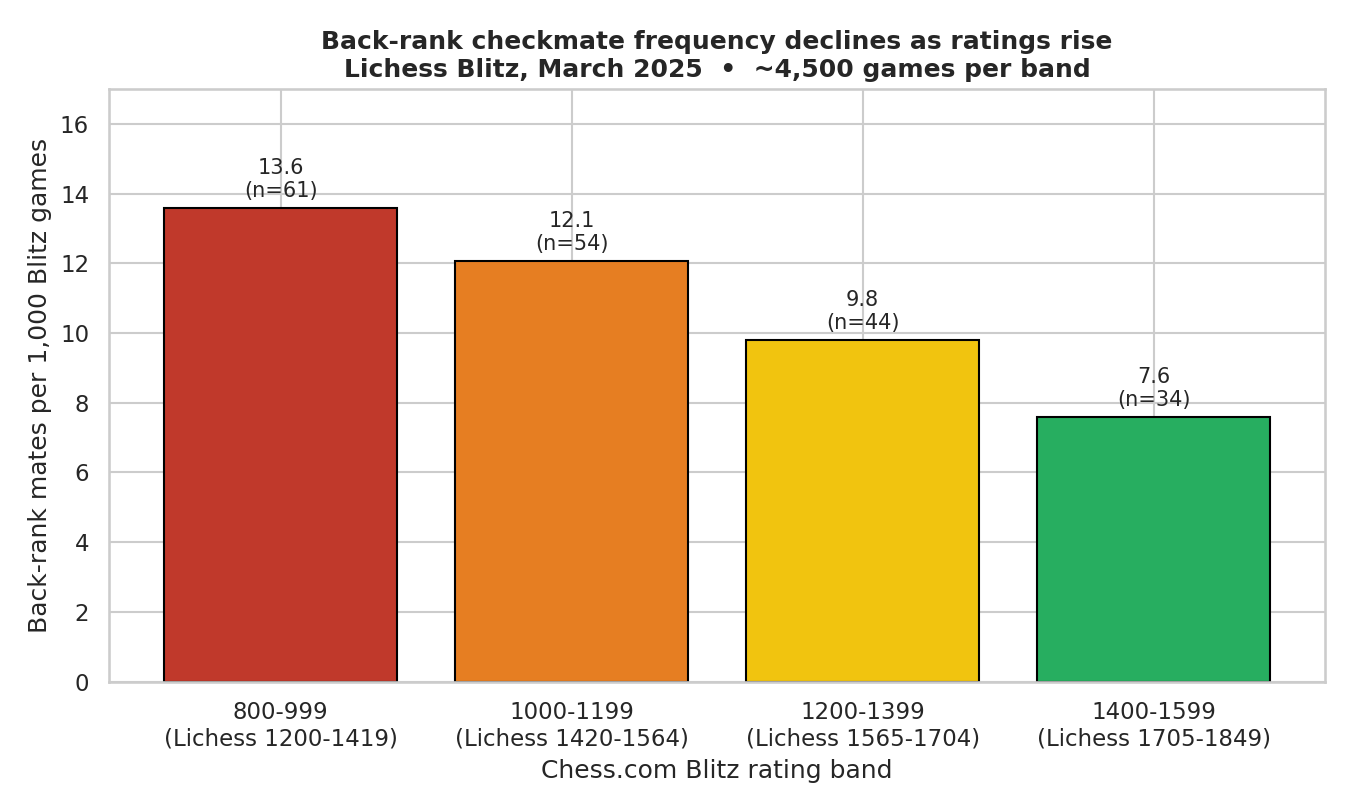
At the 800-999 level, back-rank mates occur in roughly 13.6 out of every 1,000 games. By the time players reach the 1400-1599 bracket, this frequency drops by nearly half, to 7.6 per 1,000 games.
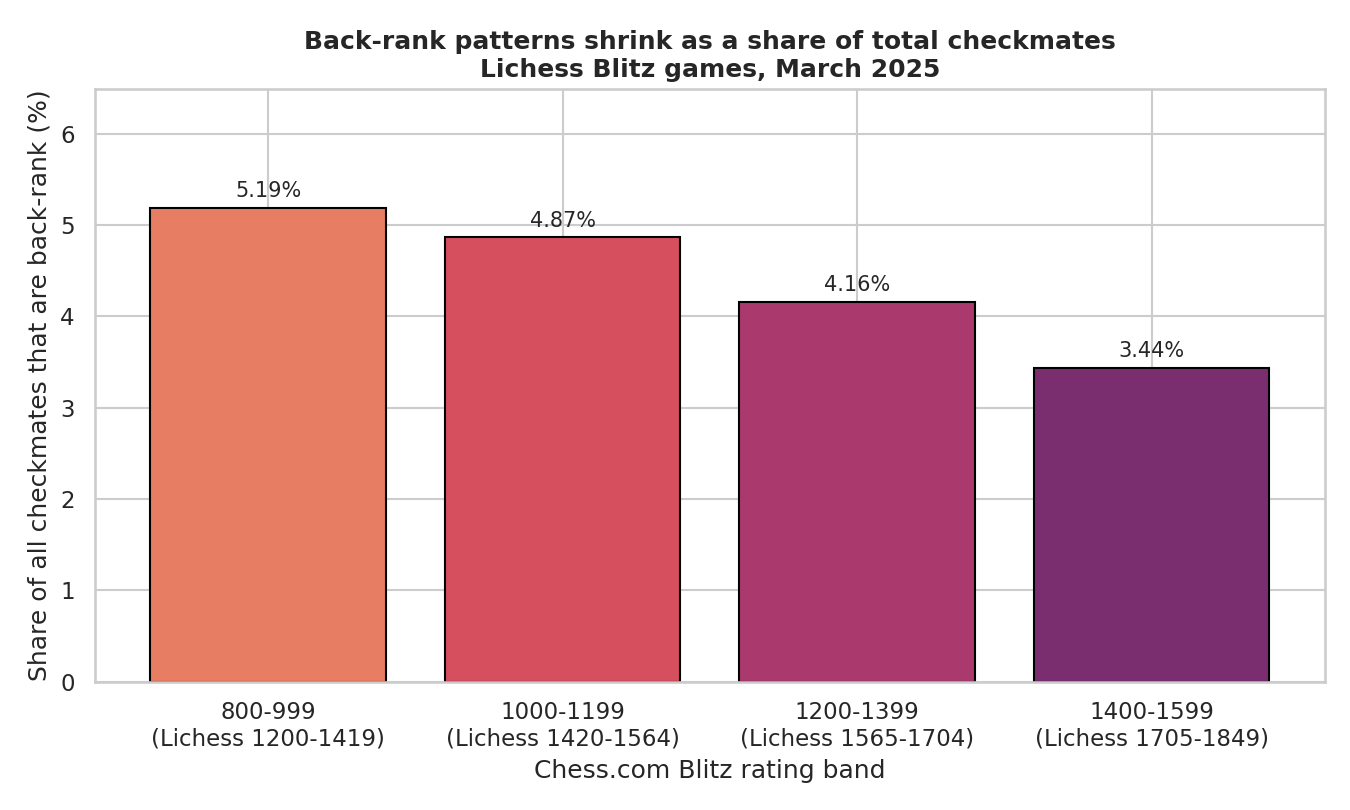
This decline is not just because higher-rated players blunder less overall. Even as a percentage of all checkmates, the back-rank pattern shrinks from 5.19% at the lowest band to 3.44% at the highest.
The Illusion of Safety: Castling Isn't Enough
A common misconception among improving players is that castling guarantees king safety. The data strongly refutes this.
Across all rating bands, the overwhelming majority of players who suffered a back-rank mate had already castled. In the 1200-1399 and 1400-1599 bands, a staggering 100% of back-rank victims had castled earlier in the game.
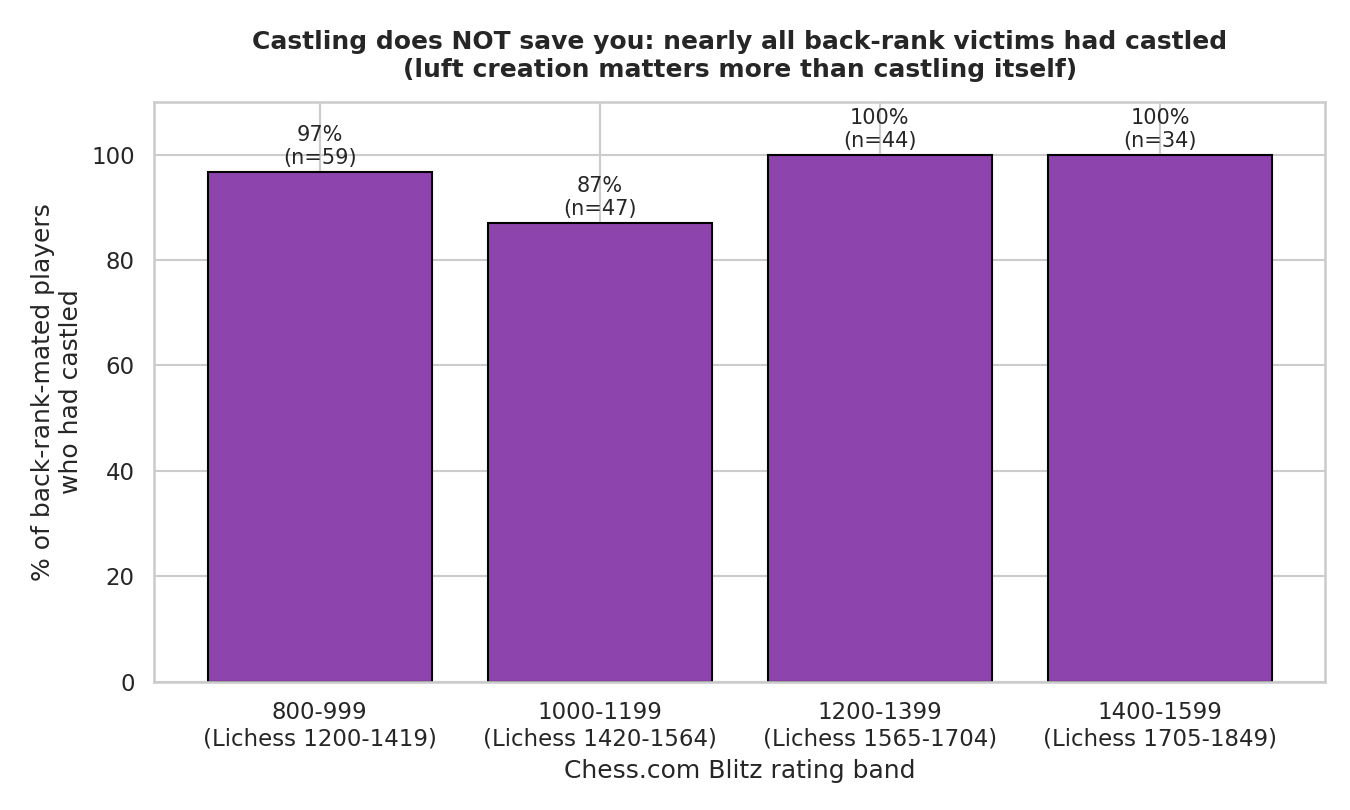
Castling tucks the king away, but it also places it behind a wall of three pawns. Without a subsequent pawn move to create luft (such as h3 or h6), the castled king remains a sitting duck for sudden back-rank tactics in the middlegame and endgame.
The Tragedy of the Unplayed Pawn Move
How preventable are these losses? We analyzed the position exactly one move before the mating sequence began. We asked the engine: Was there a single pawn move available that would have created luft and prevented the mate?
The answer is a resounding yes.
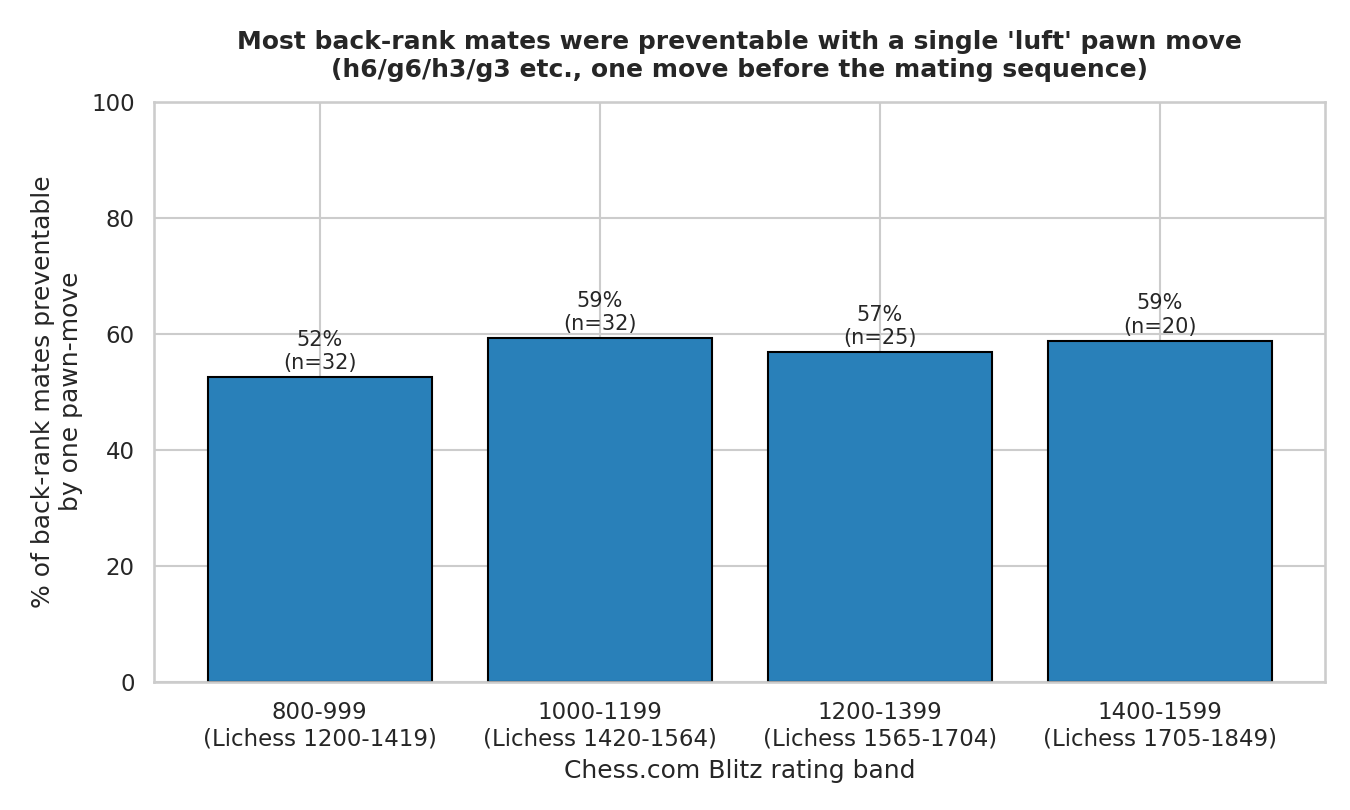
In over 50% of the back-rank mates across all rating bands, the losing player had the opportunity to play a simple pawn move (like h3, h6, g3, or g6) on their previous turn to save the game. Instead, they prioritized another action—often an attack or a piece development—and left their back door wide open.
Visual Evidence from Real Games
Let's look at how this plays out on the board. In each of these examples from our dataset, the player on the losing side missed a critical opportunity to create luft.
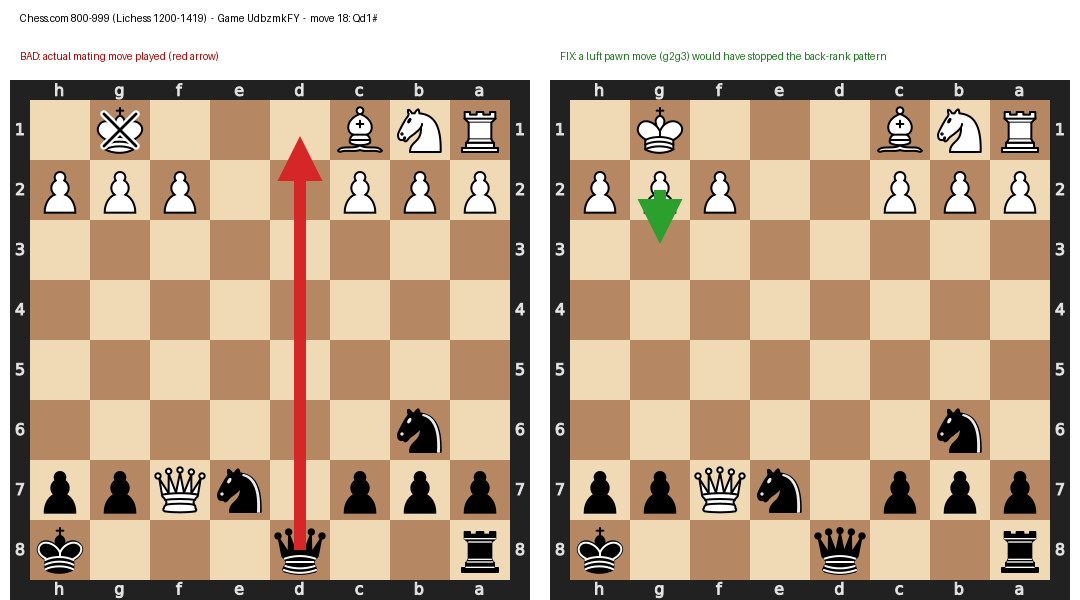
Example 1: Chess.com 800-999 Band
In this game, White is completely winning but neglects the back rank. Instead of playing g3 to give the king an escape square, White allows Black's queen to deliver mate on d1.
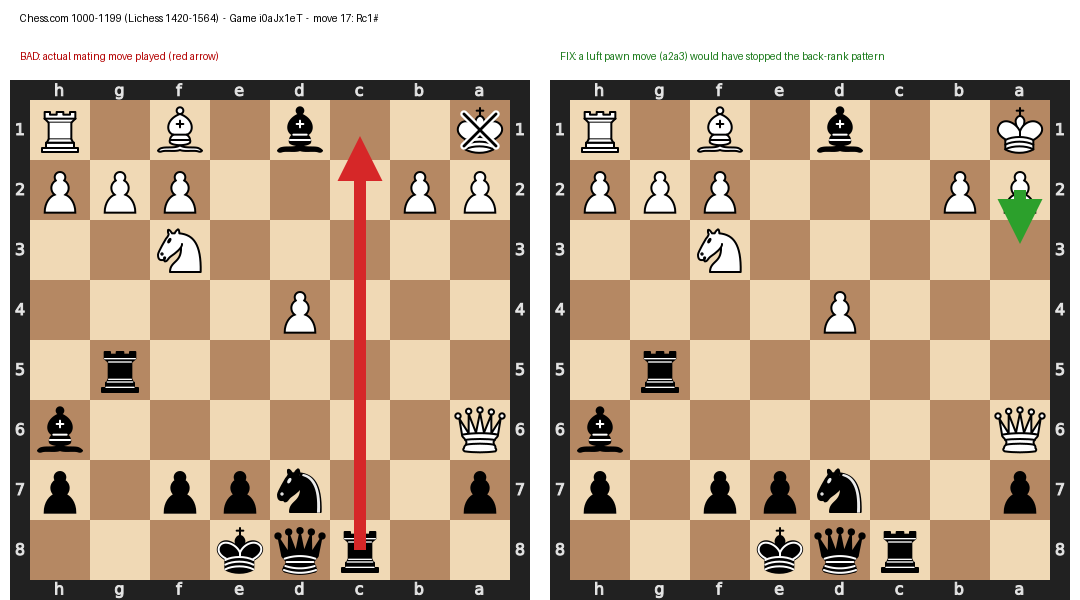
Example 2: Chess.com 1000-1199 Band
Here, White's rook is aggressively placed, but the king is trapped. A simple a3 would have secured the position.
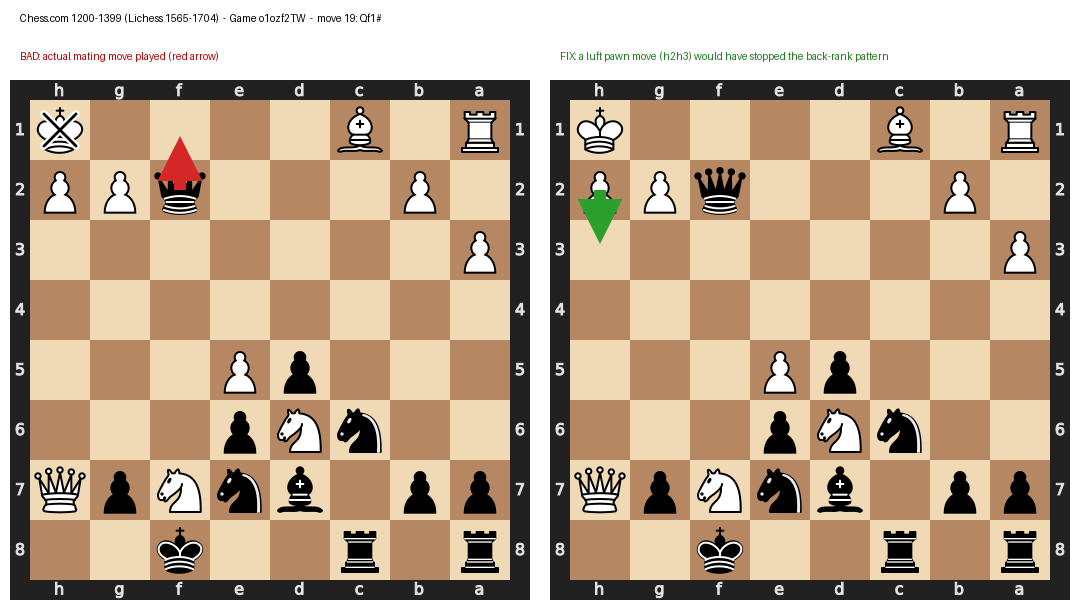
Example 3: Chess.com 1200-1399 Band
Even at the 1200+ level, players get tunnel vision. White pushes forward, ignoring the threat on the first rank. Playing h3 would have neutralized the danger.
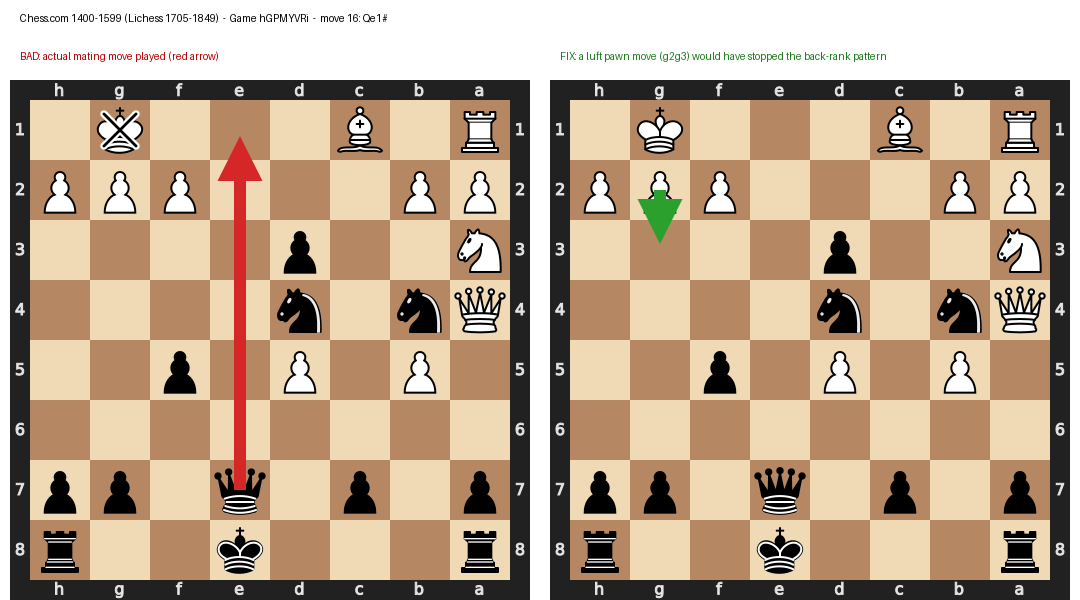
Example 4: Chess.com 1400-1599 Band
At the highest band in our study, the tactical sequences leading to the mate are often more complex, but the root cause remains the same: a castled king with no breathing room.
Actionable Advice for Climbing the Ranks
Based on the data, here is a roadmap for eliminating back-rank mates from your games and securing those extra rating points.
For the 800-1199 Player: The "Luft Habit"
At this level, back-rank mates are frequent and often happen abruptly in relatively simple positions.
- Action: Make creating luft a mandatory checklist item. Once you have castled and completed your minor piece development, look for a quiet moment to push your h-pawn (h3 for White, h6 for Black). Do not wait for your opponent to threaten the back rank; do it proactively.
For the 1200-1399 Player: Tactical Awareness
You are likely already creating luft in many games, which is why your back-rank mate frequency is dropping. However, you are still getting caught in tactical sequences where the back rank is exploited.
- Action: Start recognizing back-rank weaknesses as tactical motifs. Before moving a piece that defends your back rank (like a rook on the first rank), ask yourself: "If I move this, is my king safe?" Use the back-rank threat to tie down your opponent's pieces.
For the 1400-1599 Player: Dynamic King Safety
At this stage, back-rank mates are rare (under 1% of games), but they still happen when you overextend in complex middlegames or endgames.
- Action: Understand when luft is strictly necessary and when it is a waste of a tempo. If the center is closed and major pieces are off the board, you might not need luft. But in heavy-piece endgames (Queens and Rooks), king safety is paramount. If you are about to launch a major attack, ensure your own king is secure first.
Data and Methodology
This research is based on a random sample of 17,937 Blitz games played on Lichess in March 2025.
Platform Calibration: Because the raw data originates from Lichess, we mapped the Lichess Blitz ratings to approximate Chess.com Blitz ratings using the following conversion [1]:
- Chess.com 800-999 ≈ Lichess 1200-1419
- Chess.com 1000-1199 ≈ Lichess 1420-1564
- Chess.com 1200-1399 ≈ Lichess 1565-1704
- Chess.com 1400-1599 ≈ Lichess 1705-1849
Analysis:
Games were parsed using Python and the python-chess library. A back-rank mate was identified programmatically by checking if the mating piece was a major piece on the king's home rank, and verifying that the king had no legal escape squares on the adjacent rank due to its own pawns.
Data Files: The underlying aggregated data used to generate the charts in this article is available here:
- - Summary statistics by rating band.
View full data →chesscom_band lichess_band total_games checkmate_finishes back_rank_mates back_rank_pct_all_games back_rank_pct_of_mates brm_loser_castled brm_loser_castled_pct brm_loser_no_luft brm_loser_no_luft_pct brm_preventable_by_one_pawn_move brm_preventable_pct avg_mate_move_number 800-999 Lichess 1200-1419 4489 1176 61 1.36 5.19 59 96.7 61 100.0 32 52.5 27.1 1000-1199 Lichess 1420-1564 4481 1108 54 1.21 4.87 47 87.0 54 100.0 32 59.3 26.7 1200-1399 Lichess 1565-1704 4487 1057 44 0.98 4.16 44 100.0 44 100.0 25 56.8 29.0 1400-1599 Lichess 1705-1849 4480 988 34 0.76 3.44 34 100.0 34 100.0 20 58.8 28.6 - - Raw analysis results for all 17,937 games.
View full data →gameId band lichess_band result checkmate back_rank_mate mated_color loser_castled loser_had_luft preventable_by_luft mate_move_number san_mating fen_after_mate fen_before_mate Xf8iBkFH 800-999 1200-1419 1-0 False False Z04L8A4X 800-999 1200-1419 0-1 True False white False True False 20 f4# r5k1/p1p3p1/bp5p/3pP2P/3P1p1q/4KP2/PPPN2Q1/7R w - - 0 21 r5k1/p1p3p1/bp5p/3pPp1P/3P3q/4KP2/PPPN2Q1/7R b - - 0 20 Q0BjZFDE 800-999 1200-1419 0-1 False False CHw19yMM 800-999 1200-1419 1-0 False False Q9D9GIwr 800-999 1200-1419 1-0 False False
References
[1] Project Rating Mapping Table: Chess.com to Lichess Equivalents.