The London System (1.d4 followed by 2.Bf4 or 3.Bf4) has become one of the most popular openings at the club level. Its solid, system-based approach allows White to bypass deep theoretical preparation while maintaining a sturdy center. For intermediate players—specifically those rated between 1200 and 1600 on Chess.com—facing the London can feel like hitting a brick wall.
This data-driven guide explores the most common "Anti-London" systems employed by Black, analyzing their real-world performance across different rating bands. By examining over 800 Rapid games, we can identify which setups offer the best practical chances for Black and provide actionable advice for climbing the rating ladder.
Overall Performance: The Best Anti-London Systems
When we pool the data across all intermediate rating bands (Chess.com 1200–1600 Rapid), a clear hierarchy emerges among Black's response systems. The chart below illustrates the overall scoring rate (Win % + 0.5 × Draw %) for the most frequently played setups.

The data reveals that classical, principled approaches tend to outperform aggressive, immediate breaks. The Classical Queen's Pawn (d5 e6) setup and the King's Indian Setup (Nf6 g6 d6) lead the pack, both scoring above 50% for Black. Conversely, the highly popular Bf5 Mirror and the aggressive c5 Break score below equality, suggesting that White players at this level are well-prepared for these common responses.
Rating Band Breakdown: What Works Where?
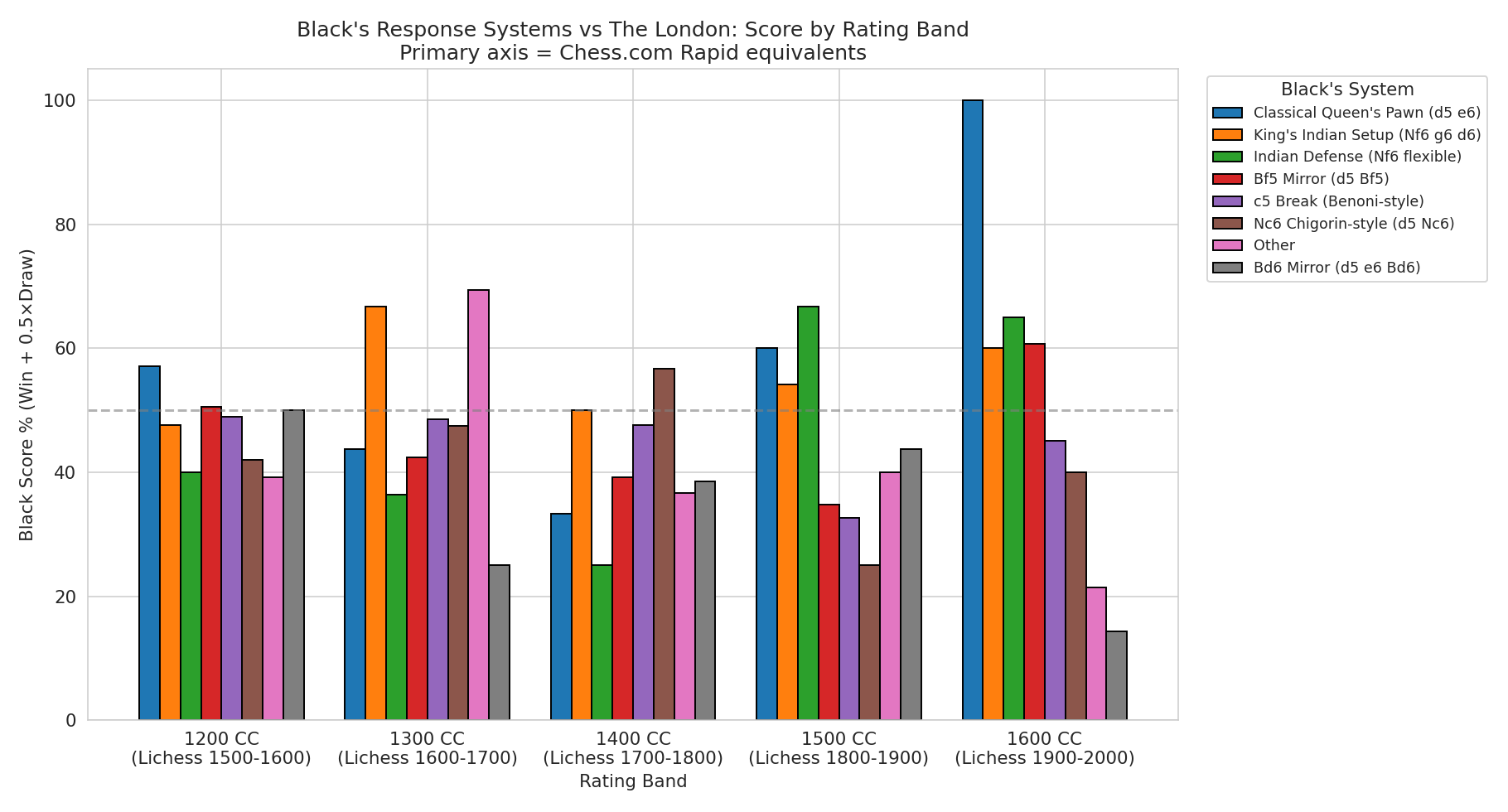
A system's effectiveness often changes as players improve. What works at 1200 might be easily refuted at 1600. The following heatmap breaks down Black's scoring rate by specific Chess.com Rapid rating bands.

The 1200–1300 Range: Tactical Foundations
At the 1200 Chess.com level (approximately 1500–1600 Lichess Rapid), most principled systems perform adequately. The Bf5 Mirror and Bd6 Mirror both hover around 50%. However, as players approach 1300, the King's Indian Setup becomes highly effective (66.7% score), while the Bd6 Mirror plummets in effectiveness.
The 1400 Range: The Chigorin Sweet Spot
At 1400 Chess.com, the Nc6 Chigorin-style setup (...d5 and ...Nc6) peaks at a 56.7% score. This setup often takes London players out of their comfort zone, forcing them to deal with immediate pressure on d4 rather than executing their standard autopilot development.
The 1500–1600 Range: Structural Integrity
As players reach the 1500–1600 Chess.com brackets, structural integrity becomes paramount. The Classical Queen's Pawn (d5 e6) and flexible Indian Defenses dominate. Notably, the c5 Break, which relies on early tactical complications, drops significantly in effectiveness (32.6% at 1500), indicating that stronger White players know how to neutralize the early tension.
Key Positions and Engine Insights
To understand why these statistics occur, we must look at the board. Below are key positions from the most common Anti-London systems, annotated with typical club-level mistakes (red arrows) and engine-recommended improvements (green arrows).
1. The Bf5 Mirror
The Bf5 Mirror is the most popular response in our dataset, but it scores a mediocre 45.9% overall. Black attempts to copy White's setup, fighting for the e4 square.
 In this typical position, Black often plays passively with ...e6 (red arrow). The engine strongly prefers developing the bishop to f5 immediately (green arrow) to challenge White's control.
2. The c5 Break (Benoni-style)
Striking at the center with an early ...c5 is a common recommendation, but it requires precise follow-up.
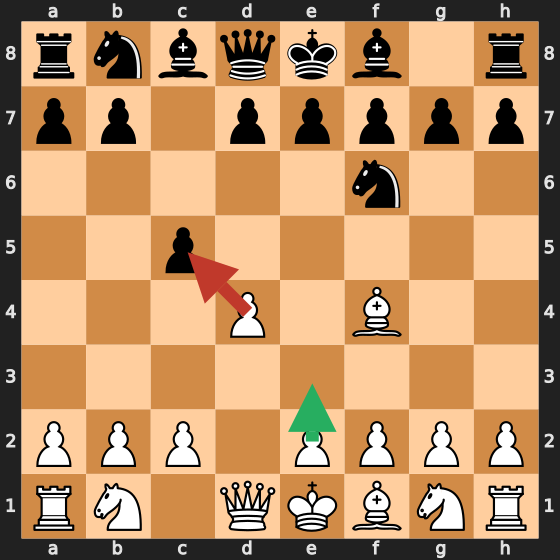 When Black plays an early ...c5, lower-rated White players sometimes panic and capture with dxc5?! (red arrow), yielding the center. The correct, solid London approach is to support the center with e3 (green arrow).
3. The Bd6 Mirror
Challenging the f4 bishop directly with ...Bd6 seems logical, but the resulting trades often favor White.
 If Black offers the trade on d6, White should avoid the immediate Bxd6 (red arrow), which helps Black develop. Instead, retreating to g3 (green arrow) maintains the tension and keeps the bishop pair on the board.
4. The King's Indian Setup
The King's Indian Setup (...g6, ...Bg7, ...d6) is highly robust, scoring 52.8% overall and performing well across almost all bands.
 Against the KID setup, White often plays a routine Bd3 (red arrow), which bites on granite against the fianchettoed bishop. A more nuanced approach is h3 (green arrow), preparing Be2 and restricting Black's light-squared bishop.
5. The Classical Queen's Pawn (d5 e6)
The highest-scoring system overall (58.0%), this setup prioritizes solid development over early confrontation.
 Against a solid ...e6 setup, White should continue standard development with Nf3 (green arrow). Prematurely pushing c4 (red arrow) transposes out of typical London structures, often into positions where Black is more comfortable.
Actionable Advice for Climbing the Ranks
Based on the data, here is a roadmap for intermediate players looking to improve their results against the London System:
- At 1200–1300 Chess.com: Focus on the King's Indian Setup. It scores exceptionally well here (66.7% at 1300) because London players often struggle to generate an attack against the solid fianchetto structure without overextending.
- At 1400 Chess.com: Consider the Chigorin-style (...Nc6) approach. It disrupts White's autopilot development and scores a strong 56.7% in this band.
- At 1500–1600 Chess.com: Transition to the Classical Queen's Pawn (d5 e6) or flexible Indian Defenses. At this level, White players are well-prepared for early tricks (like the c5 break). Solid, structurally sound setups yield the best results, with the Classical setup scoring an impressive 60–100% in the upper intermediate brackets.
- Systems to Reconsider: The Bd6 Mirror performs poorly as you climb the ranks (dropping to 14.3% at 1600). Voluntarily trading your dark-squared bishop often leaves Black with a passive position and a "bad" light-squared bishop trapped behind pawns.
Data and Methodology
This analysis is based on a dataset of 823 unique Lichess Rapid games where White employed the London System (defined as 1.d4 followed by an early Bf4, without an early c4 or Nc3). The games were collected across five Lichess Rapid rating bands (1500–2000) and mapped to approximate Chess.com Rapid ratings (1200–1600) for clarity.
The data was categorized by Black's first 4–6 moves to identify distinct structural responses. Engine evaluations for the annotated board positions were generated using the Theoria engine at depth 16.
Underlying Data Files:
- Raw Classified Games Data (CSV)
- Classified Games with Move Sequences (CSV)
- Overall Systems Ranking (CSV)
- Per-Band Systems Breakdown (CSV)
- Band Summary Statistics (CSV)
Chess Coach April 20, 2026