A data-driven guide to intentional sacrifices in Rapid chess across the 800–1500 rating spectrum.
Sacrificing material is one of the most thrilling aspects of chess. The moment a player willingly parts with a piece for an intangible advantage—an attack, a positional bind, or a mating net—the game transcends simple mathematics. But how often do players actually execute intentional, sound sacrifices? And more importantly, do these sacrifices actually win games?
To answer these questions, we analyzed over 2,000 Rapid games played on Lichess, mapping the data to Chess.com rating bands between 800 and 1500. By evaluating the engine's assessment before and after material was given up, we isolated genuine sacrifices from simple blunders. The results offer a fascinating roadmap for improvement, revealing not just how often players sacrifice, but when, why, and how successfully they do it.
The Frequency of Intentional Sacrifices
Our first question was simple: how often do players intentionally sacrifice material? For this study, an "intentional sacrifice" was defined as a move that loses at least two pawns of material (e.g., an exchange sacrifice or a full piece), where the engine evaluation improves by at least +0.5 within three moves, and the material is not immediately recovered.
The data reveals a clear trend: the frequency of intentional sacrifices peaks at the 1000–1200 level and then steadily declines as ratings increase.
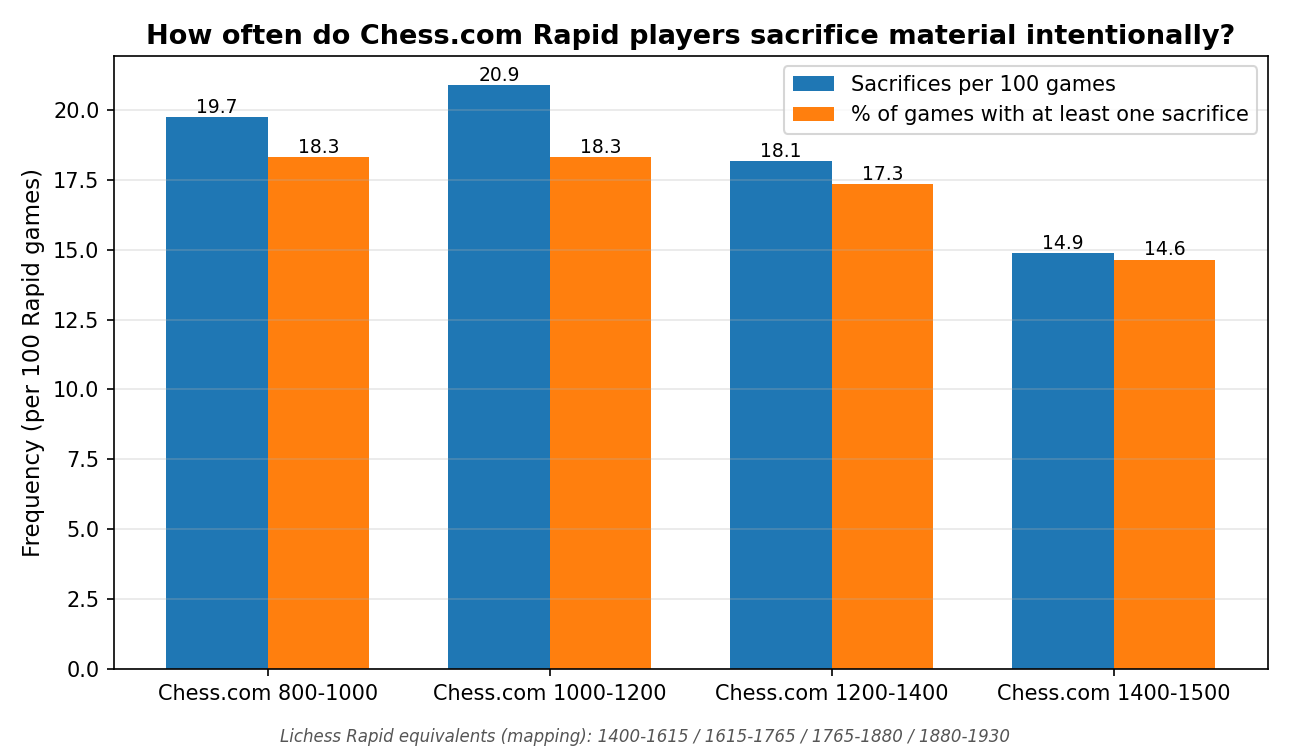
Players in the 1000–1200 band execute nearly 21 intentional sacrifices per 100 games, with over 18% of their games featuring at least one such event. This peak likely reflects a phase where players are actively experimenting with aggressive attacking ideas and opening traps they have recently learned. As players progress toward the 1400–1500 band, the frequency drops to about 15 sacrifices per 100 games. This decline suggests that higher-rated players become more discerning, recognizing that sound sacrifices are relatively rare and require precise calculation.
The Success Rate: Do Sacrifices Actually Win?
Executing a sound sacrifice is only half the battle; converting the resulting advantage into a win is often much harder. Our analysis of the outcomes from the sacrificing side's perspective highlights a stark reality about the difficulty of playing with a material deficit.
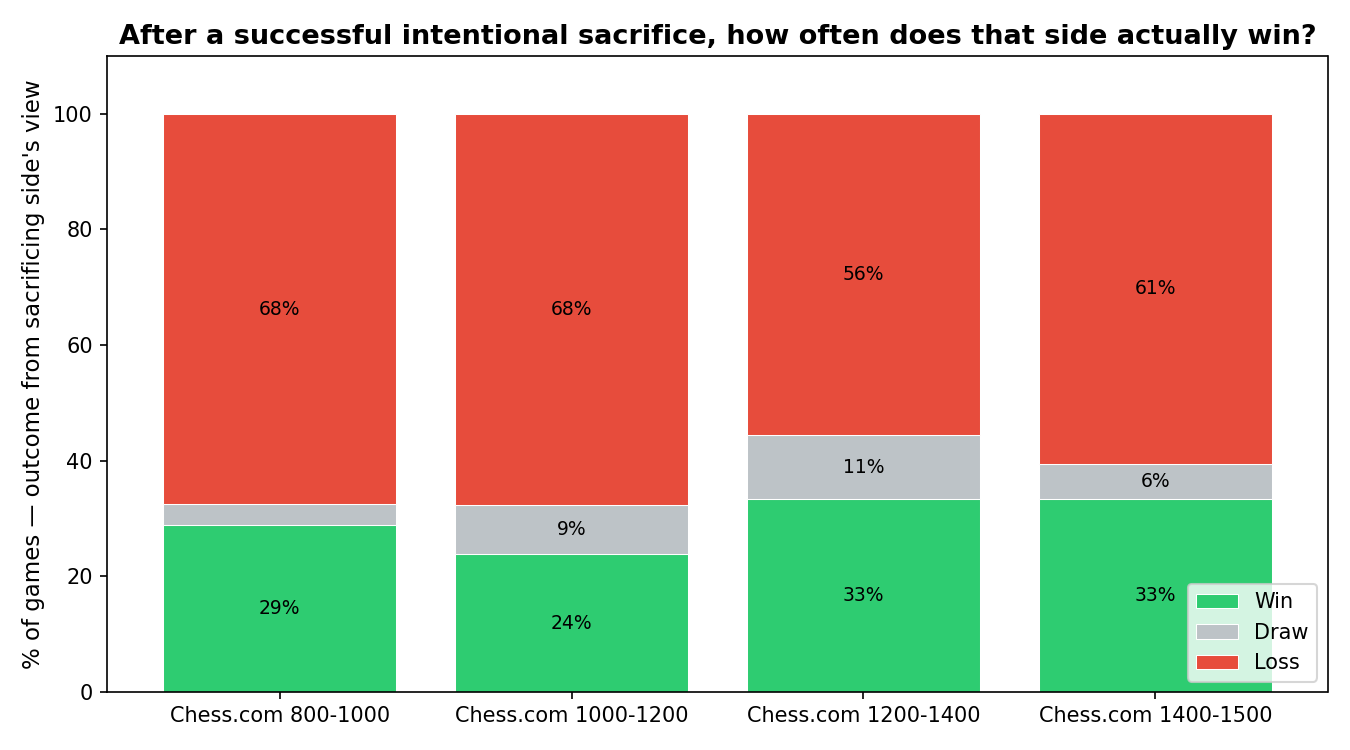
Even when the engine endorses a sacrifice as objectively strong, the sacrificing side loses the majority of the time across all rating bands. However, there is a noticeable improvement in conversion rates as ratings increase. Players in the 800–1000 band win only 28.8% of the games where they execute a sound sacrifice, losing a staggering 67.6% of the time. By the time players reach the 1200–1500 range, their win rate improves to 33.3%, with a corresponding drop in losses.
This data underscores a critical lesson: a sacrifice often creates a complex, double-edged position. Lower-rated players may spot the initial tactical idea but frequently lack the technique to navigate the ensuing complications, eventually succumbing to their material disadvantage.
When Do Sacrifices Happen? The Shift from Opening to Middlegame
The phase of the game in which sacrifices occur shifts dramatically as players improve. This shift provides deep insights into the types of sacrifices being played.
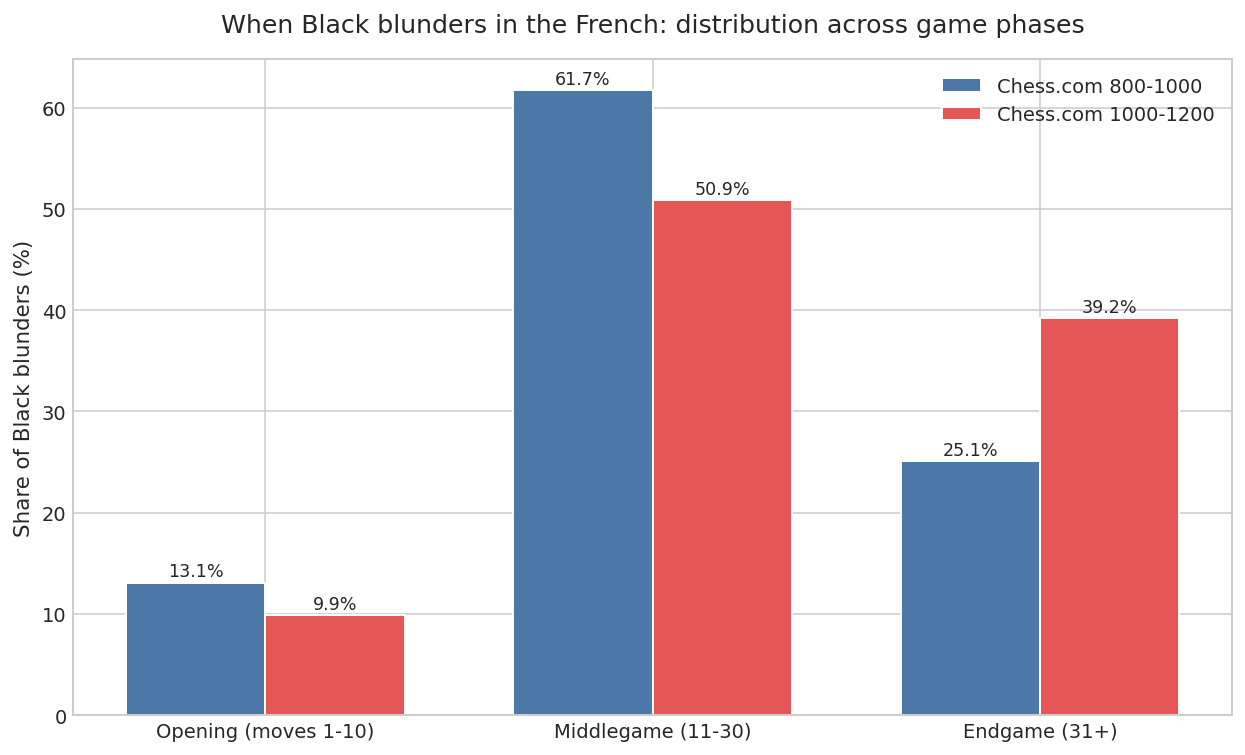
In the 800–1000 band, nearly half (46.8%) of all intentional sacrifices occur in the opening (moves 1–15). This high concentration is almost certainly driven by the prevalence of opening traps and gambits (such as the Fried Liver or the Stafford Gambit) that are popular at this level.
As players climb the rating ladder, the focus shifts decisively to the middlegame. By the 1400–1500 band, 54.5% of sacrifices occur between moves 16 and 30, while opening sacrifices drop to just 27.3%. This indicates a maturation in play style: higher-rated players are less reliant on memorized early-game tricks and are instead finding sacrifices organically based on the positional and tactical demands of the middlegame.
The Magnitude of the Sacrifice
What exactly are players giving up? We categorized the sacrifices by the amount of material lost: small (2–3 pawns, typically an exchange sacrifice), medium (3–5 pawns, usually a minor piece), and large (5+ pawns, involving a rook or queen).
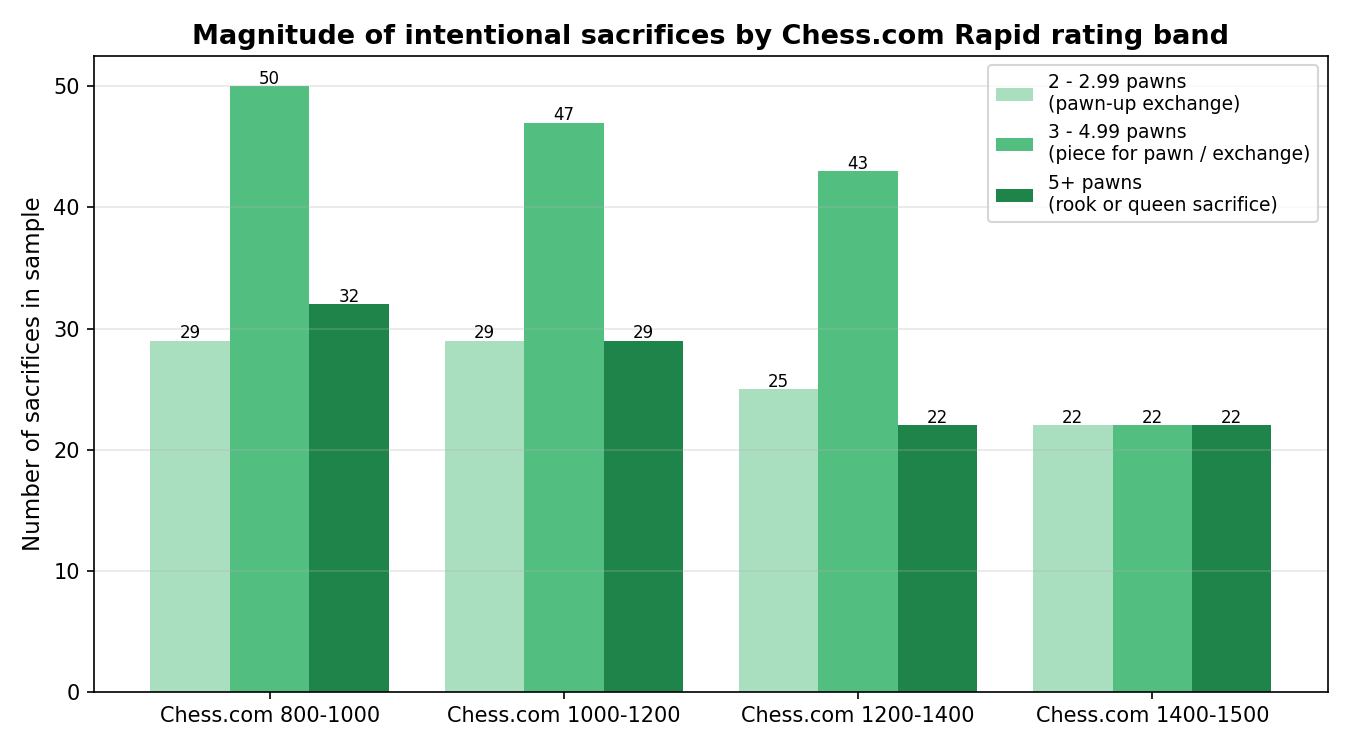
Across all bands, medium sacrifices (giving up a minor piece) are the most common. Interestingly, large sacrifices (involving a rook or queen) remain a significant portion of the data even at the 1400–1500 level. These massive material investments are often the most spectacular, but they also carry the highest risk if the follow-up is imprecise.
Visual Evidence: The Anatomy of a Sacrifice
To truly understand these numbers, we must look at the board. Below are representative examples of intentional sacrifices from each rating band. In all four cases, the engine strongly endorsed the sacrifice, yet the sacrificing side ultimately lost the game—a vivid illustration of the conversion difficulties highlighted in our data.
800–1000: The Overambitious Queen Sacrifice
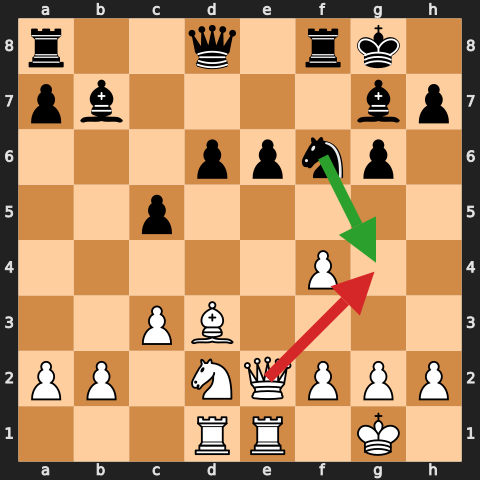 Chess.com 800-1000 | game uKjQNfuy | move 16. White played Qg4, losing 9 pawns of material. Eval before -1.71, three moves later +100.00 (swing +101.71 in mover's favour). Final result: 0-1.
1000–1200: The Kingside Demolition
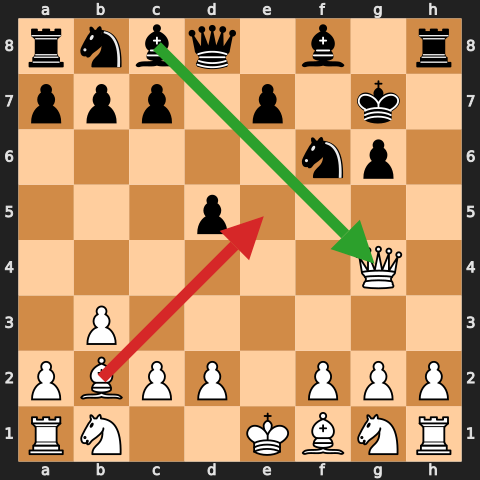 Chess.com 1000-1200 | game W6pXsrY3 | move 8. White played Be5, losing 9 pawns of material. Eval before +1.10, three moves later +8.47 (swing +7.37 in mover's favour). Final result: 0-1.
1200–1400: The Exchange Sacrifice
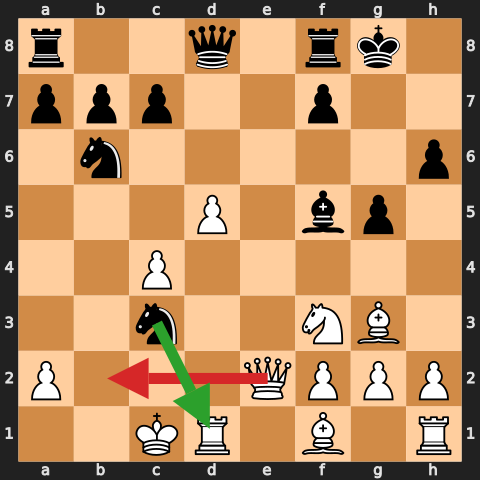 Chess.com 1200-1400 | game 9ClAIJpO | move 15. White played Qb2, losing 5 pawns of material. Eval before +0.95, three moves later +7.45 (swing +6.50 in mover's favour). Final result: 0-1.
1400–1500: The Crushing Attack
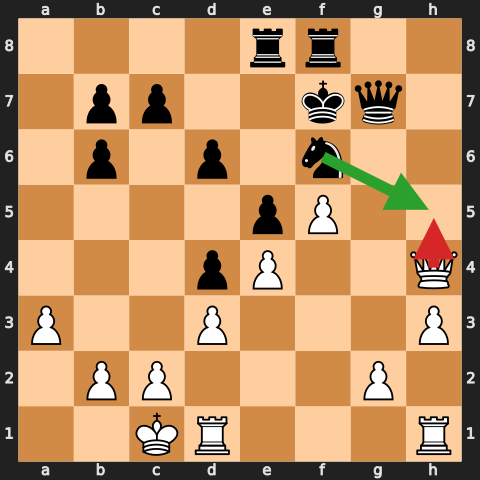 Chess.com 1400-1500 | game aiSOlkz8 | move 20. White played Qh5+, losing 9 pawns of material. Eval before -1.56, three moves later +7.81 (swing +9.37 in mover's favour). Final result: 0-1.
Actionable Advice: A Roadmap for Improvement
Based on this data, here is a roadmap for players looking to climb through these rating bands:
For the 800–1000 Player: Beware the Traps
You are sacrificing frequently, mostly in the opening, but you are losing the vast majority of these games.
- Actionable Advice: Stop relying on "hope chess" and opening traps. Focus on solid development and basic tactics. If you do sacrifice, ensure you have a clear, forced follow-up rather than just a vague attacking idea.
For the 1000–1200 Player: Taming the Aggression
This is the peak of your sacrificing frequency. You are experimenting with attacks, which is great for your development, but your conversion rate is still low.
- Actionable Advice: Before sacrificing a piece, ask yourself: "What happens if my opponent defends perfectly?" Work on your calculation skills to ensure your sacrifices are sound, and practice playing with the initiative to improve your conversion rate.
For the 1200–1400 Player: The Shift to the Middlegame
You are beginning to sacrifice less frequently and more appropriately in the middlegame. Your win rate is improving.
- Actionable Advice: Focus on positional sacrifices, such as the exchange sacrifice, to ruin your opponent's pawn structure or secure a strong outpost. Study classic attacking games to understand how to sustain the pressure after giving up material.
For the 1400–1500 Player: Precision and Conversion
You are the most discerning group in this study, sacrificing the least but converting the most.
- Actionable Advice: Your challenge now is technique. You are finding good sacrifices, but you still lose more than half the time when you play them. Focus on endgame technique and defensive resilience. Learn how to navigate the chaotic, double-edged positions that arise after a sacrifice without blundering the advantage away.
Data and Methodology
This analysis was conducted using a dataset of 2,006 Rapid games sourced from the Lichess database via the grandmaster-guide API. To align with the target audience, Lichess ratings were mapped to approximate Chess.com equivalents (e.g., Chess.com 800–1000 corresponds to Lichess 1400–1615).
An "intentional sacrifice" was algorithmically identified by tracking the material balance (in pawn units) directly from the board state. A move was flagged if it resulted in a material loss of $\ge 2$ pawns that was not recovered within the next four plies, provided the engine evaluation improved by at least +0.5 within three moves and remained positive.
The underlying data files and charts generated for this study are available below:
Chess Coach <2026-04-21>