The "Alekhine's Gun" formation—a Queen stacked behind two Rooks on a single file—is one of the most visually intimidating setups in chess. Named after former World Champion Alexander Alekhine, who famously employed it against Aron Nimzowitsch in San Remo, 1930, the formation represents the ultimate concentration of force along an open or semi-open file.
For intermediate players looking to climb the rating ladder, mastering heavy piece coordination is a critical milestone. But how often does this legendary formation actually appear in real games? And more importantly, does achieving it guarantee a victory?
To answer these questions, we analyzed a dataset of 8,059 Rapid games played on Lichess, mapping the results to Chess.com rating bands between 800 and 1600. The findings reveal surprising truths about how players at different levels handle heavy pieces, offering a clear roadmap for improvement.
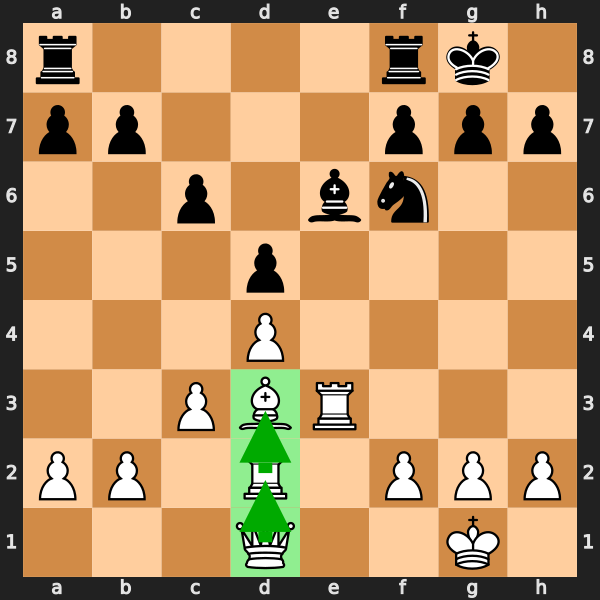
The Formation Funnel: From Batteries to the Gun
Before a player can build Alekhine's Gun, they must first master its building blocks: the Queen-Rook battery and doubled Rooks. Our analysis reveals a clear "formation funnel" that illustrates just how difficult it is to achieve the full three-piece stack.
In our dataset, 68.6% of all games featured at least one Queen-Rook battery on a file. This is a fundamental attacking concept that players grasp relatively early. Doubling Rooks on a file is less common but still frequent, occurring in 27.7% of games.
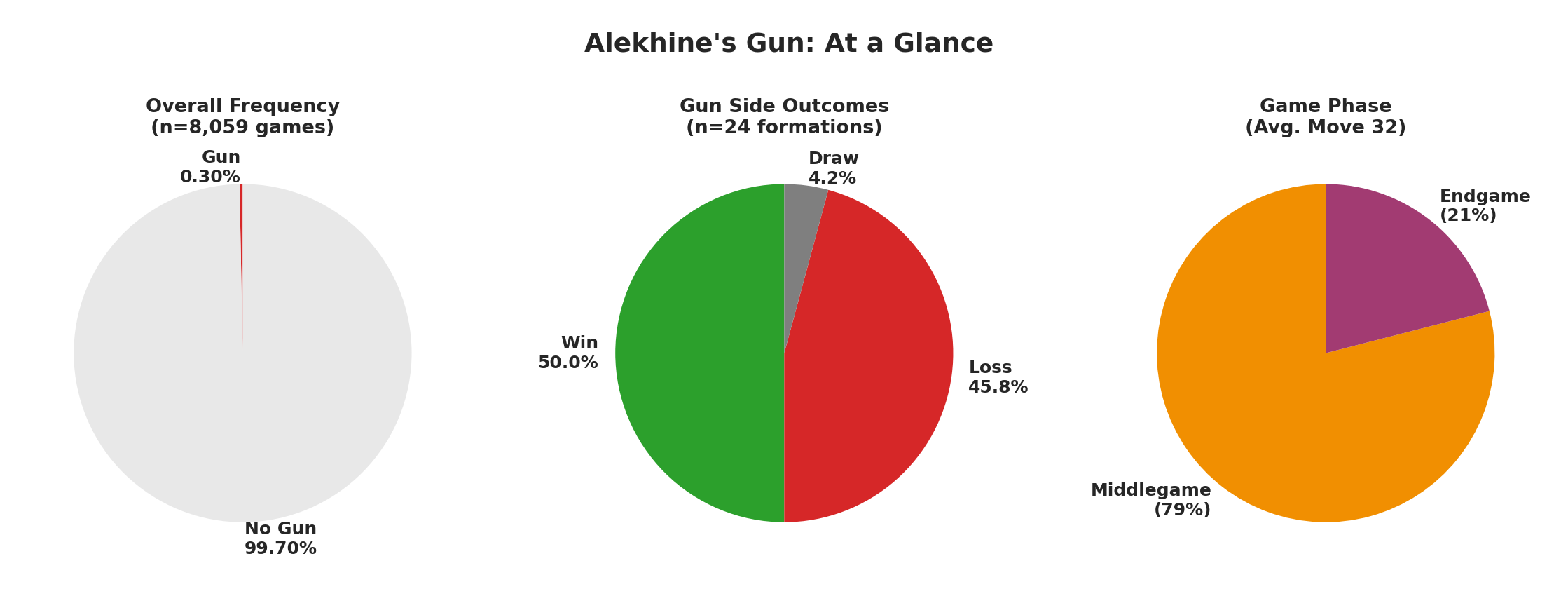
However, the full Alekhine's Gun formation is exceptionally rare. Across all 8,059 games analyzed, the formation appeared only 24 times—a frequency of just 0.30%, or roughly one in every 336 games.

This steep drop-off highlights a crucial lesson for intermediate players: while coordinating two heavy pieces is standard practice, coordinating all three requires exceptional circumstances. It demands an open file, sufficient time to maneuver the pieces into position without being attacked, and an opponent who allows the formation to be built rather than challenging the file early.
The Rating Progression: Coordination Improves with Skill
When we break down the data by Chess.com rating bands, a clear progression emerges. As players improve, their ability to coordinate heavy pieces increases significantly.
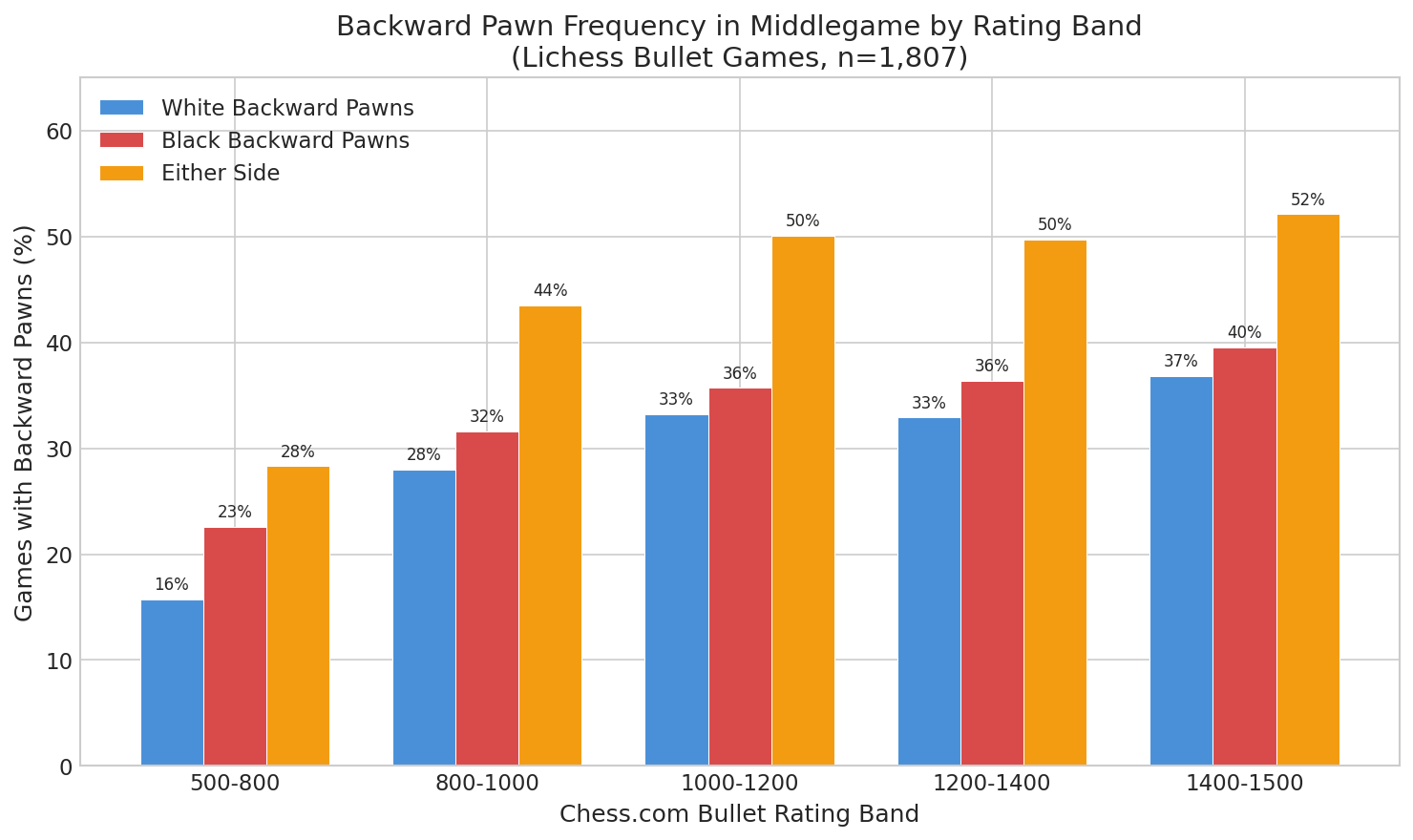
For players in the 800-1000 rating band, Alekhine's Gun appeared in 0.25% of games. This frequency dips slightly in the 1000-1200 band (0.15%) before rising sharply as players reach the intermediate ranks. In the 1200-1400 band, the frequency doubles to 0.32%, and it peaks at 0.47% for players in the 1400-1600 range.
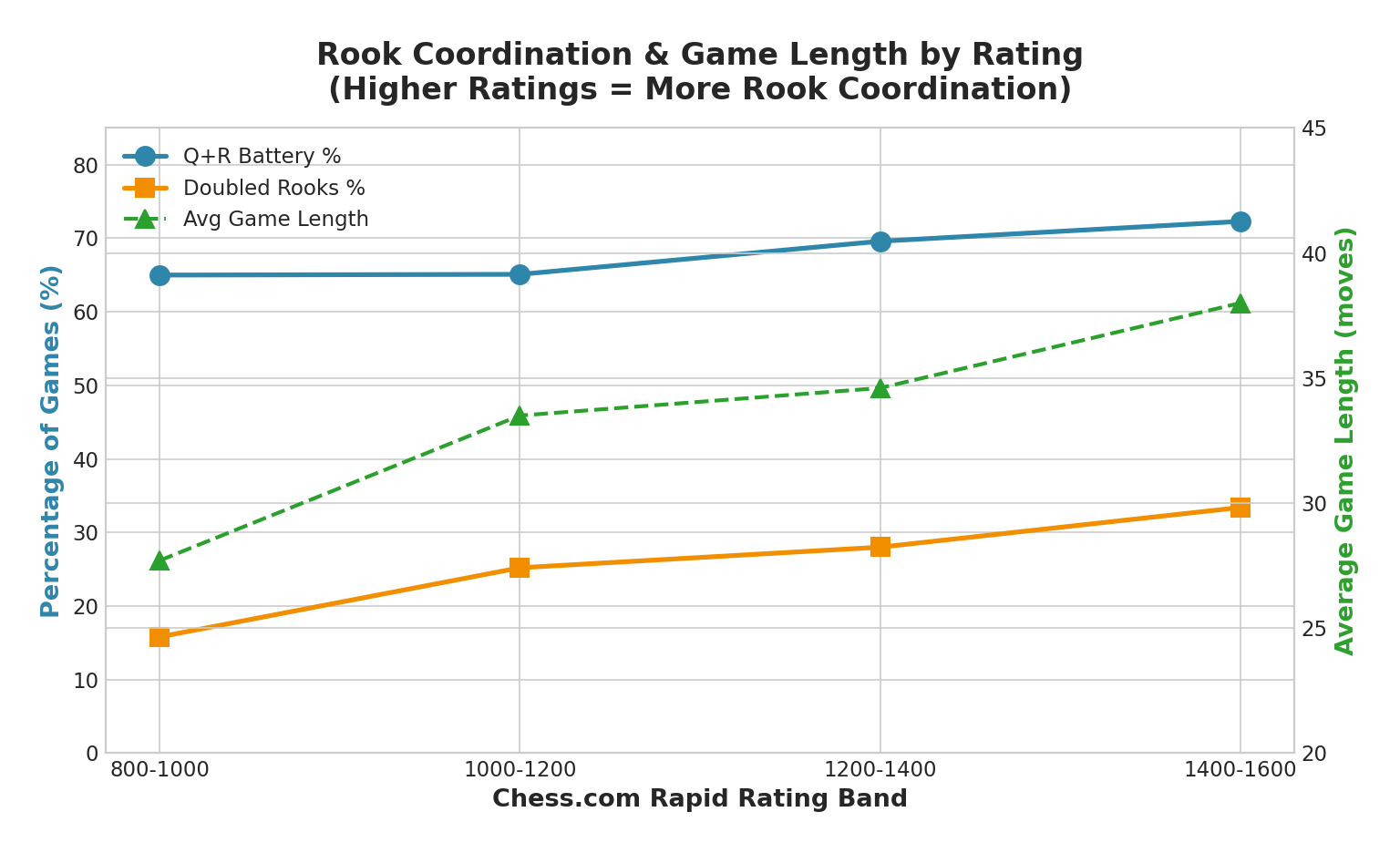
This trend is not isolated to the full gun formation. The data shows a consistent upward trajectory in basic Rook coordination as ratings increase. Players in the 800-1000 band double their Rooks in only 15.8% of games. By the time they reach the 1400-1600 band, that number more than doubles to 33.4%.
Actionable Advice by Rating Band
For the 800-1000 Player: At this level, games are often decided by one-move blunders rather than long-term strategic planning. The data shows that players in this band rarely double their Rooks (15.8%). Your primary goal should be to identify open or semi-open files and place your Rooks on them. Do not worry about building Alekhine's Gun; simply focusing on basic Queen-Rook batteries or doubled Rooks will give you a significant advantage over your peers.
For the 1000-1200 Player: Players in this band are beginning to understand file control, with doubled Rooks appearing in 25.2% of games. However, the frequency of Alekhine's Gun drops in this range. This suggests that while players are trying to coordinate their pieces, their opponents are becoming better at contesting files or creating counterplay. Your focus should be on timing. Do not waste tempos trying to stack three heavy pieces if your opponent is launching a faster attack on the other side of the board.
For the 1200-1400 Player: This is where strategic planning begins to take hold. The frequency of Alekhine's Gun jumps to 0.32%, and doubled Rooks appear in 28.0% of games. At this level, you should actively look for opportunities to dominate a file completely. If you have doubled Rooks and your opponent is defending passively, consider bringing the Queen behind them to break through their defenses.
For the 1400-1600 Player: Players in this band are the most successful at building the formation (0.47%). However, as we will see in the next section, building the gun does not guarantee a win against stronger opposition. Your focus must shift from merely building the formation to converting the advantage. Ensure that your Alekhine's Gun is aimed at a tangible target—a weak pawn or a critical entry square—rather than just occupying a file for aesthetic purposes.
The Win Rate Reality Check
Perhaps the most surprising finding from the data is the win rate associated with Alekhine's Gun. Given its fearsome reputation, one might expect the formation to be a near-guaranteed victory. The reality is far more nuanced.
Overall, the side that formed Alekhine's Gun won exactly 50.0% of the time, lost 45.8% of the time, and drew 4.2% of the time.
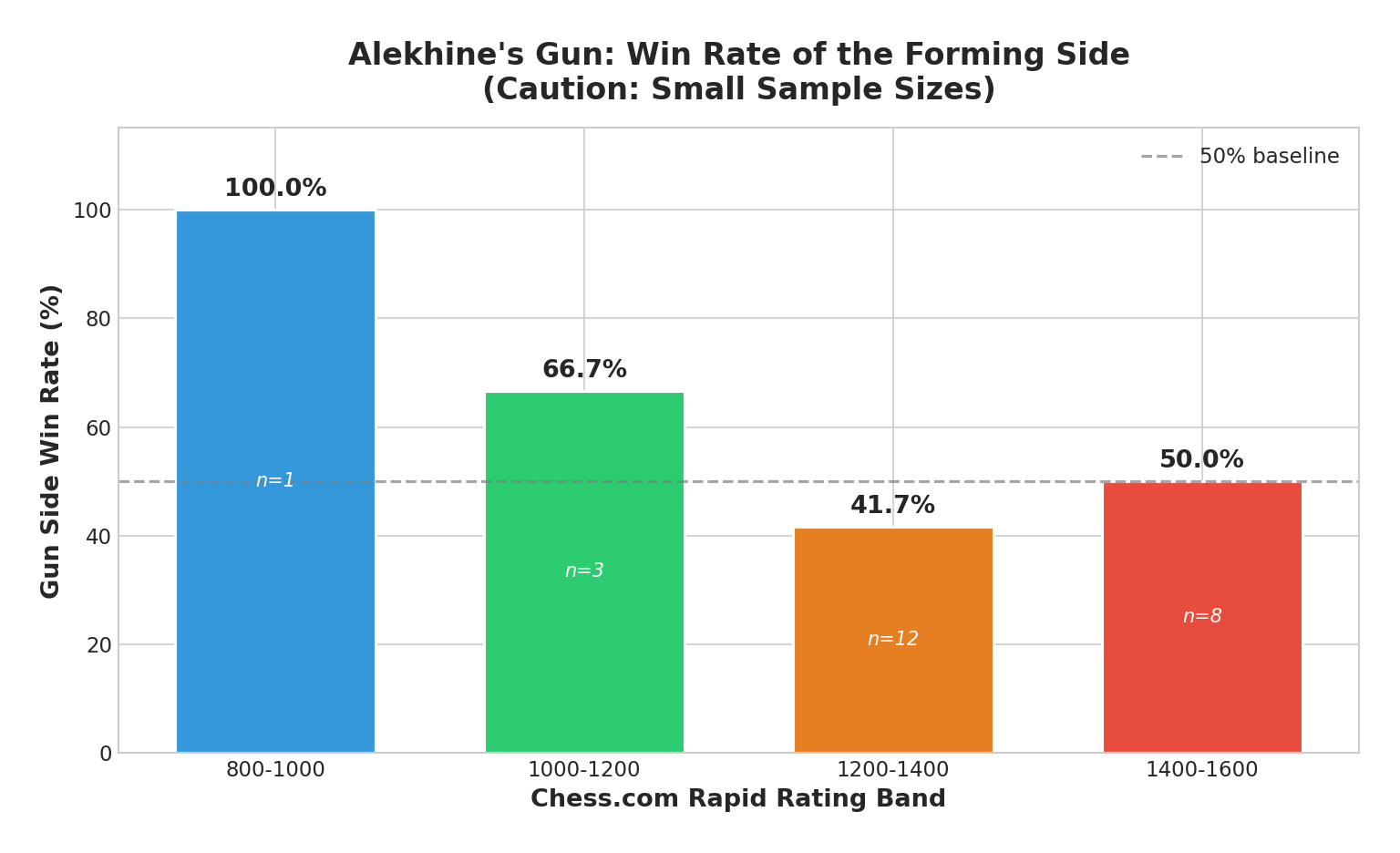
When we examine the win rate by rating band, a fascinating pattern emerges. At lower ratings (1000-1200), the gun side won 66.7% of the time. However, in the 1200-1400 band, the win rate plummeted to 41.7%, meaning the player who built the gun actually lost more often than they won. In the 1400-1600 band, the win rate stabilized at exactly 50.0%.
Why does this happen? There are three primary reasons:
- The Cost of Time: Building Alekhine's Gun requires at least three moves (often more, to clear the file of minor pieces). While one player is spending time stacking their heavy pieces, the opponent is often generating active counterplay elsewhere on the board.
- The Target Problem: A gun is only useful if it has something to shoot at. If the opponent can solidly defend the entry points on the file, the three heavy pieces become a passive traffic jam.
- Tactical Vulnerability: Stacking the Queen and both Rooks on a single file leaves the rest of the board undefended. A sudden tactical strike on the other flank or a back-rank mate threat can instantly turn the tables.
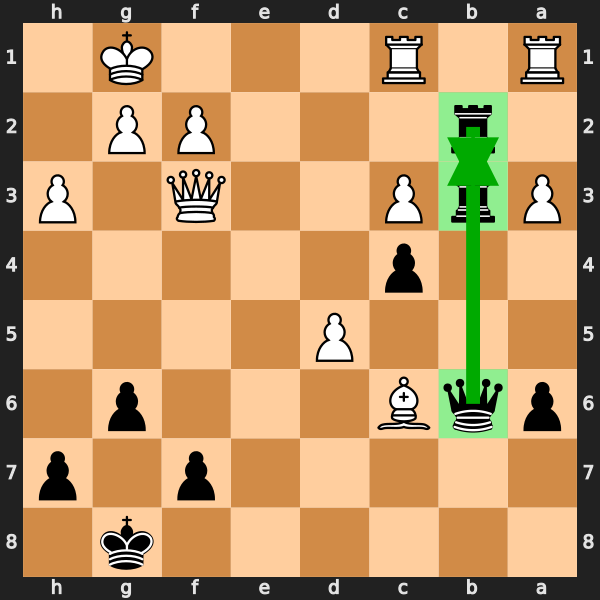 In this game (Chess.com ~1410 Rapid), Black successfully built Alekhine's Gun on the b-file. However, White won the game by generating faster threats elsewhere. The formation alone is not enough.
Timing and Placement: Where and When to Build
If you are going to invest the time to build Alekhine's Gun, you must do it correctly. The data provides clear guidance on the optimal timing and placement for the formation.
The Best Files
Alekhine's Gun is almost exclusively a central or semi-central phenomenon. In our dataset, the formation never appeared on the a-file and only once on the h-file.
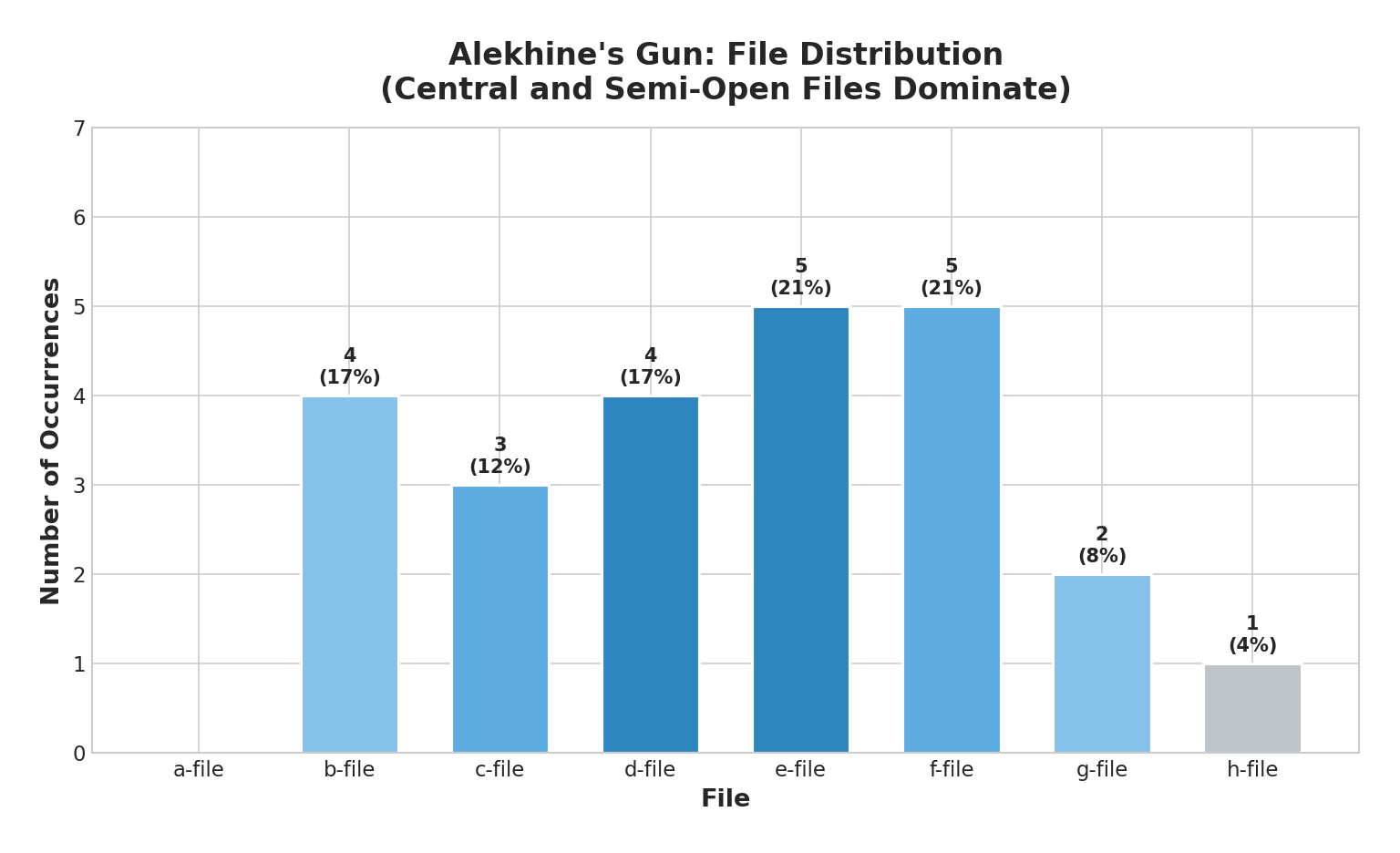
The e-file and f-file were the most common locations (20.8% each), followed closely by the d-file and b-file (16.7% each). This makes logical sense: the central files (d and e) are the most likely to open up during the middlegame, while the b and f files often become semi-open after standard pawn exchanges or fianchetto structures.
Actionable Advice: Do not try to force Alekhine's Gun on the flank files (a or h). The geometry of the board means that flank attacks usually require minor pieces and pawns rather than a slow stacking of heavy pieces. Focus your heavy piece coordination on the c, d, e, and f files.
The Right Phase of the Game
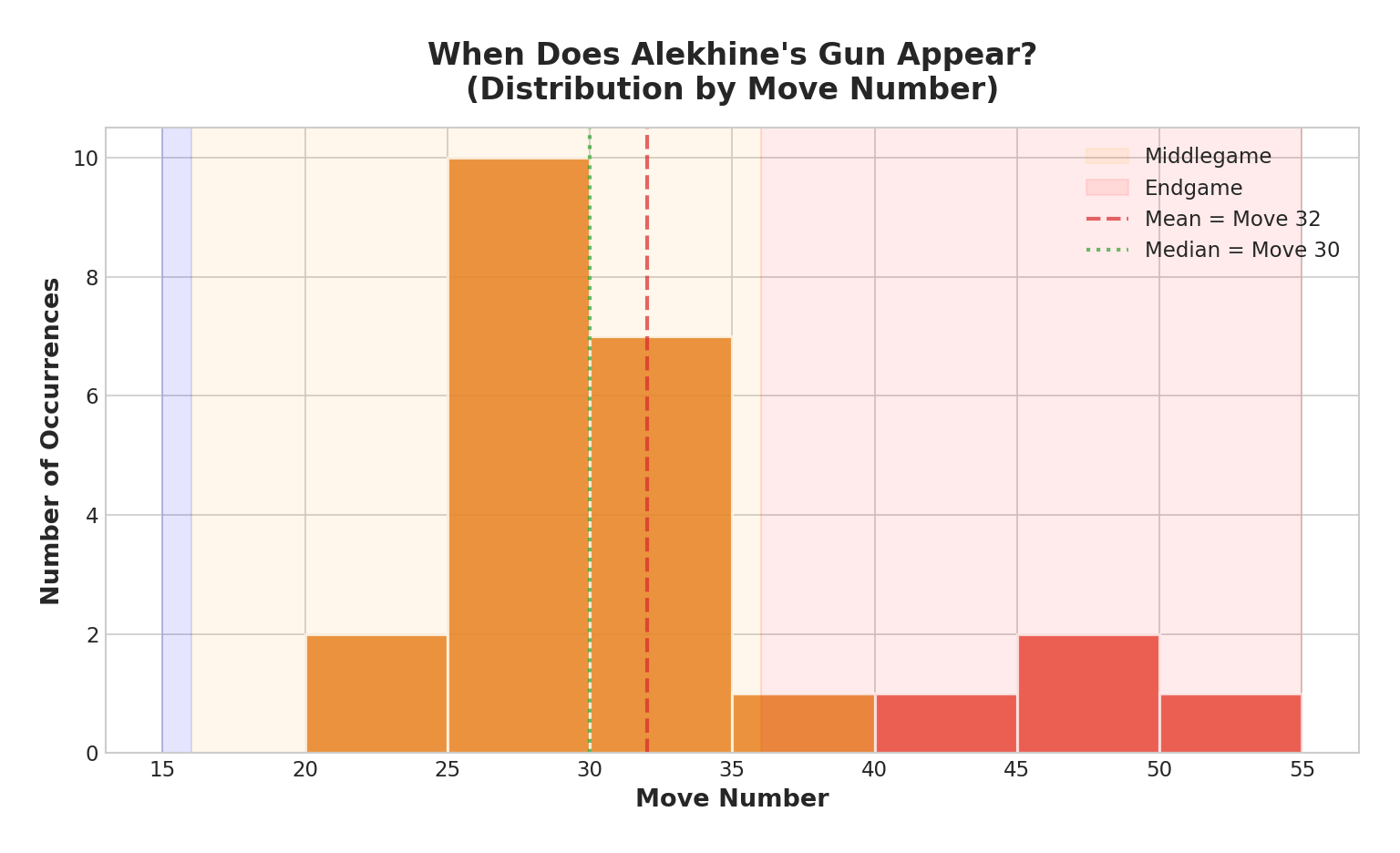
Building the gun takes time, which means it rarely happens early in the game. In our dataset, the formation never appeared before move 20.
The vast majority of Alekhine's Guns (79%) were formed during the middlegame, specifically between moves 16 and 35. The average move number for the formation to appear was move 32. The remaining 21% occurred in the endgame (move 36 and beyond).
Actionable Advice: Do not prioritize heavy piece stacking in the opening or early middlegame. Your focus should be on development, king safety, and fighting for the center. Only once the pawn structure has stabilized and the files have opened should you consider investing the tempos required to build Alekhine's Gun.
Conclusion: A Tool, Not a Magic Wand
Alekhine's Gun is a beautiful and powerful formation, but the data proves that it is not a magic wand. It occurs in only 0.30% of Rapid games, and achieving it results in a coin-flip win rate of 50.0%.
For intermediate players, the true value of studying Alekhine's Gun lies not in the formation itself, but in the building blocks required to achieve it. By focusing on creating Queen-Rook batteries and doubling your Rooks on open files, you will naturally improve your heavy piece coordination. As your rating increases, these fundamental skills will occasionally culminate in the legendary three-piece stack—but remember to always ensure your gun has a target before you pull the trigger.
Data and Methodology
This analysis was conducted using a dataset of 8,059 Rapid games downloaded via the Lichess public API in April 2026. The games were selected from recent Rapid tournaments to ensure a representative sample of active players.
Because the target audience for this article utilizes Chess.com ratings, all Lichess ratings were converted to approximate Chess.com Rapid equivalents using standard community conversion tables (e.g., Lichess 1500 ≈ Chess.com 1130).
The games were parsed using Python and the python-chess library. A custom algorithm was developed to scan every position in every game to detect the specific geometric arrangement of Alekhine's Gun (Queen behind two Rooks on the same file), as well as partial formations like doubled Rooks and Queen-Rook batteries.
The raw data and analysis results are available in the attached CSV files:
alekhines_gun_analysis.csv: The complete game-by-game analysis.band_stats.csv: Aggregated statistics by rating band.detailed_band_analysis.csv: Extended metrics including game length and win rates.formation_progression.csv: Data on the "formation funnel."gun_timing.csv: Move-by-move timing data for the 24 games where the formation appeared.
Chess Coach April 14, 2026