Every chess player wants to know how they stack up against the competition. While Chess.com has published their own accuracy charts, players who frequent Lichess or want a deeper dive into the raw data often find themselves guessing. What does a 1200-rated game actually look like under the hood? How much more accurate is a 1500-rated player?
To answer these questions, we analyzed a massive dataset of Lichess Rapid games using Stockfish 17 evaluations. We looked at average centipawn loss (ACPL), how accuracy degrades as games progress from the opening into the middlegame, and the crucial differences in accuracy between winning and losing efforts.
Note: All ratings in this article are presented in approximate Chess.com Rapid equivalents to provide a familiar baseline. Lichess Rapid ratings are typically 200-300 points higher in these brackets. For example, a Chess.com 1000 Rapid is roughly equivalent to a Lichess 1200 Rapid.
The Baseline: Average Centipawn Loss by Rating
Centipawn loss (CPL) measures how much worse a played move is compared to the engine's top choice. An average CPL (ACPL) of 0 means playing perfectly like Stockfish. An ACPL of 100 means giving away a full pawn's worth of evaluation every move.
Our analysis of Lichess Rapid games reveals a clear, linear progression in accuracy as players climb the rating ladder.
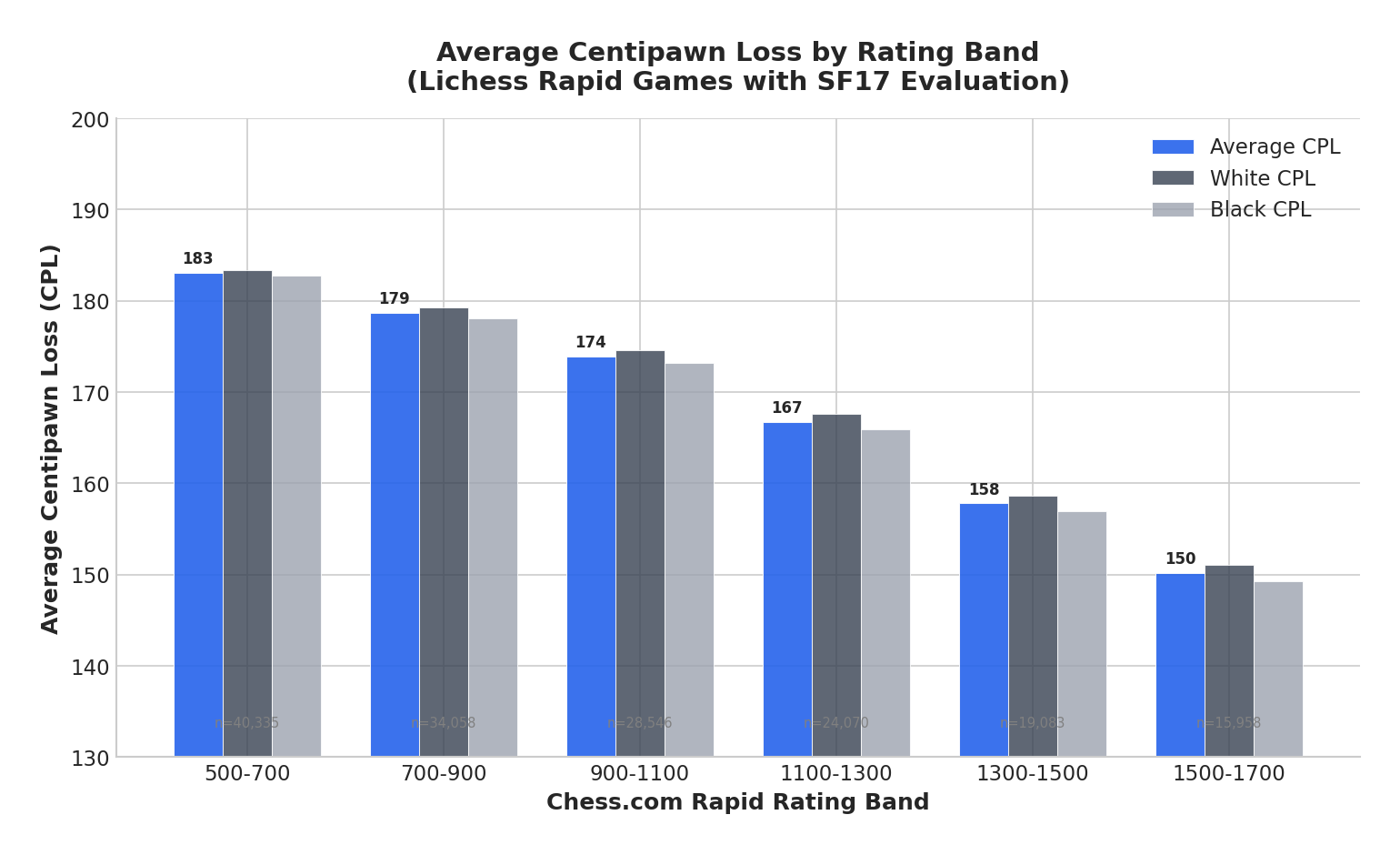
At the beginner level (Chess.com 500-700), players average an ACPL of 183. This means that, on average, nearly two pawns of evaluation are lost per move. As players improve to the intermediate level (Chess.com 900-1100), the ACPL drops to 174. By the time players reach the advanced intermediate stage (Chess.com 1500-1700), their ACPL improves significantly to 150.
Interestingly, there is virtually no difference in accuracy between playing White and Black across any rating band. The advantage of the first move does not translate into playing more accurately; it simply means White starts from a slightly better evaluation.
Actionable Advice for the 500-900 Range
At this level, games are decided by massive swings in evaluation. Your primary goal should not be finding the "best" move, but rather avoiding the worst ones. Focus entirely on board vision: checking if your pieces are defended and if your opponent has left anything hanging.
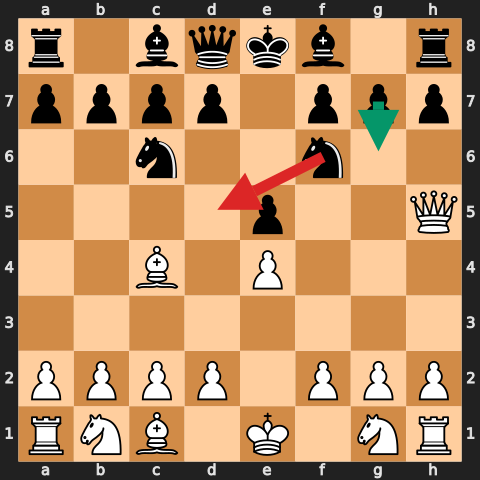 A classic beginner mistake: Black plays Nf6, ignoring the immediate threat of Qxf7#. The engine prefers g6 to block the attack.
The Phase Shift: How Accuracy Degrades
A game of chess is not a monolith. The opening is often memorized or guided by simple principles, while the middlegame introduces complex tactics and strategy. The endgame requires precise calculation. How does accuracy hold up as the game transitions between these phases?
The data shows a staggering drop in accuracy once players leave the comfort of the opening.
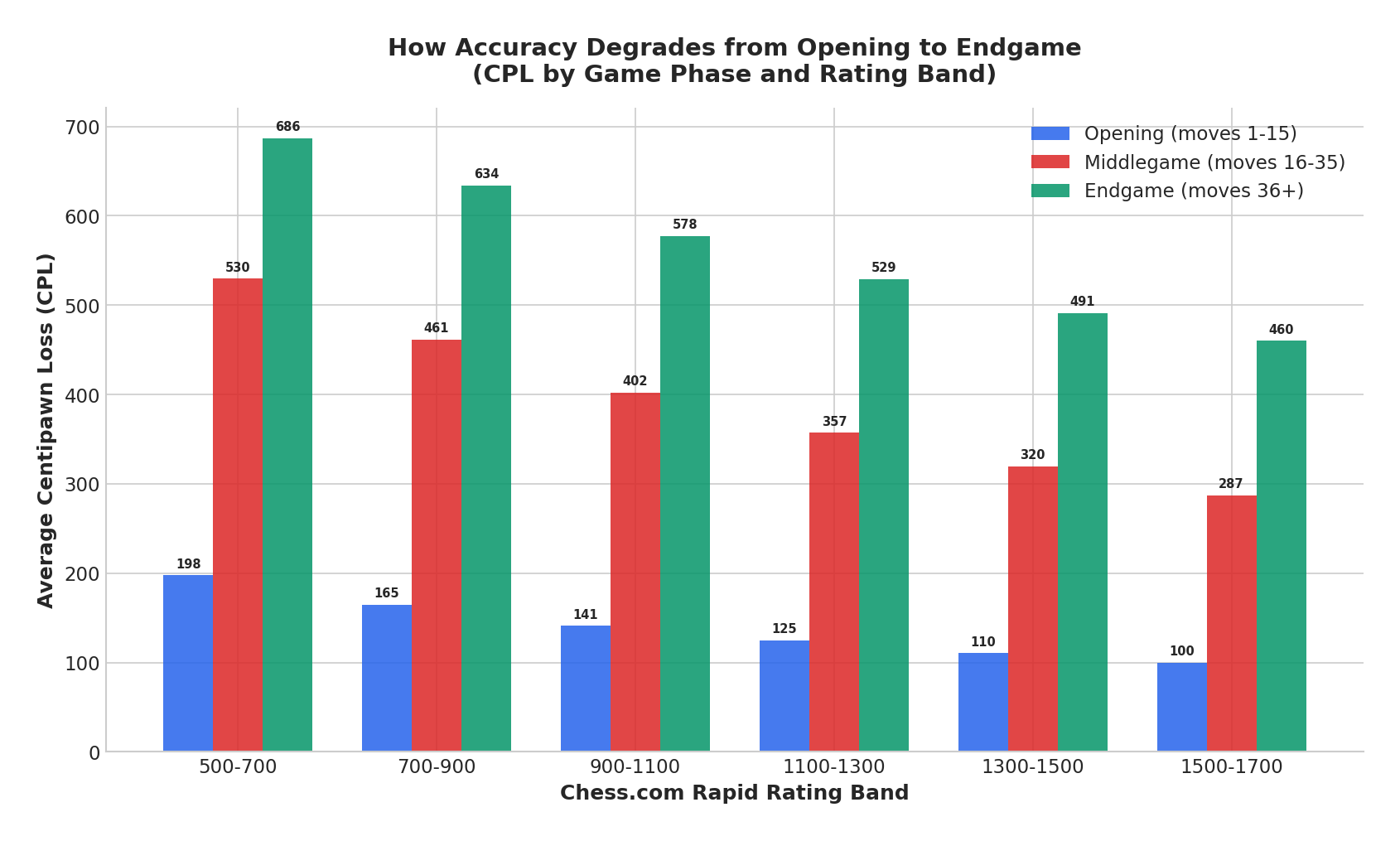
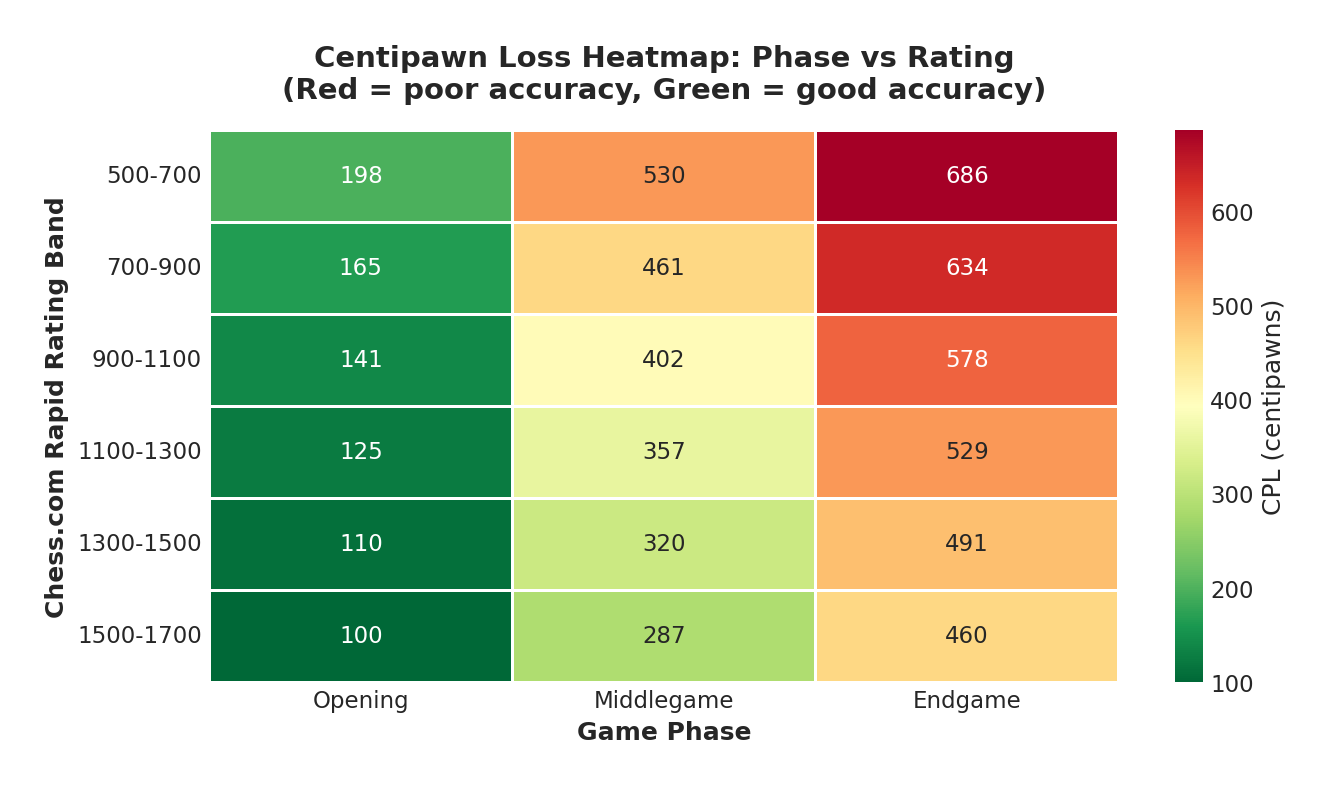
Across all rating bands, the opening (moves 1-15) is played with relative precision. A Chess.com 900-1100 player averages an ACPL of 141 in the opening. However, once the middlegame begins (moves 16-35), that same player's ACPL skyrockets to 402. In the endgame (moves 36+), it deteriorates further to 578.
This degradation is universal, but higher-rated players mitigate the damage much better. A Chess.com 1500-1700 player sees their middlegame ACPL rise to 287—still a significant jump from their opening accuracy, but vastly superior to lower-rated peers.
Actionable Advice for the 900-1300 Range
The data clearly shows that games are lost in the middlegame. Spending hours memorizing deep opening theory is an inefficient use of time when your middlegame ACPL is over 350. Instead, invest your study time in tactical puzzles and basic middlegame planning. Improving your ability to spot two-move combinations will drastically reduce your middlegame error rate.
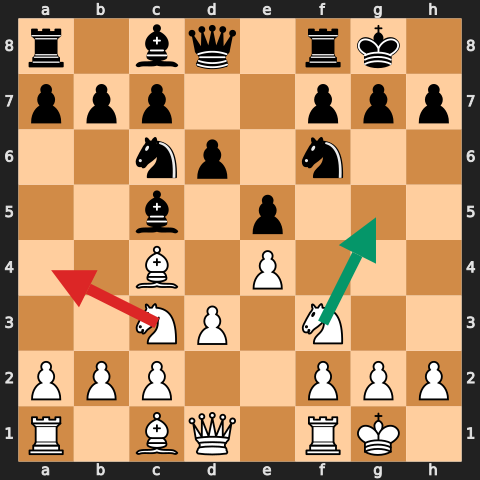 In the middlegame, complex positions lead to higher CPL. Here, White plays Na4, missing the stronger Ng5 which creates immediate tactical pressure.
The Anatomy of Errors: Blunders vs. Inaccuracies
Not all mistakes are created equal. Stockfish categorizes errors into inaccuracies (50-99cp loss), mistakes (100-299cp loss), and blunders (300+cp loss).
When we break down the types of errors made in each phase, the dominance of blunders in the middlegame and endgame becomes apparent.
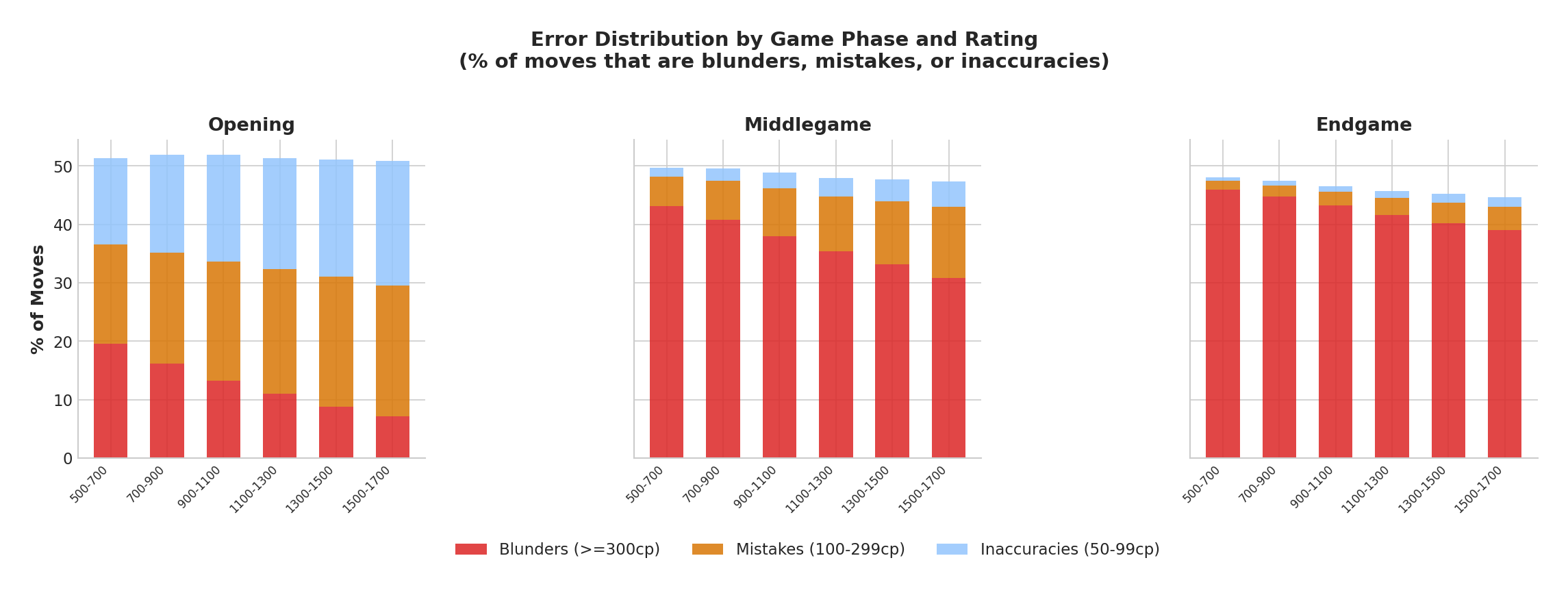
In the middlegame, over 35% of all moves played by a Chess.com 1100-1300 player are classified as blunders. This means that more than one in three moves gives away at least a minor piece worth of evaluation. Even at the 1500-1700 level, nearly 31% of middlegame moves are blunders.
Furthermore, the timing of the first critical mistake is a strong indicator of rating.
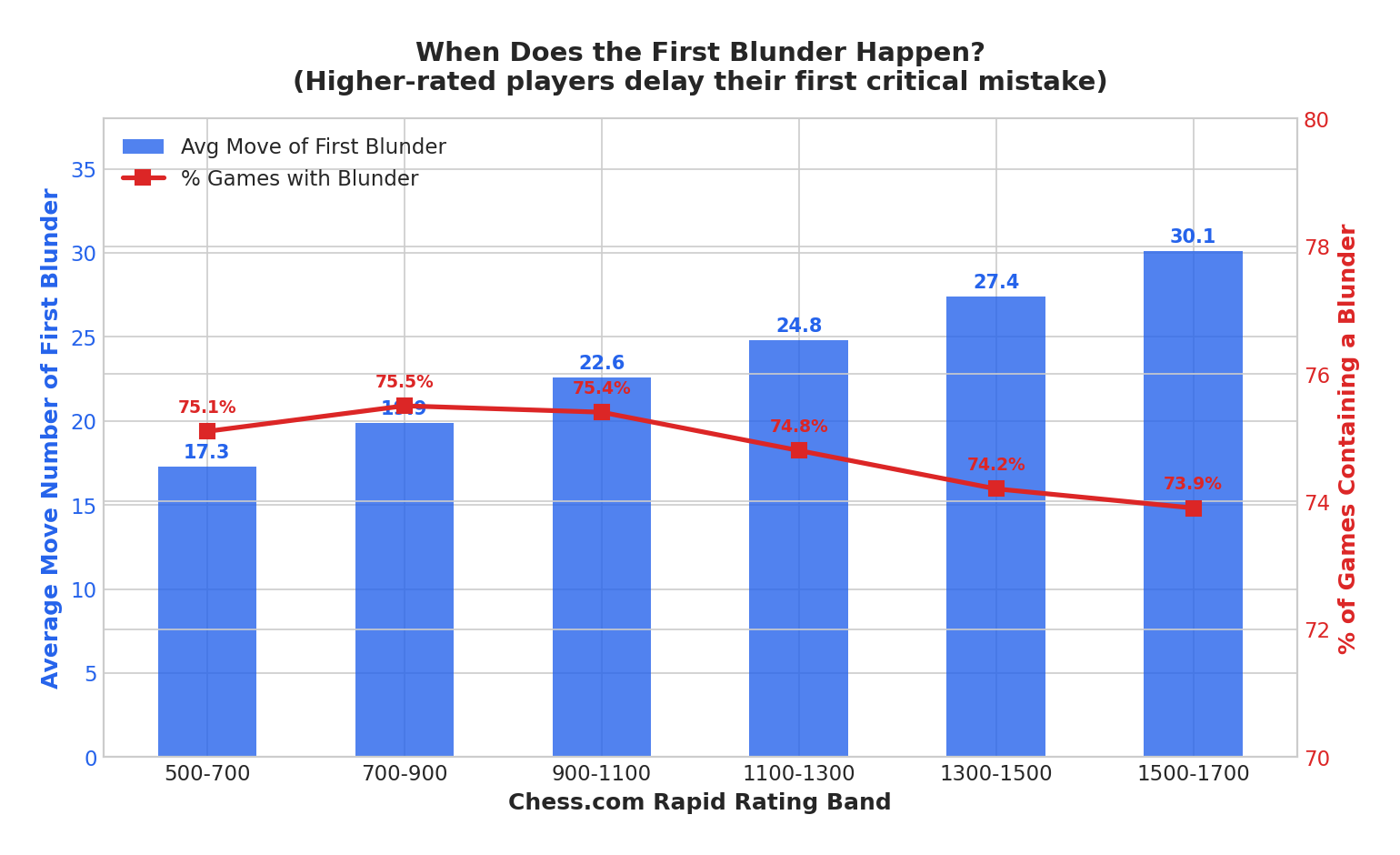
Lower-rated players (Chess.com 500-700) make their first blunder around move 17, right as the opening transitions into the middlegame. Advanced players (Chess.com 1500-1700) manage to delay their first blunder until move 30, navigating the complexities of the early middlegame much more safely.
Actionable Advice for the 1300-1500 Range
You are surviving the opening and early middlegame better than your lower-rated peers, but the endgame remains a minefield. With an endgame ACPL still hovering around 500, basic endgame knowledge is your fastest path to improvement. Learn key concepts like the opposition, the Lucena position, and basic rook endgames.
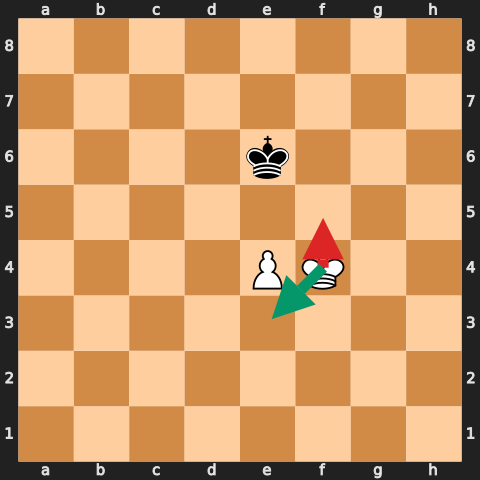 Endgame precision is difficult. Here, White plays Kf5, allowing Black to take the opposition. The correct move is Ke3, triangulating to force Black away.
Winning vs. Losing: The Accuracy Gap
Is there a significant difference in accuracy between winning Rapid games and losing Rapid games for the same player? The data provides a fascinating look at how move quality predicts outcomes.
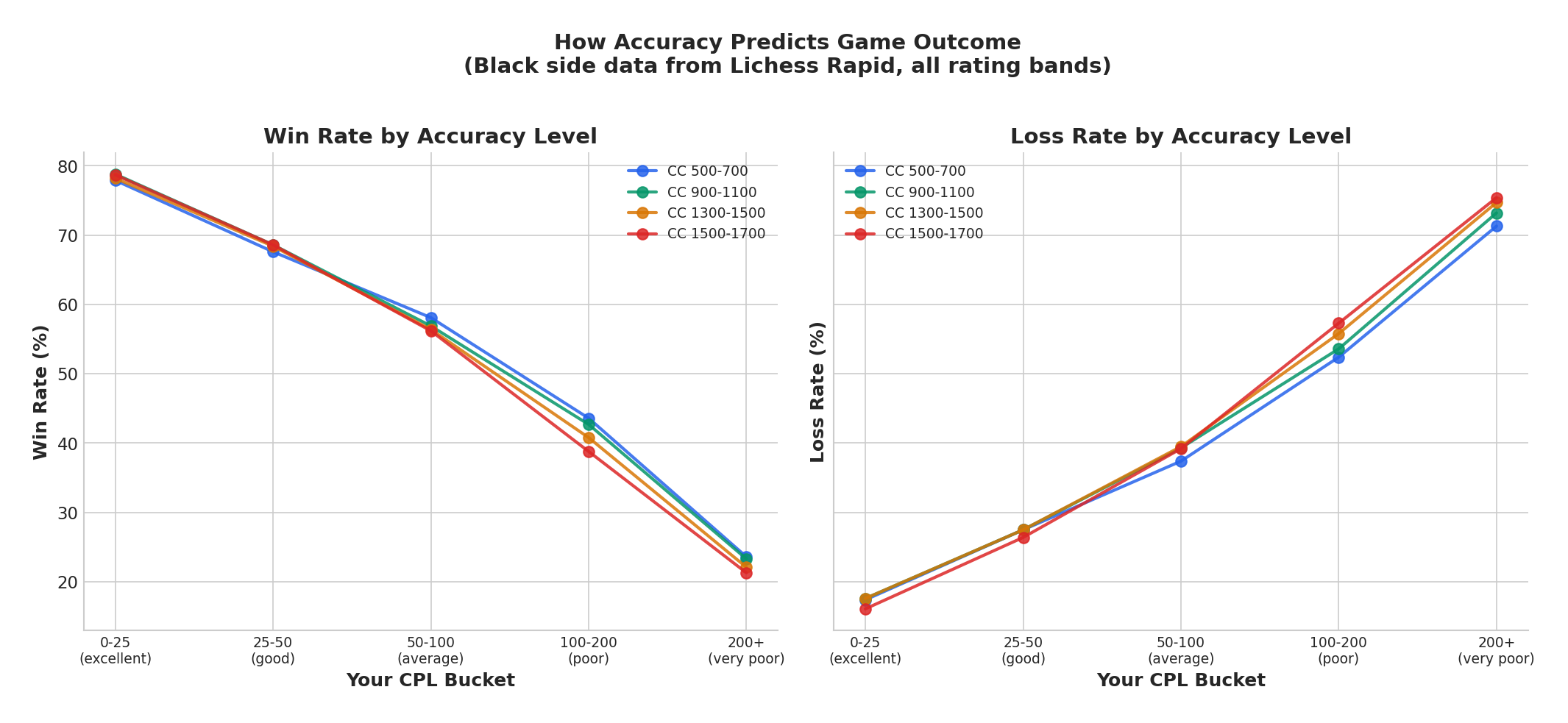
The chart above illustrates the win and loss rates based on a player's CPL bucket for that specific game. Unsurprisingly, playing with an "excellent" ACPL (0-25) results in a win rate approaching 80% across all rating bands. Conversely, playing with a "very poor" ACPL (200+) leads to a loss rate exceeding 70%.
An interesting phenomenon occurs in the data: the "fortressing effect." When a player is completely lost, almost any move they make maintains the terrible evaluation, resulting in a low CPL for those specific moves. However, the side that is winning must maintain accuracy to convert the advantage; a single blunder by the winning side spikes their CPL. This is why we look primarily at the Black side data to see the clean correlation between good moves and winning outcomes.
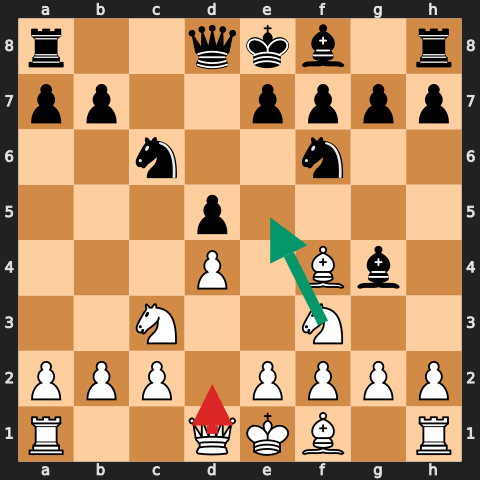 The difference between winning and losing often comes down to active vs. passive play. Here, Qd2 is passive, while Ne5 actively challenges the center and the pinned knight.
Time Control Matters
Finally, we compared Rapid accuracy to Blitz and Bullet formats to see how the clock impacts move quality.
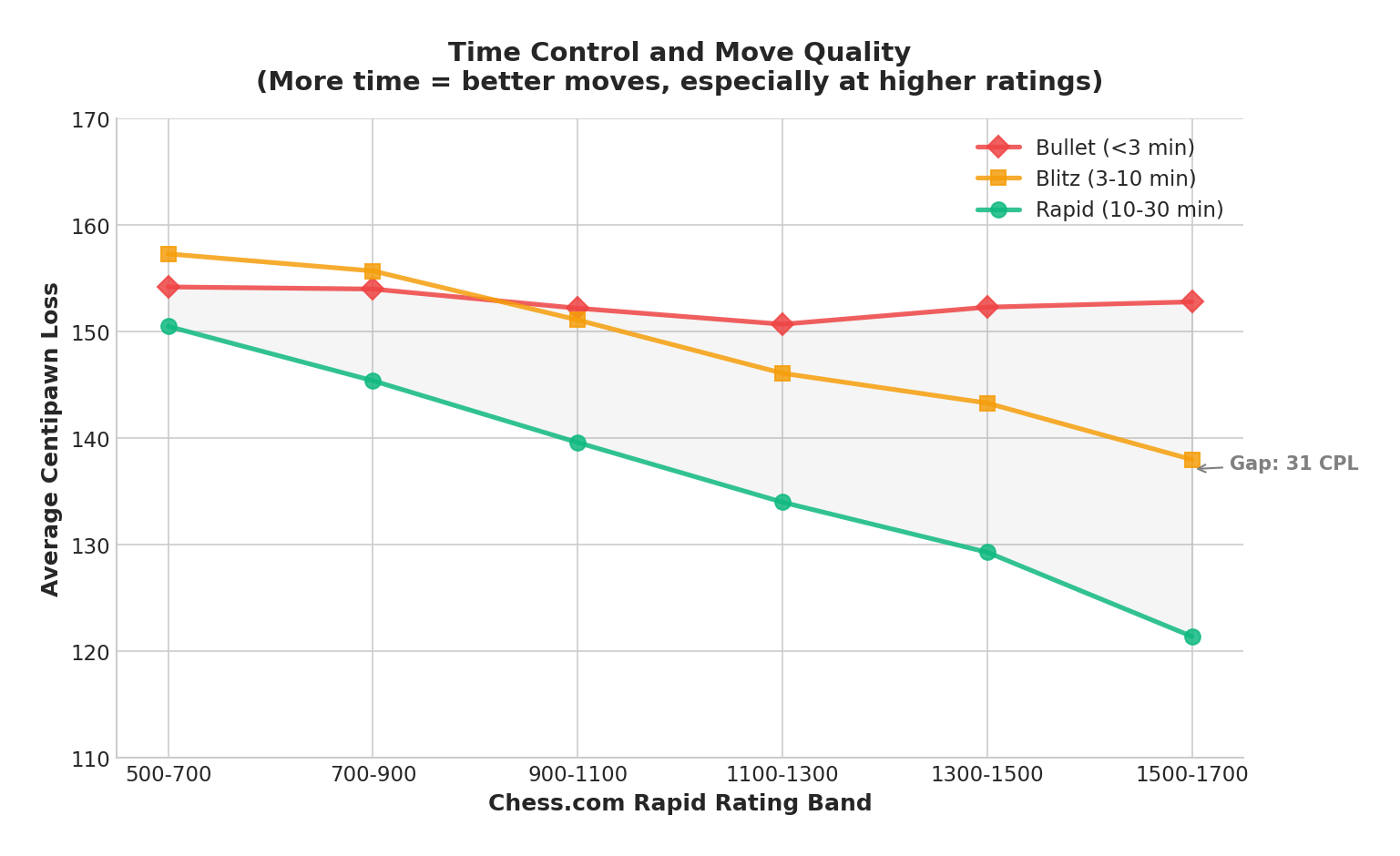
The data confirms what chess coaches have long preached: more time leads to better chess. Across all rating bands, Rapid games feature significantly lower ACPL than Blitz or Bullet games.
Crucially, the gap between Rapid and Bullet accuracy widens as players get stronger. A 700-rated player plays Bullet almost as accurately as Rapid, simply because they aren't utilizing the extra time effectively in Rapid. A 1600-rated player, however, shows a massive 31-point CPL improvement when given Rapid time controls compared to Bullet.
Actionable Advice for All Ratings
If you want to improve your fundamental chess understanding, play Rapid. The data proves that players utilize the extra time to find better moves, especially as they climb the rating ladder. Playing exclusively Blitz or Bullet ingrains bad habits and prevents you from practicing deep calculation.
Data and Methodology
This analysis was conducted using a dataset of Lichess Rapid games, evaluated by Stockfish 17 at high depth. The data was accessed via the Grandmaster Guide MCP server.
To make the insights actionable for the broader chess community, Lichess rating bands were mapped to approximate Chess.com Rapid equivalents using the following conversion:
- Lichess 700-900 ≈ Chess.com 500-700
- Lichess 900-1100 ≈ Chess.com 700-900
- Lichess 1100-1300 ≈ Chess.com 900-1100
- Lichess 1300-1500 ≈ Chess.com 1100-1300
- Lichess 1500-1800 ≈ Chess.com 1300-1500
- Lichess 1800-2000 ≈ Chess.com 1500-1700
The underlying CSV data files generated for this analysis are available for review:
View full data →lichess_band chesscom_band avgCpl whiteAvgCpl blackAvgCpl blunderRatePerGame mistakeRatePerGame inaccuracyRatePerGame sampleGames 700-900 500-700 183.1 183.4 182.8 18.93 3.91 2.92 40335 900-1100 700-900 178.7 179.3 178.1 19.32 4.77 3.5 34058 1100-1300 900-1100 173.9 174.6 173.2 19.46 5.81 4.14 28546 1300-1500 1100-1300 166.7 167.6 165.9 19.07 6.74 4.65 24070 1500-1800 1300-1500 157.8 158.6 157.0 18.33 7.98 5.42 19083
View full data →lichess_band chesscom_band phase avgCpl blunderPct mistakePct inaccuracyPct sampleMoves 700-900 500-700 opening 197.5 19.57 17.01 14.71 2513055 900-1100 700-900 opening 164.9 16.15 19.03 16.77 2565446 1100-1300 900-1100 opening 141.0 13.2 20.4 18.31 2579450 1300-1500 1100-1300 opening 124.8 11.02 21.33 19.03 2571595 1500-1800 1300-1500 opening 110.3 8.81 22.18 20.13 2505369
View full data →lichess_band chesscom_band side cplBucket winPct drawPct lossPct sampleGames 700-900 500-700 black 0-25 77.9 4.7 17.4 27127 700-900 500-700 black 25-50 67.6 4.9 27.5 12392 700-900 500-700 black 50-100 58.1 4.5 37.4 17163 700-900 500-700 black 100-200 43.6 4.0 52.4 25320 700-900 500-700 black 200+ 23.6 5.1 71.3 58380
View full data →lichess_band chesscom_band phase avgEvalAbsolute 700-900 500-700 opening 1.35 700-900 500-700 middlegame 4.17 700-900 500-700 endgame 6.39 900-1100 700-900 opening 1.07 900-1100 700-900 middlegame 3.43
View full data →lichess_band chesscom_band avgFirstBlunderMove gamesWithBlunderPct avgBlundersPerGame sampleGames 700-900 500-700 17.3 75.1 17.88 139780 900-1100 700-900 19.9 75.5 18.21 139826 1100-1300 900-1100 22.6 75.4 18.23 139127 1300-1500 1100-1300 24.8 74.8 17.99 137768 1500-1800 1300-1500 27.4 74.2 18.06 133403
View full data →timeClass lichess_band chesscom_band avgCpl sampleGames bullet 700-900 500-700 154.2 34669 blitz 700-900 500-700 157.3 79460 rapid 700-900 500-700 150.5 49133 bullet 900-1100 700-900 154.0 41074 blitz 900-1100 700-900 155.7 77662
Chess Coach <2026-04-15>