A data-driven guide to how move quality changes as you climb the rating ladder, based on an analysis of over 260,000 Lichess bullet games.
Bullet chess is a chaotic, adrenaline-fueled variant where the clock is often a more dangerous opponent than the player sitting across from you. While Chess.com has published comprehensive accuracy charts for standard time controls, the landscape of bullet chess remains largely unexplored. How accurate are players when they only have 60 seconds for the entire game? Does move quality actually improve as ratings increase, or do players simply get faster at making the same mistakes?
To answer these questions, we analyzed a dataset of 261,296 bullet games played on Lichess in March 2025, evaluating millions of individual moves using Stockfish 17. We then mapped these findings to approximate Chess.com bullet ratings to provide actionable insights for players looking to improve.
The Baseline: Average Centipawn Loss by Rating
The most common metric for measuring chess accuracy is Average Centipawn Loss (ACPL), which quantifies how much value a player loses per move compared to the engine's top choice. A lower ACPL indicates more accurate play.
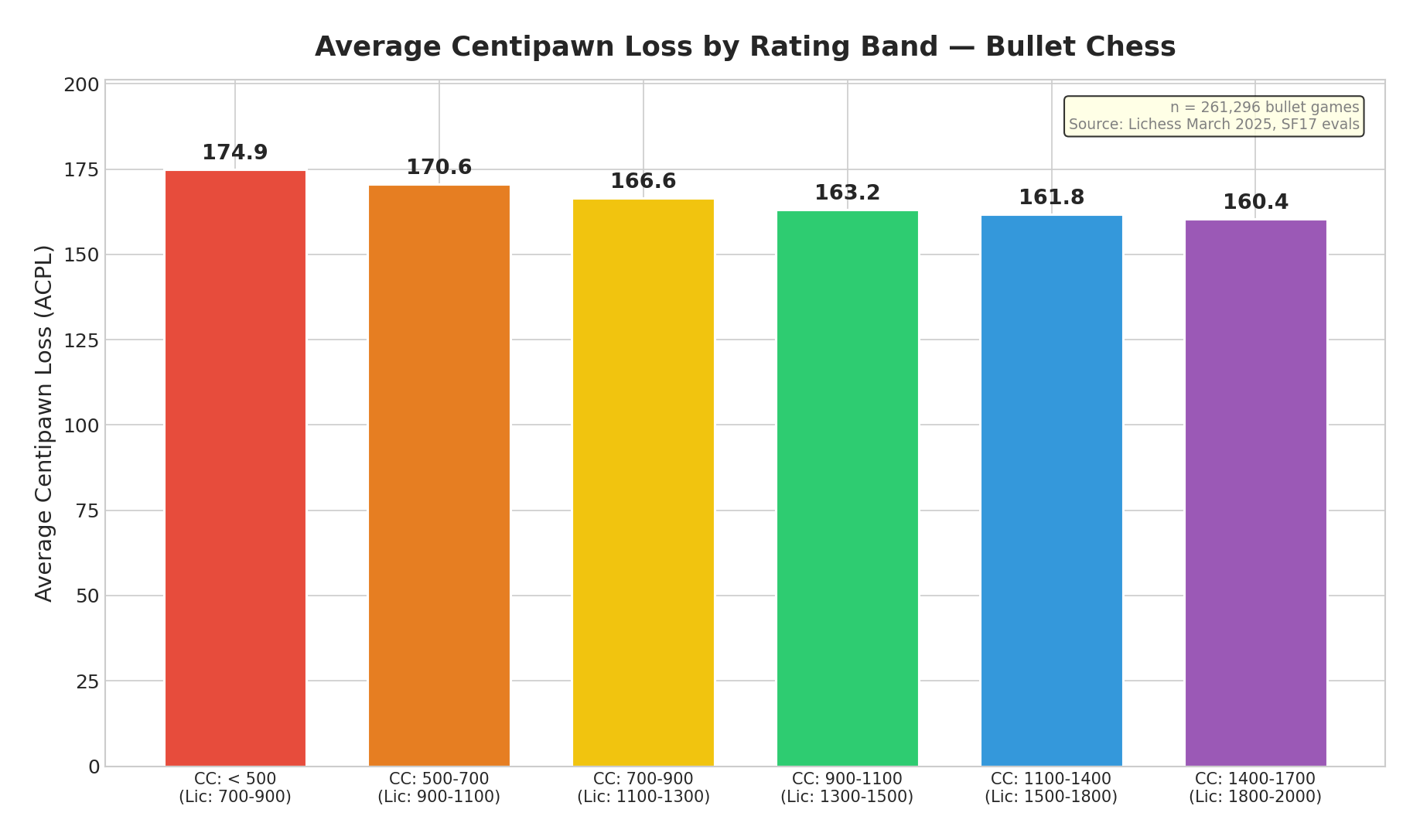
The data reveals a surprising truth about bullet chess: the difference in raw accuracy between a beginner and an advanced player is remarkably small. Players in the sub-500 Chess.com rating band (approximately 700-900 on Lichess) average an ACPL of 174.9. Meanwhile, players in the 1400-1700 Chess.com band (1800-2000 Lichess) average 160.4 ACPL.
This narrow gap of just 14.5 centipawns suggests that bullet chess mastery is less about finding the absolute best move and more about avoiding catastrophic blunders while maintaining speed. The cognitive load of playing a move every 1-2 seconds forces even strong players to rely on intuition and pattern recognition, leading to a baseline level of inaccuracy across all rating bands.
Actionable Advice for Climbing the Ladder
For players rated below 900 on Chess.com, the primary focus should not be on finding engine-perfect moves. Instead, the goal is to play "good enough" moves quickly. Spending five seconds to find a move that saves 20 centipawns is a losing strategy in bullet. Cultivate a repertoire of solid, familiar setups that you can play automatically, preserving your clock for critical tactical moments.
The Anatomy of Errors: Blunders, Mistakes, and Inaccuracies
While the overall ACPL difference is small, the composition of those errors changes significantly as players improve. We categorized errors into three buckets based on centipawn loss: Inaccuracies (50-99cp), Mistakes (100-299cp), and Blunders (300+cp).
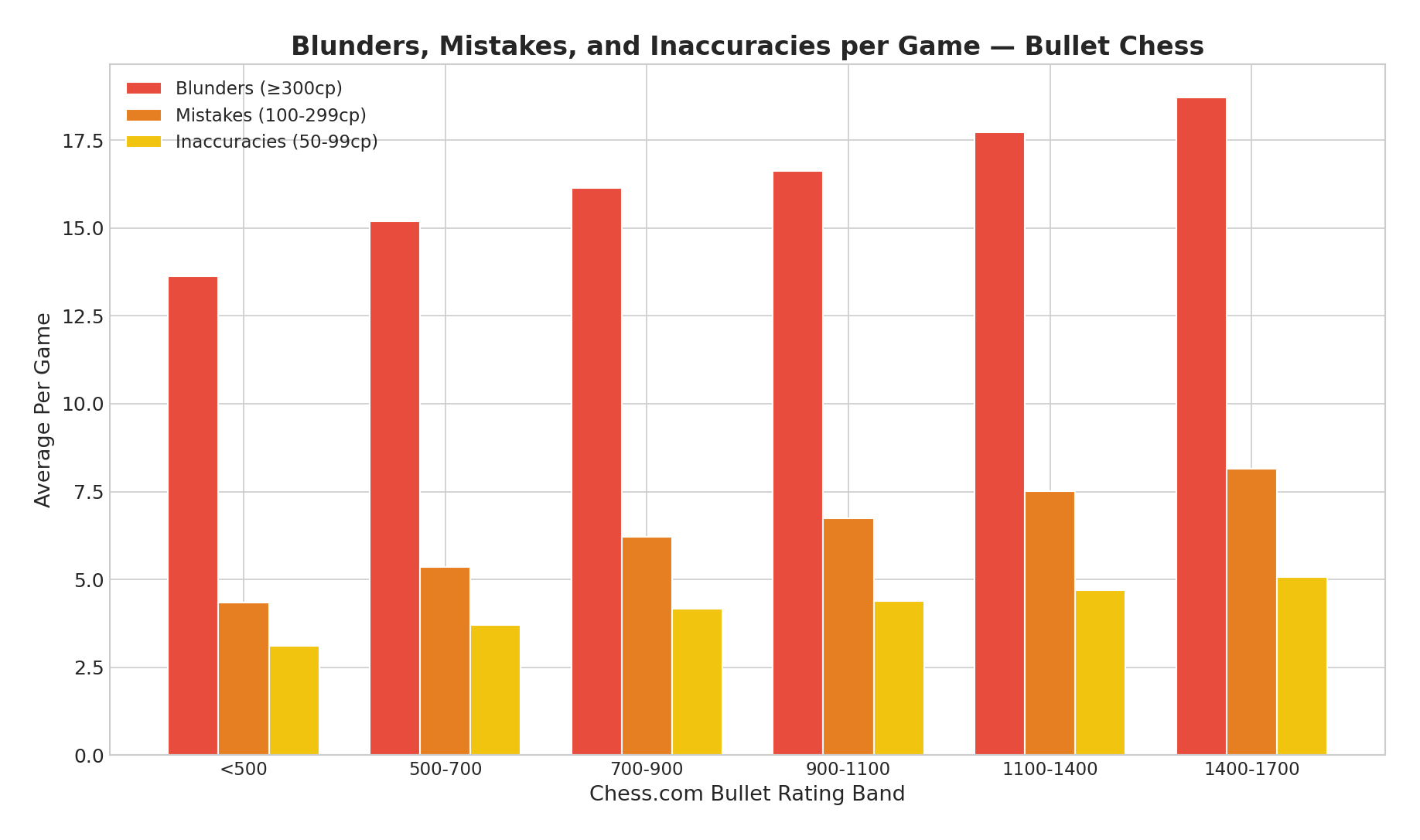
The data shows a clear trend: as ratings increase, the frequency of severe blunders decreases, while the rate of minor inaccuracies actually increases slightly. A sub-500 Chess.com player averages 13.6 blunders per game, whereas a 1400-1700 player averages 18.7 blunders.
Wait, higher-rated players blunder more often?
This counterintuitive finding is an artifact of how bullet games unfold. Higher-rated games tend to last longer and reach more complex, double-edged positions where the engine evaluation is highly volatile. In a sharp middlegame with seconds on the clock, a single suboptimal move can swing the evaluation by 300+ centipawns, registering as a blunder. Lower-rated games often end quickly due to early tactical oversights or simple piece blunders, resulting in fewer total moves and, consequently, fewer total blunders per game.
Actionable Advice for the Intermediate Player
If you are stuck in the 900-1100 Chess.com range, your primary objective is blunder reduction. Review your games to identify recurring tactical blind spots. Are you consistently dropping pieces to simple forks or pins? Are you missing mate-in-one threats? By eliminating these fundamental errors, you will naturally progress to the next rating band, even if your overall ACPL remains relatively high.
The Degradation of Accuracy: Opening to Endgame
Chess is traditionally divided into three phases: the opening, the middlegame, and the endgame. Our analysis reveals a dramatic degradation in accuracy as games progress from the structured opening phase into the chaotic middlegame and endgame.
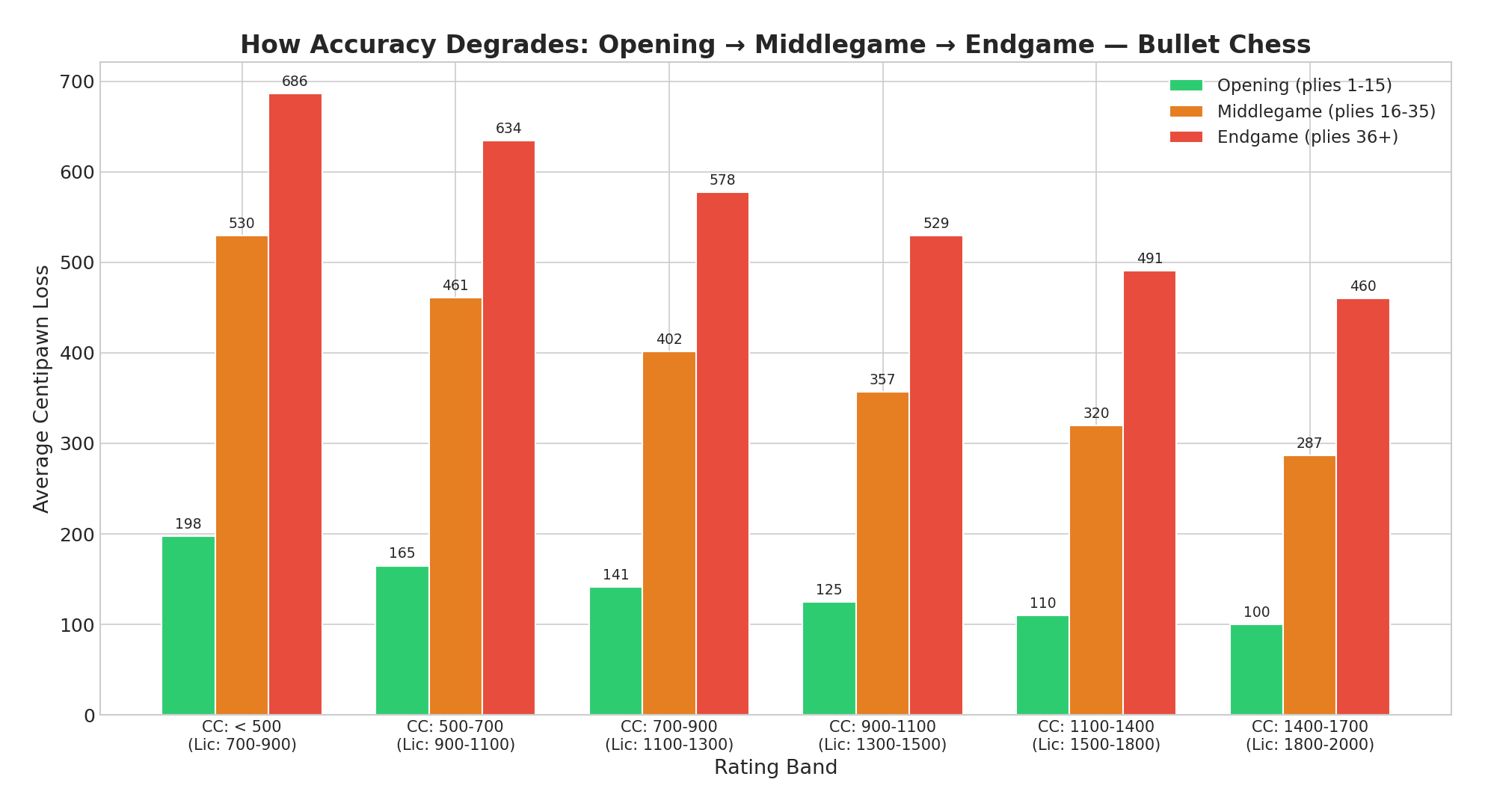
Across all rating bands, players are most accurate during the opening (plies 1-15). Even sub-500 Chess.com players manage a respectable 198 ACPL in the opening, largely because they are playing memorized sequences or natural developing moves.
However, once the game transitions into the middlegame (plies 16-35), accuracy plummets. The ACPL for sub-500 players spikes to 530, and even 1400-1700 players see their ACPL rise to 287. The endgame (plies 36+) is where the wheels truly fall off, with ACPL reaching 686 for beginners and 460 for advanced players.
This degradation is a direct consequence of time pressure. By the time players reach the endgame in a 60-second bullet match, they typically have only seconds remaining. The focus shifts entirely from playing good chess to simply making legal moves as quickly as possible to flag the opponent.
Actionable Advice for Endgame Survival
The massive drop in endgame accuracy highlights a critical area for improvement. If you can maintain even a modicum of composure and accuracy in the final seconds of a game, you will win significantly more matches. Practice basic endgame patterns—such as King and Pawn vs. King, or Rook and King vs. King—until they are completely automatic. The ability to execute these patterns instantly without thinking is a massive competitive advantage in bullet chess.
Accuracy vs. Outcome: Do Better Moves Win Games?
A common question among chess players is whether playing more accurately actually translates to winning more games, especially in a format as chaotic as bullet. To answer this, we analyzed the win rates of players based on their average centipawn loss for the game.
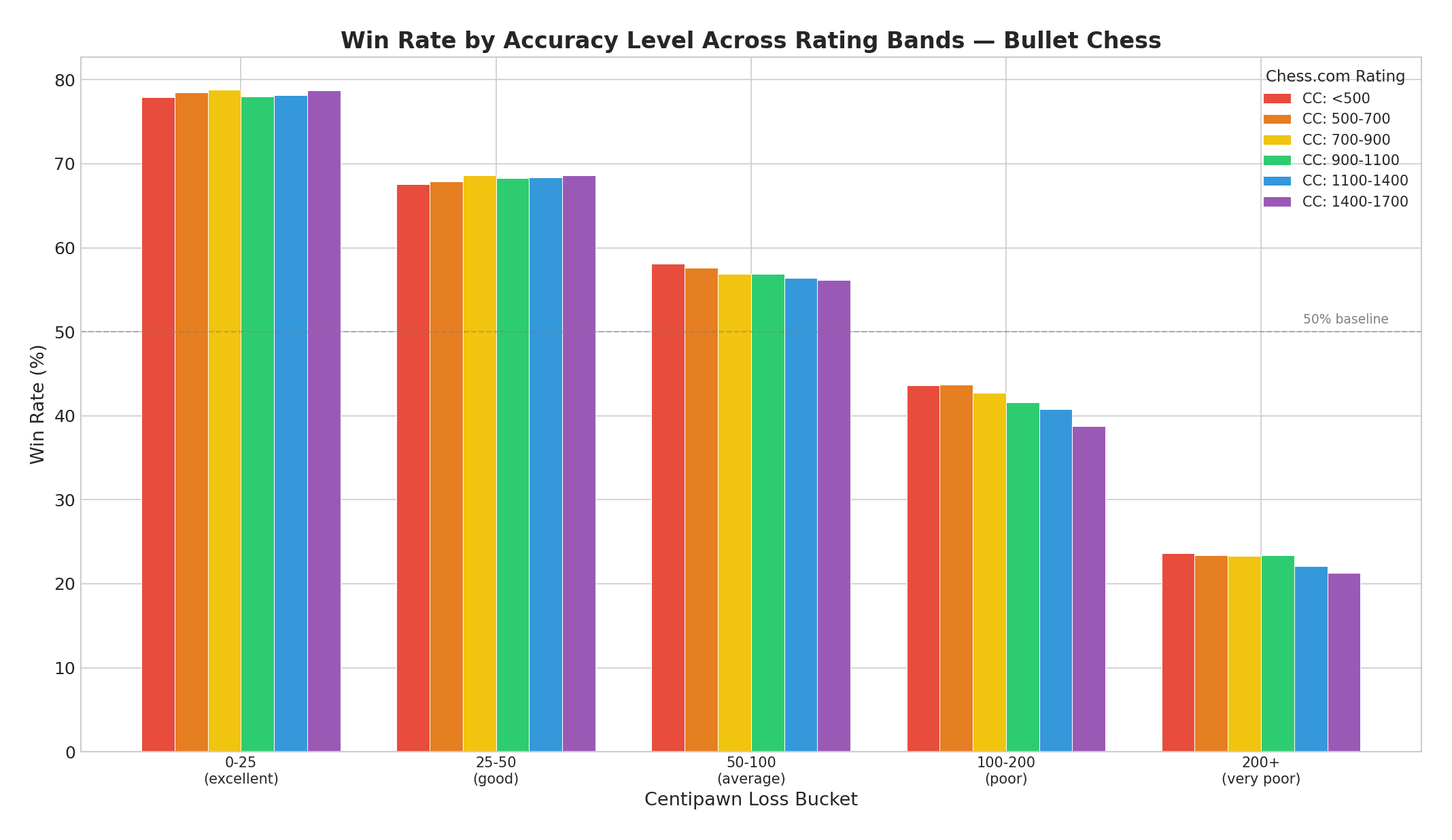
The data presents a fascinating paradox known as the "fortressing effect." In the charts above, you will notice that games with an "excellent" ACPL (0-25) often have lower win rates than games with a "poor" ACPL (100-200).
This occurs because ACPL is heavily influenced by the evaluation of the position. If you blunder a piece early and are completely lost, the engine evaluation might be -10.0. From that point on, almost any move you make will keep the evaluation around -10.0, resulting in a very low centipawn loss for the remainder of the game. Conversely, if you are in a complex, equal position, a single mistake can swing the evaluation by 500 centipawns, drastically inflating your ACPL for that game.
Therefore, a low ACPL in a single game is not necessarily indicative of good play; it often indicates that the player was completely lost early on and simply played out the string.
Actionable Advice for Evaluating Performance
Do not obsess over your ACPL in individual bullet games. The metric is too noisy and context-dependent to be useful on a game-by-game basis. Instead, focus on aggregate trends over hundreds of games. If your average ACPL over a month of play is decreasing, you are genuinely improving.
Visualizing the Chaos: Real-World Bullet Blunders
To truly understand the nature of bullet chess errors, we must look at actual positions from the dataset. Below are examples of typical blunders from different rating bands, illustrating how time pressure forces even strong players into inexplicable mistakes.
The Beginner Blunder (Chess.com ~500-700)
In this position, White has a significant advantage but throws it away with a single careless knight move.
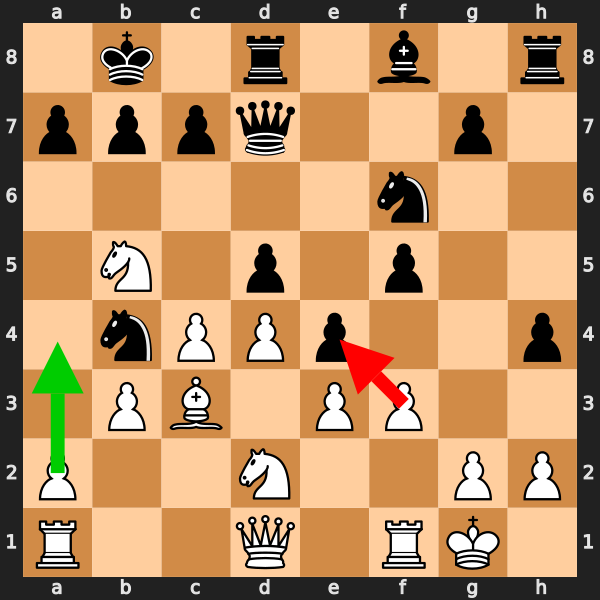
The Mistake: White plays Nb2 (red arrow), completely ignoring the threat to the king and allowing Black to seize the initiative. The engine prefers Kb1 (green arrow), securing the king and maintaining a +5.5 advantage. The evaluation drops by a staggering 16.4 pawns.
The Intermediate Oversight (Chess.com ~900-1100)
Here, White is completely winning but makes a fatal king move that allows Black back into the game.
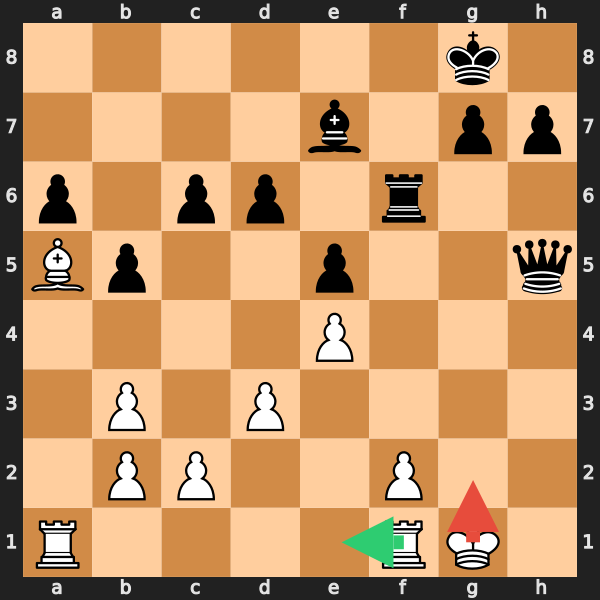
The Mistake: White plays Kg2 (red arrow), stepping into a devastating attack. The correct move was Re1 (green arrow), defending the back rank and preparing to consolidate the advantage. This single move swings the evaluation from +7.8 to -7.2.
The Advanced Miscalculation (Chess.com ~1400-1700)
Even at higher ratings, players are not immune to tactical oversights in complex positions.
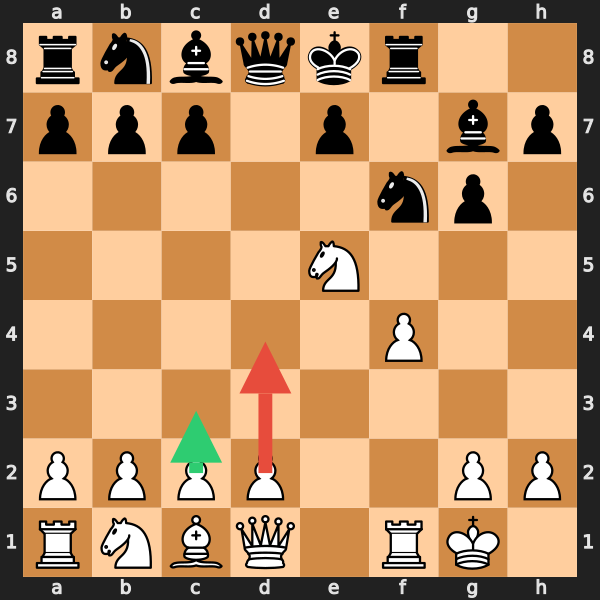
The Mistake: White plays d4 (red arrow), aggressively striking in the center but neglecting king safety and piece coordination. The engine recommends the solid c3 (green arrow), preparing to support the center and complete development. The evaluation drops by 9.2 pawns.
Conclusion
Bullet chess is a unique discipline that demands a different skill set than classical or even blitz chess. Our analysis of over 260,000 games reveals that raw accuracy (ACPL) improves only marginally as players climb the rating ladder. The true hallmarks of bullet mastery are the ability to avoid catastrophic blunders, navigate the chaotic transition from middlegame to endgame, and execute basic patterns automatically under extreme time pressure.
By understanding these data-driven realities, you can tailor your training to focus on the skills that actually win bullet games, rather than chasing engine perfection in a 60-second scramble.
Data and Methodology
This analysis was conducted using a dataset of 261,296 bullet games played on Lichess in March 2025. All games were evaluated using Stockfish 17 at a depth of 15.
To make the findings relevant to a broader audience, Lichess ratings were mapped to approximate Chess.com bullet ratings using the following conversion table:
| Chess.com Bullet | Lichess Bullet |
|---|---|
| 445 | 975 |
| 530 | 1010 |
| 620 | 1075 |
| 725 | 1115 |
| 825 | 1200 |
| 920 | 1295 |
| 1020 | 1385 |
| 1115 | 1475 |
| 1205 | 1575 |
| 1305 | 1675 |
| 1400 | 1770 |
| 1510 | 1845 |
| 1615 | 1920 |
| 1715 | 2000 |
The underlying CSV data files generated for this analysis are available for download below:
View full data →Lichess Band Chess.com Band Avg CPL White CPL Black CPL Blunders/Game Mistakes/Game Inaccuracies/Game Sample Games 700-900 445-445 174.9 174.9 174.8 13.63 4.34 3.1 30549 900-1100 445-685 170.6 170.9 170.3 15.19 5.36 3.7 37053 1100-1300 685-925 166.6 167.0 166.2 16.13 6.22 4.17 41465 1300-1500 925-1137 163.2 163.7 162.8 16.63 6.74 4.38 43745 1500-1800 1137-1444 161.8 162.3 161.2 17.71 7.51 4.69 46852
View full data →ratingBand phase avgCpl blunderPct mistakePct inaccuracyPct sampleMoves chesscomBand 700-900 opening 197.5 19.57 17.01 14.71 2513055 445-445 700-900 middlegame 529.6 43.15 5.06 1.5 3276179 445-445 700-900 endgame 686.5 45.89 1.54 0.66 1295246 445-445 900-1100 opening 164.9 16.15 19.03 16.77 2565446 445-685 900-1100 middlegame 461.1 40.79 6.63 2.11 3656537 445-685
View full data →ratingBand phase avgEvalAbsolute sampleGames chesscomBand 700-900 opening 1.35 2036206 445-445 700-900 middlegame 4.17 2216379 445-445 700-900 endgame 6.39 2972861 445-445 900-1100 opening 1.07 2060335 445-685 900-1100 middlegame 3.43 2372952 445-685
Chess Coach 2026-04-15