Every chess player faces the same dilemma when they sit down with the white pieces: how should the game begin? The debate between 1.e4 and 1.d4 is as old as modern chess itself. While grandmasters choose their openings based on deep preparation and stylistic preference, what actually works best for the rest of us?
In the chaotic, fast-paced world of bullet chess (1-minute games), opening principles often take a back seat to practical considerations. Does 1.d4 statistically outperform 1.e4 at the beginner level due to fewer immediate tactical blunders? At what rating does 1.Nf3 or 1.c4 become a statistically viable choice?
To answer these questions, we analyzed nearly one million bullet games played on Lichess, adjusting the rating bands to approximate Chess.com ratings (roughly 500 to 1900). The data reveals fascinating trends about how opening effectiveness evolves as players climb the rating ladder.
The Data at a Glance
Before diving into the rating-by-rating breakdown, consider the overall landscape. The chart below shows White's win rate for each major first-move family across all rating bands. The 50% line represents perfect balance.
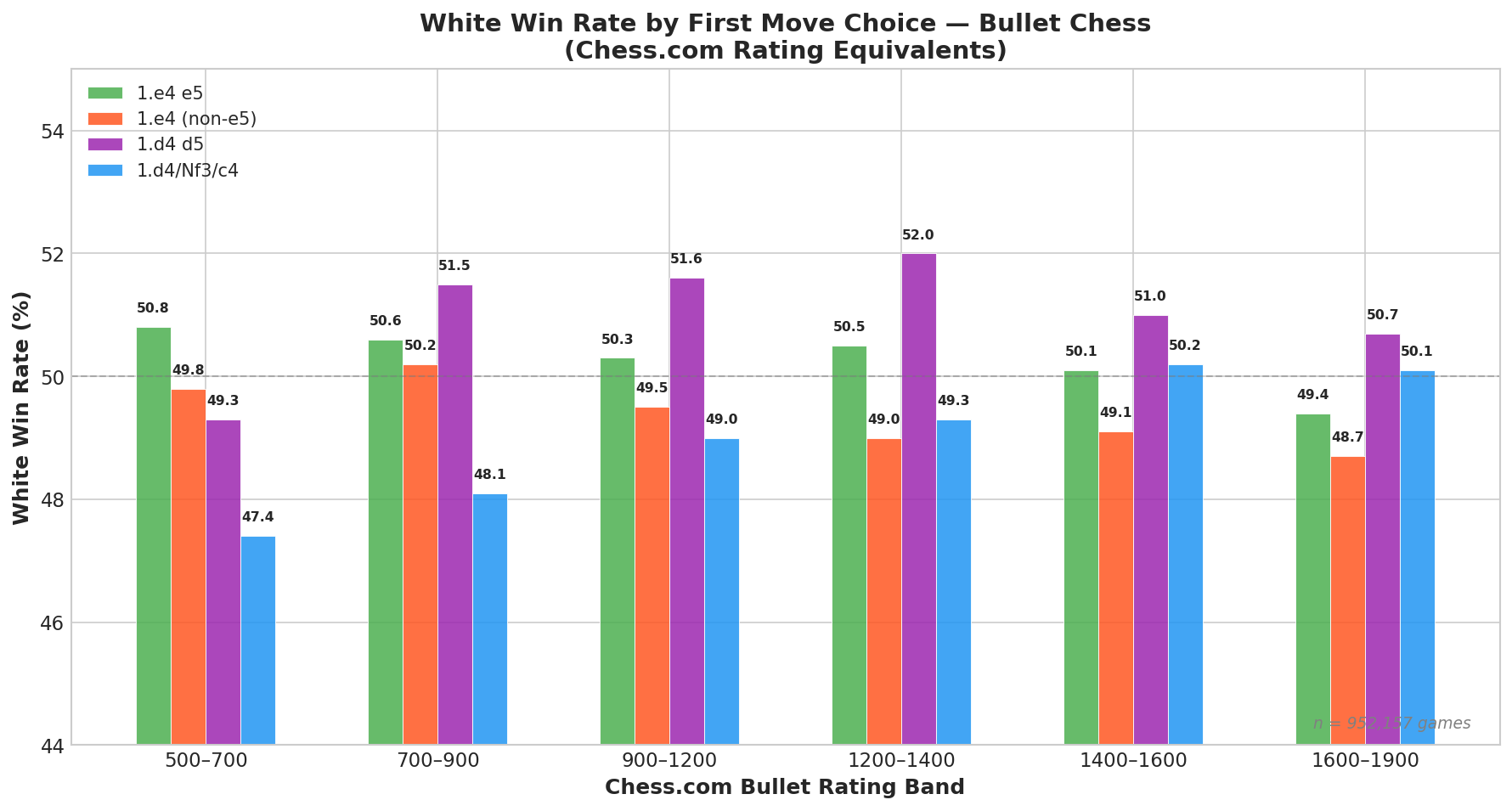
Two patterns are immediately visible. First, 1.d4 d5 (purple) is the most consistent performer for White across nearly every rating band. Second, 1.e4 e5 (green) starts strong but gradually loses its edge as players improve.
The Big Picture: 1.e4 Dominates Early, 1.d4 Scales Better
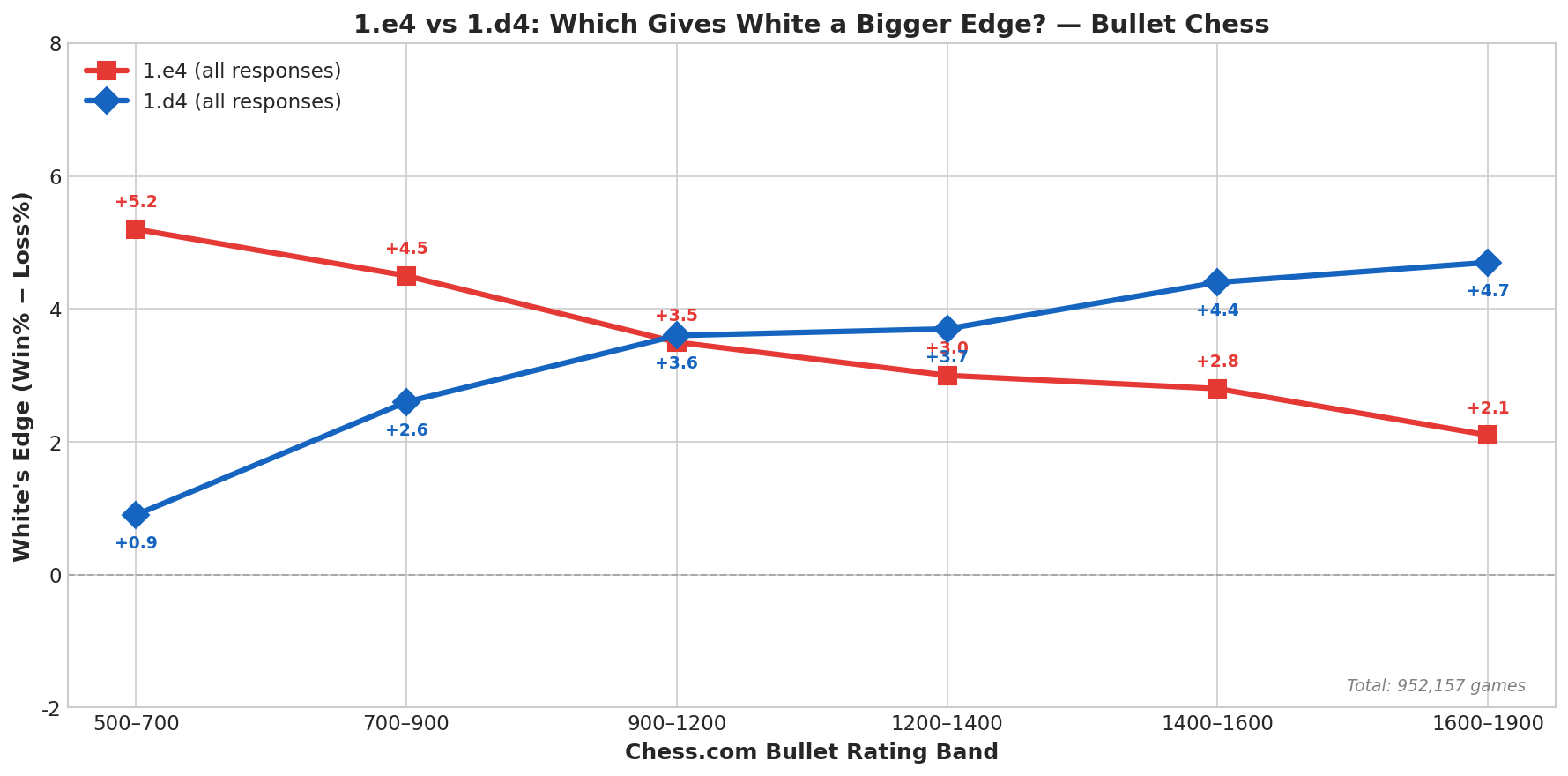
The most striking finding from the data is the "crossing point" between 1.e4 and 1.d4. At lower ratings, pushing the king's pawn two squares forward is statistically superior. However, as players improve, the queen's pawn opening steadily gains ground, eventually overtaking 1.e4 in effectiveness.
The 500–900 Rating Band: The Tactical Wild West
For players rated between 500 and 900 on Chess.com (roughly 1000–1200 on Lichess), 1.e4 is the undisputed king. When White plays 1.e4 and Black responds symmetrically with 1...e5, White enjoys a massive +5.9% edge in win rate over Black.
Why does 1.e4 perform so well here? The answer lies in the immediate tactical tension it creates. Games starting with 1.e4 e5 frequently lead to open positions where pieces develop quickly and attacks materialize out of nowhere. At this level, the player who creates the first threat often wins, simply because their opponent fails to spot it.
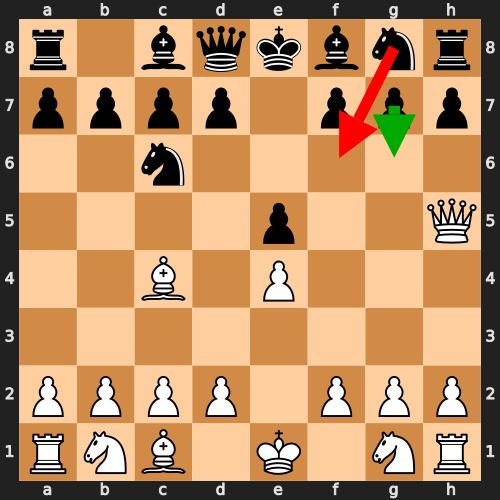
Consider the classic Scholar's Mate threat (1.e4 e5 2.Bc4 Nc6 3.Qh5). While objectively poor, early queen sorties are incredibly common and devastatingly effective against beginners who struggle to defend accurately under severe time pressure.
Actionable Advice for 500–900 Players: If you are playing White, stick to 1.e4. The open, tactical games will train your board vision and calculation skills. If you are playing Black against 1.e4, prioritize solid development and always ask yourself, "What is my opponent threatening?" before making a move.
The 900–1400 Rating Band: The Transition Phase
As players cross the 900 threshold and move toward 1400, the landscape begins to shift. The massive advantage of 1.e4 e5 starts to wane, dropping from a +5.9% edge to around +4.2%. Meanwhile, 1.d4 openings begin to show their strength.
In the 1200–1400 band, 1.d4 d5 actually becomes the most effective first-move combination for White, offering a +7.3% edge. This is the rating range where players stop falling for simple one-move blunders and start playing more solid, principled chess.
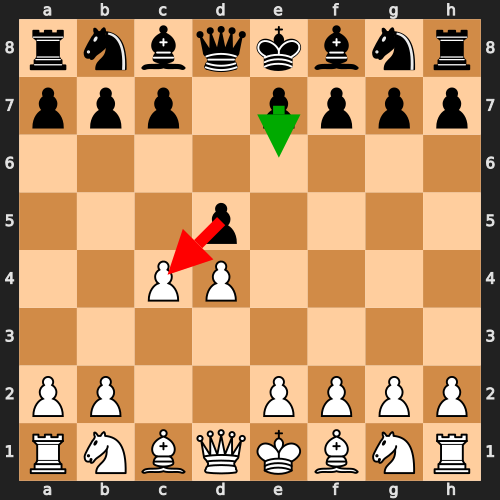
The Queen's Gambit (1.d4 d5 2.c4) exemplifies why 1.d4 shines here. It immediately challenges the center but in a more stable, strategic manner than 1.e4 openings. Black players at this level often struggle to handle the central tension, either surrendering the center too easily or defending passively.
Actionable Advice for 900–1400 Players: This is the perfect time to experiment with 1.d4 if you haven't already. The positions tend to be more closed and strategic, which can frustrate opponents who are only comfortable in wild, tactical brawls. For 1.e4 players, it is crucial to learn how to handle non-e5 responses (like the Sicilian or French), as their popularity increases significantly in this bracket.
The 1400–1900 Rating Band: The Rise of Strategy
In the upper echelons of our dataset (1400–1900 Chess.com), the trend solidifies. The combined win rate edge for 1.d4 (+4.7%) clearly surpasses that of 1.e4 (+2.1%).
At this level, players are tactically competent enough to navigate the sharp lines of 1.e4 without immediately blundering. Consequently, the game often hinges on deeper strategic understanding, pawn structures, and maneuvering—areas where 1.d4 naturally excels.
Interestingly, this is also where the Indian Defenses (1.d4 Nf6) become highly relevant. While 1.d4 Nf6 performs poorly for White at lower ratings (where Black's hypermodern setups often confuse White), it becomes a robust battleground at higher levels.
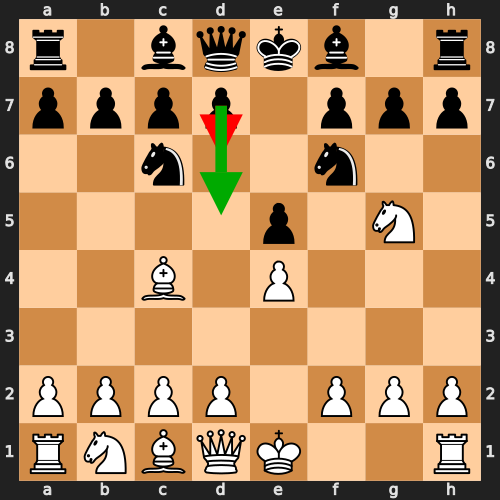
Even in 1.e4 games, the nature of the mistakes changes. Instead of dropping pieces to simple forks, players might miscalculate complex tactical sequences, such as the defense against the Fried Liver Attack (where 3...Nf6 4.Ng5 is met with the disastrous 4...d6?? instead of the correct 4...d5!).
Actionable Advice for 1400–1900 Players: Opening preparation becomes a genuine differentiator here. If you play 1.d4, you must be prepared for the King's Indian and Nimzo-Indian defenses. If you stick with 1.e4, you need deep knowledge of the main lines of the Sicilian and Caro-Kann, as relying on early traps will no longer yield consistent results.
Who Plays What? Opening Popularity by Rating
Before assessing which opening is best, it is worth understanding which openings are most popular at each level. The distribution of first-move choices shifts dramatically as players improve.
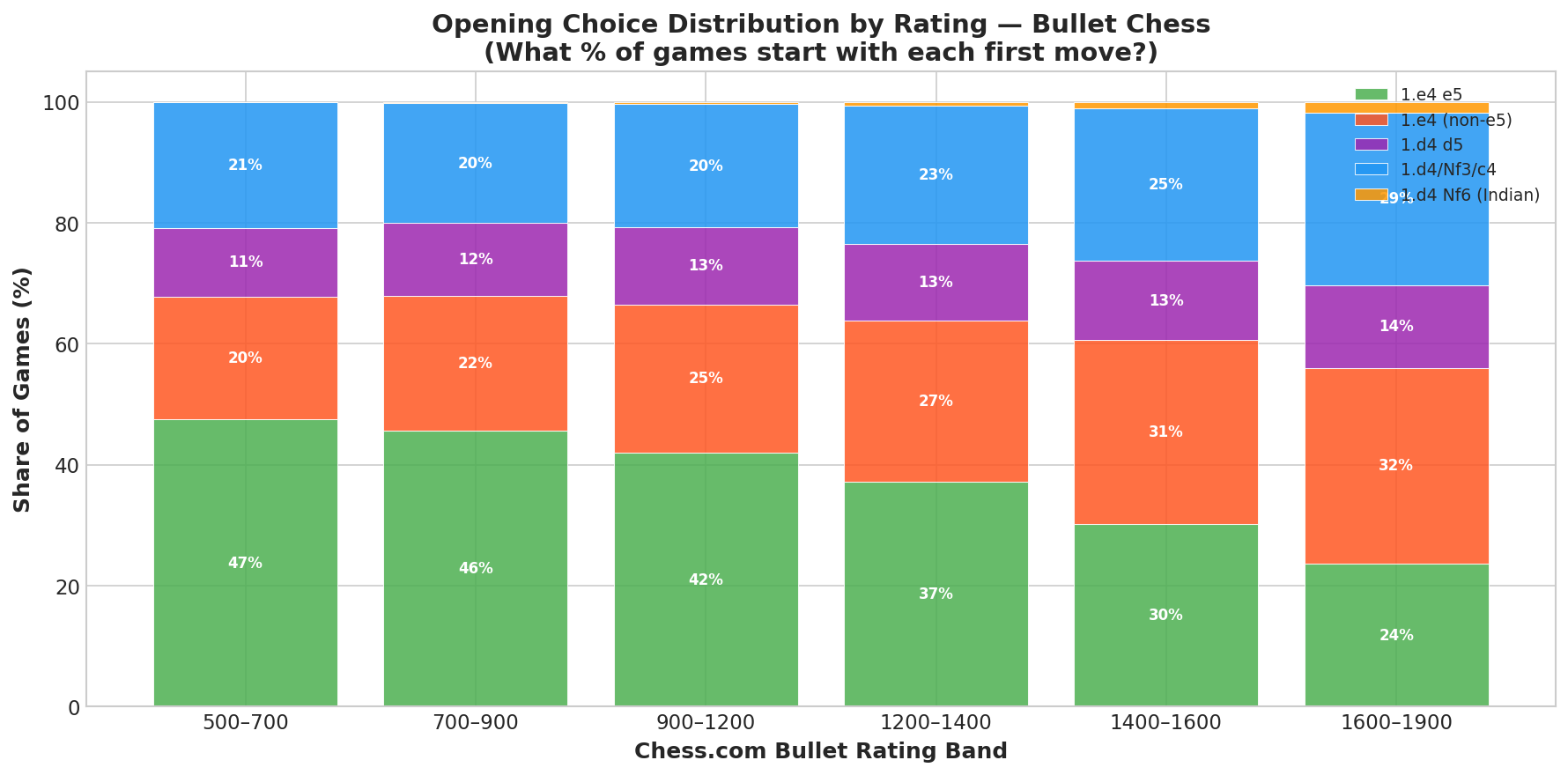
At the lowest ratings, nearly half of all games (47%) begin with 1.e4 e5. This drops steadily to just 24% at the 1600–1900 level. Meanwhile, the share of 1.e4 games where Black plays something other than 1...e5 (Sicilian, Caro-Kann, French, etc.) grows from 20% to 32%. The 1.d4 complex also expands, reflecting a broader opening repertoire as players gain experience.
This shift in popularity is itself a form of data. As players improve, they naturally gravitate toward openings that offer more nuanced play, even if they do not consciously analyze the statistics.
The Heatmap: White's Edge at Every Level
The following heatmap summarizes the net advantage for White (Win% minus Loss%) for each first-move family across all rating bands. Gold borders highlight the statistically best option at each level.
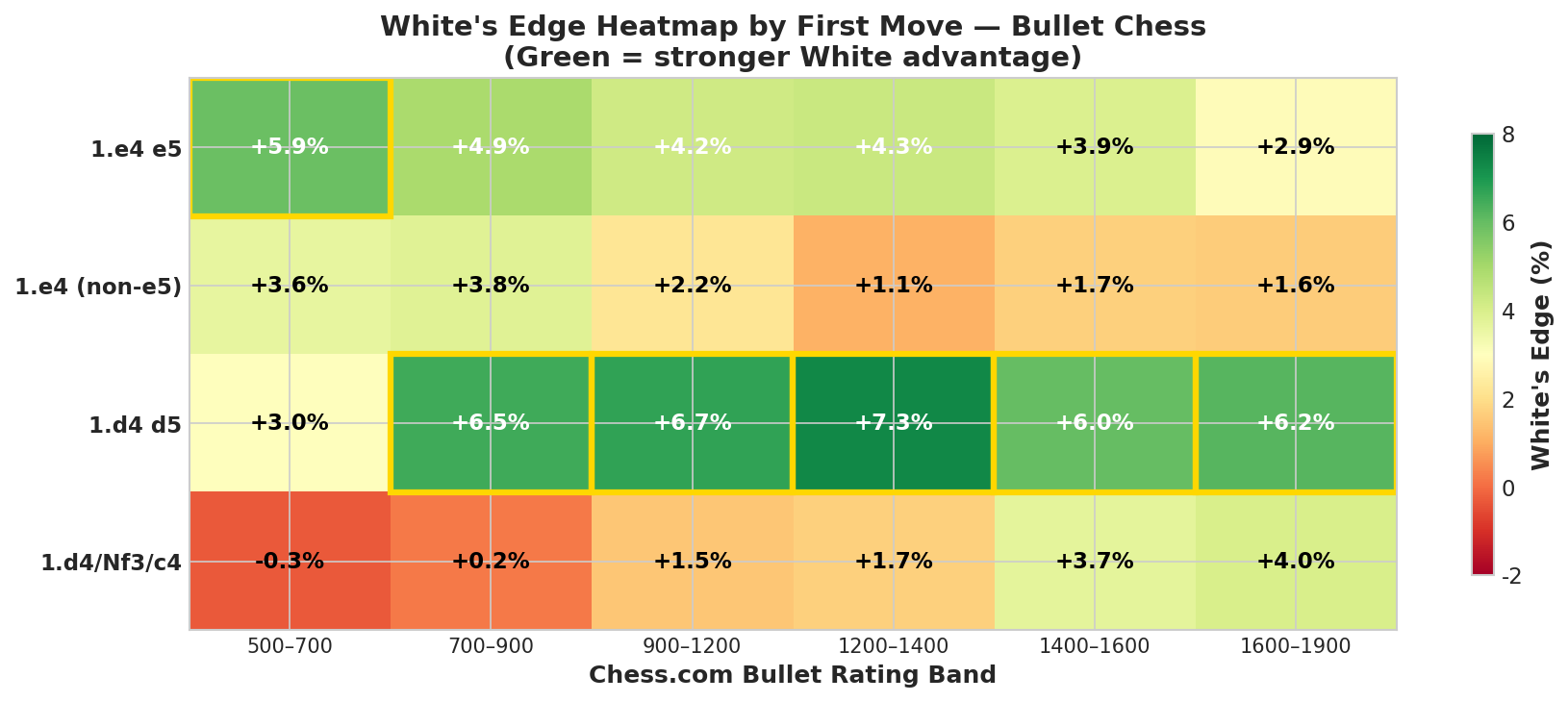
The heatmap confirms the central thesis: 1.e4 e5 is the best choice at the lowest levels, but 1.d4 d5 dominates from 700 onward. The flank openings (1.d4/Nf3/c4) are consistently the weakest choice until the highest rating bands.
The Bullet Context: Time Pressure and Game Length
Bullet chess is not just faster chess; it is a fundamentally different game. The following charts illustrate two critical factors that shape opening effectiveness in this time control.
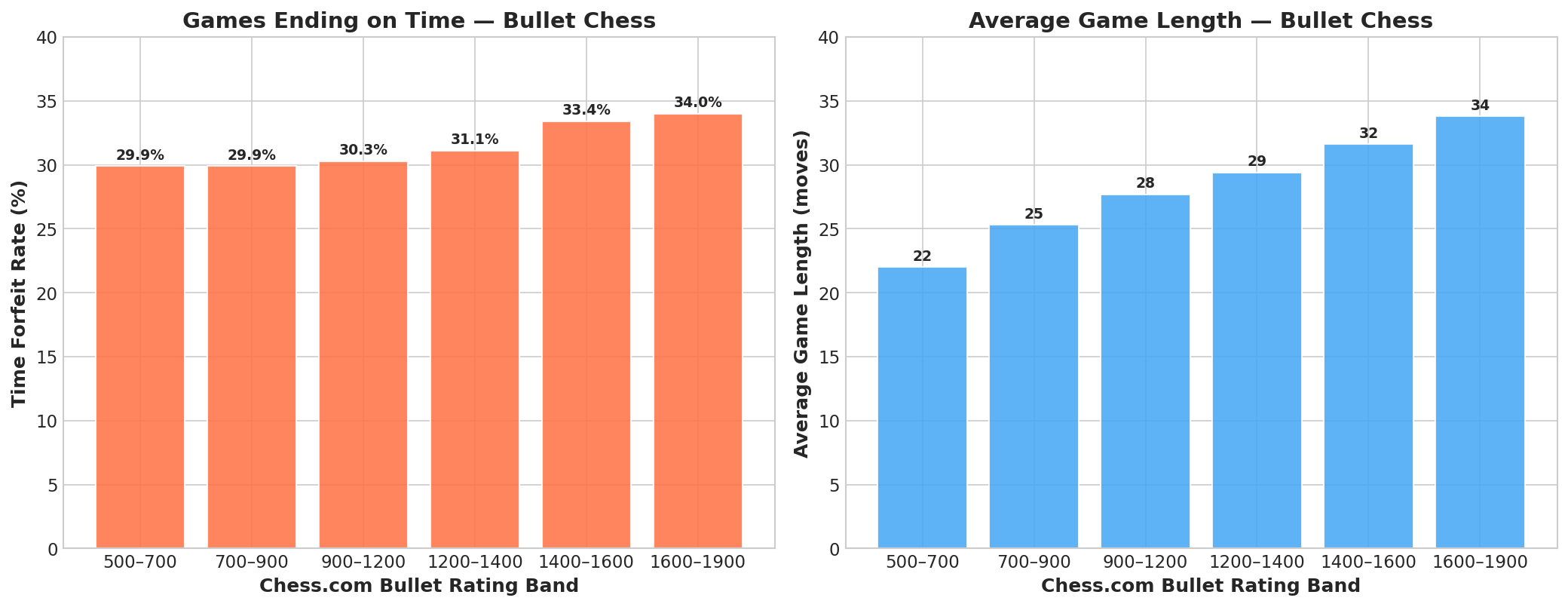
Roughly 30% of all bullet games end in a time forfeit, and this percentage actually increases with rating (from 29.9% at 500–700 to 34.0% at 1600–1900). Higher-rated players play longer games (34 moves on average vs. 22 at the lowest level), which means they are more likely to run into time trouble. This has a direct implication for opening choice: an opening you can play quickly and confidently is worth more than an objectively superior opening that requires deep calculation.
What About 1.Nf3 and 1.c4?
The flank openings (1.Nf3 and 1.c4) are often touted as sophisticated choices that avoid heavy theory. But do they work in bullet chess?
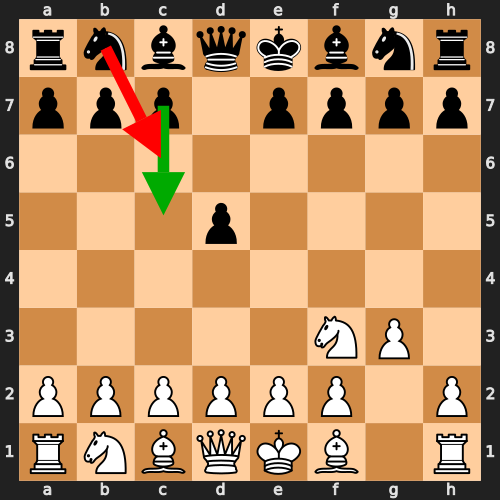
Our data groups these under the "ECO A" family. Across all rating bands, these openings consistently underperform compared to both 1.e4 and 1.d4. In the 500–700 band, they actually yield a negative edge (-0.3%), meaning Black wins more often than White!
The reason is simple: bullet chess rewards immediate initiative and clear plans. Flank openings are inherently flexible and slow-burning. In a one-minute game, spending the first five moves quietly fianchettoing bishops and maneuvering knights often allows Black to seize the center and dictate the pace of the game.
It is only as players approach the 1600–1900 band that these openings start to show a respectable positive edge (+4.0%), as stronger players can utilize the flexibility without getting overrun.
Actionable Advice: Unless you are rated above 1500 and have a specific, well-practiced system (like the King's Indian Attack), avoid 1.Nf3 and 1.c4 in bullet chess. Stick to claiming the center immediately with 1.e4 or 1.d4.
The Draw Rate Reality
A common myth is that 1.d4 leads to more draws than 1.e4. In classical chess, this might hold some truth, but in bullet chess, the draw rate is universally low across all openings.
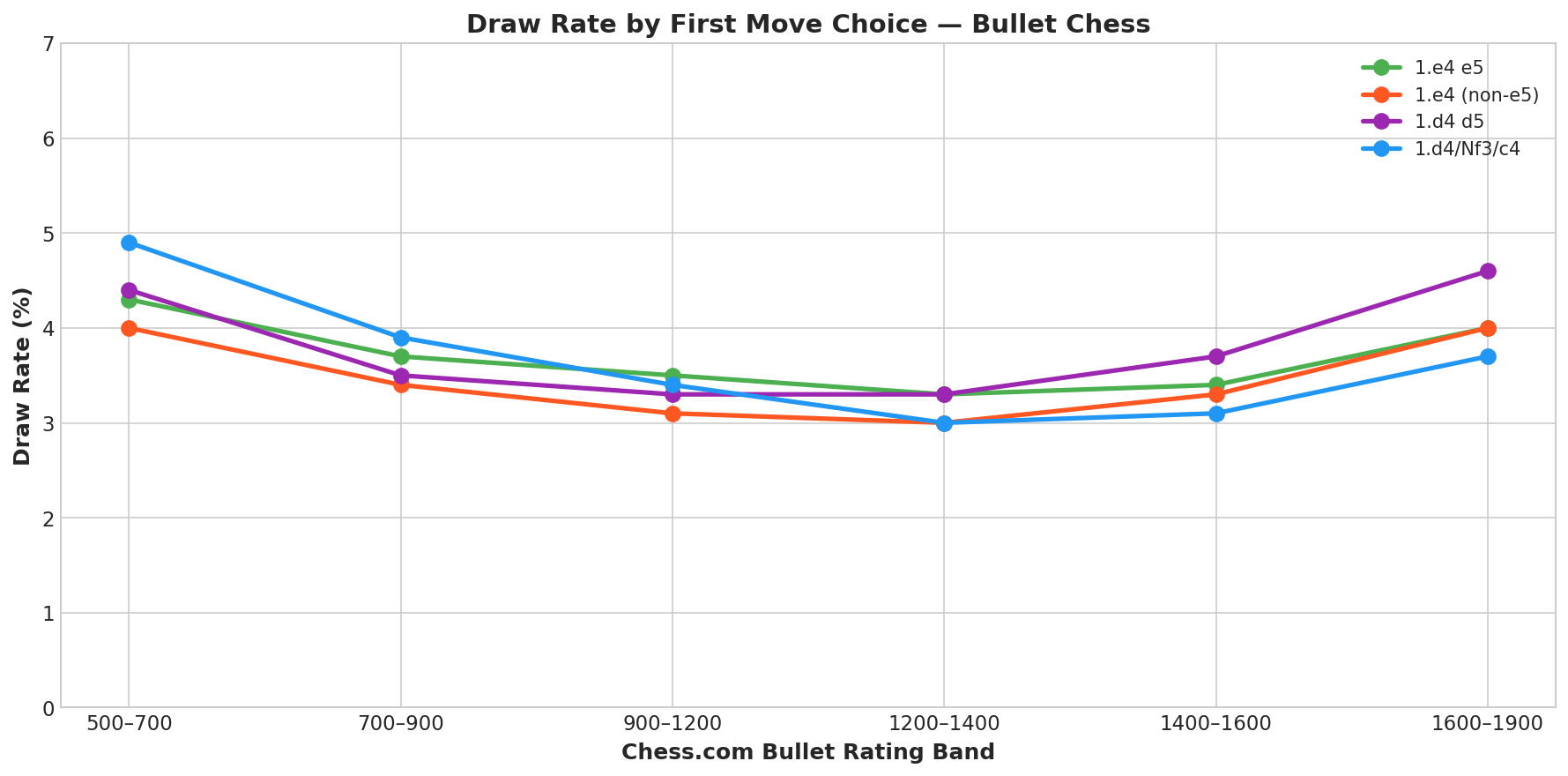
As the chart shows, draw rates hover between 1% and 5% across all rating bands. While they do increase slightly as ratings go up (from ~1.5% at 500 to ~3.0% at 1900), the difference between 1.e4 and 1.d4 is negligible. In bullet, games are decided by checkmates and time forfeits, not agreed draws in equal endgames.
Speaking of time forfeits, our data shows that roughly 30% to 34% of all bullet games end in a flag. This reinforces the idea that playing an opening you know well quickly is often more important than playing the objectively "best" opening slowly.
The Detailed Breakdown by First Move
The following line chart tracks White's net advantage across all four major first-move families. It provides the most granular view of how each opening scales with rating.
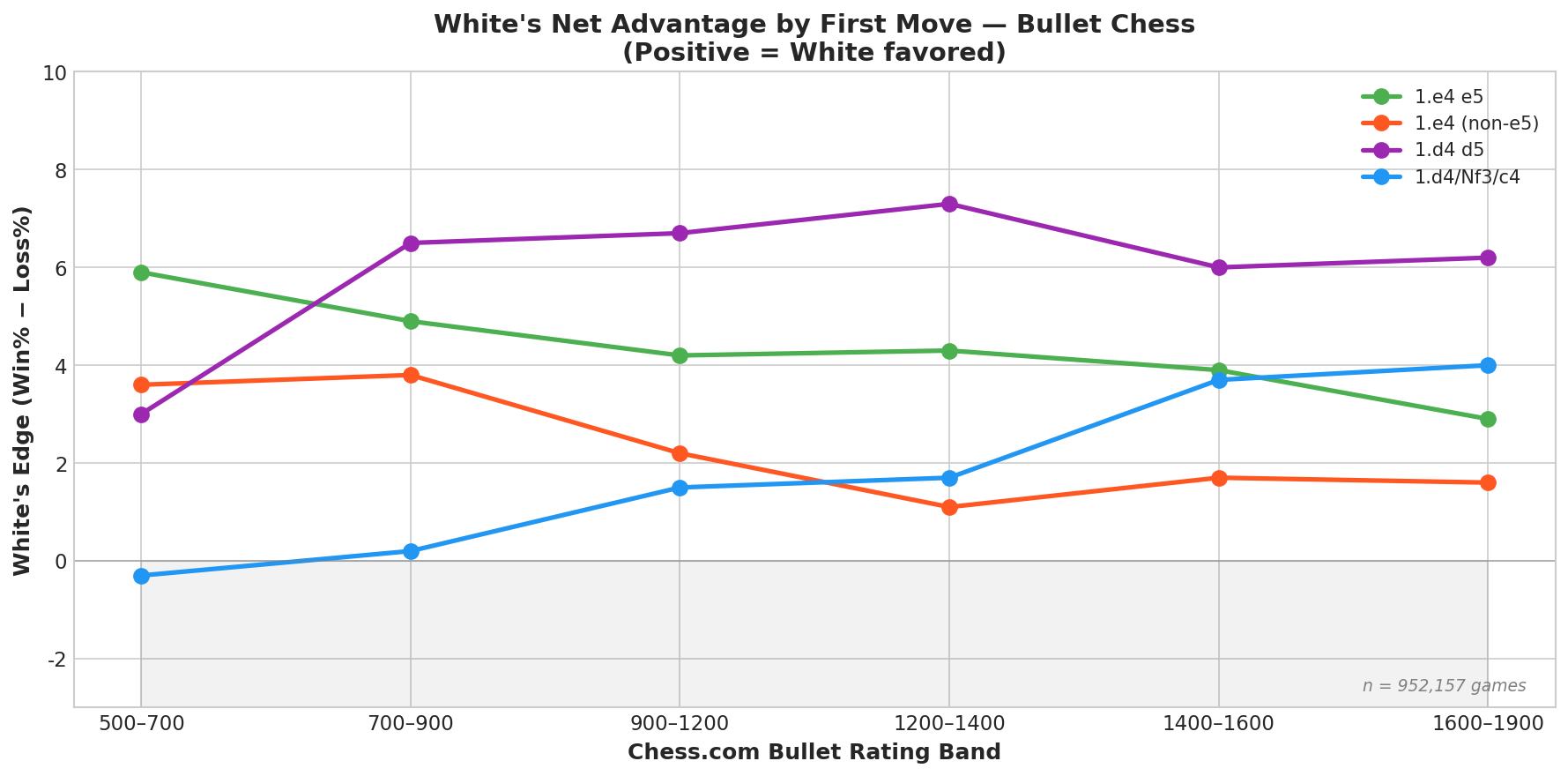
The key takeaways from this chart are:
- 1.d4 d5 (purple) maintains a consistently high edge (+3.0% to +7.3%) across all levels, peaking in the 1200–1400 band.
- 1.e4 e5 (green) starts as the best option at the lowest level (+5.9%) but declines steadily to +2.9% at the highest band.
- 1.e4 (non-e5 responses) (orange) is surprisingly weak for White, hovering between +1.1% and +3.8%. This suggests that Black's asymmetric defenses (Sicilian, French, Caro-Kann) are effective at neutralizing White's initiative.
- 1.d4/Nf3/c4 (flank) (blue) starts in negative territory (-0.3%) but climbs steadily to +4.0% at the highest level, reflecting the growing ability of stronger players to exploit flexible setups.
Conclusion: The Best Move for You
The data paints a clear picture of how opening effectiveness evolves in bullet chess:
- Under 900: Play 1.e4. The immediate tactical complexity favors the side asking the questions, and the resulting open games are essential for your chess development.
- 900 to 1400: This is the transition zone. 1.e4 is still fine, but 1.d4 begins to offer a more stable, consistent advantage as opponents stop falling for cheap tricks.
- 1400 and Above: 1.d4 statistically outperforms 1.e4. The strategic depth of queen's pawn openings proves harder to handle in a one-minute scramble than the heavily analyzed lines of 1.e4.
- Flank Openings (1.Nf3/1.c4): Avoid these until you are highly rated. They concede too much early initiative in a time control that demands immediate action.
Ultimately, the "best" first move is the one that leads to positions you understand and enjoy playing. But if you are looking for a statistical edge to help you climb to the next rating band, the numbers offer a clear roadmap.
Data and Methodology
This analysis is based on a dataset of 952,157 bullet chess games played on Lichess. To make the insights actionable for the broader chess community, Lichess ratings were mapped to approximate Chess.com bullet ratings using standard conversion estimates (e.g., Lichess 1200 ≈ Chess.com 825).
The data was categorized by ECO (Encyclopedia of Chess Openings) codes to group first-move choices:
- A: 1.d4 (non-d5/Nf6 responses), 1.Nf3, 1.c4, and other flank openings.
- B: 1.e4 (non-1...e5 responses, e.g., Sicilian, French, Caro-Kann).
- C: 1.e4 e5.
- D: 1.d4 d5.
- E: 1.d4 Nf6 (Indian Defenses).
The underlying data files used to generate the charts in this article are available below:
View full data →ecoFamily firstMove ratingBand whiteWinRate drawRate blackWinRate totalGames chesscom_label whiteEdge A 1.d4/1.Nf3/1.c4 700-900 47.4 4.9 47.7 33899 500–700 -0.30000000000000426 A 1.d4/1.Nf3/1.c4 900-1100 48.1 3.9 47.9 31929 700–900 0.20000000000000284 A 1.d4/1.Nf3/1.c4 1100-1300 49.0 3.4 47.5 32242 900–1200 1.5 A 1.d4/1.Nf3/1.c4 1300-1500 49.3 3.0 47.6 35356 1200–1400 1.6999999999999957 A 1.d4/1.Nf3/1.c4 1500-1800 50.2 3.1 46.5 37110 1400–1600 3.700000000000003
View full data →firstMove ratingBand whiteWinRate drawRate blackWinRate totalGames chesscom_label whiteEdge 1.e4 (all responses) 700-900 50.5 4.2 45.3 110902 500–700 5.2 1.e4 (all responses) 900-1100 50.5 3.6 45.9 109656 700–900 4.5 1.e4 (all responses) 1100-1300 50.0 3.4 46.5 105472 900–1200 3.5 1.e4 (all responses) 1300-1500 49.9 3.2 46.9 98850 1200–1400 3.0 1.e4 (all responses) 1500-1800 49.6 3.3 46.8 89014 1400–1600 2.8
View full data →ratingBand drawRate whiteWinRate blackWinRate totalGames chesscom_label 700-900 1.4 50.2 48.5 34669 500–700 900-1100 1.6 50.3 48.1 41074 700–900 1100-1300 1.8 50.3 47.9 45388 900–1200 1300-1500 1.9 49.8 48.2 47397 1200–1400 1500-1800 2.2 50.5 47.2 49779 1400–1600
View full data →ratingBand avgMoves shortGames longGames chesscom_label 700-900 22.0 41.1 0.5 500–700 900-1100 25.3 27.8 0.9 700–900 1100-1300 27.7 21.6 1.3 900–1200 1300-1500 29.4 18.0 1.4 1200–1400 1500-1800 31.6 14.3 1.8 1400–1600
View full data →ratingBand normal_pct time_forfeit_pct chesscom_label 700-900 69.6 29.9 500–700 900-1100 69.7 29.9 700–900 1100-1300 69.3 30.3 900–1200 1300-1500 68.5 31.1 1200–1400 1500-1800 66.1 33.4 1400–1600
Chess Coach <Apr 13, 2026>