By Chess Coach April 21, 2026
When a pawn reaches the 8th rank, the choice is almost always automatic: promote to a Queen. The Queen is the most powerful piece on the board, and in the vast majority of positions, it is the objectively best choice. However, chess lore is filled with brilliant tactical underpromotions—promoting to a Knight to deliver a devastating fork, or promoting to a Rook to avoid a tragic stalemate.
But how often do these underpromotions actually happen in real games? And more importantly, when they do happen at the intermediate level (around 1400 Chess.com Rapid), are they brilliant tactical strokes, or just unfortunate mouse-slips?
To answer this, we analyzed a dataset of 40,000 Rapid chess games played by users in the Chess.com 800 to 1500 rating range (using equivalent Lichess data). We looked specifically at how often players promote to a Knight or Rook instead of a Queen, and what happens when they do.
The Data: How Often Do Pawns Promote?
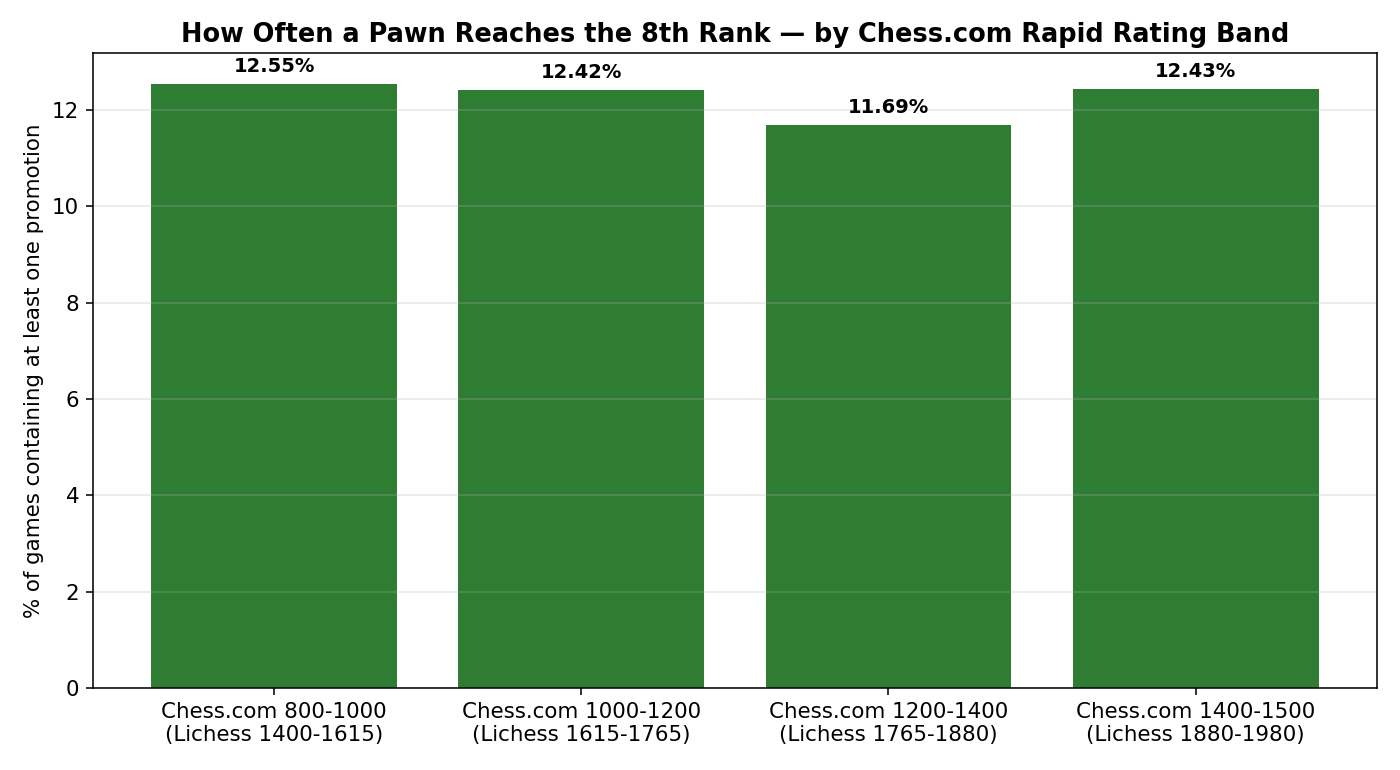
Before looking at underpromotions, we first need to understand how often pawns promote at all. In our dataset of 40,000 Rapid games, we found that a pawn promotes in roughly 12% of all games. This rate is remarkably consistent across all rating bands from 800 to 1500.
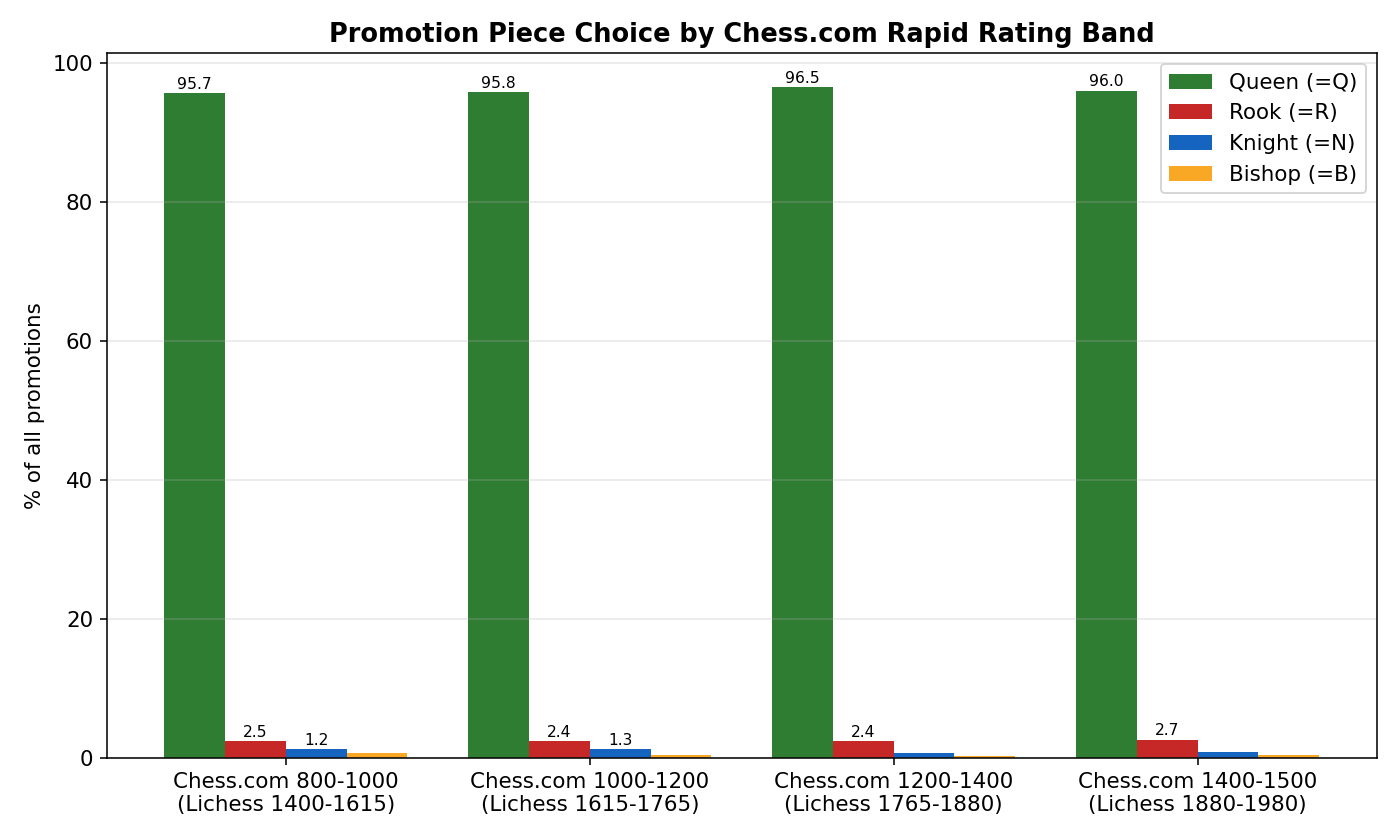
When a pawn does promote, the Queen is overwhelmingly the piece of choice. Across all rating bands studied, the Queen was chosen in over 95% of all promotions.
The Underpromotion Rate: Knights and Rooks
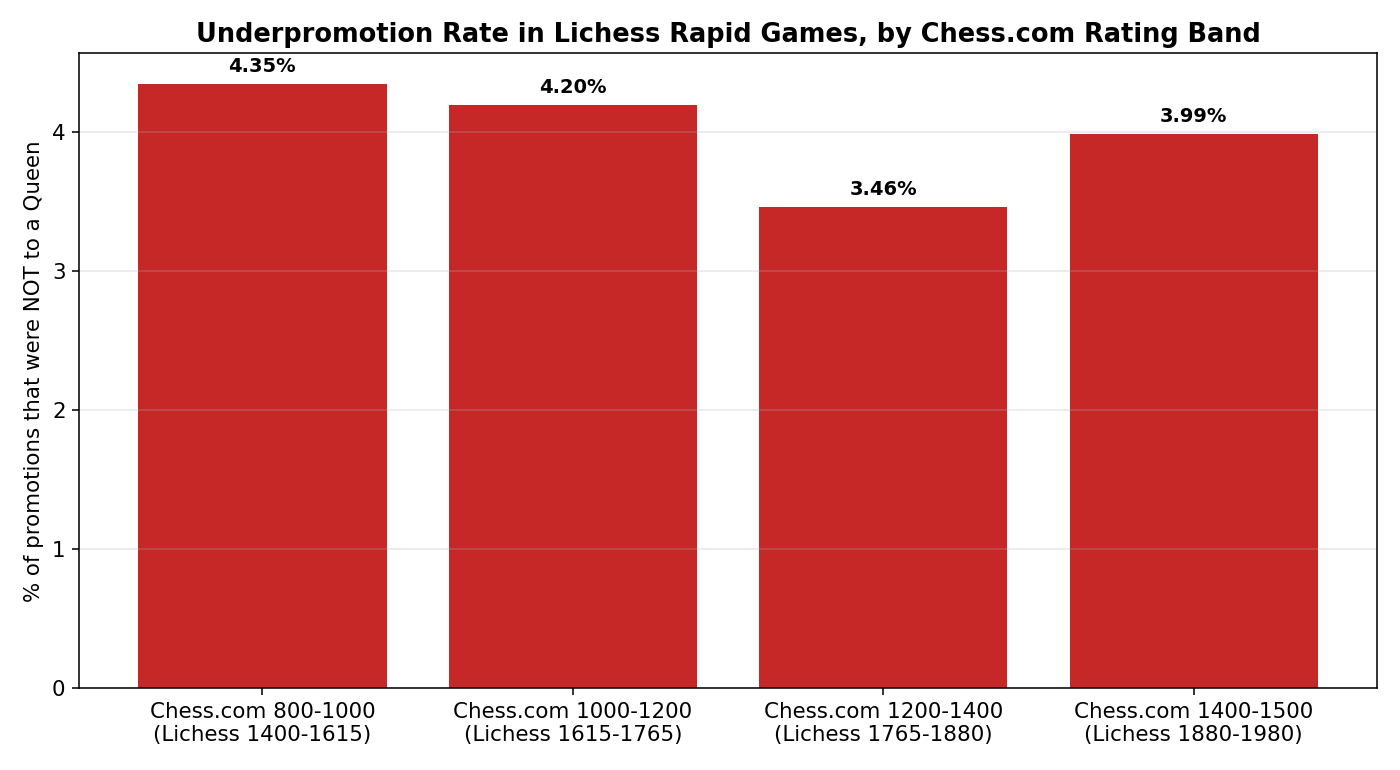
When players do not promote to a Queen, what do they choose? The data reveals that underpromotions are rare, but they do happen. Across the 800-1500 Chess.com rating spectrum, roughly 1 in every 25 promotions (about 4%) is an underpromotion.
At the specific 1400-1500 Chess.com Rapid level, the breakdown of all promotions is as follows:
- Queen: 96.01%
- Rook: 2.66%
- Knight: 0.93%
- Bishop: 0.40%
This means that at the 1400 level, players promote to a Knight or Rook instead of a Queen in 3.59% of all promotions.
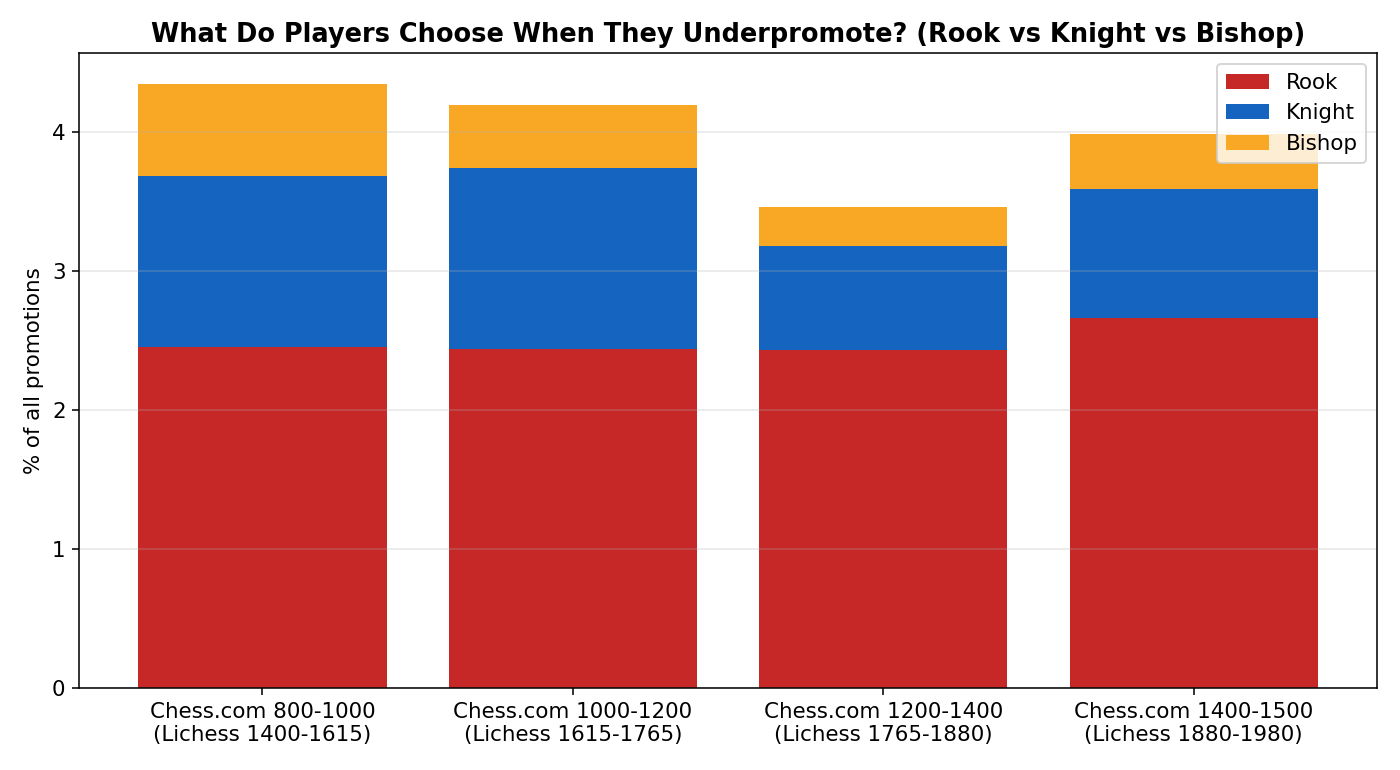
When players underpromote, the Rook is the most common choice, followed by the Knight. Bishop underpromotions are exceedingly rare and, as we will see, almost always accidental.
Brilliant Tactics or Mouse-Slips?
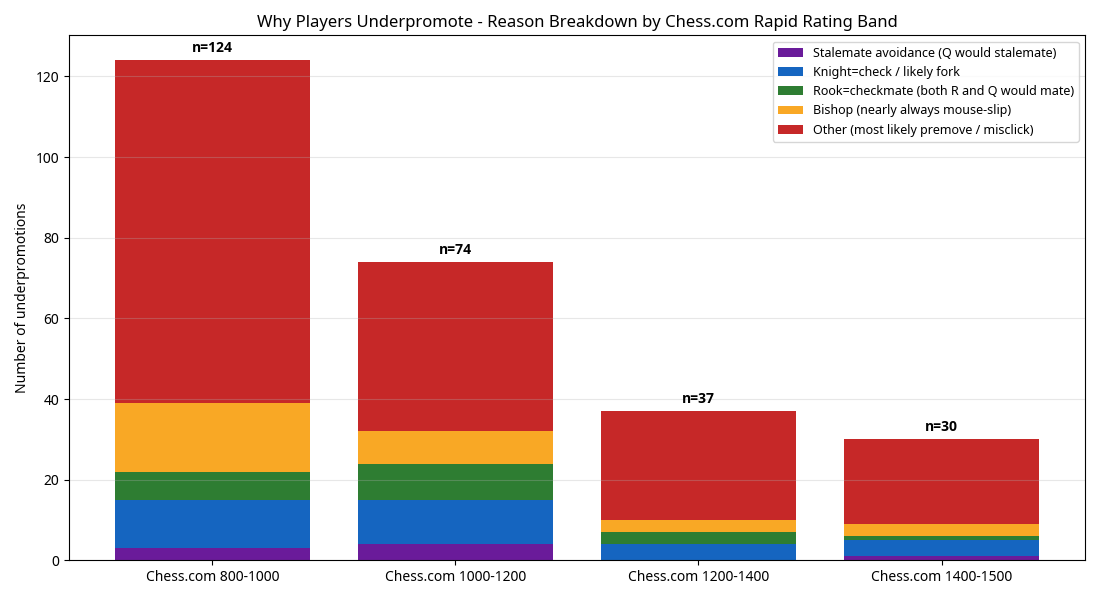
To understand why players underpromote, we categorized every non-Queen promotion in our dataset based on the engine evaluation of the position. We looked for specific motifs:
- Stalemate Avoidance: Promoting to a Queen would result in an immediate stalemate, but promoting to a Rook or Bishop allows the game to continue.
- Tactical Knight Check: Promoting to a Knight delivers an immediate check (often a fork).
- Rook Checkmate: Promoting to a Rook delivers an immediate checkmate (in positions where a Queen would also deliver checkmate).
- Mouse-slips / Premoves: The underpromotion serves no tactical purpose and often results in a worse position or a loss.
The Rook Underpromotion: Style and Safety
The most common underpromotion is to a Rook. Interestingly, our analysis shows that Rook underpromotions have an incredibly high win rate (over 90% across all bands).
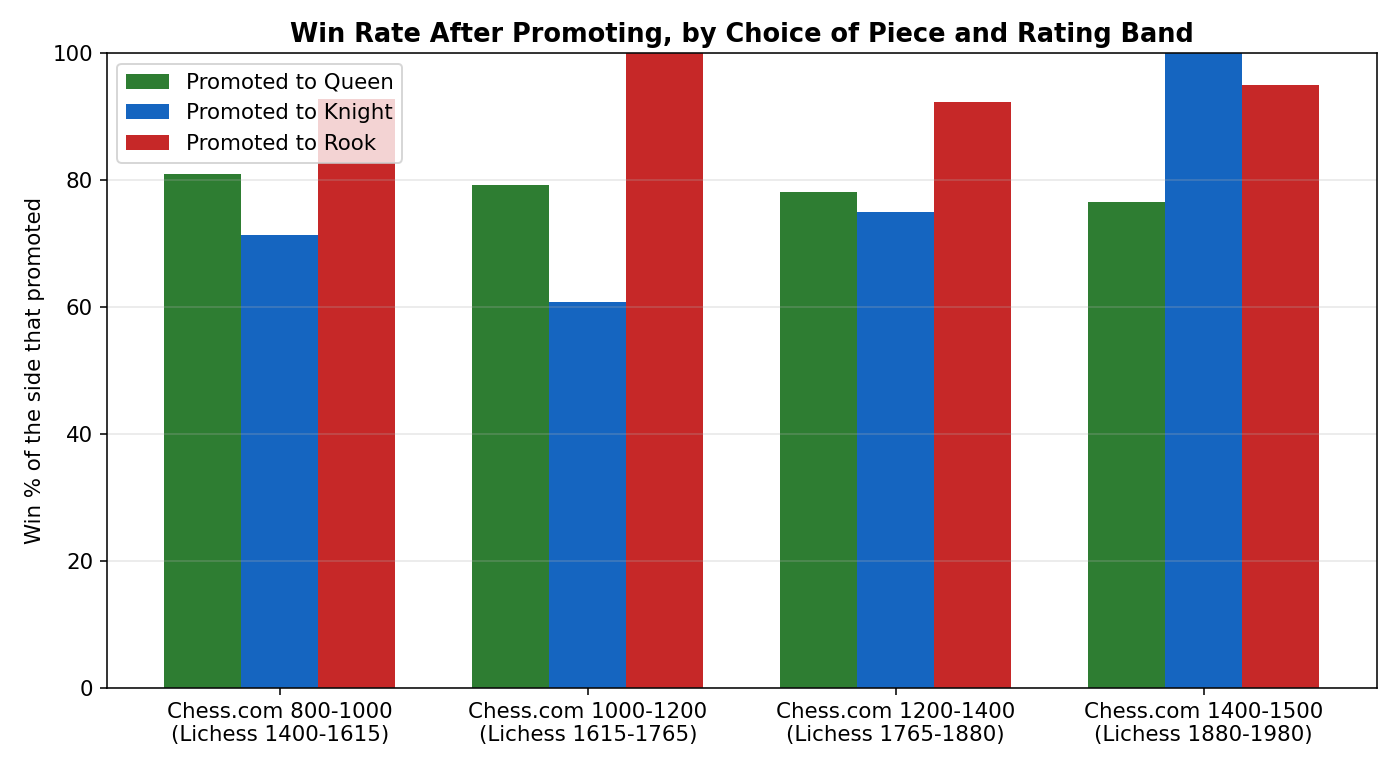
Why is the win rate so high? Because Rook underpromotions are almost entirely intentional, and they occur in completely winning positions. They fall into two main categories:
1. The "BM" (Bad Manners) Checkmate: The player has a forced mate where either a Queen or a Rook would deliver checkmate. The player intentionally chooses the Rook for stylistic reasons.
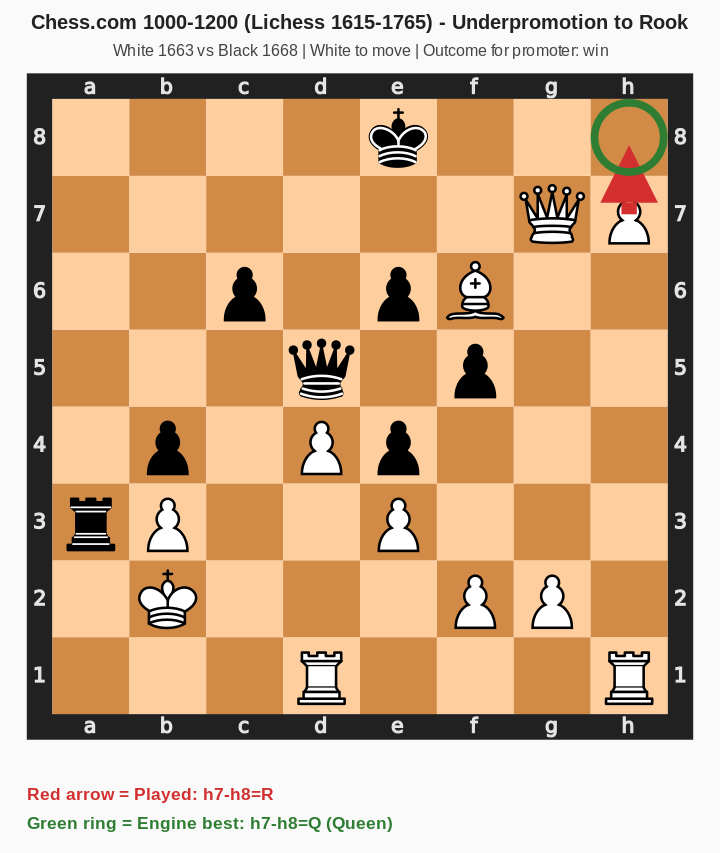
2. Stalemate Avoidance: The player is completely winning but realizes that promoting to a Queen would result in a stalemate. They promote to a Rook to keep the game going and secure the win.
The Knight Underpromotion: The Tactical Fork
Knight underpromotions are the most tactically interesting. At the 1400-1500 level, over half of all Knight underpromotions are genuine tactical choices where the Knight delivers an immediate check or fork.
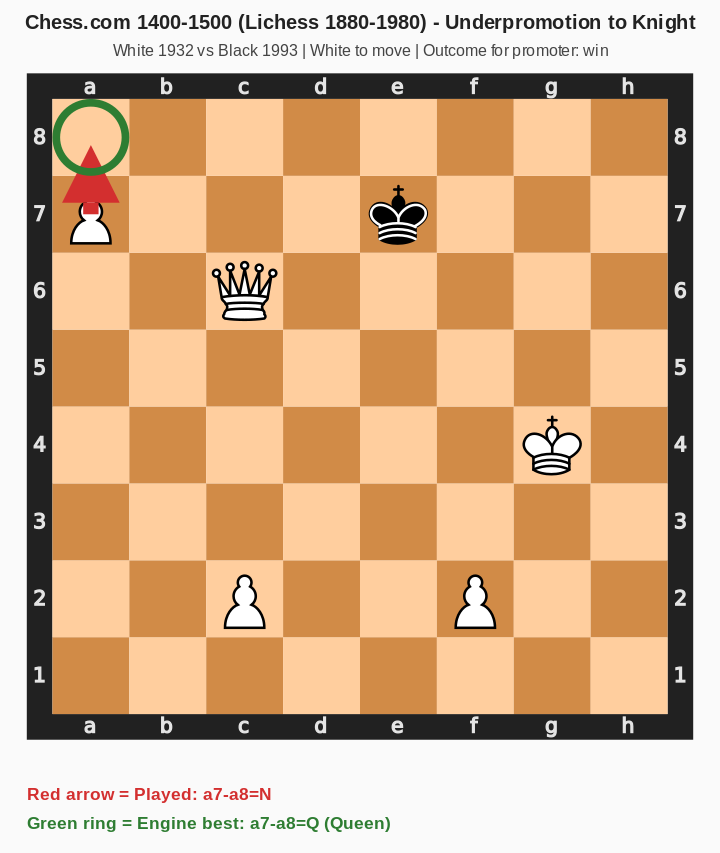
However, Knight underpromotions also have a noticeable failure rate. In lower rating bands (800-1200), many Knight underpromotions are accidental mouse-slips or panicked premoves in time scrambles, leading to a lower overall win rate compared to Rook underpromotions.
The Bishop Underpromotion: The Tragic Mouse-Slip
If you see a Bishop underpromotion, it is almost certainly a mistake. Our data shows that Bishop underpromotions have the lowest win rate of any piece choice. They rarely serve a tactical purpose (stalemate avoidance with a Bishop is exceptionally rare) and are usually the result of a player dragging their mouse slightly too far or slipping on a promotion menu.
Actionable Advice for Climbing the Ranks
Based on this data, here is a roadmap for intermediate players looking to improve their promotion decision-making:
For the 800-1000 Player: Slow Down
At this level, the "Other" category (mouse-slips and panicked premoves) dominates underpromotions. You are losing games because you are accidentally promoting to Knights and Bishops.
- Action: Turn on "Auto-Queen" in your settings if you play fast time controls, or consciously take an extra half-second to ensure you click the Queen when promoting.
For the 1000-1200 Player: Beware the Stalemate
You are starting to win more endgames, but you are also starting to stalemate your opponents when you have a massive material advantage.
- Action: When you are pushing your final pawn, always ask yourself: "If this becomes a Queen, does my opponent have a legal move?" If the answer is no, look for a Rook underpromotion.
For the 1200-1400 Player: Look for the Fork
You have stopped mouse-slipping, and you know how to avoid stalemates. Now it is time to look for tactical opportunities.
- Action: Before you automatically promote to a Queen, quickly scan the board. Does promoting to a Knight deliver a check that wins a crucial piece or forces a mate?
For the 1400-1500 Player: Mastery and Efficiency
At this level, your underpromotions are highly accurate. When you promote to a Knight, it is usually a calculated tactical strike.
- Action: Continue to calculate accurately. Remember that while underpromotions are beautiful, they are only necessary in about 1 in every 100 promotions. Do not overcomplicate winning positions looking for a brilliant Knight underpromotion when a simple Queen will do the job.
Data and Methodology
This analysis was conducted using a sample of 40,000 Rapid chess games (time controls between 8 and 25 minutes) sourced from the Lichess open database (March 2025).
Because Lichess ratings are generally higher than Chess.com ratings for the same skill level, we applied a calibration mapping to group the Lichess games into equivalent Chess.com rating bands. For example, the Chess.com 1400-1500 band corresponds to Lichess Rapid ratings between 1880 and 1980.
The raw data and analysis scripts used to generate this report are available in the attached CSV files:
promotions.csv: The raw data for all 6,435 promotions observed in the dataset.summary_by_band.csv: Aggregated promotion statistics by rating band.underpromotion_categorized.csv: Detailed categorization of every non-Queen promotion.outcome_by_piece_band.csv: Win/loss/draw rates for each promotion piece choice.
Chess Coach April 21, 2026